2025년 6월 고2 전국연합 영어 모의고사
28문제 · 제한시간 48분
이 시험 한눈에 — 2025년 6월 고2 전국연합 영어 모의고사
18~45번 28문항을 유형별로 보면 목적 1 · 심경/분위기 1 · 주장 1 · 함축의미추론 1 · 요지/주장 1 · 주제 1 · 제목 1 · 도표 1 · 내용일치 1 · 실용문 1 · 어법 2 · 어휘 1 · 빈칸추론2 1 · 빈칸추론3 1 · 빈칸추론4 1 · 빈칸추론5 1 · 무관한문장 1 · 순서배열1 1 · 순서배열2 1 · 문장삽입1 1 · 문장삽입2 1 · 요약문완성 1 · 장문 5. 아래 지문으로 변형문제·단어장·정답표를 바로 만들 수 있습니다.
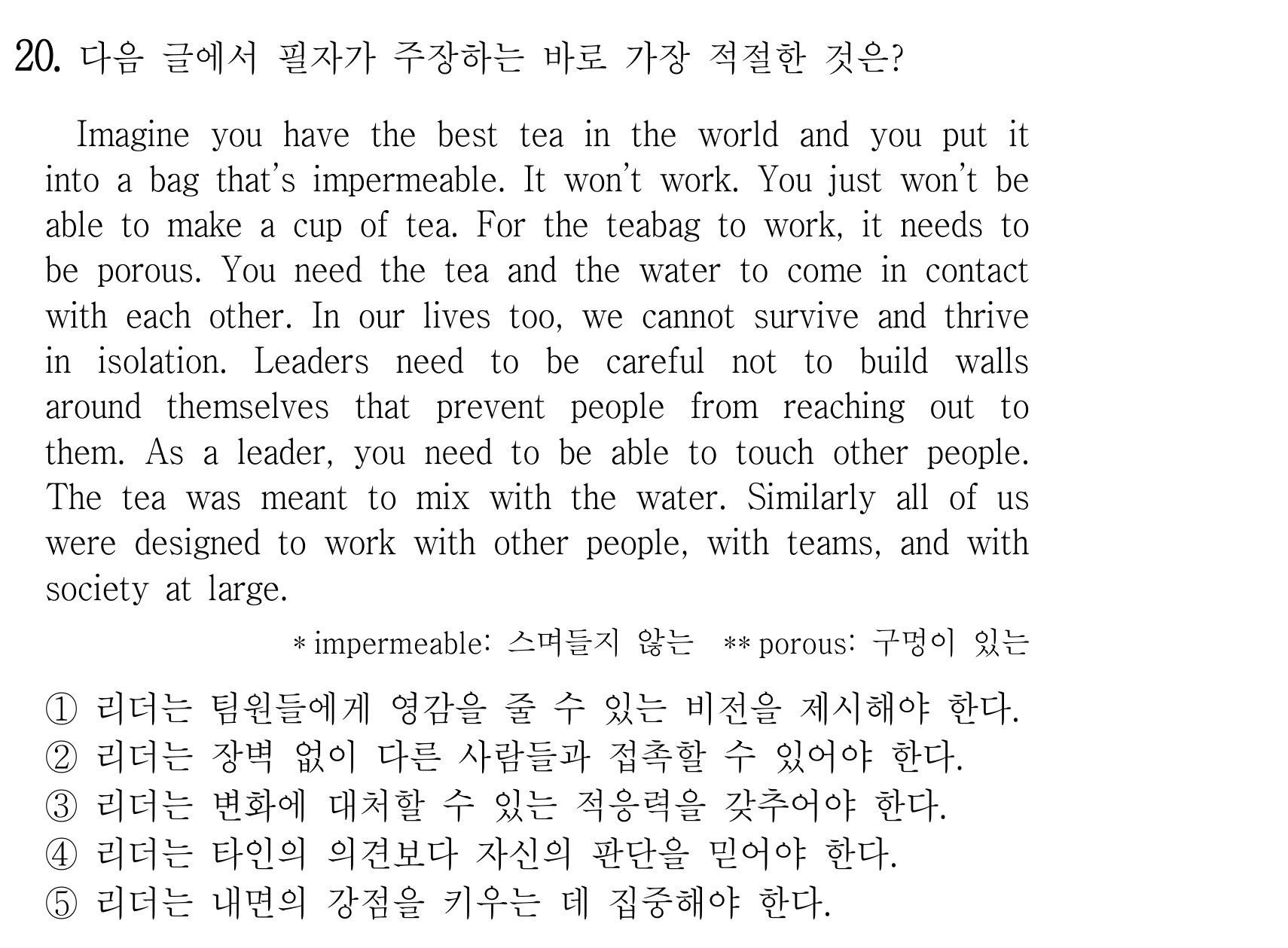
20번주장Imagine you have the best tea in the world and you put it into a bag that’s impermeable.
Imagine you have the best tea in the world and you put it into a bag that’s impermeable. It won’t work. You just won’t be able to make a cup of tea. For the teabag to work, it needs to be porous. You need the tea and the water to come in contact with each other. In our lives too, we cannot survive and thrive in isolation. Leaders need to be careful not to build walls around themselves that prevent people from reaching out to them. As a leader, you need to be able to touch other people. The tea was meant to mix with the water. Similarly all of us were designed to work with other people, with teams, and with society at large.
21번함축의미추론It is difficult, if not impossible, to define the limits which reason should impose on th…
It is difficult, if not impossible, to define the limits which reason should impose on the desire for wealth; for there is no absolute or definite amount of wealth which will satisfy a man. The amount is always relative, that is to say, just so much as will maintain the proportion between what he wants and what he gets; for to measure a man’s happiness only by what he gets, and not also by what he expects to get, is as pointless as to try and express a fraction which shall have a numerator but no denominator. A man never feels the loss of things which it never occurs to him to ask for; he is just as happy without them; whilst another, who may have a hundred times as much, feels miserable because he has not got the one thing he wants. In fact, every man has a horizon of his own, and he will expect as much as he thinks it is possible for him to get.
22번요지/주장All of the restaurants are using carefully chosen words to evoke vivid mental images of d…
All of the restaurants are using carefully chosen words to evoke vivid mental images of delicious food and rich desserts in order to draw the potential customer to their particular establishment. Just like the restaurants, nature has its own dining establishments. In a fashion similar to the restaurants' financial dependence upon drawing in many customers, the restaurateurs of the natural world (i.e., flowers) must also attract potential diners to sample their offerings. In the natural world, there are no neon signs or flashy words in which to market a potential meal to hungry animals. These restaurants that I am referring to are the world's flowers, and the potential guests are the host of organisms that visit flowers to obtain nectar and other valuable resources. Instead of using a written language or neon sign, they advertise their offerings just as effectively using the language of smell.
23번주제Would you rather receive $1,000 in a year or $1,100 in a year and a month?
Would you rather receive $1,000 in a year or $1,100 in a year and a month? Most people will opt for the larger sum in thirteen months — where else will you find a monthly interest rate of 10 percent. A wise choice, since the interest will compensate you generously for any risks you face by waiting the extra few weeks. Second question: Would you prefer $1,000 today cash on the table or $1,100 in a month? If you think like most people, you'll take the $1,000 right away. This is amazing. In both cases, if you hold out for just a month longer, you get $100 more. In the first case, it's simple enough. You figure: "I've already waited twelve months; what's one more?" Not in the second case. The introduction of "now" causes us to make inconsistent decisions. Science calls this phenomenon hyperbolic discounting. The closer a reward is, the higher our "emotional interest rate" rises and the more we are willing to give up in exchange for it.
24번제목Of central importance for understanding the development of handedness is the answer to th…
Of central importance for understanding the development of handedness is the answer to the question of when in development it is actually determined whether a child will be left-handed or right-handed. It was long thought that handedness could only be reliably determined in elementary school, when a child learns to write. However, this assumption is incorrect. In fact, scientific studies show that left-handedness is established in many children long before elementary school — interestingly, even before birth in most people. In such studies, the hand and arm movements of unborn children in the womb are recorded using ultrasound images. Using this technique, it was shown that a clear preference for the movement of the right arm exists as early as 10 weeks after fertilization. In this study, ultrasound images of 72 unborn children 10 weeks after fertilization were evaluated and 85% showed more movements of the right arm than the left. This number is already very close to the approximately 89.4% right-handers among adults.
29번어법In art, there are a number of ways to use perspective to obtain the illusion of depth, in…
In art, there are a number of ways to use perspective to obtain the illusion of depth, including using colors and graduated values of black and white, and accurately drawing the subject by applying the rules of the geometric system of perspective. In order to achieve perspective, you must make a number of observations. The forms or objects that you draw on a flat surface actually have depth and dimension in real life. As you view them and place their shapes and forms on a drawing surface, try to represent that depth to make the objects appear realistic and three‐ dimensional. Objects appear differently when viewed from various positions. Because of this, it’s important to establish the viewpoint, and stick with it. When observing a subject, you see depth and three dimensions. When you draw this subject onto a flat surface as it appears to the eye, you are drawing in perspective.
30번어휘Low oil prices are a good thing, because it means lower energy costs of production for th…
Low oil prices are a good thing, because it means lower energy costs of production for the majority of industries, not least the automobile and the logistics industries. Firms directly benefit from the decrease in their costs of production and provision of services. This has the effect of stimulating the aggregate supply and provides a stimulus for growth. Conversely, a sudden rise in oil prices due to a shrink in oil production is never good news, even though it definitely gives a big boost to the energy sector. A look through the history of oil price fluctuations confirms this notion, as this has been the subject of much economic research. Following an oil price jump of 10 per cent due to a contraction in supply, an economy (as typified by the US economy) typically sees its output (GDP) slowed by close to 1 percentage point. For a $15 trillion economy, that is a loss of $150 billion in potential wealth or economic growth. Conversely, there has never been much concern with oil price decreases following an excess in its supply.
31번빈칸추론2We might forget an anecdote about a stranger because it makes few connections with our ex…
We might forget an anecdote about a stranger because it makes few connections with our existing associations, but we won’t forget a piece of gossip about our cousin. There’s one complex network that is larger and quicker to access than all others — the self. We’ve been thinking about ourselves in our whole lives. (In fact, there were entire years during junior high when we weren’t capable of thinking about much else.) So if a new piece of information has something to do with us, it will be more easily and thoroughly processed. It hits even closer to home than our actual home — we can take a vacation away from our home, but not from ourselves. The most effective communicators find ways to make the abstract personal. Consider the warning that law schools give to motivate first-year law students concerning the rigors of their program. Hearing that “the first-year dropout rate is 33%” is an abstract statistic. “Look to your left, look to your right. One of the three of you won’t be joining us next fall” wakes up the self.
32번빈칸추론3Steve Jobs used analogy to get people to embrace the new technology.
Steve Jobs used analogy to get people to embrace the new technology. Before computers, people worked in a physical world. We used paper and pens and physical file folders and so on. The idea of working in a virtual world was radically different. Or at least *seemed* radically different. What Jobs understood was that a physical office was fundamentally similar to a virtual office. To win over the masses, Jobs drew strong analogies between the traditional workplace people knew well with the new, unfamiliar virtual workplace. In the pre-computer workplace, when ideas were written on paper it was called ... a document. When those documents needed to be stored they were put in ... a folder. And those folders were kept on ... a desk. Documents, folders, and desktops are the terms we use in our virtual work because Steve Jobs understood that using familiar terms would make the new technology easier to understand. The parallels between the physical and virtual workplace now seem obvious.
33번빈칸추론4Turtle hatchlings have, it seems, evolved to crawl toward the light.
Turtle hatchlings have, it seems, evolved to crawl toward the light. For millions of years this was a highly rational and effective strategy because the light on a dark beach represented the reflection of the moon and stars on the water's surface. Following the lights led baby turtles back home to the sea. The problems started when humans began building beachfront homes and sparkling hotels on the other side of the beach. Now after hatching, turtles heading for the brightest nearby lights were being guided straight into traffic. Are self-destructive sea turtles naturally irrational? Yes, in the modern world. But there's a deeper truth. Turtles are basing their decisions on simple cues that were perfectly rational for their ancestors; these days, however, their evolved decision-making mechanisms lead them to disaster.
34번빈칸추론5Sensory organs are the only channels of communication between the brain and the outside w…
Sensory organs are the only channels of communication between the brain and the outside world. Simply put, the brain is not designed to sense on its own. For instance, an exposed brain would neither sense light shining on it nor feel something touching it. In fact, patients are often kept awake during brain surgery, which can help a surgeon isolate specific regions of the brain. The ancient Greek philosopher Aristotle recognized this characteristic of the brain over 2,000 years ago when he said, "Nothing is in the mind that does not pass through the senses." This concept can be seen clearly when volunteers are blind-folded and placed in the warm water of a sensory deprivation tank. They soon experience visual, auditory, and tactile (touch) hallucinations, as well as incoherent thought patterns. From these experiments and others, it is apparent that we need constant input from our senses to carry out functions that give us personality and intellect.
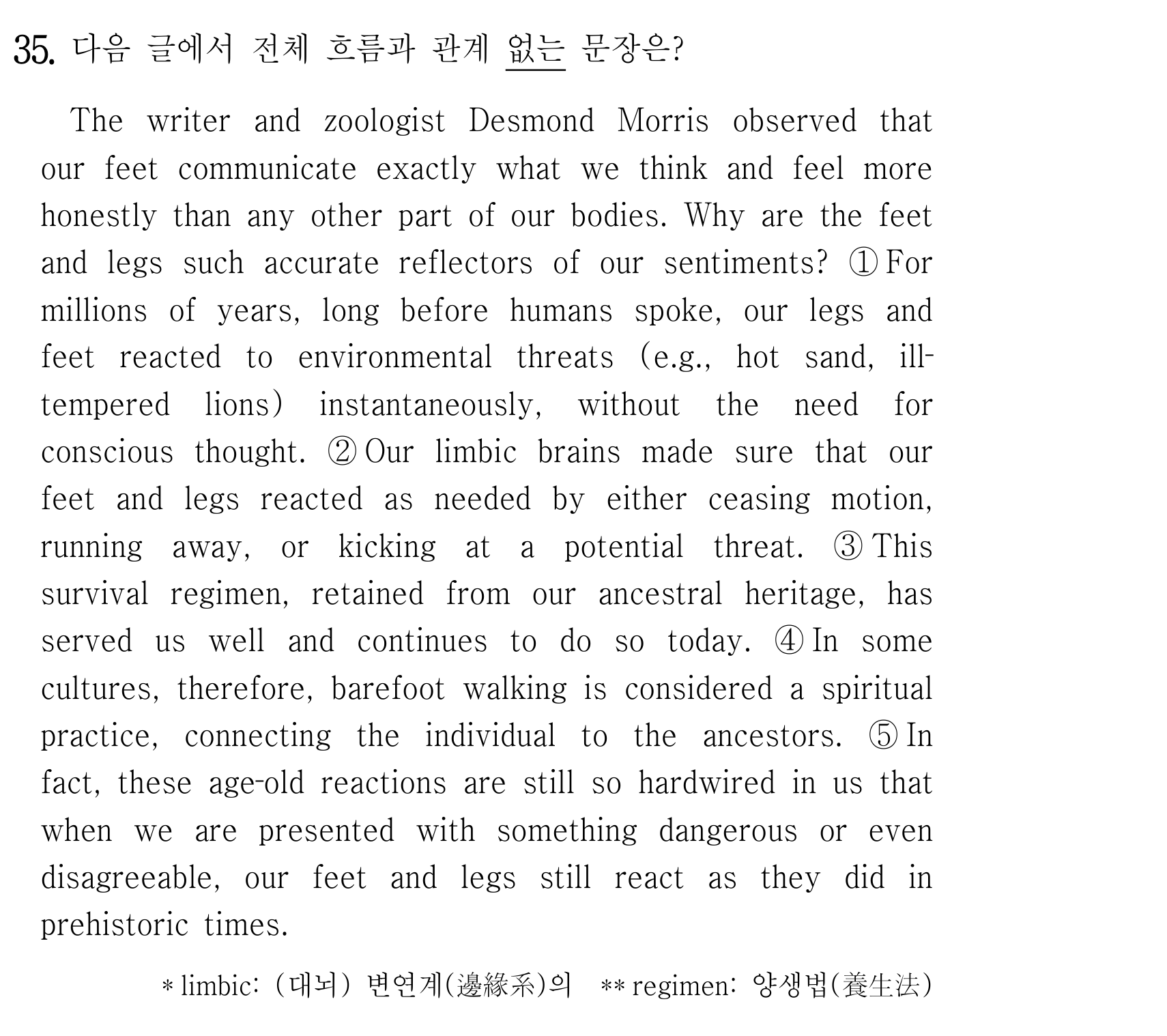
35번무관한문장The writer and zoologist Desmond Morris observed that our feet communicate exactly what w…
The writer and zoologist Desmond Morris observed that our feet communicate exactly what we think and feel more honestly than any other part of our bodies. Why are the feet and legs such accurate reflectors of our sentiments? For millions of years, long before humans spoke, our legs and feet reacted to environmental threats (e.g., hot sand, ill‐ tempered lions) instantaneously, without the need for conscious thought. Our limbic brains made sure that our feet and legs reacted as needed by either ceasing motion, running away, or kicking at a potential threat. This survival regimen, retained from our ancestral heritage, has served us well and continues to do so today. In fact, these age‐old reactions are still so hardwired in us that when we are presented with something dangerous or even disagreeable, our feet and legs still react as they did in prehistoric times.
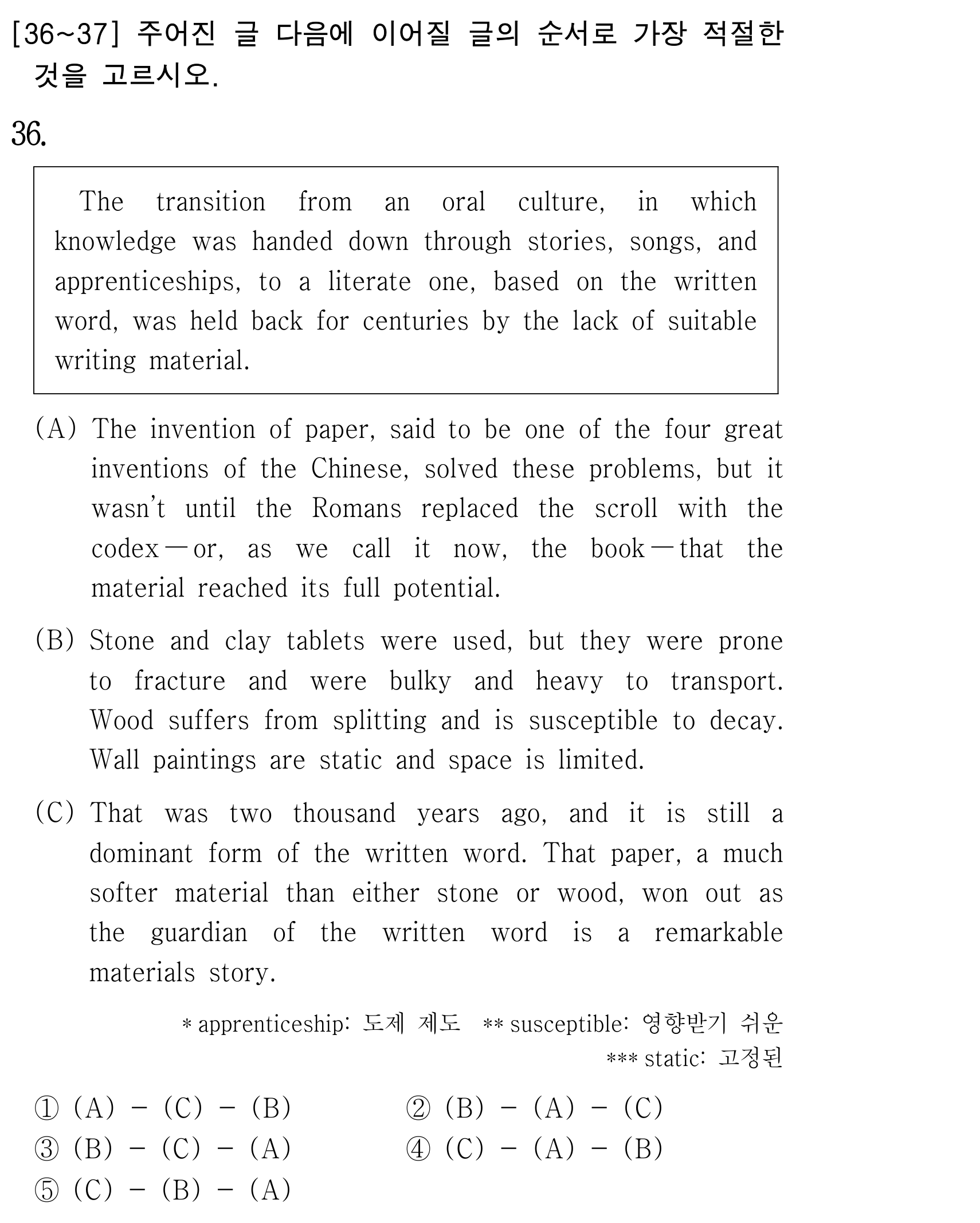
36번순서배열1The transition from an oral culture, in which knowledge was handed down through stories,…
The transition from an oral culture, in which knowledge was handed down through stories, songs, and apprenticeships, to a literate one, based on the written word, was held back for centuries by the lack of suitable writing material. Stone and clay tablets were used, but they were prone to fracture and were bulky and heavy to transport. Wood suffers from splitting and is susceptible to decay. Wall paintings are static and space is limited. The invention of paper, said to be one of the four great inventions of the Chinese, solved these problems, but it wasn't until the Romans replaced the scroll with the codex—or, as we call it now, the book—that the material reached its full potential. That was two thousand years ago, and it is still a dominant form of the written word. That paper, a much softer material than either stone or wood, won out as the guardian of the written word is a remarkable materials story.
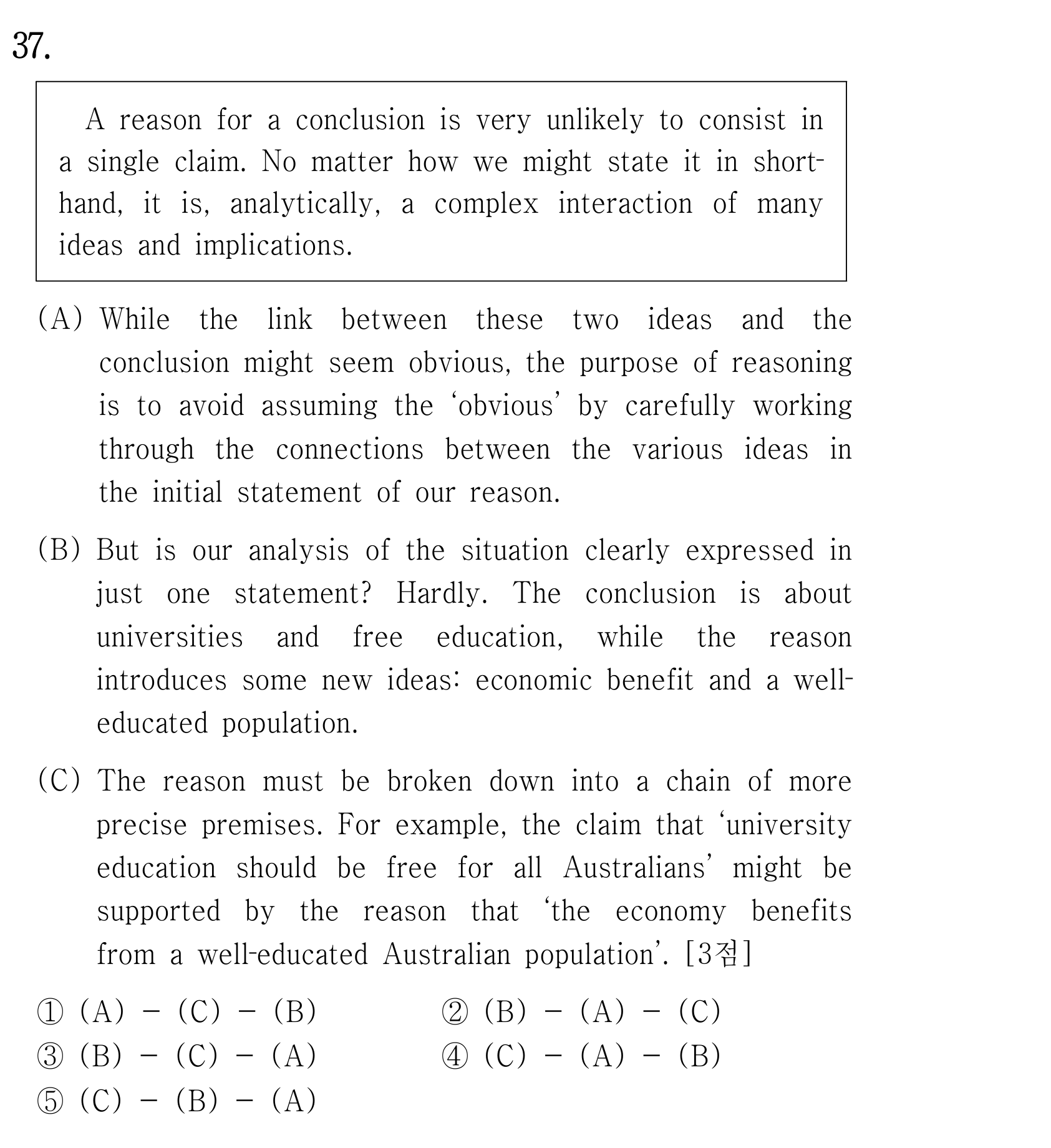
37번순서배열2A reason for a conclusion is very unlikely to consist in a single claim.
A reason for a conclusion is very unlikely to consist in a single claim. No matter how we might state it in short-hand, it is, analytically, a complex interaction of many ideas and implications. The reason must be broken down into a chain of more precise premises. For example, the claim that ‘university education should be free for all Australians’ might be supported by the reason that ‘the economy benefits from a well-educated Australian population’. But is our analysis of the situation clearly expressed in just one statement? Hardly. The conclusion is about universities and free education, while the reason introduces some new ideas: economic benefit and a well-educated population. While the link between these two ideas and the conclusion might seem obvious, the purpose of reasoning is to avoid assuming the ‘obvious’ by carefully working through the connections between the various ideas in the initial statement of our reason.
38번문장삽입1The word “migration” is almost always reported in the popular media and even in scientifi…
The word “migration” is almost always reported in the popular media and even in scientific literature as a problem or a crisis. For example, migrants are assumed to overcrowd cities, clog up labor markets, and increase poverty. The other questionable assumption is that most migration is involuntary — people fleeing natural or man-made disasters. The reality, however, is more complex, and many migrants are simply seeking greater economic opportunity. Of course migration can and does create social and economic problems. But migration can also be a solution for many preexisting problems. For example, out-migration generally redistributes workers from places of labor surplus to areas where there is greater demand or more opportunity. Migration is generally selective of persons who are younger, healthier, more flexible, and more willing to endure hardship in hopes of a better life relative to their prospects in their places of origin. Most research that examines long-term outcomes of migration, including remittances and intergenerational mobility, finds positive “long-term” effects on places of origin and destination.
39번문장삽입2The big problem with money created by the government is that those who run the government…
The big problem with money created by the government is that those who run the government always face the temptation to create more money and spend it. Whether among ancient kings or modern politicians, this has happened again and again over the centuries, leading to inflation and the many economic and social problems that follow from inflation. For this reason, many countries have preferred using gold, silver, or some other material that is inherently limited in supply, as money. It is a way of depriving governments of the power to expand the money supply to inflationary levels. Gold has long been considered ideal for this purpose, since the supply of gold in the world usually cannot be increased rapidly. When paper money is convertible into gold whenever the individual chooses to do so, then the money is said to be “backed up” by gold. This expression is misleading only if we imagine that the value of the gold is somehow transferred to the paper money, when in fact the real point is that the gold simply limits the amount of paper money that can be issued.
40번요약문완성The study of emotions and decision making is now of considerable importance.
The study of emotions and decision making is now of considerable importance. This involves the application of various tools afforded by neuroscience. One important stream of the literature examines people with brain damage and how damage to particular parts of the brain known to be responsible for particular cognitive functions impacts on decision making. One example of this research is the work of Antonio Damasio, who finds that when the emotional part of the brain is damaged, this actually reduces the efficacy of decision making. Good decisions are a product of the emotional part of the brain working in conjunction with the deliberative part. This contradicts the assumptions of conventional economics, where emotions play a negative role in the decision-making process. Here it is assumed that decision making can be modeled as being generated in a stoic, unemotional fashion, and that's why decisions tend to be optimal. But the evidence suggests that emotions actually play an important and, often, a positive role in decision making.
41번장문_제목Shoppers confronted with the choice of thirty different varieties of gourmet chocolates a…
Shoppers confronted with the choice of thirty different varieties of gourmet chocolates are more likely to walk away without buying any, compared with when they are presented with only half a dozen choices. If employees are given a free trip to Paris, they are happy. If you give them a free trip to Hawaii, they are happy. But if you offer them the choice between the two destinations, they are less happy, no matter what they choose. Why might choice be so (a) disruptive? The reason is that choice forces us to make comparisons and acknowledge relative (b) disadvantages. People who choose Paris complain that it doesn't have the ocean and those who choose Hawaii regret that it doesn't have the museums. Psychologist Barry Schwartz calls this the 'tyranny of choice' because rather than providing freedom, it actually (c) constrains our decision-making. He argues that (d) narrower choice increases unhappiness because we worry that we are going to make the wrong decision and so we get stressed about trying to process all the comparisons in an effort to get it right. This both increases our fear of making the wrong choice and raises expectations that we should be able to get the best choice. Having made the choice, we then (e) start to regret, wondering whether it was the right one.
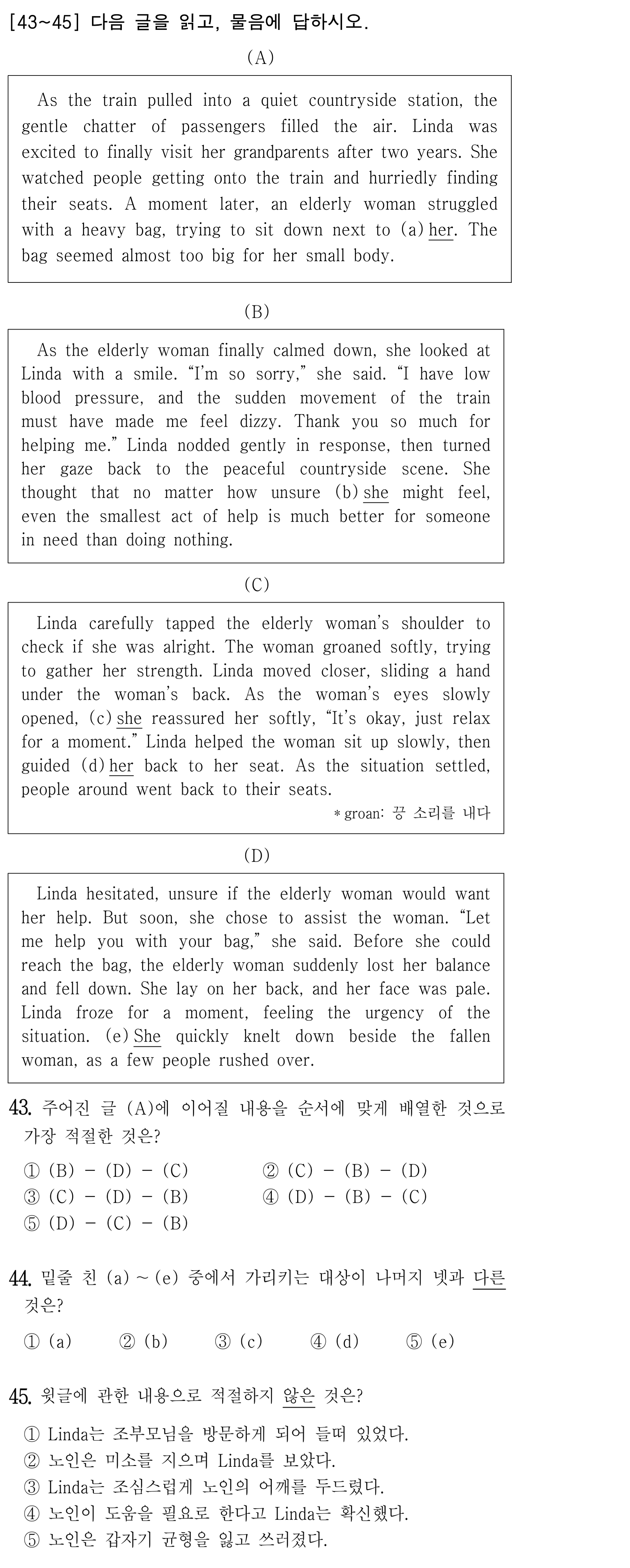
43번장문_순서(A) As the train pulled into a quiet countryside station, the gentle chatter of passenger…
(A) As the train pulled into a quiet countryside station, the gentle chatter of passengers filled the air. Linda was excited to finally visit her grandparents after two years. She watched people getting onto the train and hurriedly finding their seats. A moment later, an elderly woman struggled with a heavy bag, trying to sit down next to (a) her. The bag seemed almost too big for her small body.
(B) As the elderly woman finally calmed down, she looked at Linda with a smile. “I’m so sorry,” she said. “I have low blood pressure, and the sudden movement of the train must have made me feel dizzy. Thank you so much for helping me.” Linda nodded gently in response, then turned her gaze back to the peaceful countryside scene. She thought that no matter how unsure (b) she might feel, even the smallest act of help is much better for someone in need than doing nothing.
(C) Linda carefully tapped the elderly woman’s shoulder to check if she was alright. The woman groaned softly, trying to gather her strength. Linda moved closer, sliding a hand under the woman’s back. As the woman’s eyes slowly opened, (c) she reassured her softly, “It’s okay, just relax for a moment.” Linda helped the woman sit up slowly, then guided (d) her back to her seat. As the situation settled, people around went back to their seats.
(D) Linda hesitated, unsure if the elderly woman would want her help. But soon, she chose to assist the woman. “Let me help you with your bag,” she said. Before she could reach the bag, the elderly woman suddenly lost her balance and fell down. She lay on her back, and her face was pale. Linda froze for a moment, feeling the urgency of the situation. (e) She quickly knelt down beside the fallen woman, as a few people rushed over.
2025년 6월 고2 전국연합 영어 모의고사 변형문제 맛보기
이 시험 지문으로 만든 변형문제가 아직 없습니다. 지문을 고르면 어법·빈칸·주제·어휘 등 유형별 변형문제를 바로 만들 수 있습니다.
이 시험으로 첫 변형문제 만들기 →남은 시간
48:00








아직 28문제를 풀지 않았어요 (0/28)