주제feet and legs as honest communicators우리의 생각과 감정을 가장 솔직하게 드러내는 발과 다리
흐름honest feet → evolutionary reason → modern reactions발이 가장 솔직하다는 관찰 → 진화론적 생존 기제 설명 → 오늘날까지 이어진 본능
주장Our feet communicate exactly what we think and feel.우리의 발은 우리가 생각하고 느끼는 것을 가장 정직하게 전달한다.
근거Limbic brains made feet react to threats without conscious thought.변연계 뇌가 의식적 생각 없이 위협에 즉각 반응하도록 발을 진화시켰다.
결론These age-old survival reactions remain hardwired in us today.이러한 오래된 생존 반응은 오늘날에도 우리 몸에 여전히 깊이 새겨져 있다.
사람들은 흔히 말을 할 때 얼굴 표정이나 손짓을 신경 씁니다. 하지만 막상 우리가 정말로 무슨 생각을 하는지 가장 솔직하게 드러내는 부위는 따로 있다는 사실을 알고 있나요? 바로 발입니다. 미국에서 아이들을 가르칠 때도 아이들이 긴장하거나 불안할 때 발을 꼼지락거리는 모습을 자주 봤는데, 이는 인종이나 문화를 막론하고 인간이라면 누구나 본능적으로 나타내는 신호더군요.
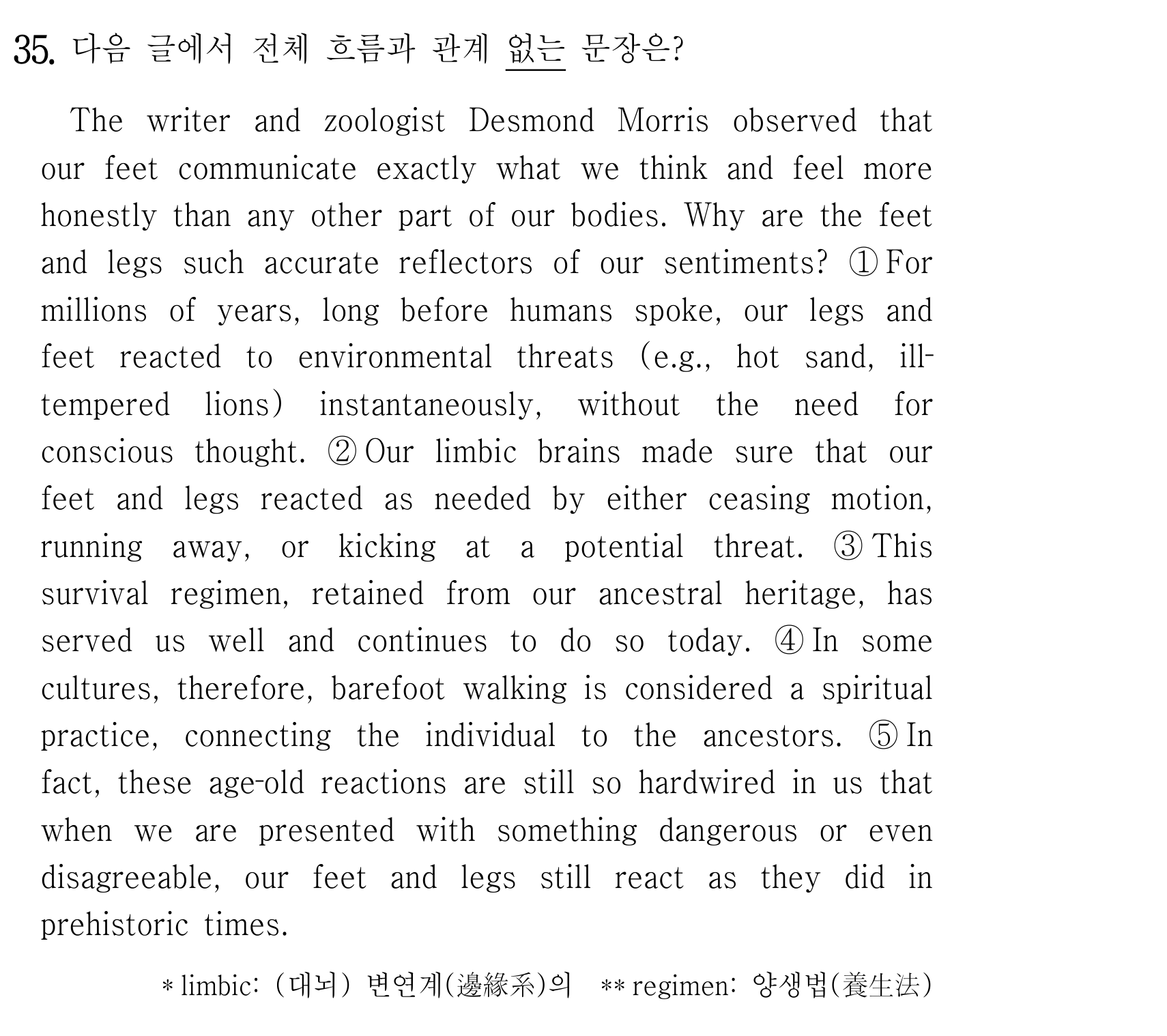
The writer and zoologist Desmond Morris observed that our feet communicate exactly what we think and feel more honestly than any other part of our bodies. Why are the feet and legs such accurate reflectors of our sentiments? ①For millions of years, long before humans spoke, our legs and feet reacted to environmental threats (e.g., hot sand, ill‐tempered lions) instantaneously, without the need for conscious thought. ②Our limbic brains made sure that our feet and legs reacted as needed by either ceasing motion, running away, or kicking at a potential threat. ③This survival regimen, retained from our ancestral heritage, has served us well and continues to do so today. ④In some cultures, therefore, barefoot walking is considered a spiritual practice, connecting the individual to the ancestors. ⑤In fact, these age‐old reactions are still so hardwired in us that when we are presented with something dangerous or even disagreeable, our feet and legs still react as they did in prehistoric times.
문장별 구조 분석
주제문3형식 SVOThe writer and zoologist Desmond MorrisSobservedV명사절that our feet communicate exactly 명사절what we think and feel more honestly than any other part of our bodiesO.
작가이자 동물학자인 Desmond Morris는S관찰했다V우리의 발이 우리가 생각하고 느끼는 것을 우리 몸의 다른 어떤 부위보다 더 솔직하게 전달한다고O.
근거For millions of yearsM, long before humans spokeM, our legs and feetSreactedVto environmental threatsMinstantaneouslyM, without the need for conscious thoughtM.
수백만 년 동안, 인간이 말을 하기 훨씬 전부터,M우리의 다리와 발은S반응했다V의식적인 생각의 필요 없이 즉각적으로 환경적 위협에M.
동의어 instantaneously ≒ immediately, promptly, at once · conscious ≒ deliberate, intentional
3형식 SVOOur limbic brainsSmade sureV명사절that our feet and legs reacted as needed by either ceasing motion, running away, or kicking at a potential threatO.
우리의 변연계 뇌는S확실히 했다V동작을 멈추거나, 도망치거나, 잠재적 위협을 발로 차는 방식으로 우리의 발과 다리가 필요한 대로 반응하도록O.
In some culturesM, thereforeM, barefoot walkingSis consideredVa spiritual practiceSC, connecting the individual to the ancestorsM.
따라서 일부 문화권에서는M맨발 걷기가S여겨진다V개인을 조상과 연결해 주는 영적인 수행으로SC.
결론In factM, these age‐old reactionsSareVstill so hardwired in usSC부사절that when we are presented with something dangerous or even disagreeable, our feet and legs still react as they did in prehistoric timesM.
사실, 이러한 아주 오래된 반응들은S우리 몸에 여전히 너무나 깊이 새겨져 있어서,SC우리가 위험하거나 불쾌한 무언가를 마주할 때 우리의 발과 다리는 선사 시대에 그랬던 것처럼 여전히 반응한다M.