The transition from an oral culture — 2025년 6월 고2 36번 해석 및 풀이
후니쌤2026년 5월 25일조회 157

2025-06-29
핵심 문제유형: 순서 배열 — 기술의 발전이 지식의 기록 방식에 미친 영향
이 지문, 뼈대만 먼저
주제the evolution of writing materials in recording knowledge지식 기록 매체의 역사적 발전 과정
흐름material shortage → drawbacks of early mediums → paper and codex기록 재료의 부족 → 초기 매체들의 단점 나열 → 종이와 책의 등장으로 극복
주장The transition to literacy required suitable writing materials.기록 문화로의 전환에는 그에 걸맞은 필기 재료가 필수적이었다.
근거Stone, clay, and wood had physical limits that restricted knowledge sharing.돌, 점토, 나무 등은 파손이나 부패 등 물리적 한계가 뚜렷했다.
결론Paper and the codex format unlocked the full potential of written words.종이와 코덱스(책) 형태가 결합하면서 기록 문화가 완성되었다.
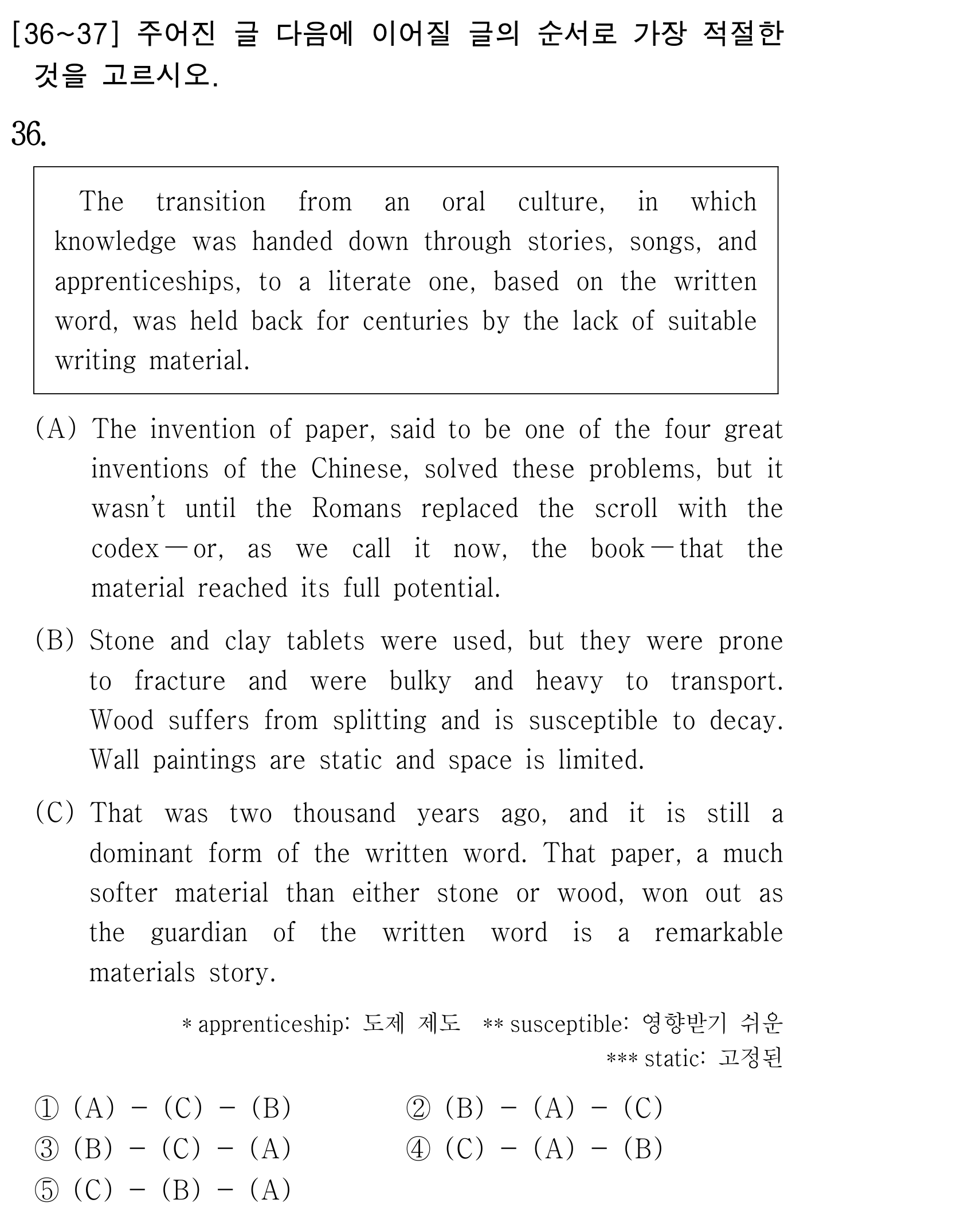
"The transition from an oral culture, in which knowledge was handed down through stories, songs, and apprenticeships, to a literate one, based on the written word, was held back for centuries by the lack of suitable writing material."
지문의 첫 문장부터 무척 긴 호흡을 보여줍니다. 우리가 당연하게 여기는 '책'이라는 매체가 없던 시절, 지식이 어떻게 전달되었는지 생각해보면 이 긴 문장이 담고 있는 무게감이 느껴질 거예요. 기록 문화로의 변화가 왜 그토록 오래 걸렸는지, 그 이유를 하나씩 파헤쳐 보겠습니다.
문장별 구조 분석
도입
3형식 SVO (수동태)
The transitionS
형용사절from an oral culture, 형용사절in which knowledge was handed down through stories, songs, and apprenticeshipsM,
to a literate oneM,
형용사절based on the written wordM,
was held backV
for centuriesM
by the lack of suitable writing materialM.
지식이 이야기, 노래, 그리고 도제 관계를 통해 전수되던 구술 문화에서, 기록된 단어에 기반을 둔 읽고 쓰는 문화로의 전환은S 수 세기 동안 지체되었다V 적절한 필기 재료의 부족으로 인해M.
동의어 transition ≒ shift, conversion · literate ≒ educated, lettered · hold back ≒ delay, hinder, obstruct
예시
2형식 SVC
Stone and clay tabletsS
were usedV,
but theyS
wereV
prone to fractureSC
and wereV
bulky and heavy to transportSC.
돌과 점토판이S 사용되었지만V, 그것들은S 부서지기 쉬웠고 운반하기에 부피가 크고 무거웠다SC.
동의어 prone to ≒ susceptible to, inclined to · fracture ≒ breakage, cracking · bulky ≒ massive, unwieldy
2형식 SVC
WoodS
suffers from splittingV
and isV
susceptible to decaySC.
나무는S 쪼개지는 현상으로 고통받고(잘 쪼개지고)V 부패하기 쉽다SC.
동의어 susceptible to ≒ vulnerable to, sensitive to · decay ≒ rot, decomposition
2형식 SVC
Wall paintingsS
areV
staticSC
and spaceS
isV
limitedSC.
벽화는S 정적이며SC 공간이S 제한적이다SC.
전환
3형식 SVO
The invention of paperS,
said to be one of the four great inventions of the ChineseM,
solvedV
these problemsO,
but itS
wasn'tV
until the Romans replaced the scroll with the codex—or, as we call it now, the book—that the material reached its full potentialM.
중국의 4대 발명품 중 하나라고 일컬어지는 종이의 발명은S 이러한 문제들을O 해결했지만V, 로마인들이 두루마리를 코덱스, 즉 우리가 지금 책이라고 부르는 것으로 대체하고 나서야 비로소 그 재료(종이)는 완전한 잠재력에 도달했다M.
It is not until ~ that ... 강조구문
It was not until + [시간/조건의 부사절/구] + that + [주어 + 동사]
'~하고 나서야 비로소 ...하다'라는 뜻으로, 특정 시점을 강하게 강조할 때 사용합니다.
원래 문장인 "The material did not reach its full potential until the Romans..."에서 until 이하를 It was와 that 사이에 넣어 강조한 구조입니다.
원래 문장인 "The material did not reach its full potential until the Romans..."에서 until 이하를 It was와 that 사이에 넣어 강조한 구조입니다.
It was not until the Romans replaced ... that the material reached...
→ It is not until ~ that 강조구문 정상 적용 (O)
→ It is not until ~ that 강조구문 정상 적용 (O)
It was until the Romans replaced ... not that the material reached...
→ 부정어 not의 위치가 잘못되어 의미가 왜곡됨 (X)
→ 부정어 not의 위치가 잘못되어 의미가 왜곡됨 (X)
출제 포인트 — replace A with B
- replace A with B: A를 B로 대체하다 (A자리에 scroll, B자리에 codex)
- 비교: substitute B for A: A를 B로 대체하다 (전치사 for를 쓸 때는 순서가 뒤바뀜에 주의!)
2형식 SVC
ThatS
wasV
two thousand years agoSC,
and itS
isV
stillM
a dominant form of the written wordSC.
그것은S 2천 년 전의 일이었고SC, 그것(책)은S 여전히 기록된 단어의 지배적인 형태이다SC.
동의어 dominant ≒ prevailing, primary, leading
결론
2형식 SVC
명사절That paper, a much softer material than either stone or wood, won out as the guardian of the written wordS
isV
a remarkable materials storySC.
돌이나 나무보다 훨씬 더 부드러운 재료인 종이가 기록된 단어의 수호자로 승리했다는 사실은S 놀라운 재료 이야기이다SC.
동의어 win out ≒ triumph, prevail, succeed · remarkable ≒ extraordinary, astonishing, incredible
명사절 접속사 That 주어절
That + [완전한 문장] + 단수동사(is)
접속사 That이 이끄는 절이 문장 전체의 주어 역할을 할 때, 이 주어 덩어리는 언제나 단수 취급하므로 복수 동사(are)가 아닌 is를 써야 합니다.
핵심 어휘 정리
transition 전환
≒ shift, conversion, changeover
literate 읽고 쓸 줄 아는
≒ educated, lettered, schooled
fracture 파손
≒ breakage, cracking, splitting
susceptible 영향받기 쉬운
≒ vulnerable, prone, sensitive
codex 코덱스(책의 초기 형태)
≒ early book, manuscript volume
dominant 지배적인
≒ prevailing, primary, predominant
remarkable 놀라운
≒ extraordinary, outstanding, striking
decay 부패
≒ rot, decomposition, deterioration
static 정적인
≒ stationary, immobile, unchanging
bulky 부피가 큰
≒ massive, oversized, unwieldy
풀이 전략
이 문제는 주어진 글 뒤에 이어질 내용을 재료의 '한계'와 '극복'이라는 흐름으로 연결하는 것이 중요합니다.
- 주어진 글은 필기 재료 부족으로 인한 어려움을 언급합니다.
- (B)에서 돌, 점토, 나무, 벽화 등 구체적인 재료의 단점을 나열합니다.
- (A)에서 종이의 발명으로 그 문제들이 해결되었음을 말합니다.
- (C)에서 종이의 진정한 가치가 코덱스(책)의 형태로 완성되었음을 설명하며 마무리합니다.
따라서 정답은 2번 (B) - (A) - (C) 입니다.
미국에서 아이들을 가르칠 때도 이런 연대기적 흐름을 가진 글은 늘 인과관계의 단서를 찾는 연습을 시키곤 했어요. 순서 배열 문제는 글의 연결어와 지시어가 어디를 가리키는지 확인하는 것만으로도 정답률을 크게 높일 수 있답니다.
- 기록 문화로의 전환
- 필기 재료의 한계와 극복
- 지시어와 연결어를 통한 논리 파악
2025년 6월 고2 · 36번 · 순서 배열
이 지문, 어떻게 쓰시겠어요?