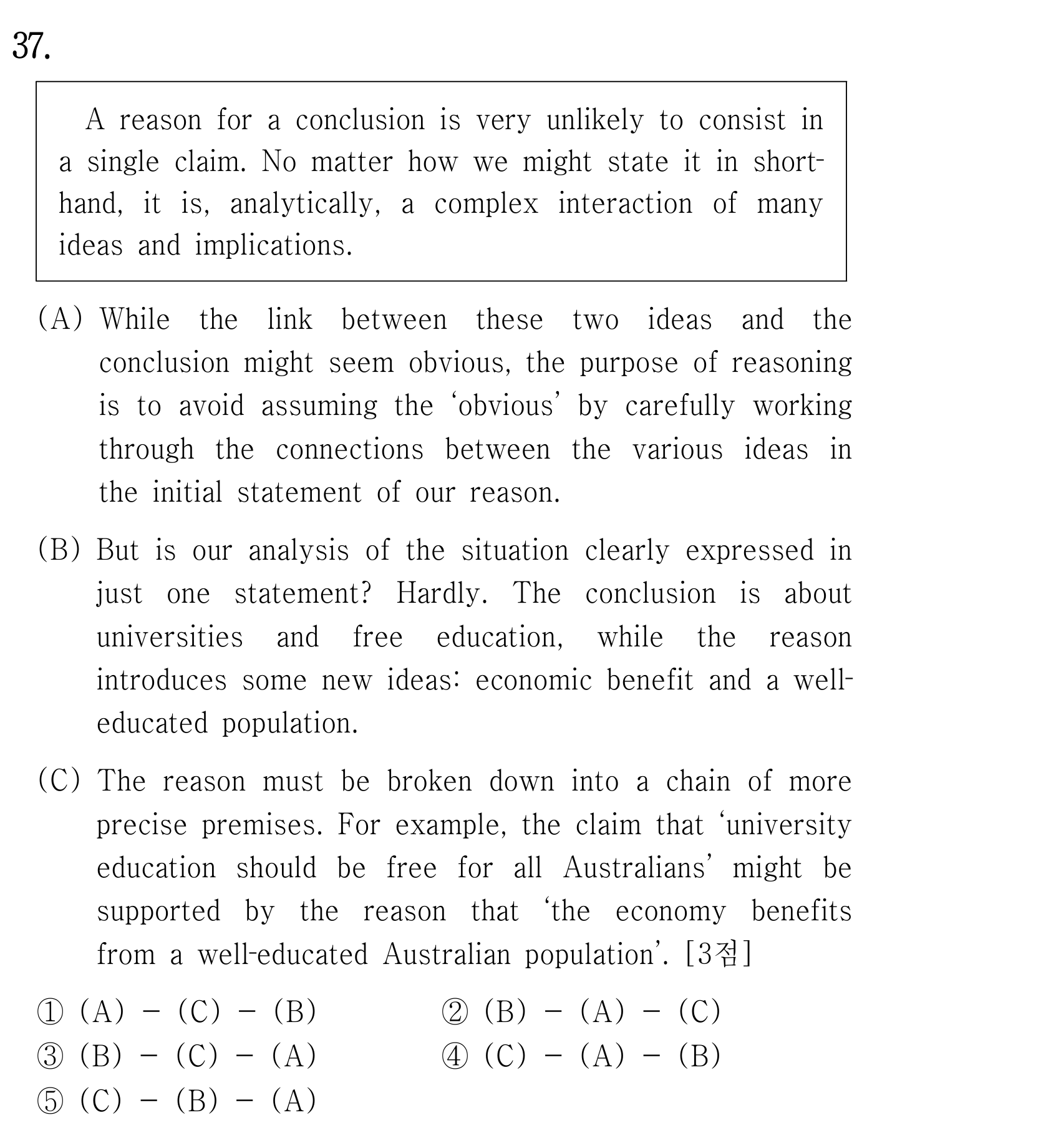
이 지문, 뼈대만 먼저
주제the complex nature of reasoning and premises추론과 전제의 복잡한 성격
흐름single claim is not enough → break down into premises → analyze the connections단일 주장은 부족함 → 세부 전제들로 쪼갬 → 생각들 사이의 연결을 분석함
주장A reason must be broken down into precise premises.근거는 더 정확한 전제들로 세분화되어야 한다.
근거A simple claim contains multiple hidden ideas and implications.단순해 보이는 주장도 여러 숨겨진 생각과 함축을 담고 있다.
결론Reasoning avoids assuming the obvious by working through connections.추론은 연결 고리를 신중히 검토하여 당연한 가정을 피하는 것이다.
많은 학생들이 글의 순서를 맞출 때 단순히 접속사나 지시어에만 매달리곤 합니다. 하지만 정작 글 전체의 논리적 흐름을 뚫어내는 열쇠는 문장 속에 숨어 있는 어휘들의 '관계'에 있어요. 특히 오늘 다룰 지문처럼 추상적인 개념을 설명할 때는, 앞선 문장에서 던진 단어가 뒤에서 어떻게 구체화되는지를 추적하는 능력이 무엇보다 중요합니다.
A reason for a conclusion is very unlikely to consist in a single claim.
도입
2형식 SVC
A reason for a conclusionS
isV
very unlikely to consist in a single claimSC.
결론에 대한 근거가S 단 하나의 주장으로 구성될 가능성은 매우 낮습니다SC.
동의어 consist in ≒ lie in, reside in · claim ≒ assertion, allegation
No matter how we might state it in short-hand, it is, analytically, a complex interaction of many ideas and implications.
2형식 SVC
부사절No matter how we might state it in short-handM,
itS
isV,
analyticallyM,
a complex interaction of many ideas and implicationsSC.
우리가 그것을 아무리 간략하게 말하더라도M, 그것은S 분석적으로 볼 때 많은 생각과 함축의 복잡한 상호작용입니다SC.
동의어 state ≒ express, declare · implication ≒ connotation, significance
The reason must be broken down into a chain of more precise premises.
주제문
3형식 SVO (수동태)
The reasonS
must be broken downV
into a chain of more precise premisesM.
그 근거는S 더 정확한 전제들의 사슬로M 세분화되어야 합니다V.
동의어 break down ≒ analyze, dissect, deconstruct · precise ≒ exact, accurate · premise ≒ assumption, postulate
For example, the claim that ‘university education should be free for all Australians’ might be supported by the reason that ‘the economy benefits from a well-educated Australian population’.
예시
3형식 SVO (수동태)
For exampleM,
the claimS
형용사절(동격)that ‘university education should be free for all Australians’
might be supportedV
by the reasonM
형용사절(동격)that ‘the economy benefits from a well-educated Australian population’.
예를 들어, '대학 교육은 모든 호주인에게 무료여야 한다'는 주장은S '경제가 잘 교육받은 호주 인구로부터 혜택을 받는다'는 근거에 의해M 뒷받침될 수 있습니다V.
출제 포인트 — 동격의 접속사 that
- the claim / the reason 뒤의 that은 뒤에 완전한 문장을 이끄는 동격의 접속사입니다.
- 관계대명사 which나 what으로 바꾸어 출제하면 오답입니다.
But is our analysis of the situation clearly expressed in just one statement? Hardly.
전환
2형식 SVC
ButM
isV
our analysis of the situationS
clearly expressedSC
in just one statementM?
하지만 상황에 대한 우리의 분석이S 단 하나의 진술로 명확히 표현되었을까요SC? 그렇지 않습니다M.
The conclusion is about universities and free education, while the reason introduces some new ideas: economic benefit and a well-educated population.
2형식 SVC
The conclusionS
isV
about universities and free educationSC,
부사절while the reason introduces some new ideas: economic benefit and a well-educated populationM.
결론은 대학과 무상 교육에 관한 것이지만S, 근거는 경제적 이익과 잘 교육받은 인구라는 몇 가지 새로운 아이디어를 도입합니다M.
동의어 introduce ≒ present, bring in · benefit ≒ advantage, profit
While the link between these two ideas and the conclusion might seem obvious, the purpose of reasoning is to avoid assuming the ‘obvious’ by carefully working through the connections between the various ideas in the initial statement of our reason.
결론
2형식 SVC
부사절While the link between these two ideas and the conclusion might seem obviousM,
the purpose of reasoningS
isV
to avoid assuming the ‘obvious’SC
by carefully working through the connections between the various ideas in the initial statement of our reasonM.
이 두 아이디어와 결론 사이의 연결이 명백해 보일지라도M, 추론의 목적은S '명백한 것'을 당연하게 여기는 것을 피하는 것입니다SC 우리 근거의 초기 진술에 있는 다양한 아이디어 사이의 연결을 신중하게 검토함으로써M.
동의어 obvious ≒ apparent, evident, clear · avoid ≒ shun, evade · work through ≒ examine, analyze
핵심 어휘 심층 정리
implication 함축, 영향, 결과
≒ connotation, significance, undertone
precise 정확한, 정밀한
≒ exact, accurate, specific
premise 전제
≒ assumption, postulate, hypothesis
analytically 분석적으로
≒ logically, systematically, rationally
interaction 상호작용
≒ interplay, communication, synergy
obvious 명백한
≒ apparent, evident, manifest
consist in ~에 있다, 존재하다
≒ lie in, reside in, exist in
state 진술하다, 말하다
≒ express, declare, assert
break down 세분화하다, 나누다
≒ analyze, dissect, divide
work through 검토하다, 해결하다
≒ examine, analyze, study
미국에서는 학술적인 글쓰기(academic writing)를 배울 때, 자신의 주장을 뒷받침하는 근거(reasoning)가 얼마나 촘촘하게 쪼개져 있는지를 매우 중요하게 생각합니다. 단순히 "이게 좋으니까"라고 말하는 것이 아니라, 그 주장을 구성하는 세부 전제(premise)들을 하나씩 풀어내는 과정이 바로 '논리'거든요. 단어를 외울 때도 단순히 뜻만 보지 말고, 이 단어가 '논리적 단계'를 설명하는지 아니면 '결론'을 향하는지 맥락을 함께 보길 바랍니다.
정답은 5번 (C) - (B) - (A) 입니다.
이 지문에서 기억해야 할 단 한 가지는, 우리가 '명백하다'고 믿는 것들이 사실은 수많은 아이디어가 얽혀 만들어진 복잡한 결과물이라는 사실입니다. 당연함을 의심하는 것, 그게 바로 독해의 시작입니다.
- premise(전제)
- implication(함축)
- work through(검토하다)
- 어원으로 묶이는 단어군: infer(추론하다) - implication(함축)
- 시험에 자주 나오는 콜로케이션: be unlikely to V
>> 2025년 6월 고2 모의고사 전체 풀어보기