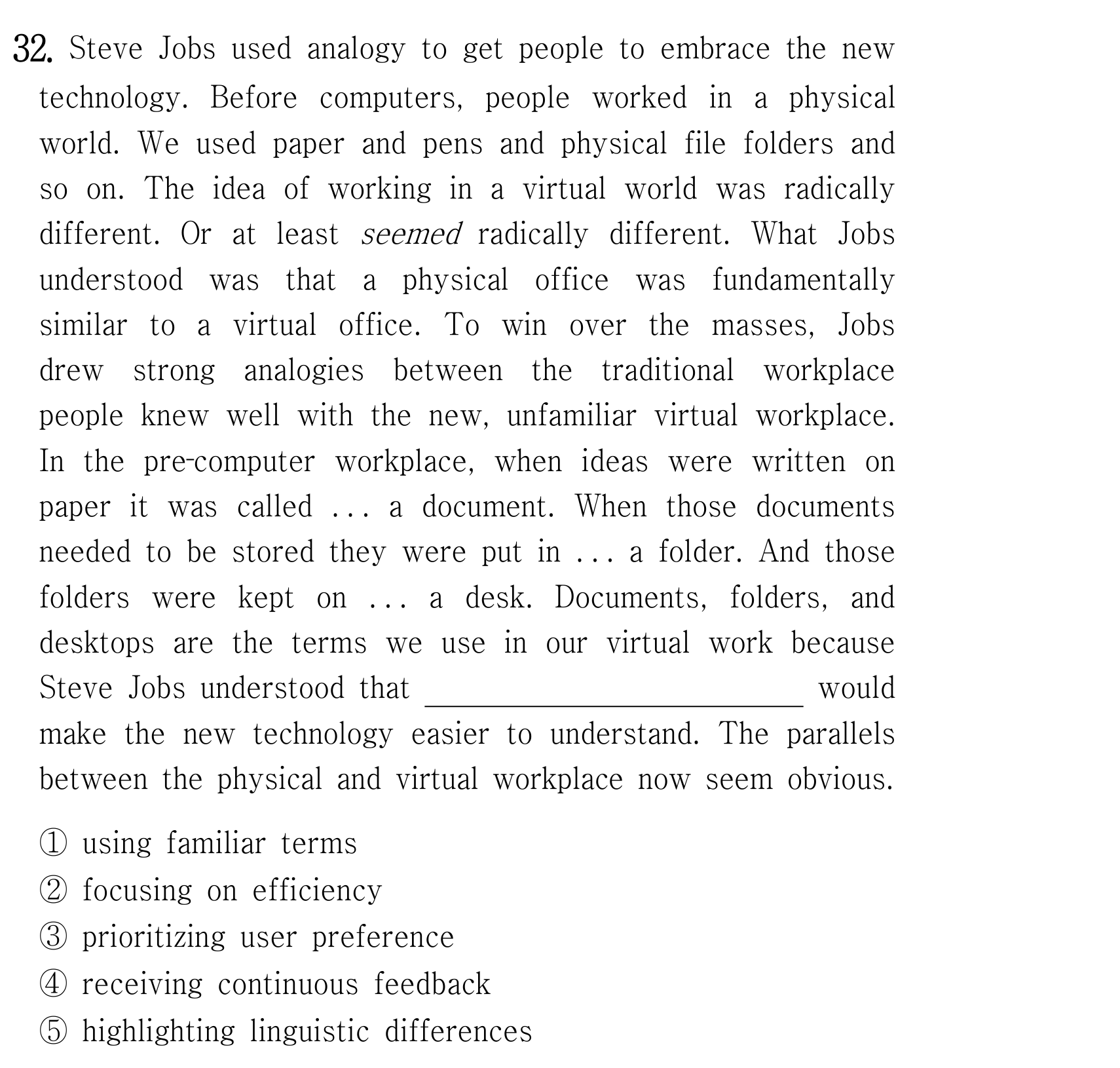
Steve Jobs used analogy to get people to embrace the new technology — 2025년 6월 고2 32번 해석/풀이
후니쌤2026년 5월 17일조회 129
2025-06-29
핵심 문제유형: 빈칸추론 — 낯선 기술을 익숙하게 만드는 전략
이 지문, 뼈대만 먼저
주제using analogy to introduce new technology새로운 기술을 도입하기 위한 유추의 사용
흐름physical world → virtual world barrier → bridging with familiar terms물리적 세계 → 가상 세계의 장벽 → 익숙한 용어로 가교 놓기
주장Steve Jobs used familiar analogies to win over the masses.스티브 잡스는 대중을 사로잡기 위해 익숙한 유추를 사용했다.
근거Terms like documents, folders, and desktops mirror the physical office.문서, 폴더, 바탕화면 같은 용어들은 물리적 사무실을 그대로 모방한다.
결론Familiar terms make unfamiliar technology easier to understand.익숙한 용어가 낯선 기술을 더 이해하기 쉽게 만든다.
새로운 기술이 세상에 나올 때마다 사람들은 본능적으로 경계심부터 갖곤 합니다. 우리가 익숙한 것과 너무 다르기 때문이죠. 이 지문에서 다루는 스티브 잡스의 전략은 바로 그 '낯섦'을 '익숙함'으로 치환하는 마법 같은 과정입니다. 이 글 전체를 관통하는 핵심 단어 하나를 꼽자면 단연 analogy(유추)입니다.
주제문
3형식 SVO
Steve JobsS
usedV
analogyO
to get people to embrace the new technologyM.
스티브 잡스는S 유추를O 사용했다V 사람들이 새로운 기술을 받아들이게 하려고M.
동의어 analogy ≒ comparison, metaphor · embrace ≒ accept, adopt, welcome
1형식 SV
Before computersM,
peopleS
workedV
in a physical worldM.
컴퓨터 이전에는M 사람들이S 물리적인 세상에서M 일했다V.
3형식 SVO
WeS
usedV
paper and pens and physical file folders and so onO.
우리는S 종이와 펜, 물리적인 파일 폴더 등을O 사용했다V.
반론
2형식 SVC
The idea of working in a virtual worldS
wasV
radically differentSC.
가상 세계에서 일한다는 생각은S 근본적으로 완전히 달랐다SC.
동의어 radically ≒ completely, thoroughly, fundamentally · virtual ≒ simulated, digital
2형식 SVC
Or at leastM
seemedV
radically differentSC.
아니, 적어도M 근본적으로 달라SC 보였다V.
2형식 감각동사 seem
S + seem + SC(형용사)
상태를 나타내는 2형식 동사로, 뒤에 반드시 형용사 형태의 보어가 와야 합니다. 부사를 쓰지 않도록 주의하세요.
seemed radically different
→ 형용사 보어 사용 (O)
→ 형용사 보어 사용 (O)
seemed radically differently
→ 보어 자리에 부사 사용 (X)
→ 보어 자리에 부사 사용 (X)
전환
2형식 SVC
명사절What Jobs understoodS
wasV
명사절that a physical office was fundamentally similar to a virtual officeSC.
잡스가 이해했던 것은S 물리적 사무실이 가상 사무실과 근본적으로 유사하다는 점이었다SC.
동의어 fundamentally ≒ essentially, basically · similar ≒ alike, comparable
관계대명사 what절 vs 접속사 that절
What + 불완전한 문장 (주어 역할) / That + 완전한 문장 (보어 역할)
주어 자리에 쓰인 What은 선행사를 포함하는 관계대명사로 뒤가 불완전하며, 보어 자리에 쓰인 that은 접속사로 뒤에 완전한 문장이 옵니다.
출제 포인트 — What vs That
- What Jobs understood (understood의 목적어가 없는 불완전한 문장)
- was that a physical office was... (주어+동사+보어가 모두 갖춰진 완전한 문장)
근거
3형식 SVO
To win over the massesM,
JobsS
drewV
strong analogiesO
between the traditional workplace 형용사절(that) people knew well with the new, unfamiliar virtual workplaceM.
대중의 마음을 얻기 위해,M 잡스는S 강력한 유추를O 사람들이 잘 아는 전통적인 작업장과 새롭고 낯선 가상 작업장 사이에 끌어왔다M.
동의어 win over ≒ persuade, convince, attract · unfamiliar ≒ strange, novel, alien
(참고: 미국에서는 새로운 것을 설명할 때 'bridge the gap'이라는 표현을 자주 쓰는데, 잡스의 방식이 딱 그 예시였죠.)
1형식 SV
In the pre-computer workplaceM,
부사절when ideas were written on paper
itS
was calledV
a documentSC.
컴퓨터 이전의 작업장에서, 아이디어가 종이에 적힐 때M 그것은S '문서'라고SC 불렸다V.
1형식 SV
부사절When those documents needed to be stored
theyS
were putV
in a folderM.
그 문서들을 저장할 필요가 있을 때M 그것들은S 폴더에M 넣어졌다V.
1형식 SV
And those foldersS
were keptV
on a deskM.
그리고 그 폴더들은S 책상 위에M 보관되었다V.
결론
2형식 SVC
Documents, folders, and desktopsS
areV
the terms 형용사절(that) we use in our virtual workSC
부사절because Steve Jobs understood 명사절that using familiar terms would make the new technology easier to understand.
문서, 폴더, 그리고 바탕화면은S 우리가 가상 작업에서 사용하는 용어들인데,SC 그 이유는 스티브 잡스가 익숙한 용어를 사용하는 것이 새로운 기술을 더 쉽게 이해하도록 만들 것임을 알았기 때문이다M.
동의어 terms ≒ expressions, vocabulary · familiar ≒ recognizable, well-known
5형식 동사 make + 형용사 목적격보어
S + make + O + OC(형용사)
동사 make가 5형식으로 쓰일 때, 목적격보어(OC) 자리에는 부사가 아닌 형용사(또는 형용사의 비교급)가 와야 합니다.
make the new technology easier to understand
→ 형용사 비교급 보어 사용 (O)
→ 형용사 비교급 보어 사용 (O)
make the new technology easily to understand
→ 보어 자리에 부사 사용 (X)
→ 보어 자리에 부사 사용 (X)
2형식 SVC
The parallels between the physical and virtual workplaceS
now seemV
obviousSC.
물리적 작업장과 가상 작업장 사이의 유사점들은S 이제 명백해SC 보인다V.
동의어 parallel ≒ similarity, resemblance, correspondence · obvious ≒ clear, apparent, evident
어휘 정리
analogy 유추
≒ comparison, metaphor, similarity
embrace 받아들이다
≒ accept, adopt, welcome
radically 근본적으로
≒ completely, thoroughly, fundamentally
masses 대중
≒ public, populace, crowd
parallel 유사점
≒ similarity, resemblance, correspondence
virtual 가상의
≒ simulated, digital, cyber
unfamiliar 낯선
≒ strange, novel, alien
obvious 명백한
≒ clear, apparent, evident
fundamentally 근본적으로
≒ basically, essentially, inherently
win over 마음을 얻다
≒ persuade, convince, attract
풀이 전략
지문의 후반부, "using familiar terms would make the new technology easier to understand"라는 문장이 결정적인 힌트입니다. 잡스가 왜 굳이 '문서'나 '폴더'라는 단어를 고집했는지 생각해보면 답은 명확해집니다.
정답은 1번 using familiar terms 입니다.
사람들은 본능적으로 낯선 것을 배울 때 겁을 먹죠. 하지만 그 낯선 대상을 이미 알고 있는 개념에 빗대어 설명하면 심리적 장벽이 낮아집니다. 여러분도 공부할 때 어려운 개념을 여러분이 좋아하는 취미나 일상적인 상황에 빗대어 생각해보세요. 훨씬 기억에 오래 남을 겁니다.
- 유추(analogy)의 효과
- 낯선 개념을 익숙한 용어로 치환
- 5형식 구조의 이해
- 문맥적 단서 파악