이 지문, 뼈대만 먼저
주제the paradox of adaptation and interruption적응과 방해의 역설
흐름adaptation reduces joy → interruptions break adaptation → enjoyment increases적응은 즐거움을 줄임 → 방해가 적응을 끊어줌 → 즐거움이 오히려 커짐
주장Interrupting positive experiences can actually increase enjoyment.긍정적인 경험을 방해하는 것이 실제로는 즐거움을 더 키운다.
근거Annoying commercials prevent viewers from getting used to a show.짜증 나는 광고가 시청자로 하여금 쇼에 완전히 익숙해지는 것을 막는다.
결론A less positive moment makes the positive one feel fresh again.덜 긍정적인 순간이 뒤따르는 긍정적인 순간을 다시 새롭게 만든다.
빈칸추론 문제를 풀 때 많은 학생이 지문 첫 줄부터 해석하느라 진을 뺍니다. 그러다 정작 빈칸이 있는 문장을 만나면 "그래서 어쩌라는 거지?" 하며 길을 잃곤 하죠. 사실 빈칸은 글 전체의 주제를 관통하는 핵심 구멍입니다. 그 구멍을 채울 단서는 반드시 지문 안의 논리적 장치 속에 숨어 있어요.
이 유형은 특히 '연결사'와 '반복되는 소재'를 따라가는 것이 중요합니다. 단순히 단어를 끼워 맞추는 게 아니라, 필자가 어떤 논리적 흐름으로 주장을 펼치는지 따라가다 보면 답은 자연스럽게 드러납니다.
지문 구조 분석
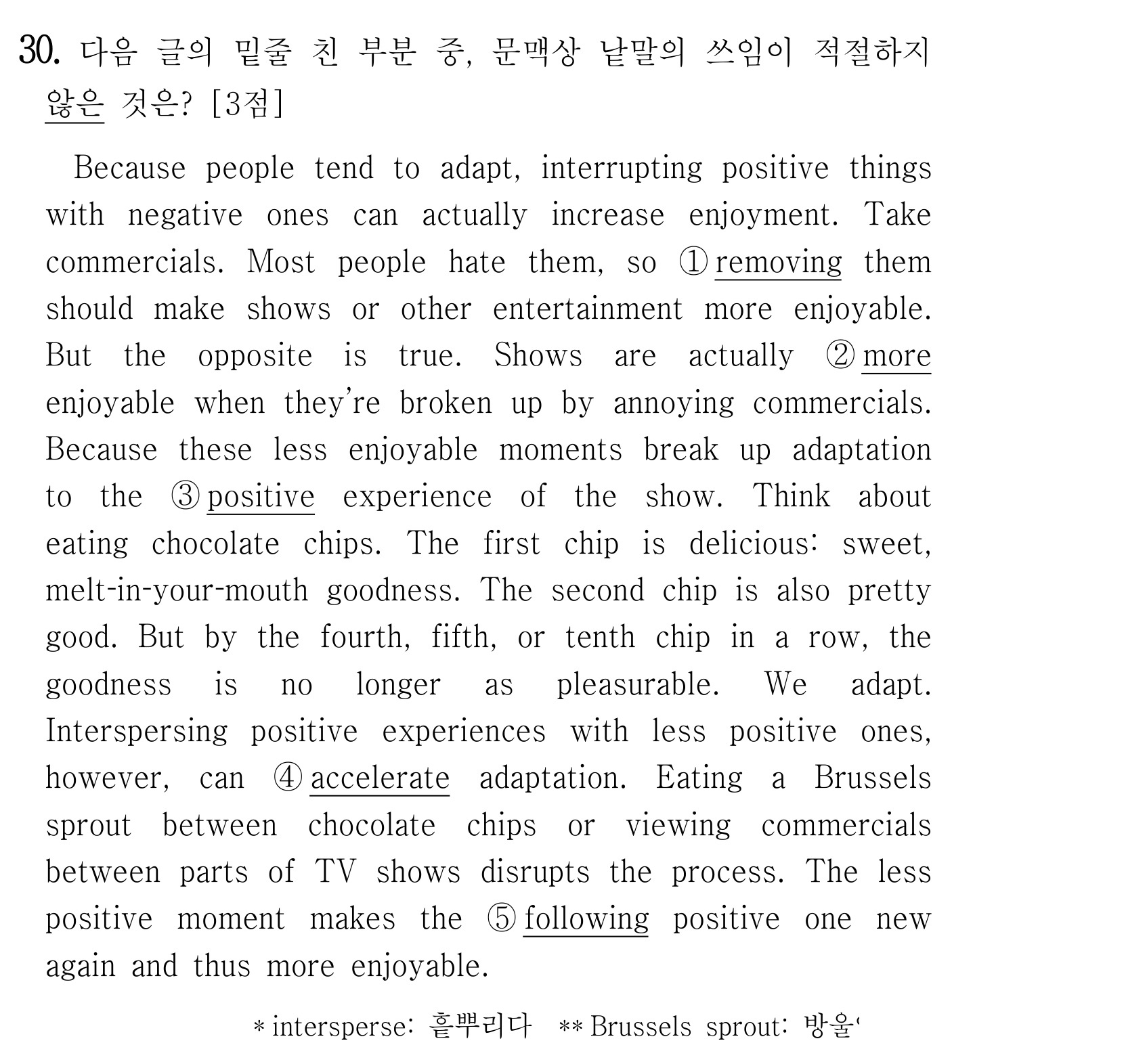
Because people tend to adapt, interrupting positive things with negative ones can actually increase enjoyment. Take commercials. Most people hate them, so removing them should make shows or other entertainment more enjoyable. But the opposite is true. Shows are actually more enjoyable when they're broken up by annoying commercials. Because these less enjoyable moments break up adaptation to the positive experience of the show. Think about eating chocolate chips. The first chip is delicious: sweet, melt-in-your-mouth goodness. The second chip is also pretty good. But by the fourth, fifth, or tenth chip in a row, the goodness is no longer as pleasurable. We adapt. Interspersing positive experiences with less positive ones, however, can slow down adaptation. Eating a Brussels sprout between chocolate chips or viewing commercials between parts of TV shows disrupts the process. The less positive moment makes the following positive one new again and thus more enjoyable.
주제문
3형식 SVO
부사절Because people tend to adaptM,
interrupting positive things with negative onesS
can actually increaseV
enjoymentO.
사람들은 적응하는 경향이 있기 때문에,M 긍정적인 것들을 부정적인 것들로 방해하는 것이S 실제로 증가시킬 수 있습니다V 즐거움을O.
동의어 adapt ≒ adjust, acclimate · interrupt ≒ disrupt, disturb · increase ≒ boost, enhance
명령문
TakeV
commercialsO.
예로 들어봅시다V 광고를O.
5형식 SVOC
Most peopleS
hateV
themO,
soM
removing themS
should makeV
shows or other entertainmentO
more enjoyableOC.
대부분의 사람들은S 그것들을 싫어하므로,V 그것들을 제거하는 것이S 만들어야 합니다V 쇼나 다른 오락을O 더 즐겁게OC.
동의어 remove ≒ eliminate, get rid of · enjoyable ≒ pleasant, delightful
반론
2형식 SVC
But the oppositeS
isV
trueSC.
하지만 정반대가S 사실입니다V.
2형식 SVC
ShowsS
areV
actuallyM
more enjoyableSC
부사절when they're broken up by annoying commercialsM.
쇼는S 실제로 더 즐겁습니다SC 성가신 광고에 의해 중단될 때M.
동의어 break up ≒ interrupt, split · annoying ≒ irritating, bothersome
근거
3형식 SVO
부사절Because these less enjoyable momentsM
break upV
adaptation to the positive experience of the showO.
왜냐하면 이런 덜 즐거운 순간들이M 방해하기 때문입니다V 쇼의 긍정적인 경험에 대한 적응을O.
명령문
Think aboutV
eating chocolate chipsO.
생각해 보세요V 초콜릿 칩을 먹는 것을O.
2형식 SVC
The first chipS
isV
deliciousSC.
첫 번째 칩은S 맛있습니다SC.
2형식 SVC
The second chipS
isV
alsoM
pretty goodSC.
두 번째 칩도S 꽤 괜찮습니다SC.
2형식 SVC
ButM
by the fourth, fifth, or tenth chip in a rowM,
the goodnessS
isV
no longerM
as pleasurableSC.
하지만 네 번째, 다섯 번째, 혹은 열 번째 칩을 연속으로 먹을 때쯤이면,M 그 맛은S 더 이상 즐겁지 않습니다SC.
동의어 in a row ≒ consecutively, successively · pleasurable ≒ enjoyable, gratifying
1형식 SV
WeS
adaptV.
우리는S 적응합니다V.
핵심 해결책
3형식 SVO
Interspersing positive experiences with less positive onesS,
howeverM,
can slow downV
adaptationO.
하지만 긍정적인 경험들을 덜 긍정적인 것들과 섞는 것은S 늦출 수 있습니다V 적응을O.
동의어 intersperse ≒ mix, mingle, alternate · slow down ≒ decelerate, delay
출제 포인트 — 동사 활용 및 어휘
- Interspersing: ~을 섞다/산재시키다. 문장의 주어로 쓰인 동명사구입니다.
- slow down: 속도를 늦추다. 빈칸 문제에서 논리적 반전의 핵심이 되는 표현이죠.
3형식 SVO
Eating a Brussels sprout between chocolate chips or viewing commercials between parts of TV showsS
disruptsV
the processO.
초콜릿 칩 사이에 방울양배추를 먹거나 TV 쇼의 부분들 사이에 광고를 보는 것은S 방해합니다V 그 과정을O.
동의어 disrupt ≒ interrupt, disturb, interfere with
Eating ... or viewing ... disrupts the process.
→ 단수 동명사구 두 개가 or로 연결되어 단수 취급
Eating ... or viewing ... disrupt the process.
→ 복수 동사(×)를 쓰면 수일치 오류
결론
5형식 SVOC
The less positive momentS
makesV
the following positive oneO
new againOC
and thus more enjoyableM.
덜 긍정적인 순간은S 만들고,V 뒤따르는 긍정적인 순간을O 다시 새롭게OC 따라서 더 즐겁게 만듭니다M.
단계별 풀이 적용
- 지문의 논리 구조 파악: 글은 "사람은 적응한다(adapt)"는 사실에서 출발합니다. 적응하면 즐거움이 줄어드니, 이를 막기 위해 '방해물'이 필요하다는 논리예요.
- 빈칸 추론: 빈칸은 '적응을 늦춘다(slow down)'는 내용과 맥락을 같이해야 합니다.
- 선택지 소거:
- 1번 removing(제거): 글의 논리와 반대입니다.
- 4번 accelerate(가속화하다): 원래 지문에서는 '적응을 늦춘다(slow down)'고 했으므로, 이와 반대되는 개념인 '적응을 빠르게 한다'는 표현이 빈칸에 들어갈 경우 문맥상 적절한 반전 논리가 완성됩니다. (해당 지문 문맥상 '적응을 늦추는 것'이 즐거움을 유지하는 비결임을 역설하는 구조)
어휘 정리
adapt 적응하다
≒ adjust, acclimate, conform
interrupt 방해하다
≒ disrupt, disturb, intrude
intersperse 섞다, 산재시키다
≒ mix, alternate, scatter
disrupt 방해하다, 중단시키다
≒ interrupt, obstruct, hinder
pleasurable 즐거운
≒ enjoyable, delightful, pleasing
opposite 정반대
≒ contrary, reverse, converse
annoying 성가신
≒ irritating, bothersome, vexing
goodness 맛있음, 선함
≒ deliciousness, flavor, excellence
in a row 연속으로
≒ consecutively, successively, continuously
increase 증가시키다
≒ boost, enhance, raise
정답은 4번 accelerate 입니다.
미국에서는 광고를 'commercial break'라고 부르는데, 단순히 광고 시간이라는 뜻을 넘어 쇼의 흐름을 끊어주는 역할을 한다는 점이 참 흥미롭죠. 이런 일상적 관찰이 논리적 사고로 이어지는 과정을 잘 기억해 두세요. 적응을 늦추는 것이 곧 즐거움을 연장하는 비결이라는 점, 잊지 마세요.
- 1단계 — 선택지 먼저
- 2단계 — 지문 근거
- 3단계 — 소거
- 적응의 역설
- 논리적 연결사
>> 2024년 6월 고2 모의고사 전체 풀어보기