2024년 6월 고2 전국연합 영어 모의고사
28문제 · 제한시간 48분
이 시험 한눈에 — 2024년 6월 고2 전국연합 영어 모의고사
18~45번 28문항을 유형별로 보면 목적 1 · 심경/분위기 1 · 주장 1 · 함축의미추론 1 · 요지/주장 1 · 주제 1 · 제목 1 · 도표 1 · 내용일치 1 · 실용문 1 · 어법 2 · 어휘 1 · 빈칸추론2 1 · 빈칸추론3 1 · 빈칸추론4 1 · 빈칸추론5 1 · 무관한문장 1 · 순서배열1 1 · 순서배열2 1 · 문장삽입1 1 · 문장삽입2 1 · 요약문완성 1 · 장문 5. 아래 지문으로 변형문제·단어장·정답표를 바로 만들 수 있습니다.
20번주장Most people resist the idea of a true self-estimate, probably because they fear it might…
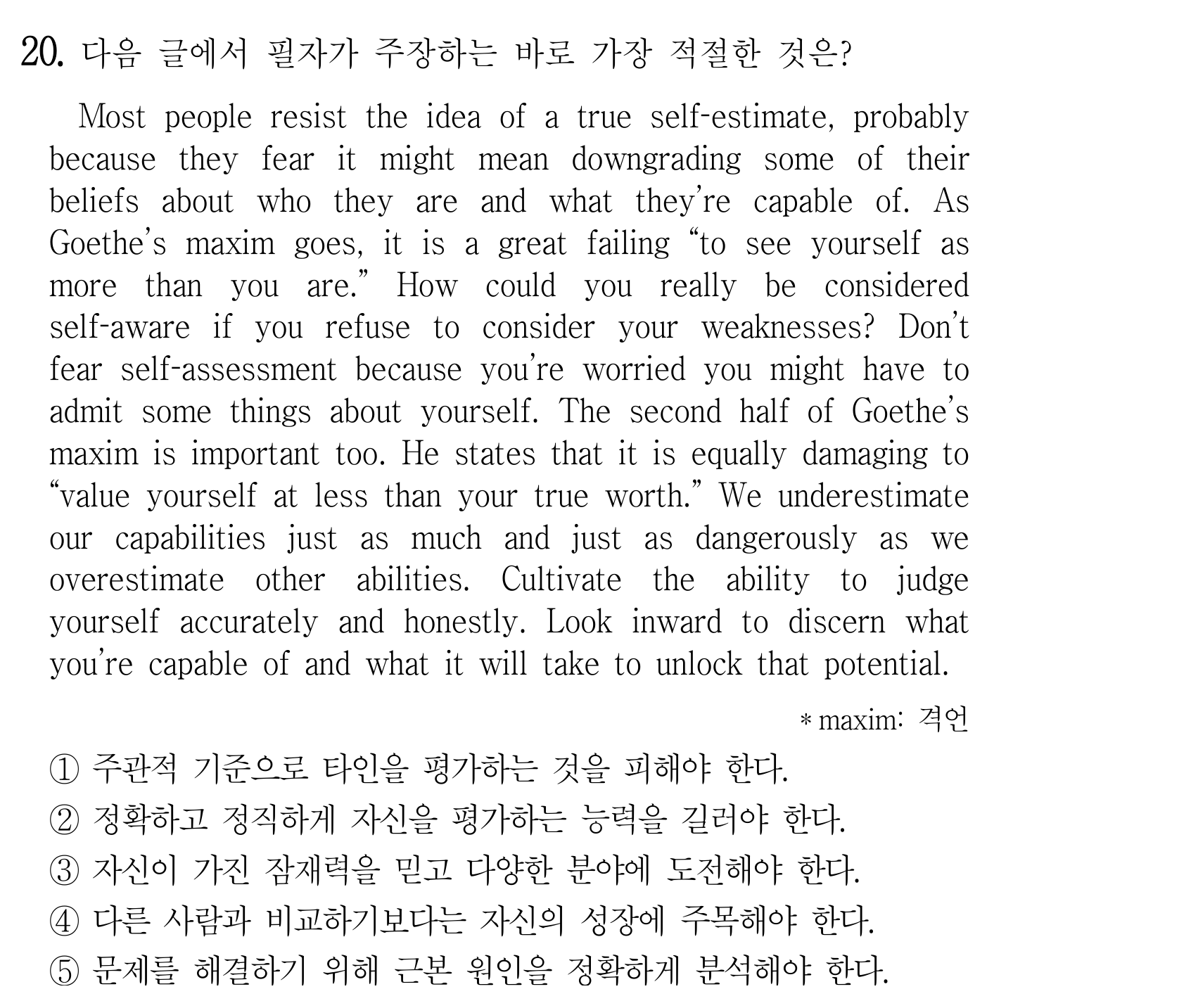
Most people resist the idea of a true self-estimate, probably because they fear it might mean downgrading some of their beliefs about who they are and what they're capable of. As Goethe's maxim goes, it is a great failing "to see yourself as more than you are." How could you really be considered self-aware if you refuse to consider your weaknesses? Don't fear self-assessment because you're worried you might have to admit some things about yourself. The second half of Goethe's maxim is important too. He states that it is equally damaging to "value yourself at less than your true worth." We underestimate our capabilities just as much and just as dangerously as we overestimate other abilities. Cultivate the ability to judge yourself accurately and honestly. Look inward to discern what you're capable of and what it will take to unlock that potential.
21번함축의미추론Take a look at some of the most powerful, rich, and famous people in the world.
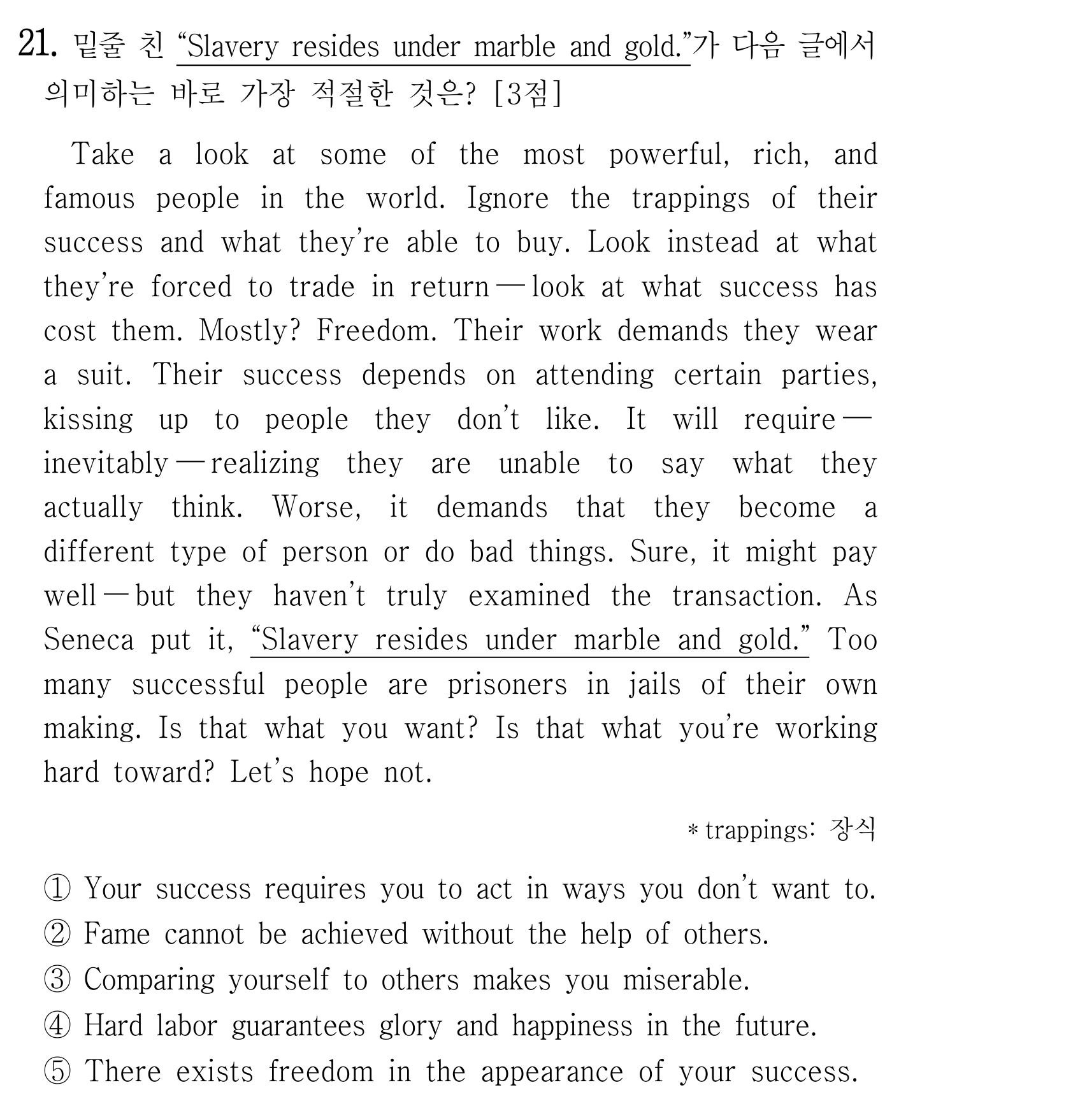
Take a look at some of the most powerful, rich, and famous people in the world. Ignore the trappings of their success and what they’re able to buy. Look instead at what they’re forced to trade in return — look at what success has cost them. Mostly? Freedom. Their work demands they wear a suit. Their success depends on attending certain parties, kissing up to people they don’t like. It will require — inevitably — realizing they are unable to say what they actually think. Worse, it demands that they become a different type of person or do bad things. Sure, it might pay well — but they haven’t truly examined the transaction. As Seneca put it, “Slavery resides under marble and gold.” Too many successful people are prisoners in jails of their own making. Is that what you want? Is that what you’re working hard toward? Let’s hope not.
22번요지/주장If a firm is going to be saved by the government, it might be easier to concentrate on lo…
If a firm is going to be saved by the government, it might be easier to concentrate on lobbying the government for more money rather than taking the harder decision of restructuring the company to be able to be profitable and viable in the long term. This is an example of something known as moral hazard — when government support alters the decisions firms take. For example, if governments rescue banks who get into difficulty, as they did during the credit crisis of 2007-08, this could encourage banks to take greater risks in the future because they know there is a possibility that governments will intervene if they lose money. Although the government rescue may be well intended, it can negatively affect the behavior of banks, encouraging risky and poor decision making.
23번주제If there is little or no diversity of views, and all scientists see, think, and question…
If there is little or no diversity of views, and all scientists see, think, and question the world in a similar way, then they will not, as a community, be as objective as they maintain they are, or at least aspire to be. The solution is that there should be far greater diversity in the practice of science: in gender, ethnicity, and social and cultural backgrounds. Science works because it is carried out by people who pursue their curiosity about the natural world and test their and each other's ideas from as many varied perspectives and angles as possible. When science is done by a diverse group of people, and if consensus builds up about a particular area of scientific knowledge, then we can have more confidence in its objectivity and truth.
24번제목We tend to break up time into units, such as weeks, months, and seasons; in a series of s…
We tend to break up time into units, such as weeks, months, and seasons; in a series of studies among farmers in India and students in North America, psychologists found that if a deadline is on the other side of a “break” — such as in the New Year — we’re more likely to see it as remote, and, as a result, be less ready to jump into action. What you need to do in that situation is find another way to think about the timeframe. For example, if it’s November and the deadline is in January, it’s better to tell yourself you have to get it done “this winter” rather than “next year.” The best approach is to view deadlines as a challenge that you have to meet within a period that’s imminent. That way the stress is more manageable, and you have a better chance of starting — and therefore finishing — in good time.
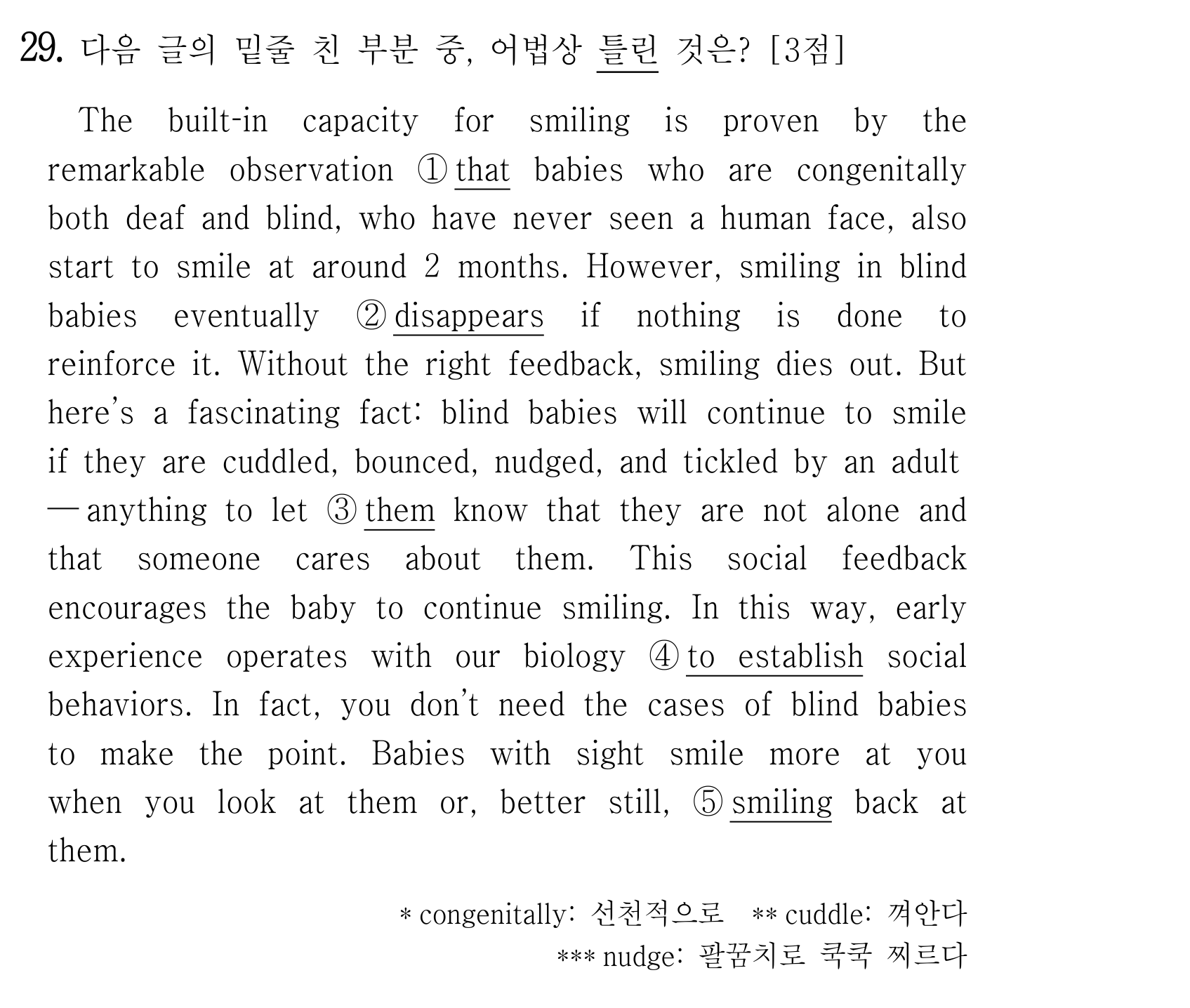
29번어법The built-in capacity for smiling is proven by the remarkable observation that babies who…
The built-in capacity for smiling is proven by the remarkable observation that babies who are congenitally both deaf and blind, who have never seen a human face, also start to smile at around 2 months. However, smiling in blind babies eventually disappears if nothing is done to reinforce it. Without the right feedback, smiling dies out. But here's a fascinating fact: blind babies will continue to smile if they are cuddled, bounced, nudged, and tickled by an adult — anything to let them know that they are not alone and that someone cares about them. This social feedback encourages the baby to continue smiling. In this way, early experience operates with our biology to establish social behaviors. In fact, you don't need the cases of blind babies to make the point. Babies with sight smile more at you when you look at them or, better still, smile back at them.
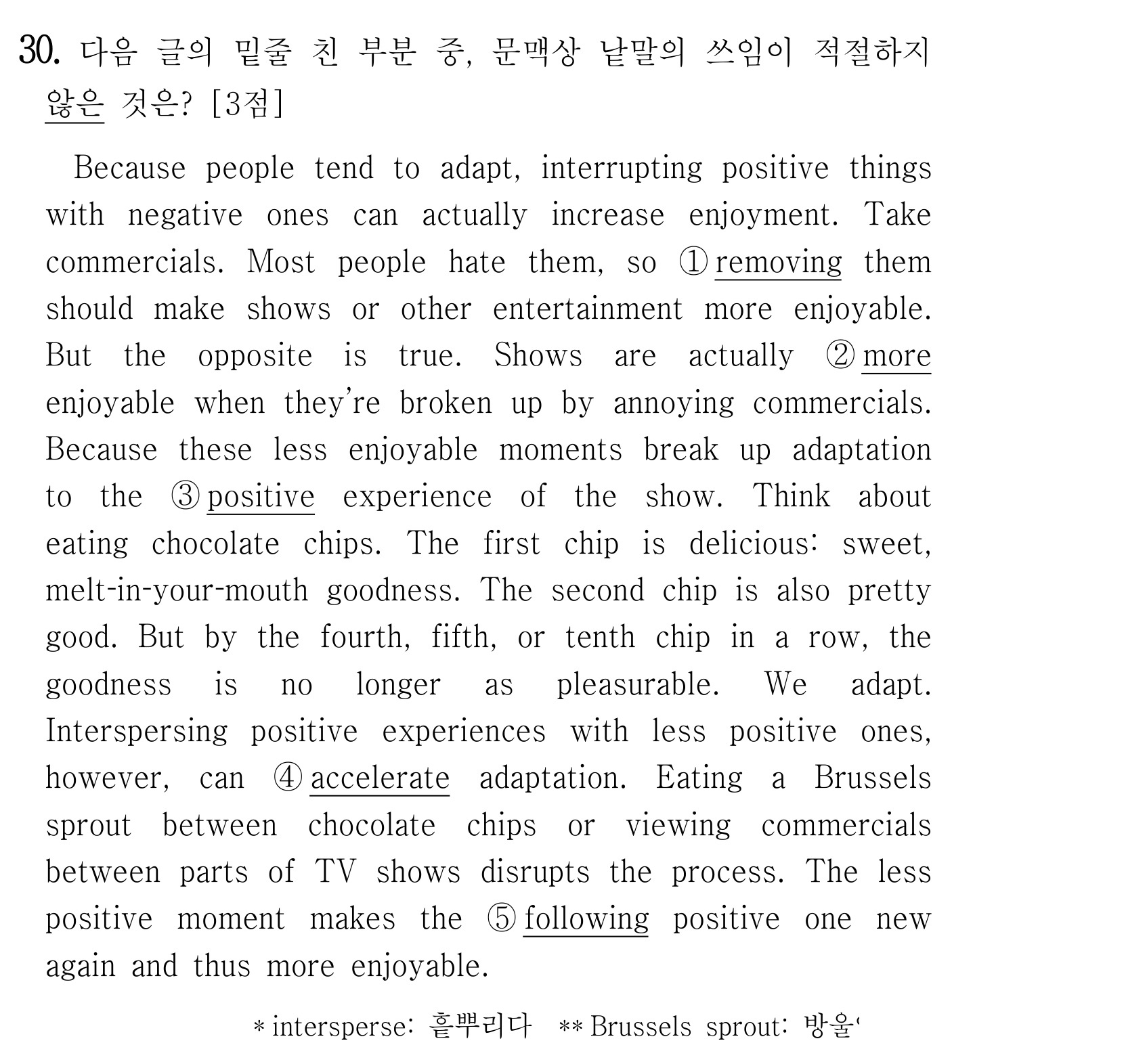
30번어휘Because people tend to adapt, interrupting positive things with negative ones can actuall…
Because people tend to adapt, interrupting positive things with negative ones can actually increase enjoyment. Take commercials. Most people hate them, so removing them should make shows or other entertainment more enjoyable. But the opposite is true. Shows are actually more enjoyable when they're broken up by annoying commercials. Because these less enjoyable moments break up adaptation to the positive experience of the show. Think about eating chocolate chips. The first chip is delicious: sweet, melt-in-your-mouth goodness. The second chip is also pretty good. But by the fourth, fifth, or tenth chip in a row, the goodness is no longer as pleasurable. We adapt. Interspersing positive experiences with less positive ones, however, can slow down adaptation. Eating a Brussels sprout between chocolate chips or viewing commercials between parts of TV shows disrupts the process. The less positive moment makes the following positive one new again and thus more enjoyable.
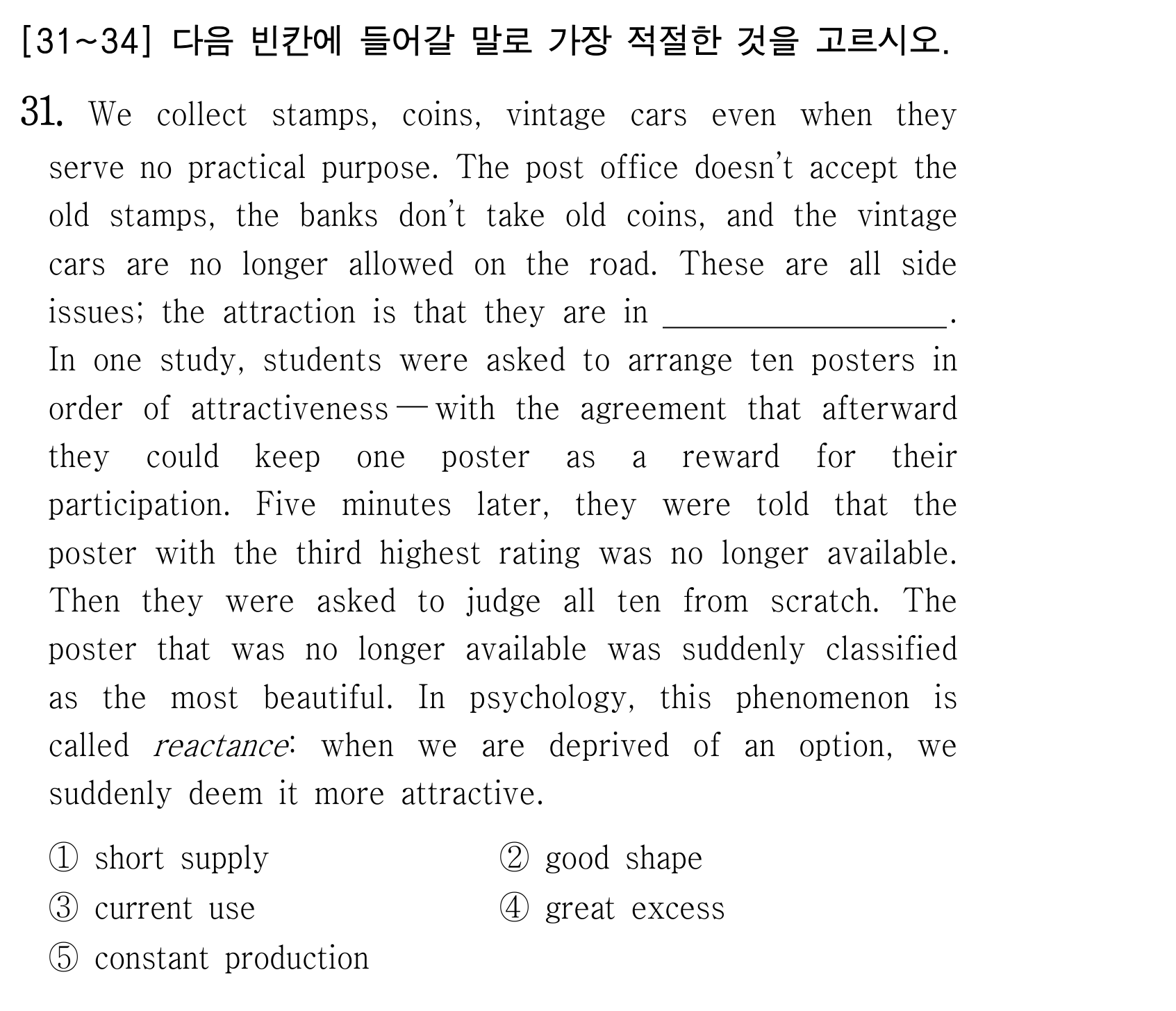
31번빈칸추론2We collect stamps, coins, vintage cars even when they serve no practical purpose.
We collect stamps, coins, vintage cars even when they serve no practical purpose. The post office doesn't accept the old stamps, the banks don't take old coins, and the vintage cars are no longer allowed on the road. These are all side issues; the attraction is that they are in short supply. In one study, students were asked to arrange ten posters in order of attractiveness — with the agreement that afterward they could keep one poster as a reward for their participation. Five minutes later, they were told that the poster with the third highest rating was no longer available. Then they were asked to judge all ten from scratch. The poster that was no longer available was suddenly classified as the most beautiful. In psychology, this phenomenon is called reactance: when we are deprived of an option, we suddenly deem it more attractive.
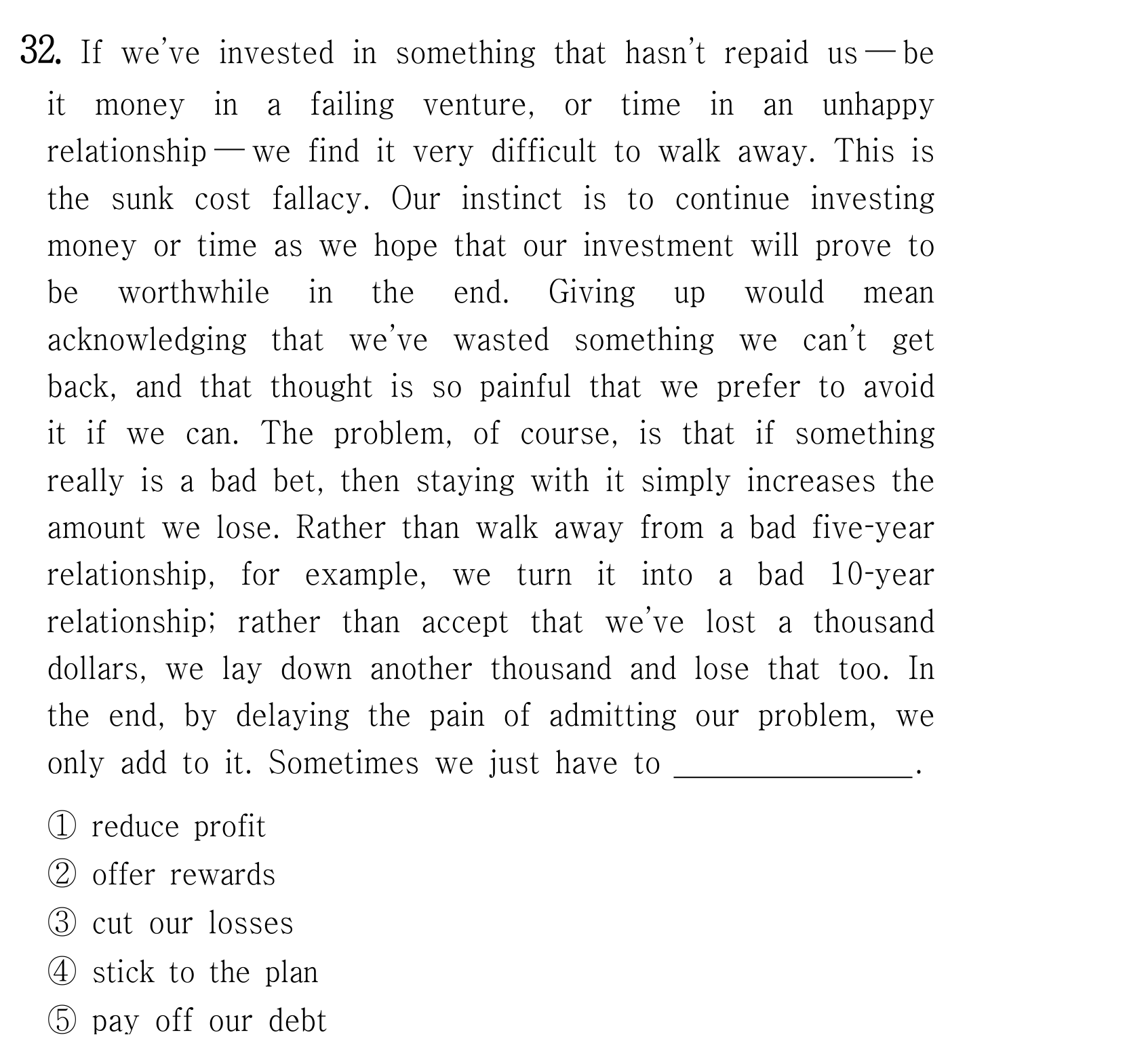
32번빈칸추론3If we've invested in something that hasn't repaid us — be it money in a failing venture,…
If we've invested in something that hasn't repaid us — be it money in a failing venture, or time in an unhappy relationship — we find it very difficult to walk away. This is the sunk cost fallacy. Our instinct is to continue investing money or time as we hope that our investment will prove to be worthwhile in the end. Giving up would mean acknowledging that we've wasted something we can't get back, and that thought is so painful that we prefer to avoid it if we can. The problem, of course, is that if something really is a bad bet, then staying with it simply increases the amount we lose. Rather than walk away from a bad five-year relationship, for example, we turn it into a bad 10-year relationship; rather than accept that we've lost a thousand dollars, we lay down another thousand and lose that too. In the end, by delaying the pain of admitting our problem, we only add to it. Sometimes we just have to cut our losses.
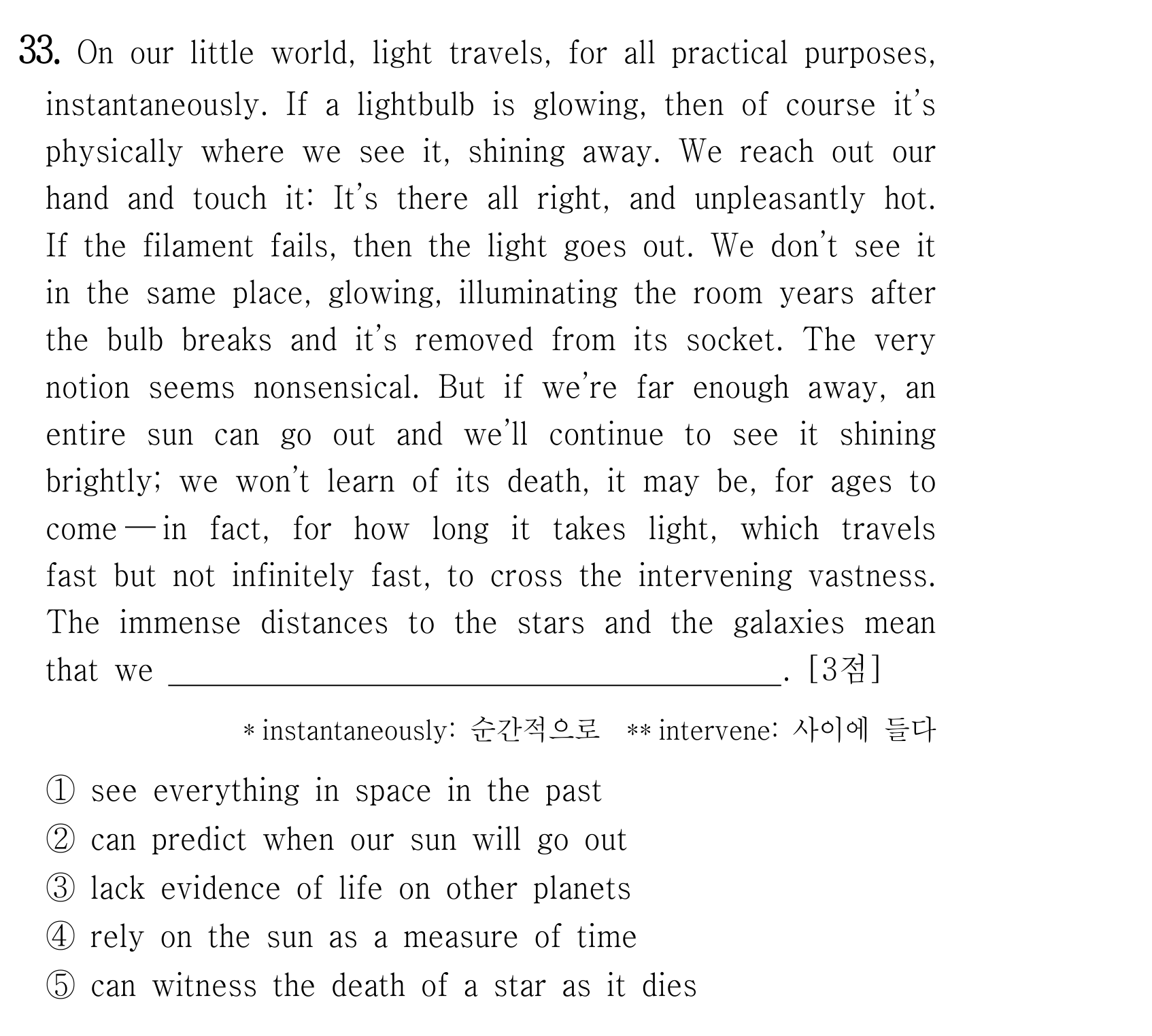
33번빈칸추론4On our little world, light travels, for all practical purposes, instantaneously.
On our little world, light travels, for all practical purposes, instantaneously. If a lightbulb is glowing, then of course it’s physically where we see it, shining away. We reach out our hand and touch it: It’s there all right, and unpleasantly hot. If the filament fails, then the light goes out. We don’t see it in the same place, glowing, illuminating the room years after the bulb breaks and it’s removed from its socket. The very notion seems nonsensical. But if we’re far enough away, an entire sun can go out and we’ll continue to see it shining brightly; we won’t learn of its death, it may be, for ages to come — in fact, for how long it takes light, which travels fast but not infinitely fast, to cross the intervening vastness. The immense distances to the stars and the galaxies mean that we see everything in space in the past.
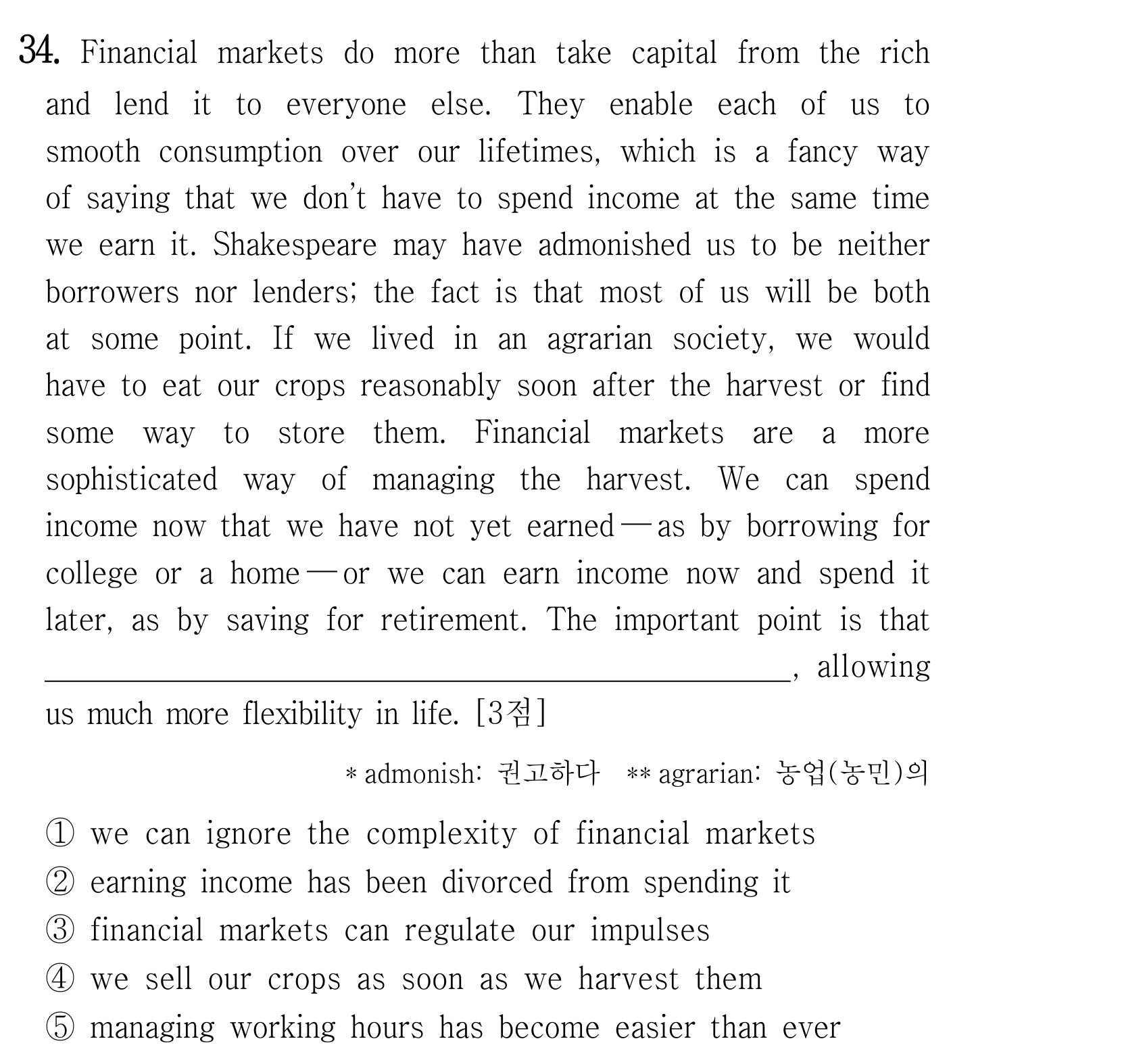
34번빈칸추론5Financial markets do more than take capital from the rich and lend it to everyone else.
Financial markets do more than take capital from the rich and lend it to everyone else. They enable each of us to smooth consumption over our lifetimes, which is a fancy way of saying that we don't have to spend income at the same time we earn it. Shakespeare may have admonished us to be neither borrowers nor lenders; the fact is that most of us will be both at some point. If we lived in an agrarian society, we would have to eat our crops reasonably soon after the harvest or find some way to store them. Financial markets are a more sophisticated way of managing the harvest. We can spend income now that we have not yet earned — as by borrowing for college or a home — or we can earn income now and spend it later, as by saving for retirement. The important point is that earning income has been divorced from spending it, allowing us much more flexibility in life.
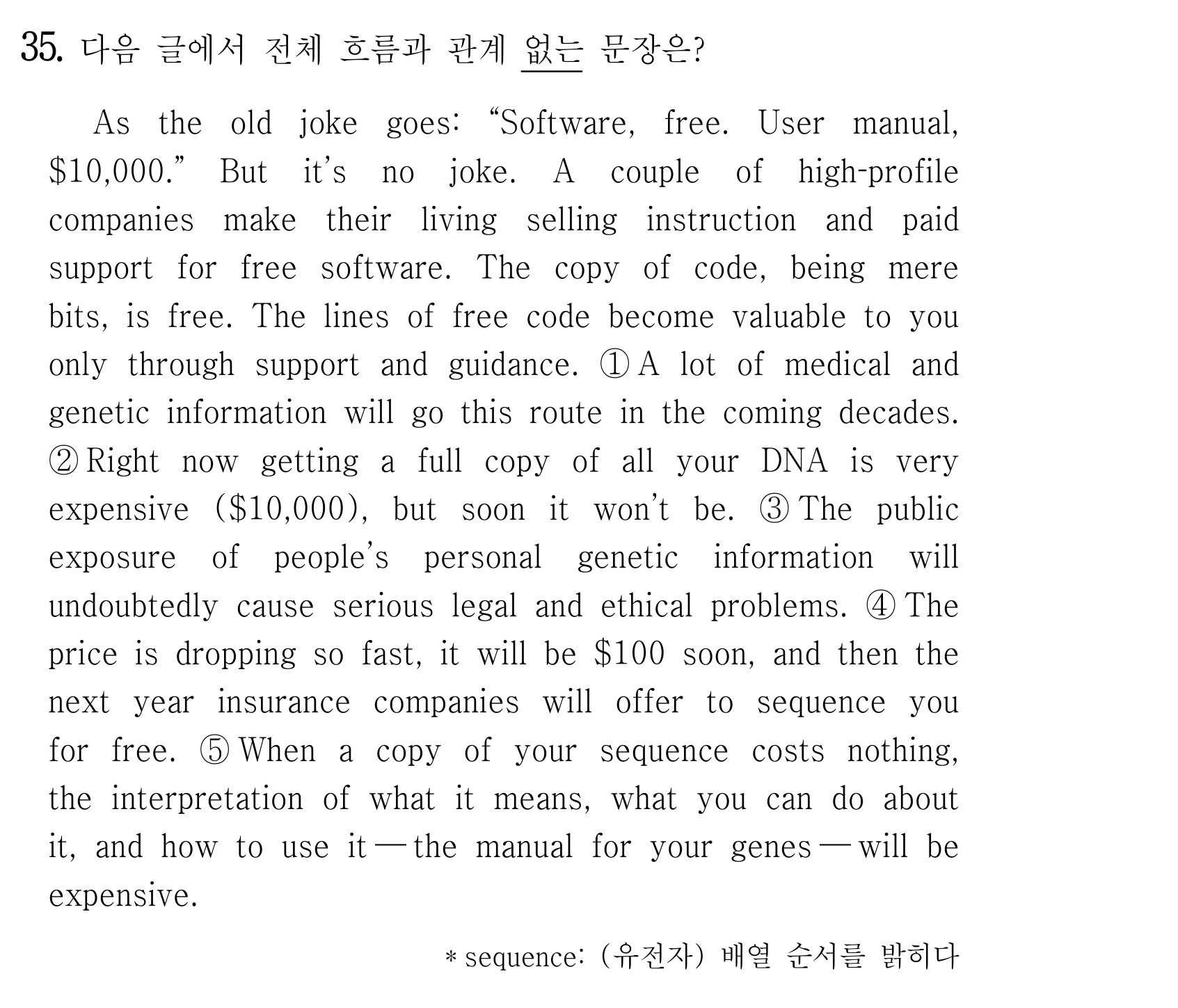
35번무관한문장As the old joke goes: "Software, free.
As the old joke goes: "Software, free. User manual, $10,000." But it's no joke. A couple of high-profile companies make their living selling instruction and paid support for free software. The copy of code, being mere bits, is free. The lines of free code become valuable to you only through support and guidance. A lot of medical and genetic information will go this route in the coming decades. Right now getting a full copy of all your DNA is very expensive ($10,000), but soon it won't be. The price is dropping so fast, it will be $100 soon, and then the next year insurance companies will offer to sequence you for free. When a copy of your sequence costs nothing, the interpretation of what it means, what you can do about it, and how to use it — the manual for your genes — will be expensive.
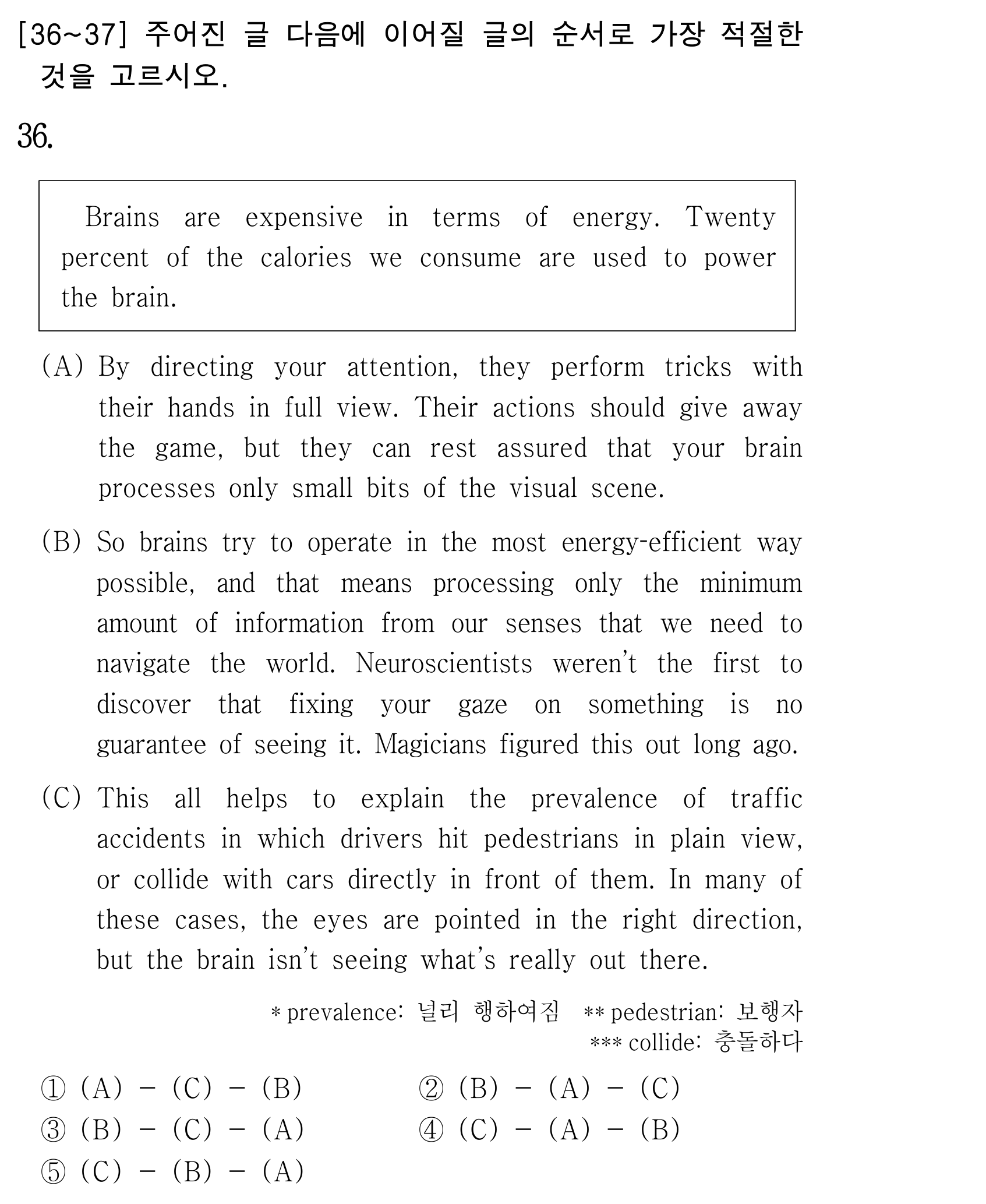
36번순서배열1Brains are expensive in terms of energy.
Brains are expensive in terms of energy. Twenty percent of the calories we consume are used to power the brain. So brains try to operate in the most energy-efficient way possible, and that means processing only the minimum amount of information from our senses that we need to navigate the world. Neuroscientists weren't the first to discover that fixing your gaze on something is no guarantee of seeing it. Magicians figured this out long ago. By directing your attention, they perform tricks with their hands in full view. Their actions should give away the game, but they can rest assured that your brain processes only small bits of the visual scene. This all helps to explain the prevalence of traffic accidents in which drivers hit pedestrians in plain view, or collide with cars directly in front of them. In many of these cases, the eyes are pointed in the right direction, but the brain isn't seeing what's really out there.
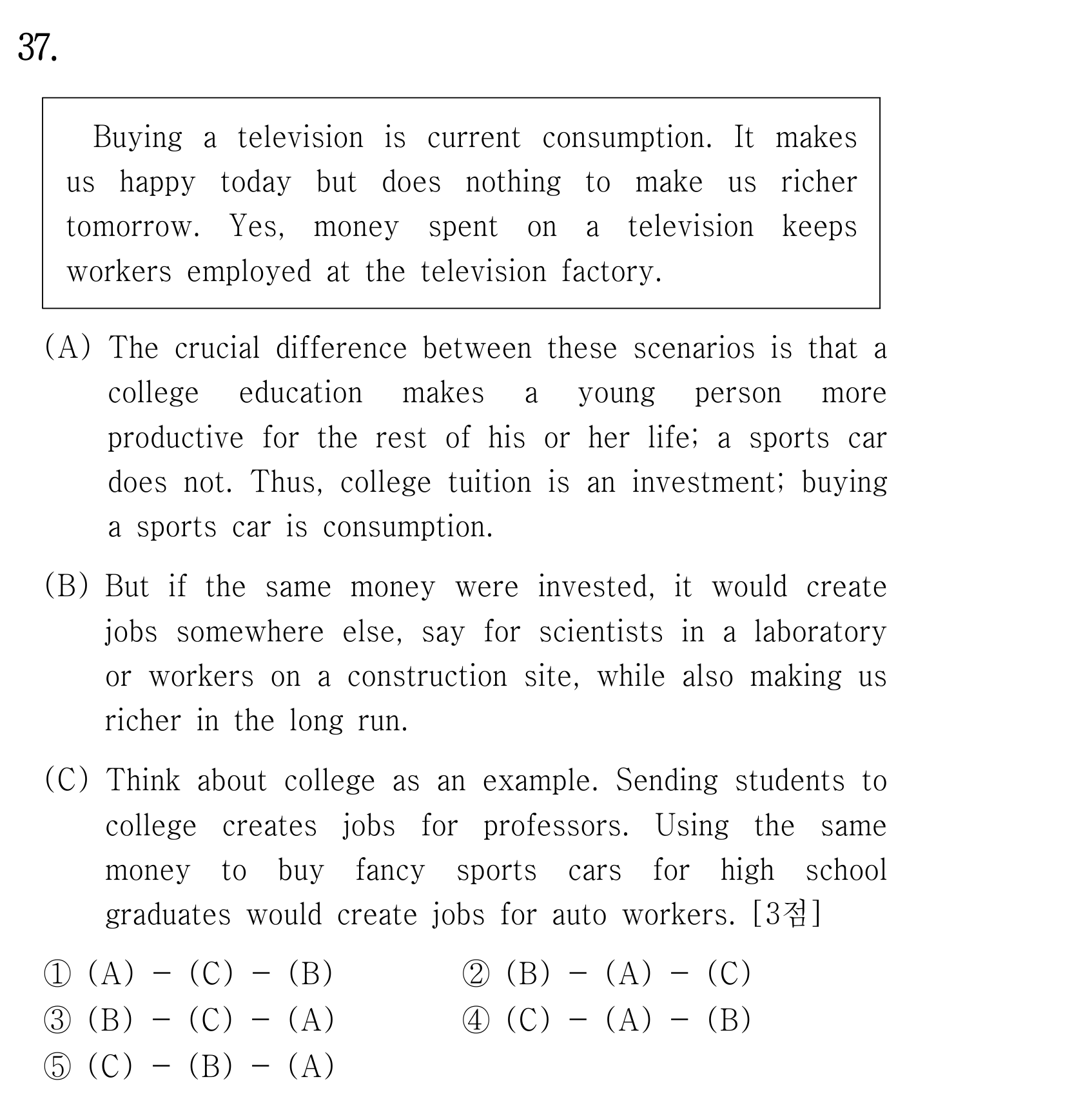
37번순서배열2Buying a television is current consumption.
Buying a television is current consumption. It makes us happy today but does nothing to make us richer tomorrow. Yes, money spent on a television keeps workers employed at the television factory. But if the same money were invested, it would create jobs somewhere else, say for scientists in a laboratory or workers on a construction site, while also making us richer in the long run. Think about college as an example. Sending students to college creates jobs for professors. Using the same money to buy fancy sports cars for high school graduates would create jobs for auto workers. The crucial difference between these scenarios is that a college education makes a young person more productive for the rest of his or her life; a sports car does not. Thus, college tuition is an investment; buying a sports car is consumption.
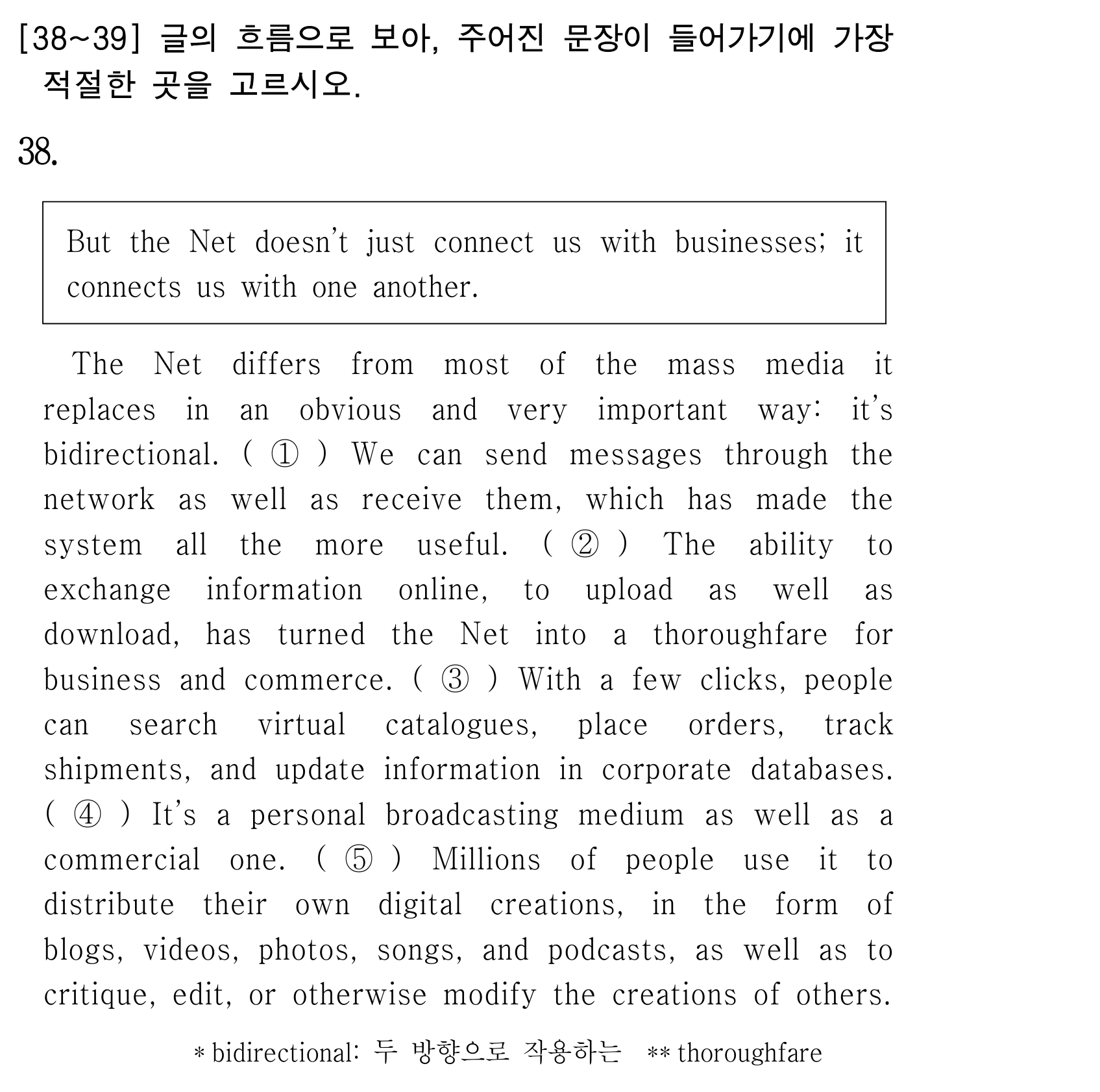
38번문장삽입1The Net differs from most of the mass media it replaces in an obvious and very important…
The Net differs from most of the mass media it replaces in an obvious and very important way: it's bidirectional. We can send messages through the network as well as receive them, which has made the system all the more useful. The ability to exchange information online, to upload as well as download, has turned the Net into a thoroughfare for business and commerce. With a few clicks, people can search virtual catalogues, place orders, track shipments, and update information in corporate databases. But the Net doesn't just connect us with businesses; it connects us with one another. It's a personal broadcasting medium as well as a commercial one. Millions of people use it to distribute their own digital creations, in the form of blogs, videos, photos, songs, and podcasts, as well as to critique, edit, or otherwise modify the creations of others.
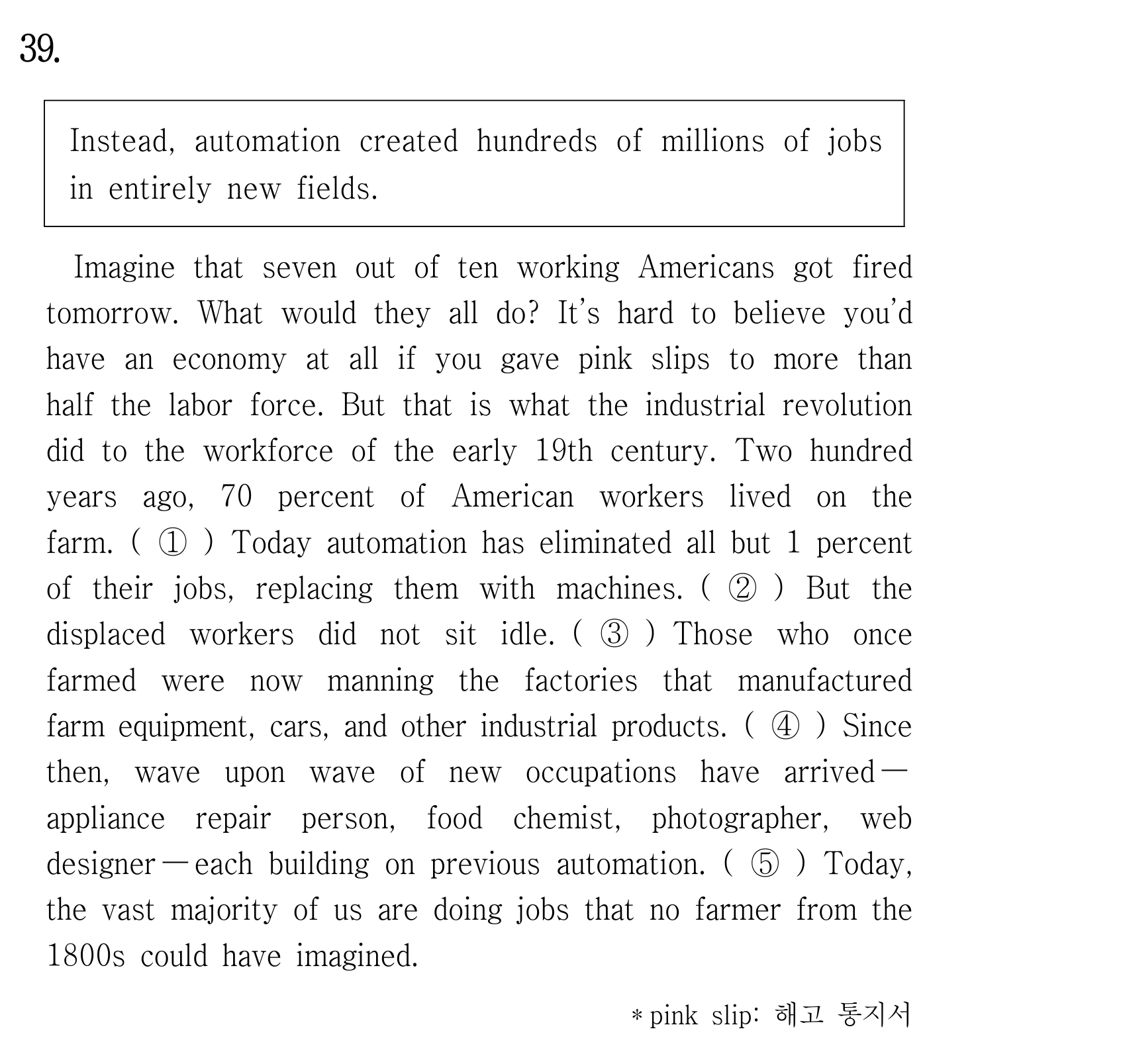
39번문장삽입2Imagine that seven out of ten working Americans got fired tomorrow.
Imagine that seven out of ten working Americans got fired tomorrow. What would they all do? It's hard to believe you'd have an economy at all if you gave pink slips to more than half the labor force. But that is what the industrial revolution did to the workforce of the early 19th century. Two hundred years ago, 70 percent of American workers lived on the farm. Today automation has eliminated all but 1 percent of their jobs, replacing them with machines. But the displaced workers did not sit idle. Instead, automation created hundreds of millions of jobs in entirely new fields. Those who once farmed were now manning the factories that manufactured farm equipment, cars, and other industrial products. Since then, wave upon wave of new occupations have arrived — appliance repair person, food chemist, photographer, web designer — each building on previous automation. Today, the vast majority of us are doing jobs that no farmer from the 1800s could have imagined.
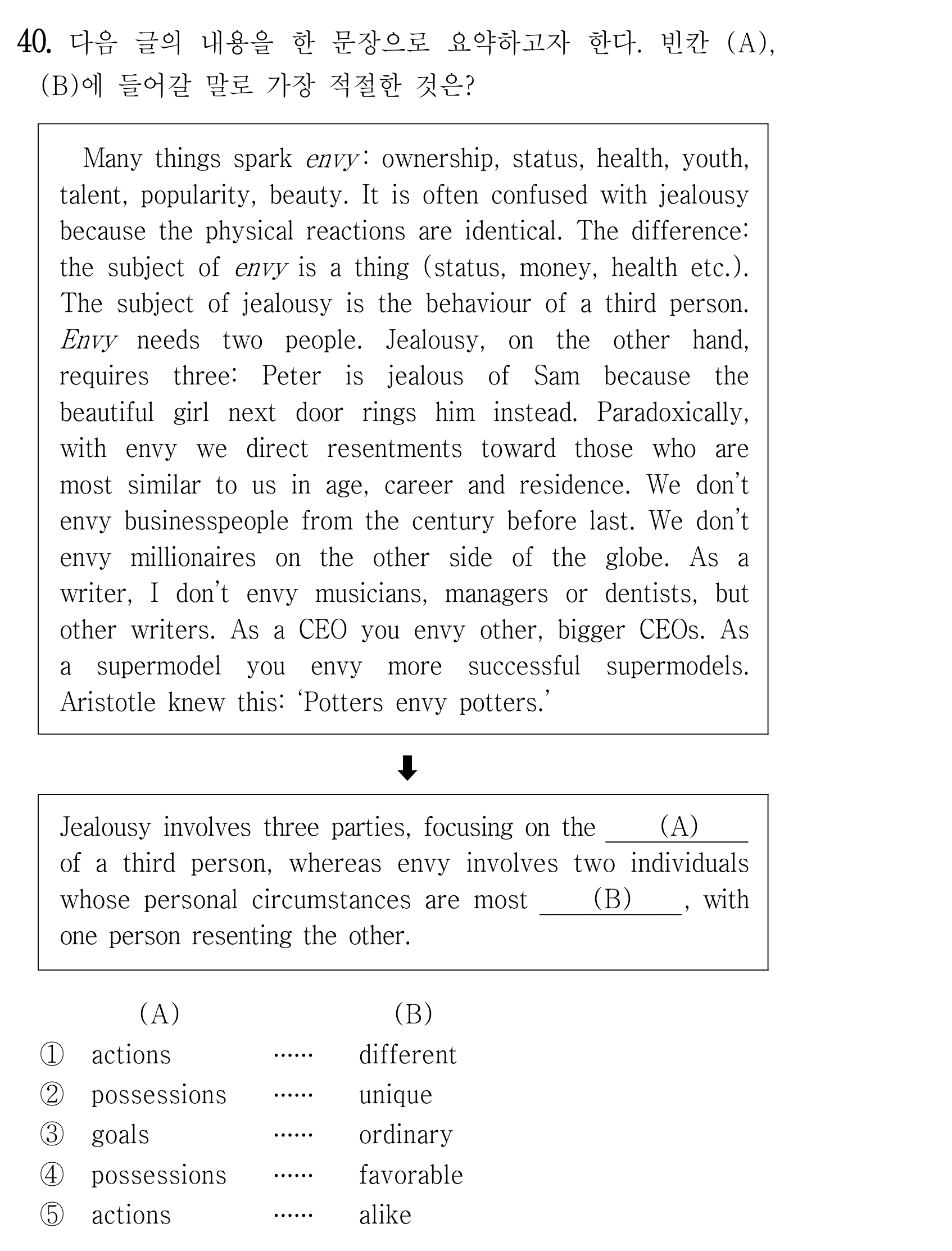
40번요약문완성Many things spark *envy*: ownership, status, health, youth, talent, popularity, beauty.
Many things spark *envy*: ownership, status, health, youth, talent, popularity, beauty. It is often confused with jealousy because the physical reactions are identical. The difference: the subject of *envy* is a thing (status, money, health etc.). The subject of jealousy is the behaviour of a third person. *Envy* needs two people. Jealousy, on the other hand, requires three: Peter is jealous of Sam because the beautiful girl next door rings him instead. Paradoxically, with envy we direct resentments toward those who are most similar to us in age, career and residence. We don't envy businesspeople from the century before last. We don't envy millionaires on the other side of the globe. As a writer, I don't envy musicians, managers or dentists, but other writers. As a CEO you envy other, bigger CEOs. As a supermodel you envy more successful supermodels. Aristotle knew this: 'Potters envy potters.'
Jealousy involves three parties, focusing on the (A) of a third person, whereas envy involves two individuals whose personal circumstances are most (B) , with one person resenting the other.
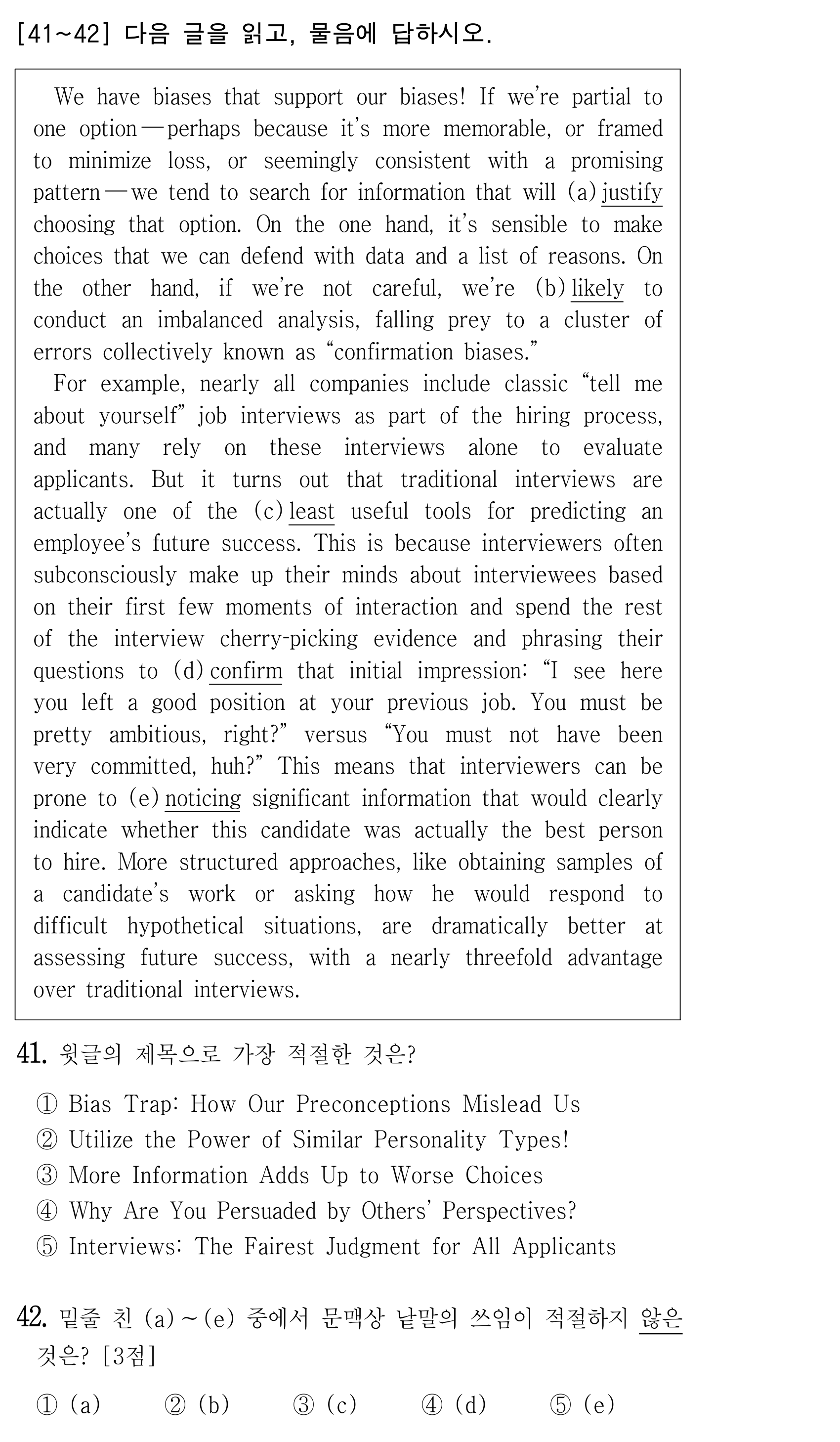
41번장문_제목We have biases that support our biases!
We have biases that support our biases! If we’re partial to one option — perhaps because it’s more memorable, or framed to minimize loss, or seemingly consistent with a promising pattern — we tend to search for information that will (a) justify choosing that option. On the one hand, it’s sensible to make choices that we can defend with data and a list of reasons. On the other hand, if we’re not careful, we’re (b) likely to conduct an imbalanced analysis, falling prey to a cluster of errors collectively known as “confirmation biases.”
For example, nearly all companies include classic “tell me about yourself” job interviews as part of the hiring process, and many rely on these interviews alone to evaluate applicants. But it turns out that traditional interviews are actually one of the (c) least useful tools for predicting an employee’s future success. This is because interviewers often subconsciously make up their minds about interviewees based on their first few moments of interaction and spend the rest of the interview cherry-picking evidence and phrasing their questions to (d) confirm that initial impression: “I see here you left a good position at your previous job. You must be pretty ambitious, right?” versus “You must not have been very committed, huh?” This means that interviewers can be prone to (e) noticing significant information that would clearly indicate whether this candidate was actually the best person to hire. More structured approaches, like obtaining samples of a candidate’s work or asking how he would respond to difficult hypothetical situations, are dramatically better at assessing future success, with a nearly threefold advantage over traditional interviews.
2024년 6월 고2 전국연합 영어 모의고사 변형문제 맛보기
이 시험 지문으로 실제로 만든 변형문제 3문항입니다. 같은 지문으로 유형을 바꿔 더 만들 수 있습니다.
20번 지문 · 어법 변형
다음 글의 밑줄 친 부분 중, 어법상 틀린 것은 모두 몇 개인가?
Most people resist the idea of a true self-estimate, probably because they fear it might mean downgrading some of their beliefs about ①who they are and what they're capable of. As Goethe's maxim goes, it is a great failing "②seeing yourself as more than you are." How could you really be considered self-aware ③if you refuse to consider your weaknesses? Don't fear self-assessment because you're worried you ④might have admitting some things about yourself. The second half of Goethe's maxim ⑤is importantly too. He states that it is equally damaging to "⑥value you at less than your true worth." We underestimate our capabilities just ⑦as much and just as dangerously as we overestimate other abilities. Cultivate the ability to judge yourself accurately and honestly. Look inward to discern what you're capable of and ⑧that it will take to unlock that potential.- ①1개
- ②2개
- ③3개
- ④4개
- ⑤5개
22번 지문 · 빈칸추론1 변형
다음 빈칸에 들어갈 말로 가장 적절한 것은? [3점]
If a firm is going to be saved by the government, it might be easier to concentrate on lobbying the government for more money rather than taking the harder decision of restructuring the company to be able to be profitable and viable in the long term. This is an example of something known as moral hazard — when ________________. For example, if governments rescue banks who get into difficulty, as they did during the credit crisis of 2007-08, this could encourage banks to take greater risks in the future because they know there is a possibility that governments will intervene if they lose money. Although the government rescue may be well intended, it can negatively affect the behavior of banks, encouraging risky and poor decision making.- ①market competition forces companies to innovate
- ②state intervention influences corporate choices
- ③financial institutions prioritize long-term stability
- ④lobbying efforts fail to secure public funds
- ⑤economic crises lead to stricter regulations
32번 지문 · 요지/주장 변형
다음 글의 주제로 가장 적절한 것은?
If we've invested in something that hasn't repaid us — be it money in a failing venture, or time in an unhappy relationship — we find it very difficult to walk away. This is the sunk cost fallacy. Our instinct is to continue investing money or time as we hope that our investment will prove to be worthwhile in the end. Giving up would mean acknowledging that we've wasted something we can't get back, and that thought is so painful that we prefer to avoid it if we can. The problem, of course, is that if something really is a bad bet, then staying with it simply increases the amount we lose. Rather than walk away from a bad five-year relationship, for example, we turn it into a bad 10-year relationship; rather than accept that we've lost a thousand dollars, we lay down another thousand and lose that too. In the end, by delaying the pain of admitting our problem, we only add to it. Sometimes we just have to cut our losses.- ①the psychological benefits of long-term commitment
- ②effective strategies for managing personal finances
- ③the necessity of persistence in failing ventures
- ④the danger of sticking to unprofitable investments
- ⑤how to overcome the fear of making decisions
남은 시간
48:00



아직 28문제를 풀지 않았어요 (0/28)