2026년 10월 고1 전국연합 영어 모의고사
28문제 · 제한시간 48분
이 시험 한눈에 — 2026년 10월 고1 전국연합 영어 모의고사
18~45번 28문항을 유형별로 보면 목적 1 · 심경/분위기 1 · 주장 1 · 함축의미추론 1 · 요지/주장 1 · 주제 1 · 제목 1 · 도표 1 · 내용일치 1 · 실용문 2 · 어법 1 · 어휘 1 · 빈칸추론1 1 · 빈칸추론2 1 · 빈칸추론3 1 · 빈칸추론4 1 · 무관한문장 1 · 순서배열1 1 · 순서배열2 1 · 문장삽입1 1 · 문장삽입2 1 · 요약문완성 1 · 장문 5. 아래 지문으로 변형문제·단어장·정답표를 바로 만들 수 있습니다.
18번목적Dear Ms.
Dear Ms. Palmer, My name is Karen Whitfield, a marketing assistant in the marketing department. As part of my efforts to contribute more to the department, I would like to receive additional training to further develop my skills. Over the last quarter, I noticed our department needs to better attract potential customers for our products online. For this reason, I'm requesting that the company cover part of my training cost. I have recently searched for training courses and found Smart Growth Training's two-week course that focuses on digital marketing strategies. It costs $1,600, and I strongly believe it would be helpful for my current work. I hope you will consider my request positively. Sincerely, Karen Whitfield
19번심경/분위기It was the last day of school before summer vacation.
It was the last day of school before summer vacation. After months of quizzes and assignments, I couldn't wait to leave everything behind. Could anything be sweeter? I practically danced while cleaning out my locker, and nothing could ruin my mood. As I zipped up my backpack, ready to leave, my science teacher, Mr. Manta, called me aside. “Rafe,” he said, “you haven't turned in your final lab report, despite all my warnings this past month.” The words hit me like cold water. He was right, but I totally forgot about it. “To make up for it, you must attend summer school,” he added. Instead of lazy mornings and endless free time, I'd be spending my vacation at a lab table — the last thing I wanted to do with my precious summer.
20번주장We might not think of ourselves as global citizens yet, but it’s both necessary and possi…
We might not think of ourselves as global citizens yet, but it’s both necessary and possible to do so. Some people are skeptical about the idea of global citizenship, but for most of human history, people didn’t think of themselves as citizens of nation-states. After all, for most of human history, nation-states didn’t exist. The rise of nation-states over the last few centuries has led people to add state citizenship to other identities, such as family, people group, or religion. Given the connections between people around the world and the common challenges we face, we need to layer global citizenship on to these other identities. This doesn’t mean that global citizenship replaces these other identities. There’s not a single story about our identities. Instead, it’s precisely because we have obligations to our families, those in our community, and those around the world.
21번함축의미추론밑줄 친 rearranging deck chairs on the Titanic이 다음 글에서 Among unsatisfied professionals, ther…
밑줄 친 rearranging deck chairs on the Titanic이 다음 글에서 Among unsatisfied professionals, there's a repeating theme — the belief that someday (a mysterious day in the future) things will miraculously change and they'll stumble into the perfect job or career. At the same time, they (typically) do little to meaningfully alter their current situation. They don't like their job, so what do they do? They head to job boards and search for roles with a similar job title, hoping that the universe will sprinkle a bit of magic on their career if they just hit the refresh button in a different department or company. Efforts like this make professionals feel like they are doing something, when really they're just setting themselves up to take a new role and quickly become just as disenchanted as they were before. It's like rearranging deck chairs on the Titanic. You've got to completely switch up your approach. If you keep playing the same game, you'll win the same prizes.
22번요지/주장Sociologists argue that our perception and usage of time are not just basic properties of…
Sociologists argue that our perception and usage of time are not just basic properties of nature, like a clock ticking away in the background, nor are they simply psychological phenomena of individual experience. Instead, how we perceive and understand time is to a large degree shaped by tradition and cultural norms. Eviatar Zerubavel’s work, The Seven Day Circle: The History and Meaning of the Week, demonstrates how the week, a fundamental unit of time, is a social invention that varies across cultures, influencing how people structure their activities and rhythms of life. Why do we consider a nine-to-five job routine? Why don’t many of us work on the weekends? Why do we usually pay our bills at the end of the month? Why is the retirement age sixty-five? These numbers and patterns aren’t really dictated by nature or any essential human characteristic, but are rather social creations that we internalize and come to accept as “normal.”
23번주제In recent years, the number of illegal actions in particular at the corporate level has g…
In recent years, the number of illegal actions in particular at the corporate level has grown, or at least the number of cases that came to light, increased. Such misconduct has often only been exposed because brave informants have risked a great deal in order to put an end to it. Hence, it is no surprise that whistleblower protection has come into focus. If violations of law and order go undetected and unpunished for years because employees of a company fear to report illegal activities for fear of reprisals or consequences, it can have several negative effects. It can harm the company itself, but also third-parties, the economy in general, the general public, and even the rule of law could be affected. Protecting those who would assist in reducing unlawful or even criminal behaviour has two main functions: Protecting the individual's actions as well as protecting the public good. A well-balanced whistleblower protection may have positive effects on both of these.
24번제목Unfortunately, sometimes the idea of a goal is disconnected from the daily reality of wha…
Unfortunately, sometimes the idea of a goal is disconnected from the daily reality of what it will take to achieve it. We fall in love with the idea of a goal, pushing out of mind how different our day-to-day will need to be for us to make it happen. In fact, research even suggests that positive fantasies about our future can lead us to put less effort into our goals because our fantasies provide us with a false and premature sense of accomplishment. We romanticize a goal — falling in love with the idea of a change. In the process, we gloss over the intricacies and challenges of integrating a complex new behavior into our life. As one study nicely summed it up, fantasizing about a positive future “seduces a person to mentally enjoy the desired future in the here and now” — and because we don’t reflect on why our fantasy is not yet our future, “a necessity to act is not induced.”
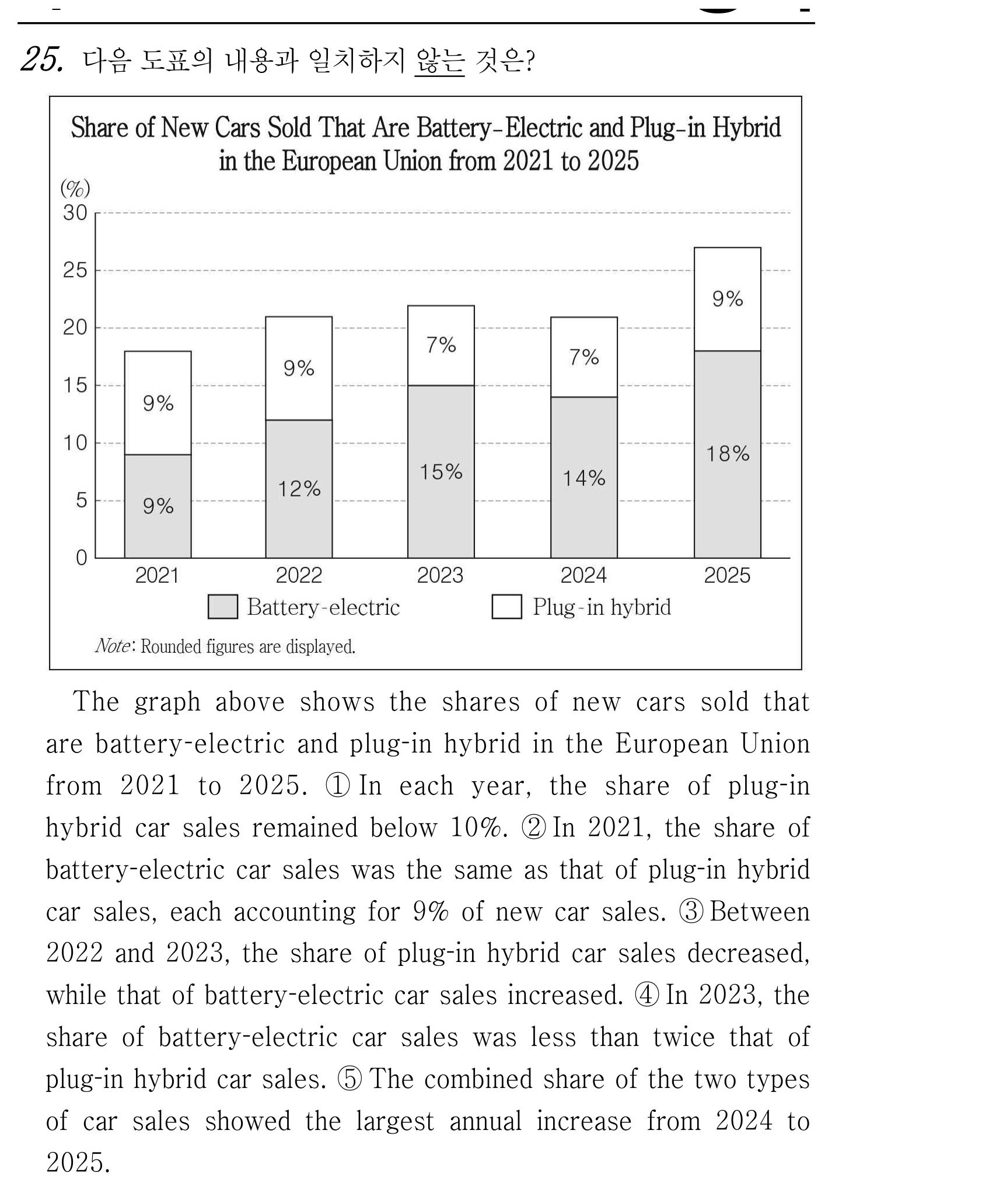
25번도표The graph above shows the shares of new cars sold that are battery-electric and plug-in h…
The graph above shows the shares of new cars sold that are battery-electric and plug-in hybrid in the European Union from 2021 to 2025. ① In each year, the share of plug-in hybrid car sales remained below 10%. ② In 2021, the share of battery-electric car sales was the same as that of plug-in hybrid car sales, each accounting for 9% of new car sales. ③ Between 2022 and 2023, the share of plug-in hybrid car sales decreased, while that of battery-electric car sales increased. ④ In 2023, the share of battery-electric car sales was less than twice that of plug-in hybrid car sales. ⑤ The combined share of the two types of car sales showed the largest annual increase from 2024 to 2025.
26번내용일치Douglas Carl Engelbart was an American engineer and inventor who transformed the field of…
Douglas Carl Engelbart was an American engineer and inventor who transformed the field of human-computer interaction. He was born in Portland, Oregon, in 1925 to a European immigrant family. During World War II, he served as a radar technician in the U.S. Navy in the Philippines. It was during this time that he read an article that influenced his vision of using computers to enhance human abilities and solve complex problems. After serving, he earned master's and doctoral degrees in electrical engineering from the University of California, Berkeley, where he focused on computer-related research. In the 1968 Fall Joint Computer Conference held in San Francisco, he demonstrated his technologies including the computer mouse, which became a monumental event in computer history. For his contributions to computer science, he received the Turing Award in 1997 and the National Medal of Technology three years later.
27번실용문2026 Flona Valley Digital Detox Camp Do you want your kids to take a break from screens?
2026 Flona Valley Digital Detox Camp Do you want your kids to take a break from screens? We offer various digital detox programs for children aged 10 to 14. Help them unplug from their digital devices at our fun camp!
When & Where • November 27-29, 2026 • Flona Valley Park
Programs • Activities: hiking, fishing, campfire cooking, and more • Workshops on building healthy digital habits
Registration • Registration should be made online (www.fvpcamp.org) at least a week before the camp starts. • Fee: $200
Note • Participants must drop off their digital devices at reception. • All participants will receive a medal of completion.
28번실용문2027 Youngpine High School Calendar Design Contest Illustrate a memorable moment in your…
2027 Youngpine High School Calendar Design Contest Illustrate a memorable moment in your school life and share it in the annual Calendar Design Contest! Have your work featured in our 2027 school calendar!
Requirements • Entries are limited to one per student. • Artistic materials such as paint and pastels are accepted. (No digitally produced artworks will be allowed.)
Judging Criteria • Artistic Skill, Creativity, Concept
Prize • 12 winners, one for each month, will be awarded a professional-grade art kit. • Winning artworks will be displayed on the school website.
Submission • Submit your entry to any art teacher by November 20.
29번어법Since hydra and the immortal jellyfish don't exhibit obvious signs of aging, they are oft…
Since hydra and the immortal jellyfish don't exhibit obvious signs of aging, they are often called biologically immortal. This doesn't mean they don't die. Nor does it even mean that they cannot die of biological causes. But, unlike most every animal, their likelihood of dying does not increase with age. Species such as hydra and the immortal jellyfish excite gerontologists because they may provide clues about how to defeat the aging process. But their property of being able to regenerate entire body parts, or even a whole organism, makes them more similar to trees than to us. Although we may learn some fascinating things about their lack of apparent aging, it is not at all clear how relevant those findings will be to human aging. Sometimes biology is universal, especially if it relates to fundamental mechanisms. But in other cases, even discoveries in rats or mice, which are mammals and biologically much closer to us, are difficult to translate into humans. It may be a very long time before any findings gained from hydra or jellyfish are useful to us.
30번어휘Subsidies, taxes, and regulations can all lead to power plants that pollute less by switc…
Subsidies, taxes, and regulations can all lead to power plants that pollute less by switching away from coal. In all cases, profits can be higher from making the transition, even taking the related costs into account. The power plants prefer subsidies over regulations or taxes. The reason is obvious. They prefer to receive money from the government rather than pay the costs themselves. But the “expansion” of their opportunity set through subsidies has to be matched by the contraction of the opportunity set of others. The electricity companies’ “freedom” is increased at the expense of the ordinary individual, who must suffer from increased taxation to pay for the subsidy. Moreover, from the perspective of pure efficiency, the subsidy distorts the economy because the electricity company is not facing the full costs of what it does, even if it is successful in limiting emissions. Indeed, electricity prices may end up lower than they should be and electricity consumption higher, which will worsen global warming, even though the emissions per unit of electricity have been reduced.
31번빈칸추론1Few people may view the Star Trek universe through an economic lens, but doing so provide…
Few people may view the Star Trek universe through an economic lens, but doing so provides a window into a world that might soon be upon us. All of classical economics is based on the notion that there isn't usually enough of anything to give everyone everything they want or need. Because of that, we use markets and pricing to allocate those goods, services, and resources to where they might result in the highest benefit. In Star Trek, however, there isn't much ________. Technology has allowed that society to reproduce any food they want, transport themselves thousands of miles in the blink of an eye, communicate over light-years, and travel among the stars. All of humanity in that world has been fully educated so that they can participate in this prosperity. Everyone is an explorer, researcher, engineer, artist, doctor, or counselor. Generative AI has the potential to allow many dimensions of our own society to be similarly highly abundant.
32번빈칸추론2People, whether customers or otherwise, want to feel heard.
People, whether customers or otherwise, want to feel heard. When someone calls customer service, asks to speak to a manager, or comes into your office with something on their mind, they want to feel like someone is listening to their concerns and going to address them. But for someone to feel heard, three things have to happen. First, they have to feel like the other person paid attention to what they said. Second, they have to feel like the other person understood what they said. And third, the other person has to ________________________. This last part is key. Imagine talking to someone who provided no response. They might have attended to everything we said. They might even have understood it completely. But without some sort of outward signal that indicates they listened, it's impossible to know whether or not they actually did.
33번빈칸추론3The very fact that all of our experiences “take place” in a physical space makes the spac…
The very fact that all of our experiences “take place” in a physical space makes the space inseparable from what defines it, from the event that took place in it. The tree and the ground beneath are inseparable from what took place there. This intertwining of space, place, and experience ____________________. If place and space are central to the very heart of experience, we must accept the possibility that the spatial framework is the medium of all experiences — actions, thoughts, memories, and feelings of every place — not merely a background or context exterior to experience (as commonly supposed). Belgian literary critic Georges Poulet made the point elegantly, writing of the space created in Marcel Proust’s great novel In Search of Lost Time: “Beings surround themselves with the places where they find themselves, the way one wraps oneself up in a garment that is at one and the same time a disguise and a characterization. Without places, beings would be only abstractions.”
34번빈칸추론4No matter how you choose to delineate your evolutionary system of interest — let's say it…
No matter how you choose to delineate your evolutionary system of interest — let's say it's cell phones — there will be some things that your model just needs to take as a given, such as the fact that new ideas emerge at particular times. Indeed, all models must make simplifying assumptions of this nature. When Wallace and Darwin presented their verbal model of biological evolution, there was little knowledge of how variation generation and inheritance worked. They just took as a given that these things happened somehow. Even at the finest level of detail, we need simplifying assumptions. Physicists, for example, must take as a given the mass and charge of fundamental particles. In a model of atomic bonds, physicists don't attempt to explain why electrons have their particular mass and charge, they just accept the measured values and move on. The key point is that we can build useful models at one level of analysis ____________________.
35번무관한문장The recognition of burnout as an occupational phenomenon by the WHO in 2019 marked an imp…
The recognition of burnout as an occupational phenomenon by the WHO in 2019 marked an important moment in the discourse on workplace mental health. This designation reframes clinical assessment and organizational responsibility, shifting attention to systemic prevention. ① It invites employers to adopt structural interventions rather than relying solely on individual-level remedies. ② In practice, this means clinicians should collaborate with occupational health and leadership to address root causes. ③ Individuals can help themselves recover from burnout by changing patterns that contribute to stress. ④ It signaled a shift away from viewing burnout as a personal failing or a matter of individual resilience, toward understanding it as a structural issue rooted in organizational culture, leadership practices, and the broader socio-economic context of work. ⑤ This reframing is essential, as it opens the door to systemic interventions and policy-level changes rather than placing the burden solely on individuals to cope or adapt.
36번순서배열1All sound begins with some kind of motion, something that disturbs molecules in air, wate…
All sound begins with some kind of motion, something that disturbs molecules in air, water, steel, wood, or other medium. Isaac Newton noted that light waves are colorless; the perception of color only occurs in the brain of a living organism.
(A) We can measure that disturbance with gauges and instruments, but until it hits a brain, it is not sound. You may have heard the old philosophical riddle, "If a tree falls in the forest and no one is there to hear it, does it make it sound?" (B) The same is true of sound. Thus perception of sound begins at our eardrums — before it hits our eardrums, it is nothing more than the disturbance of molecules. (C) No, because sound is a psychological concept, a product of brains. That tree will disturb molecules and make a mess, but if no creature hears it, no bird, fox, or human, it has not made sound.
37번순서배열2When people are collaborating face to face they can easily see each other and the range o…
When people are collaborating face to face they can easily see each other and the range of different communication cues being used, so the task space is a subset of the communication space.
(A) So, there is an artificial seam between the communication space and task space. This is the type of impact of remote communication technology that needs to be predicted through communication models. (B) Ishii, a professor at the MIT Media Lab, describes this as seamless communication because there is no functional separation between the task and communication space. However, when people are working remotely, the task space is often separated from the communication space. (C) For example, when video conferencing, people may have the face of their collaborator on one screen, while looking at a shared document on another. In this case, it is impossible to see many of the remote collaborator’s communication cues at the same time as looking at the task space.
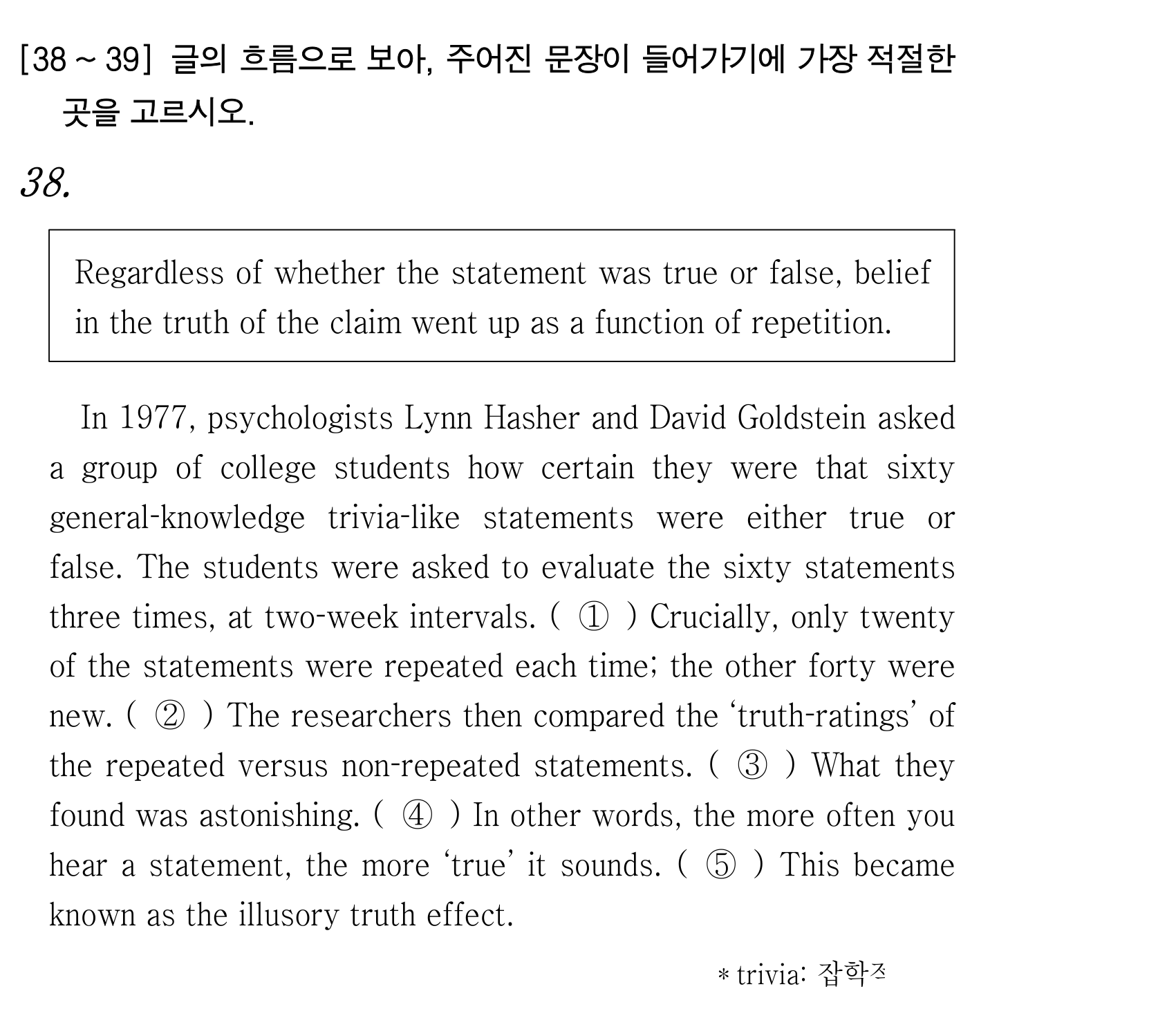
38번문장삽입1Regardless of whether the statement was true or false, belief in the truth of the claim w…
Regardless of whether the statement was true or false, belief in the truth of the claim went up as a function of repetition.
In 1977, psychologists Lynn Hasher and David Goldstein asked a group of college students how certain they were that sixty general-knowledge trivia-like statements were either true or false. The students were asked to evaluate the sixty statements three times, at two-week intervals. ( ① ) Crucially, only twenty of the statements were repeated each time; the other forty were new. ( ② ) The researchers then compared the ‘truth-ratings’ of the repeated versus non-repeated statements. ( ③ ) What they found was astonishing. ( ④ ) In other words, the more often you hear a statement, the more ‘true’ it sounds. ( ⑤ ) This became known as the illusory truth effect.
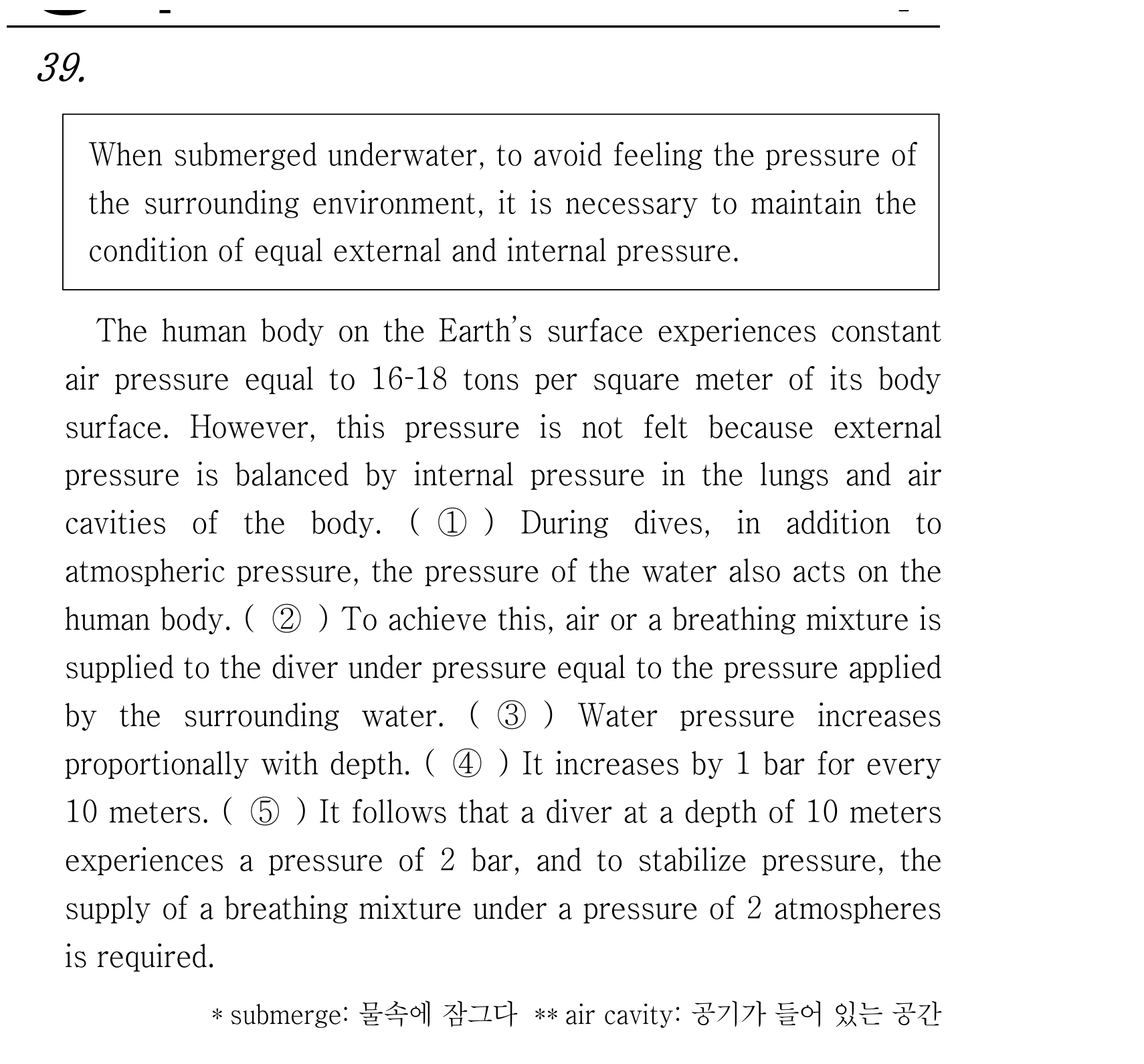
39번문장삽입2When submerged underwater, to avoid feeling the pressure of the surrounding environment,…
When submerged underwater, to avoid feeling the pressure of the surrounding environment, it is necessary to maintain the condition of equal external and internal pressure.
The human body on the Earth's surface experiences constant air pressure equal to 16-18 tons per square meter of its body surface. However, this pressure is not felt because external pressure is balanced by internal pressure in the lungs and air cavities of the body. ( ① ) During dives, in addition to atmospheric pressure, the pressure of the water also acts on the human body. ( ② ) To achieve this, air or a breathing mixture is supplied to the diver under pressure equal to the pressure applied by the surrounding water. ( ③ ) Water pressure increases proportionally with depth. ( ④ ) It increases by 1 bar for every 10 meters. ( ⑤ ) It follows that a diver at a depth of 10 meters experiences a pressure of 2 bar, and to stabilize pressure, the supply of a breathing mixture under a pressure of 2 atmospheres is required.
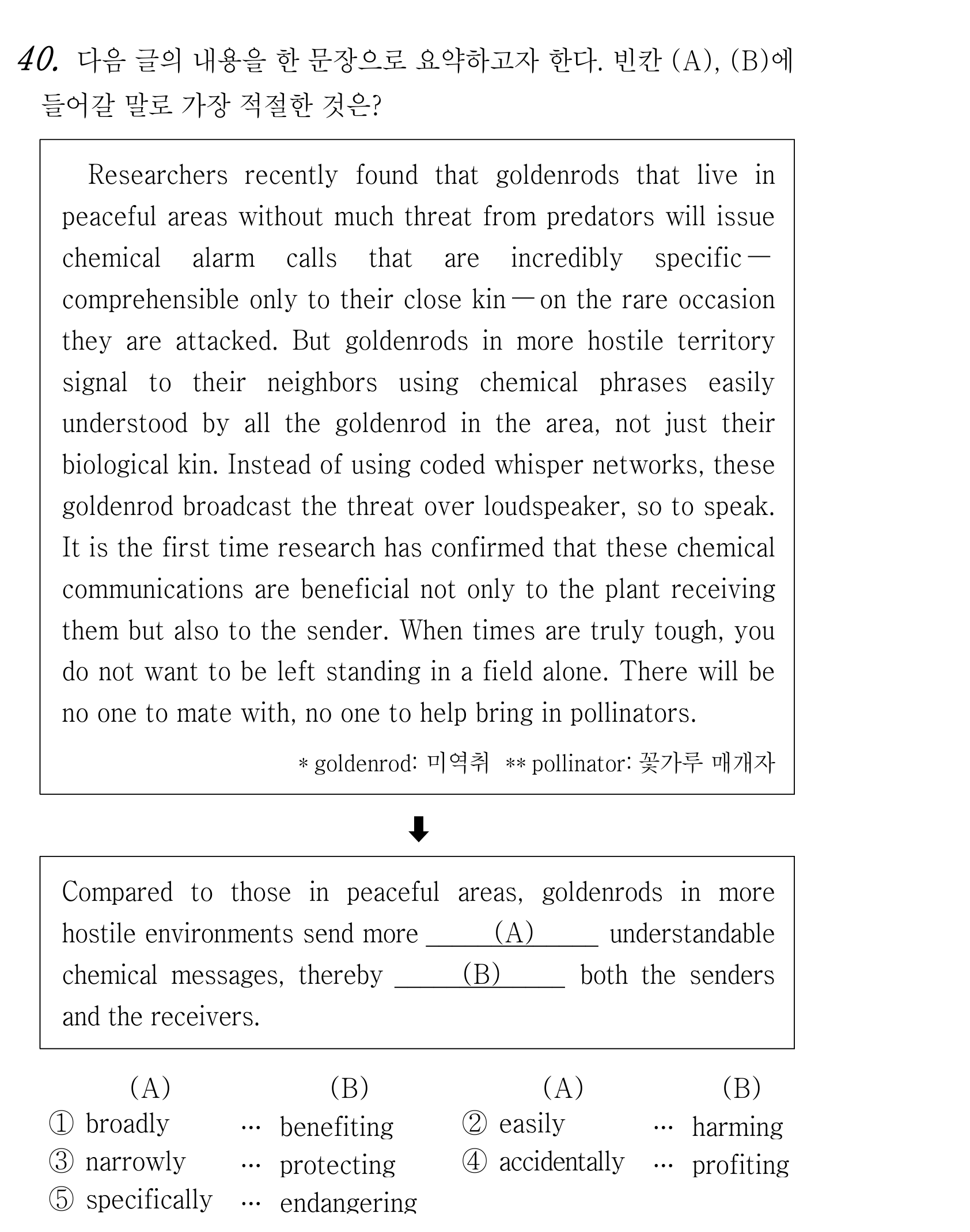
40번요약문완성Researchers recently found that goldenrods that live in peaceful areas without much threa…
Researchers recently found that goldenrods that live in peaceful areas without much threat from predators will issue chemical alarm calls that are incredibly specific — comprehensible only to their close kin — on the rare occasion they are attacked. But goldenrods in more hostile territory signal to their neighbors using chemical phrases easily understood by all the goldenrod in the area, not just their biological kin. Instead of using coded whisper networks, these goldenrod broadcast the threat over loudspeaker, so to speak. It is the first time research has confirmed that these chemical communications are beneficial not only to the plant receiving them but also to the sender. When times are truly tough, you do not want to be left standing in a field alone. There will be no one to mate with, no one to help bring in pollinators.
Compared to those in peaceful areas, goldenrods in more hostile environments send more ________ (A) ________ understandable chemical messages, thereby ________ (B) ________ both the senders and the receivers.
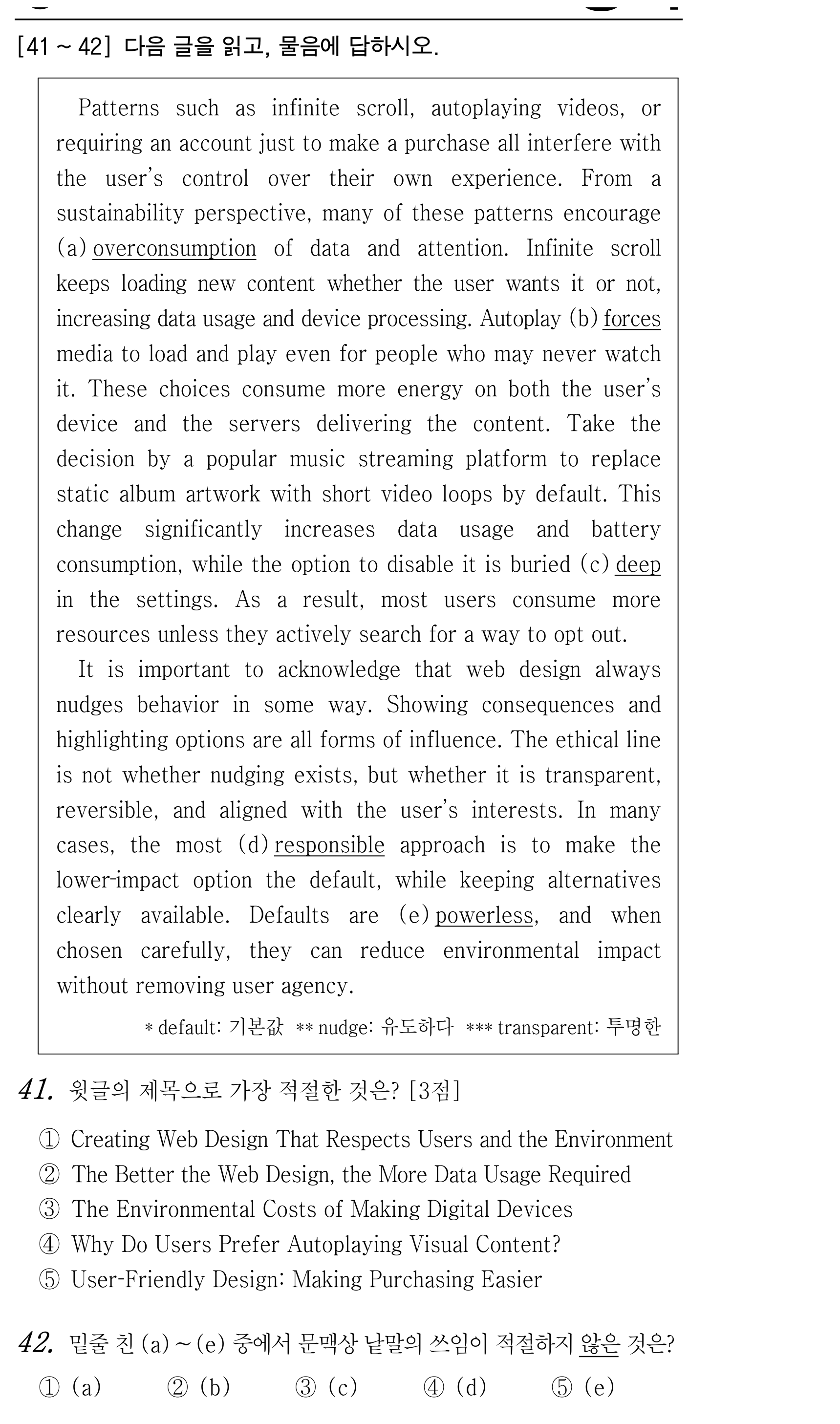
41번장문_제목Patterns such as infinite scroll, autoplaying videos, or requiring an account just to mak…
Patterns such as infinite scroll, autoplaying videos, or requiring an account just to make a purchase all interfere with the user's control over their own experience. From a sustainability perspective, many of these patterns encourage (a) overconsumption of data and attention. Infinite scroll keeps loading new content whether the user wants it or not, increasing data usage and device processing. Autoplay (b) forces media to load and play even for people who may never watch it. These choices consume more energy on both the user's device and the servers delivering the content. Take the decision by a popular music streaming platform to replace static album artwork with short video loops by default. This change significantly increases data usage and battery consumption, while the option to disable it is buried (c) deep in the settings. As a result, most users consume more resources unless they actively search for a way to opt out.
It is important to acknowledge that web design always nudges behavior in some way. Showing consequences and highlighting options are all forms of influence. The ethical line is not whether nudging exists, but whether it is transparent, reversible, and aligned with the user's interests. In many cases, the most (d) responsible approach is to make the lower-impact option the default, while keeping alternatives clearly available. Defaults are (e) powerless, and when chosen carefully, they can reduce environmental impact without removing user agency.
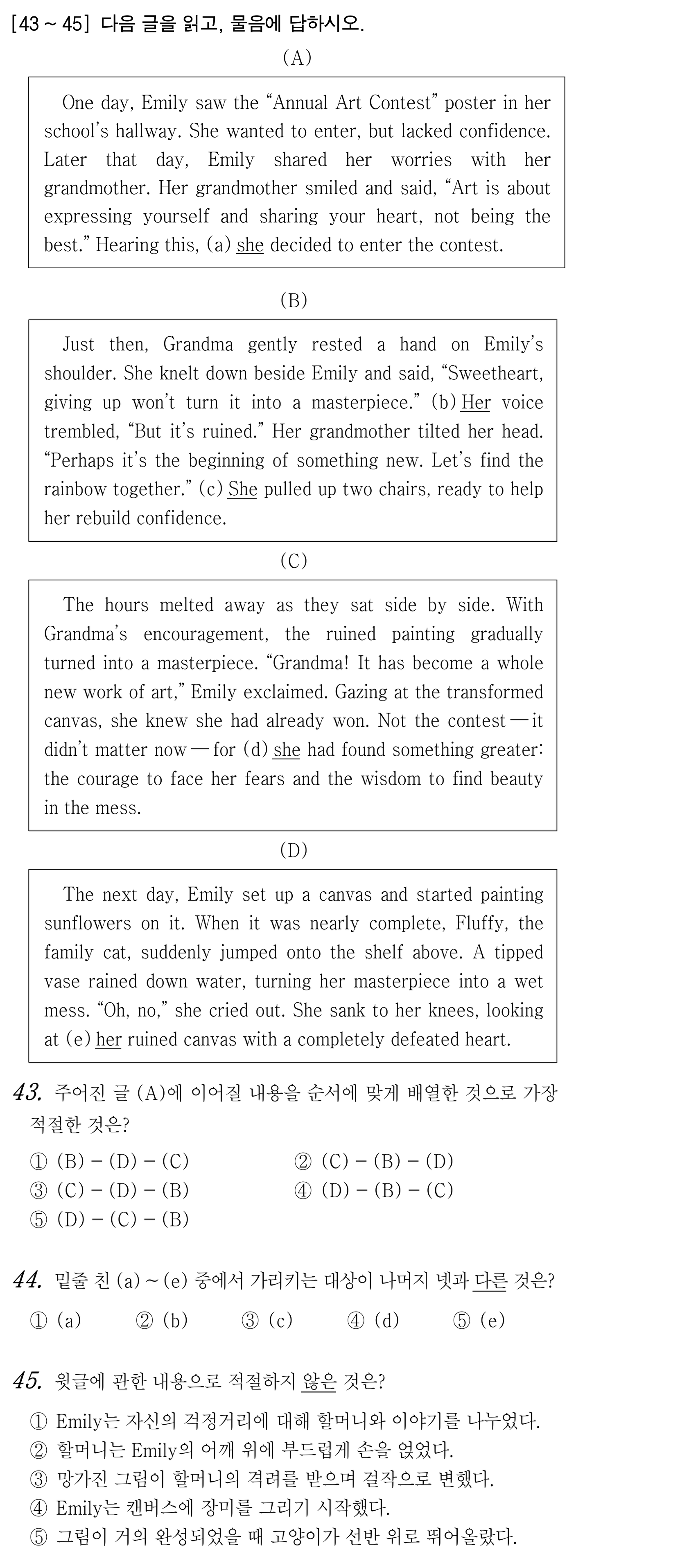
43번장문_순서(A) One day, Emily saw the “Annual Art Contest” poster in her school’s hallway.
(A)
One day, Emily saw the “Annual Art Contest” poster in her school’s hallway. She wanted to enter, but lacked confidence. Later that day, Emily shared her worries with her grandmother. Her grandmother smiled and said, “Art is about expressing yourself and sharing your heart, not being the best.” Hearing this, (a) she decided to enter the contest.
(B)
Just then, Grandma gently rested a hand on Emily’s shoulder. She knelt down beside Emily and said, “Sweetheart, giving up won’t turn it into a masterpiece.” (b) Her voice trembled, “But it’s ruined.” Her grandmother tilted her head. “Perhaps it’s the beginning of something new. Let’s find the rainbow together.” (c) She pulled up two chairs, ready to help her rebuild confidence.
(C)
The hours melted away as they sat side by side. With Grandma’s encouragement, the ruined painting gradually turned into a masterpiece. “Grandma! It has become a whole new work of art,” Emily exclaimed. Gazing at the transformed canvas, she knew she had already won. Not the contest — it didn’t matter now — for (d) she had found something greater: the courage to face her fears and the wisdom to find beauty in the mess.
(D)
The next day, Emily set up a canvas and started painting sunflowers on it. When it was nearly complete, Fluffy, the family cat, suddenly jumped onto the shelf above. A tipped vase rained down water, turning her masterpiece into a wet mess. “Oh, no,” she cried out. She sank to her knees, looking at (e) her ruined canvas with a completely defeated heart.
2026년 10월 고1 전국연합 영어 모의고사 변형문제 맛보기
이 시험 지문으로 만든 변형문제가 아직 없습니다. 지문을 고르면 어법·빈칸·주제·어휘 등 유형별 변형문제를 바로 만들 수 있습니다.
이 시험으로 첫 변형문제 만들기 →남은 시간
48:00
아직 28문제를 풀지 않았어요 (0/28)