2025년 7월 고3 모의고사
28문제 · 제한시간 48분
이 시험 한눈에 — 2025년 7월 고3 모의고사
18~45번 28문항을 유형별로 보면 목적 1 · 심경/분위기 1 · 주장 1 · 함축의미추론 1 · 요지/주장 1 · 주제 1 · 제목 1 · 도표 1 · 내용일치 1 · 실용문 1 · 어법 2 · 어휘 1 · 빈칸추론2 1 · 빈칸추론3 1 · 빈칸추론4 1 · 빈칸추론5 1 · 무관한문장 1 · 순서배열1 1 · 순서배열2 1 · 문장삽입1 1 · 문장삽입2 1 · 요약문완성 1 · 장문 5. 아래 지문으로 변형문제·단어장·정답표를 바로 만들 수 있습니다.
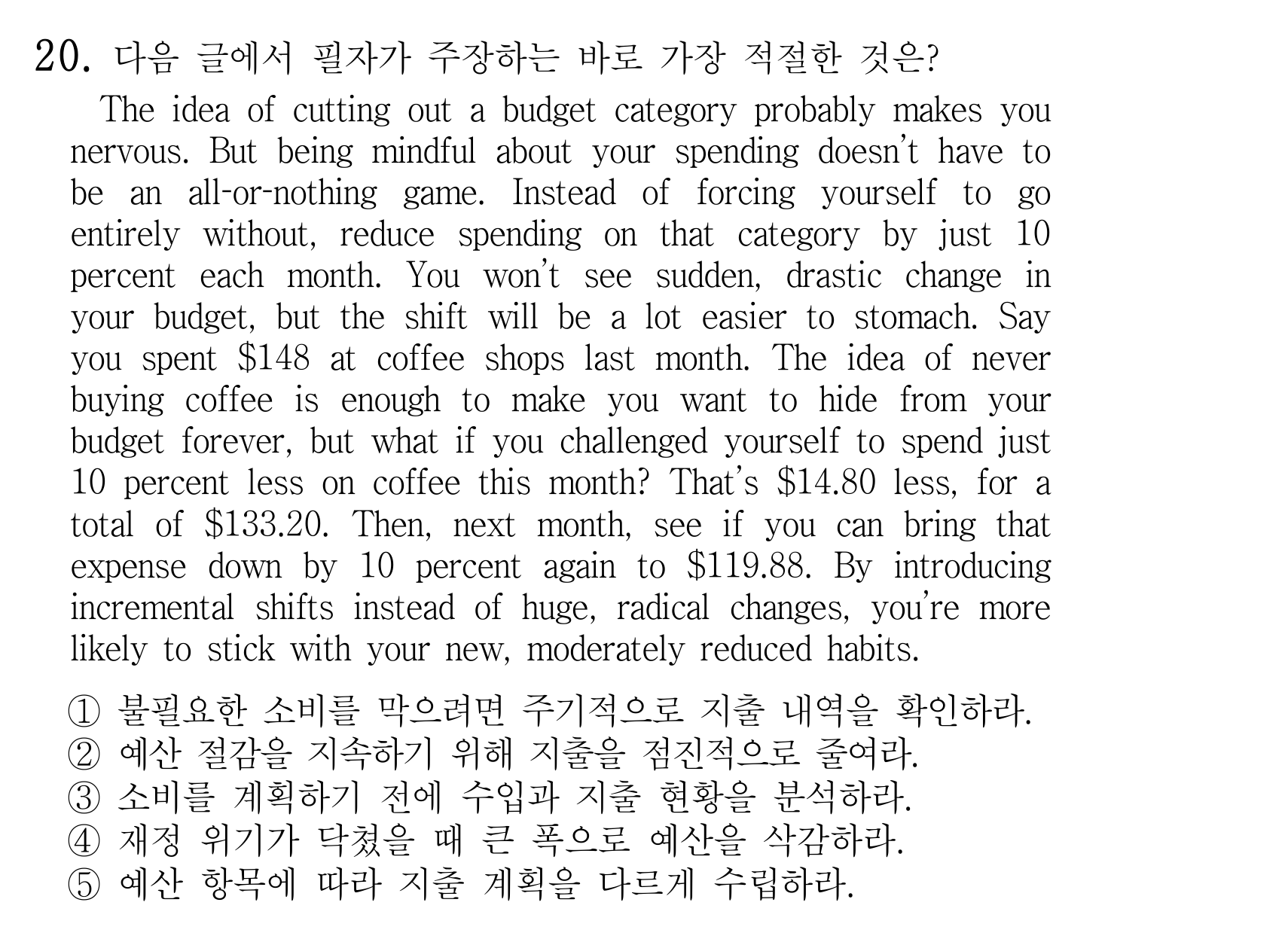
20번주장The idea of cutting out a budget category probably makes you nervous.
The idea of cutting out a budget category probably makes you nervous. But being mindful about your spending doesn't have to be an all-or-nothing game. Instead of forcing yourself to go entirely without, reduce spending on that category by just 10 percent each month. You won't see sudden, drastic change in your budget, but the shift will be a lot easier to stomach. Say you spent $148 at coffee shops last month. The idea of never buying coffee is enough to make you want to hide from your budget forever, but what if you challenged yourself to spend just 10 percent less on coffee this month? That's $14.80 less, for a total of $133.20. Then, next month, see if you can bring that expense down by 10 percent again to $119.88. By introducing incremental shifts instead of huge, radical changes, you're more likely to stick with your new, moderately reduced habits.
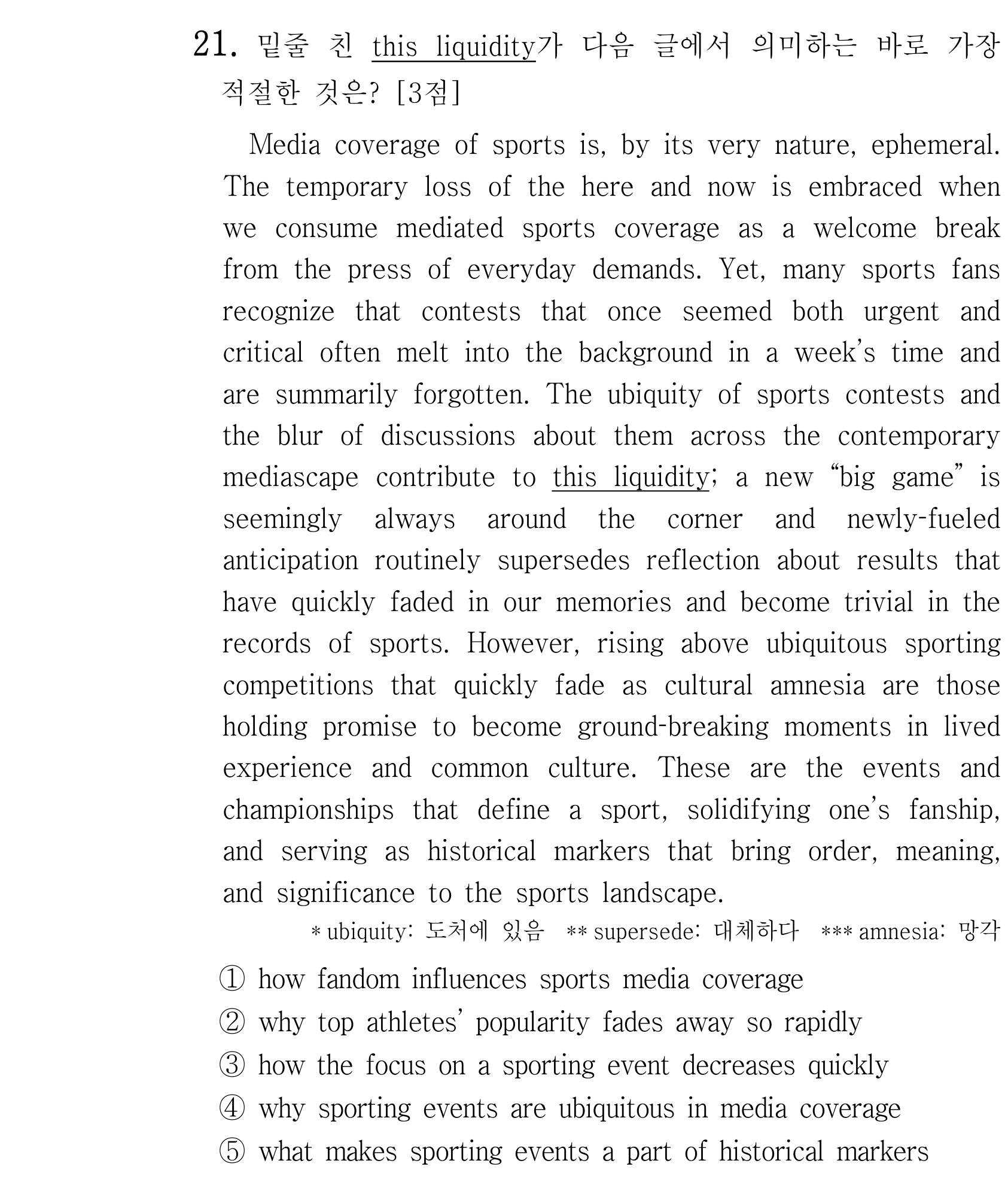
21번함축의미추론Media coverage of sports is, by its very nature, ephemeral.
Media coverage of sports is, by its very nature, ephemeral. The temporary loss of the here and now is embraced when we consume mediated sports coverage as a welcome break from the press of everyday demands. Yet, many sports fans recognize that contests that once seemed both urgent and critical often melt into the background in a week's time and are summarily forgotten. The ubiquity of sports contests and the blur of discussions about them across the contemporary mediascape contribute to this liquidity; a new "big game" is seemingly always around the corner and newly-fueled anticipation routinely supersedes reflection about results that have quickly faded in our memories and become trivial in the records of sports. However, rising above ubiquitous sporting competitions that quickly fade as cultural amnesia are those holding promise to become ground-breaking moments in lived experience and common culture. These are the events and championships that define a sport, solidifying one's fanship, and serving as historical markers that bring order, meaning, and significance to the sports landscape.
22번요지/주장Making your marketing fun for customers is what makes them tell other people about you.
Making your marketing fun for customers is what makes them tell other people about you. This is the basis of viral marketing — the word of mouth that ultimately generates more business than all the advertising campaigns put together. Humor is good, but something that encourages customers to pass on messages to friends, business colleagues, family, and indeed anyone else will result in stronger customers' perception of your brand and increased awareness of what your company is all about. The message need not be too serious, either, or indeed be an overt marketing plug. Just passing the brand name along, and having it associated with something entertaining and fun, is quite sufficient. Your other marketing promotions will fill in the gaps, and anyway no single promotion will ever cover all the communication you want it to — the best you can hope for is that one communication will sensitize the customers to receiving a later one.
23번주제The prevalence of diseases among wild animals can be compared to an iceberg.
The prevalence of diseases among wild animals can be compared to an iceberg. It is only its top that appears visible to us, an insignificant fraction of its total volume. There are two main causes that converge to bring about this scenario. First, until very recently, research on wild animal disease has been an underestimated field of inquiry. Wild animal disease is thought to be relevant only inasmuch as it proves instrumental in bettering our knowledge about treatment of diseases affecting human and domestic populations. Second, disease is a fundamentally surreptitious phenomenon, often resulting from many factors interacting simultaneously. Unlike humans and other animals under human control, wild animals are anonymous. We can make estimations about their numbers and whereabouts, but we do not have accurate records of them. In addition, sick and dead animals are quickly assimilated into the environment by predators and scavengers. As a consequence, the results of wild animal death caused by disease remain, for the most part, hidden from us.
24번제목What sets off literary works from other narrative display texts is that they have undergo…
What sets off literary works from other narrative display texts is that they have undergone a process of selection: they have been published, reviewed, and reprinted, so that readers approach them with the assurance that others have found them well constructed and ‘worth it’. So for literary works, the cooperative principle is ‘hyper-protected’. We can put up with many obscurities and apparent irrelevancies, without assuming that this makes no sense. Readers assume that in literature complications of language ultimately have a communicative purpose and, instead of imagining that the speaker or writer is being uncooperative, as they might in other speech contexts, they struggle to interpret elements that flout principles of efficient communication in the interests of some further communicative goal. ‘Literature’ is an institutional label that gives us reason to expect that the results of our reading efforts will be ‘worth it’. And many of the features of literature follow from the willingness of readers to pay attention, to explore uncertainties, and not immediately ask ‘what do you mean by that?’
29번어법There is a kind of artificial intelligence application that is frequently advertised, whi…
There is a kind of artificial intelligence application that is frequently advertised, which can be described as “vaporware”. Vaporware is applications that have either been announced or made available for sale but are not yet fully functional as artificial intelligence applications. It is often systems that seem to run on artificial intelligence technologies, but which in fact do not. Instead, they are frequently built by people manually adding the content that the artificial intelligence application is supposed to be processing. This is frequently done because initially it is cheaper to pay people to add this content than it is to develop full artificial intelligence capabilities and populate the data. Vaporware can be used for many reasons. Sometimes a product may start to be sold before it is fully developed. Taking a vaporware product to market means developers can validate ideas with customers before investing the amounts required to build a full application, allowing for more flexibility in development and for more time to build data.
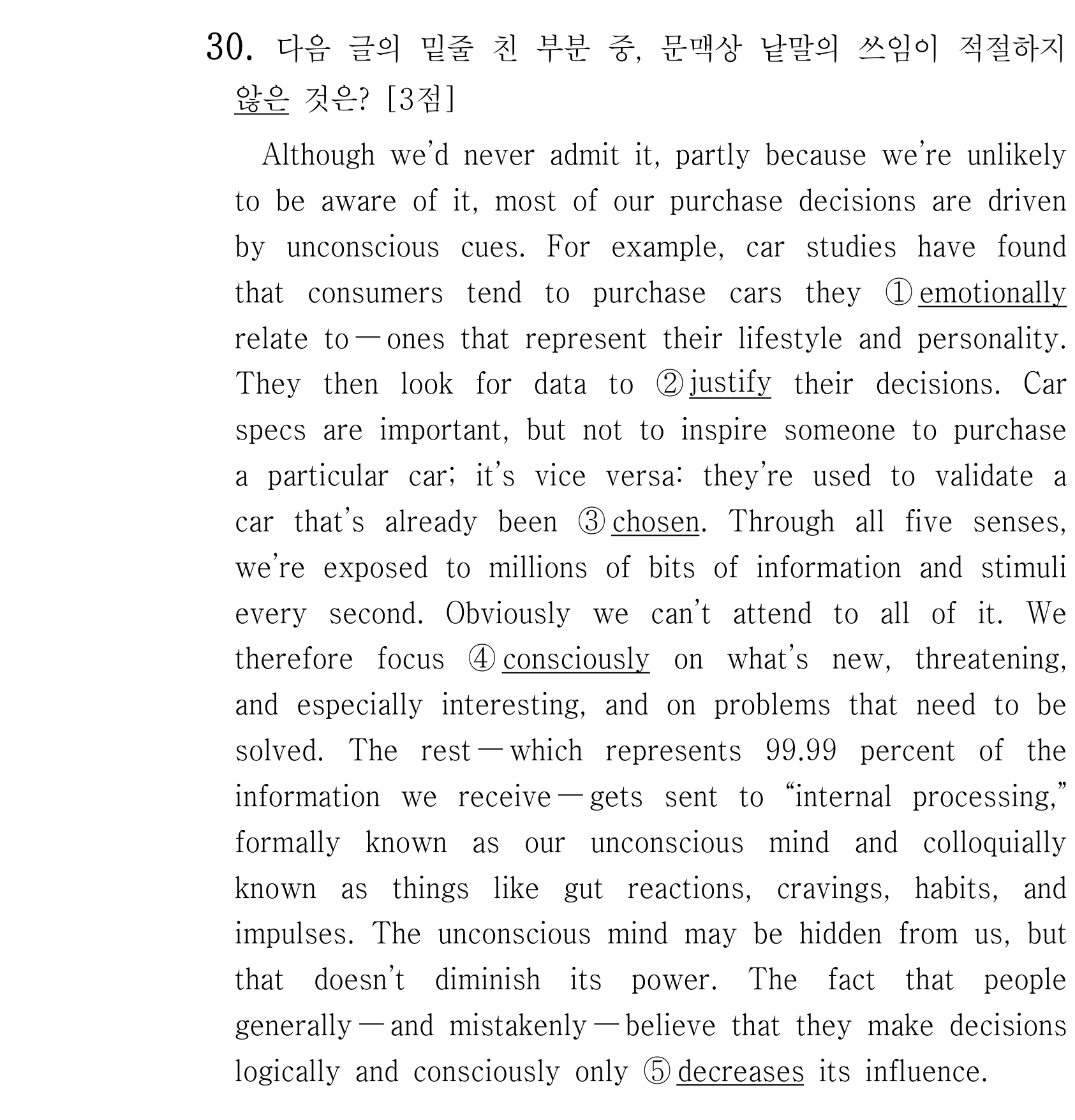
30번어휘Although we’d never admit it, partly because we’re unlikely to be aware of it, most of ou…
Although we’d never admit it, partly because we’re unlikely to be aware of it, most of our purchase decisions are driven by unconscious cues. For example, car studies have found that consumers tend to purchase cars they emotionally relate to — ones that represent their lifestyle and personality. They then look for data to justify their decisions. Car specs are important, but not to inspire someone to purchase a particular car; it’s vice versa: they’re used to validate a car that’s already been chosen. Through all five senses, we’re exposed to millions of bits of information and stimuli every second. Obviously we can’t attend to all of it. We therefore focus consciously on what’s new, threatening, and especially interesting, and on problems that need to be solved. The rest — which represents 99.99 percent of the information we receive — gets sent to “internal processing,” formally known as our unconscious mind and colloquially known as things like gut reactions, cravings, habits, and impulses. The unconscious mind may be hidden from us, but that doesn’t diminish its power. The fact that people generally — and mistakenly — believe that they make decisions logically and consciously only increases its influence.
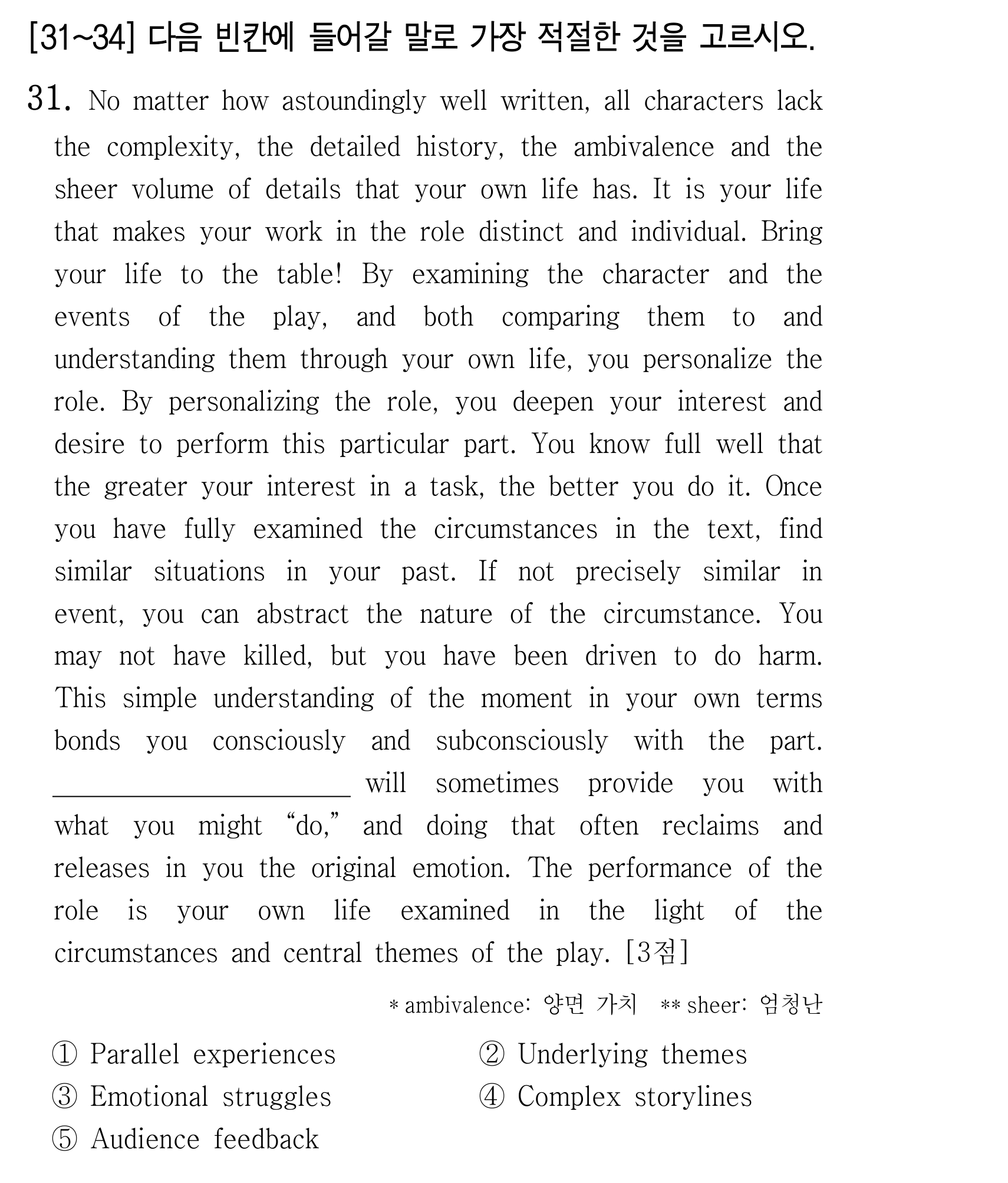
31번빈칸추론2No matter how astoundingly well written, all characters lack the complexity, the detailed…
No matter how astoundingly well written, all characters lack the complexity, the detailed history, the ambivalence and the sheer volume of details that your own life has. It is your life that makes your work in the role distinct and individual. Bring your life to the table! By examining the character and the events of the play, and both comparing them to and understanding them through your own life, you personalize the role. By personalizing the role, you deepen your interest and desire to perform this particular part. You know full well that the greater your interest in a task, the better you do it. Once you have fully examined the circumstances in the text, find similar situations in your past. If not precisely similar in event, you can abstract the nature of the circumstance. You may not have killed, but you have been driven to do harm. This simple understanding of the moment in your own terms bonds you consciously and subconsciously with the part. Parallel experiences will sometimes provide you with what you might “do,” and doing that often reclaims and releases in you the original emotion. The performance of the role is your own life examined in the light of the circumstances and central themes of the play.
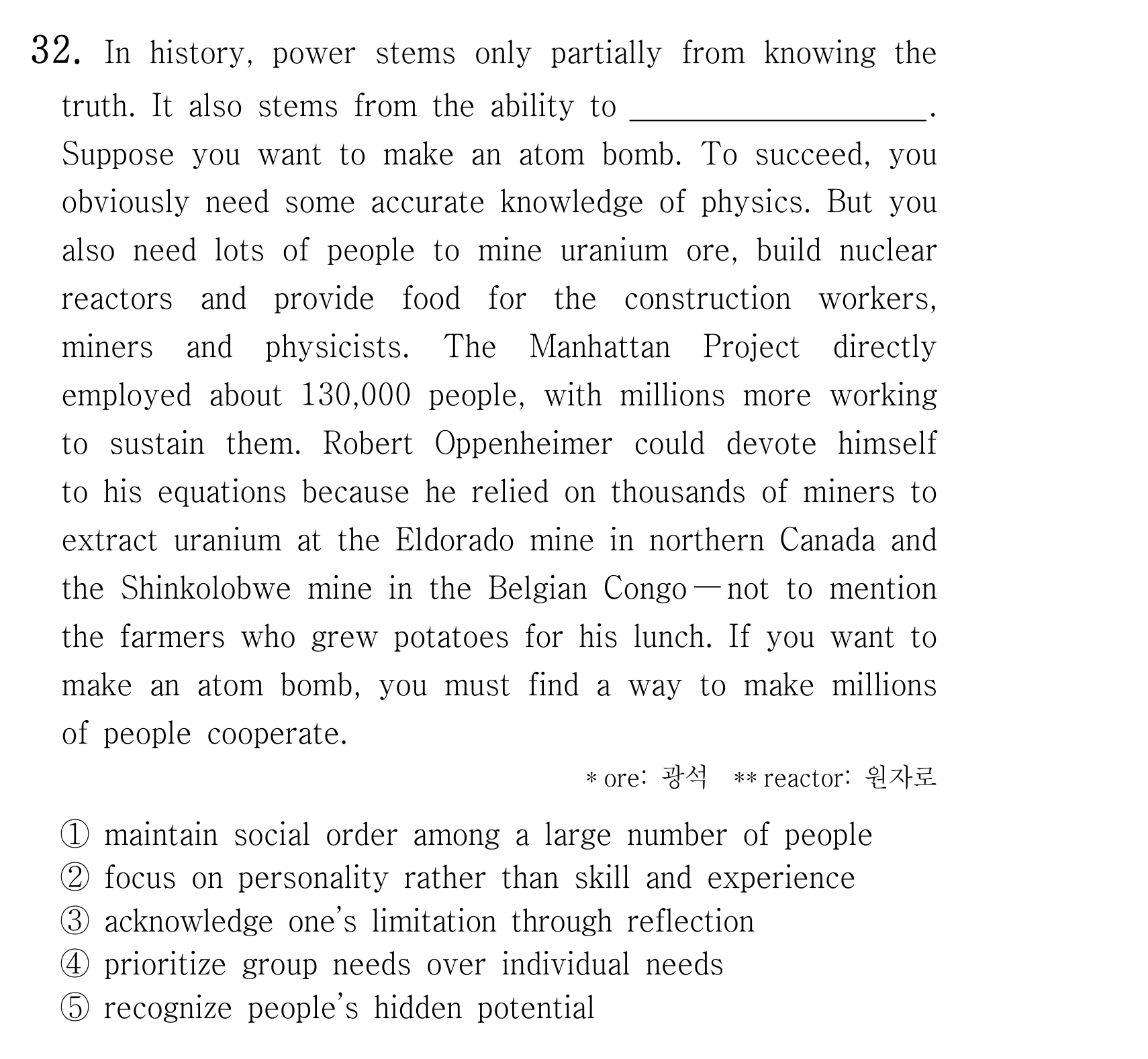
32번빈칸추론3In history, power stems only partially from knowing the truth.
In history, power stems only partially from knowing the truth. It also stems from the ability to maintain social order among a large number of people. Suppose you want to make an atom bomb. To succeed, you obviously need some accurate knowledge of physics. But you also need lots of people to mine uranium ore, build nuclear reactors and provide food for the construction workers, miners and physicists. The Manhattan Project directly employed about 130,000 people, with millions more working to sustain them. Robert Oppenheimer could devote himself to his equations because he relied on thousands of miners to extract uranium at the Eldorado mine in northern Canada and the Shinkolobwe mine in the Belgian Congo — not to mention the farmers who grew potatoes for his lunch. If you want to make an atom bomb, you must find a way to make millions of people cooperate.
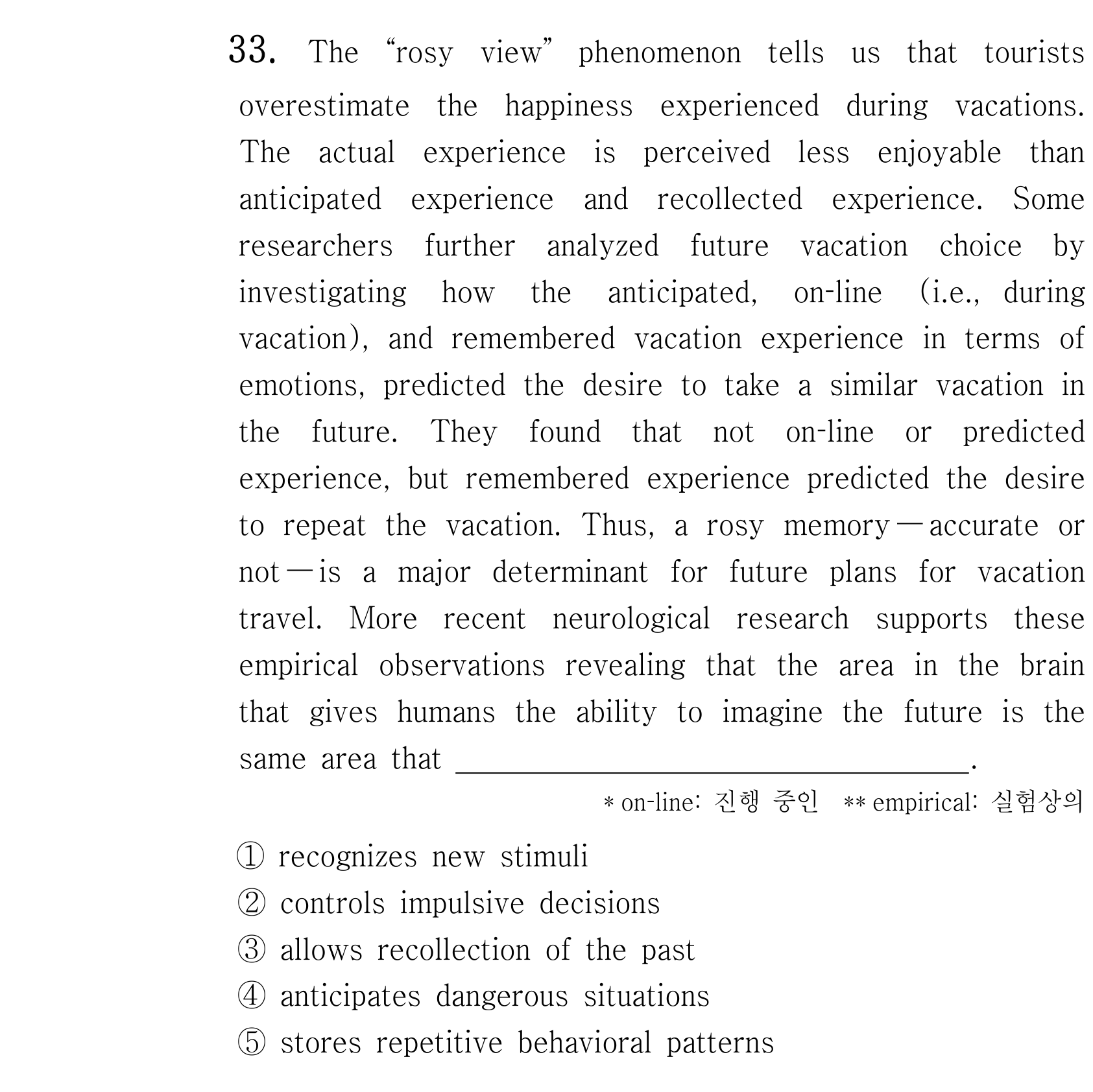
33번빈칸추론4The “rosy view” phenomenon tells us that tourists overestimate the happiness experienced…
The “rosy view” phenomenon tells us that tourists overestimate the happiness experienced during vacations. The actual experience is perceived less enjoyable than anticipated experience and recollected experience. Some researchers further analyzed future vacation choice by investigating how the anticipated, on-line (i.e., during vacation), and remembered vacation experience in terms of emotions, predicted the desire to take a similar vacation in the future. They found that not on-line or predicted experience, but remembered experience predicted the desire to repeat the vacation. Thus, a rosy memory—accurate or not—is a major determinant for future plans for vacation travel. More recent neurological research supports these empirical observations revealing that the area in the brain that gives humans the ability to imagine the future is the same area that .
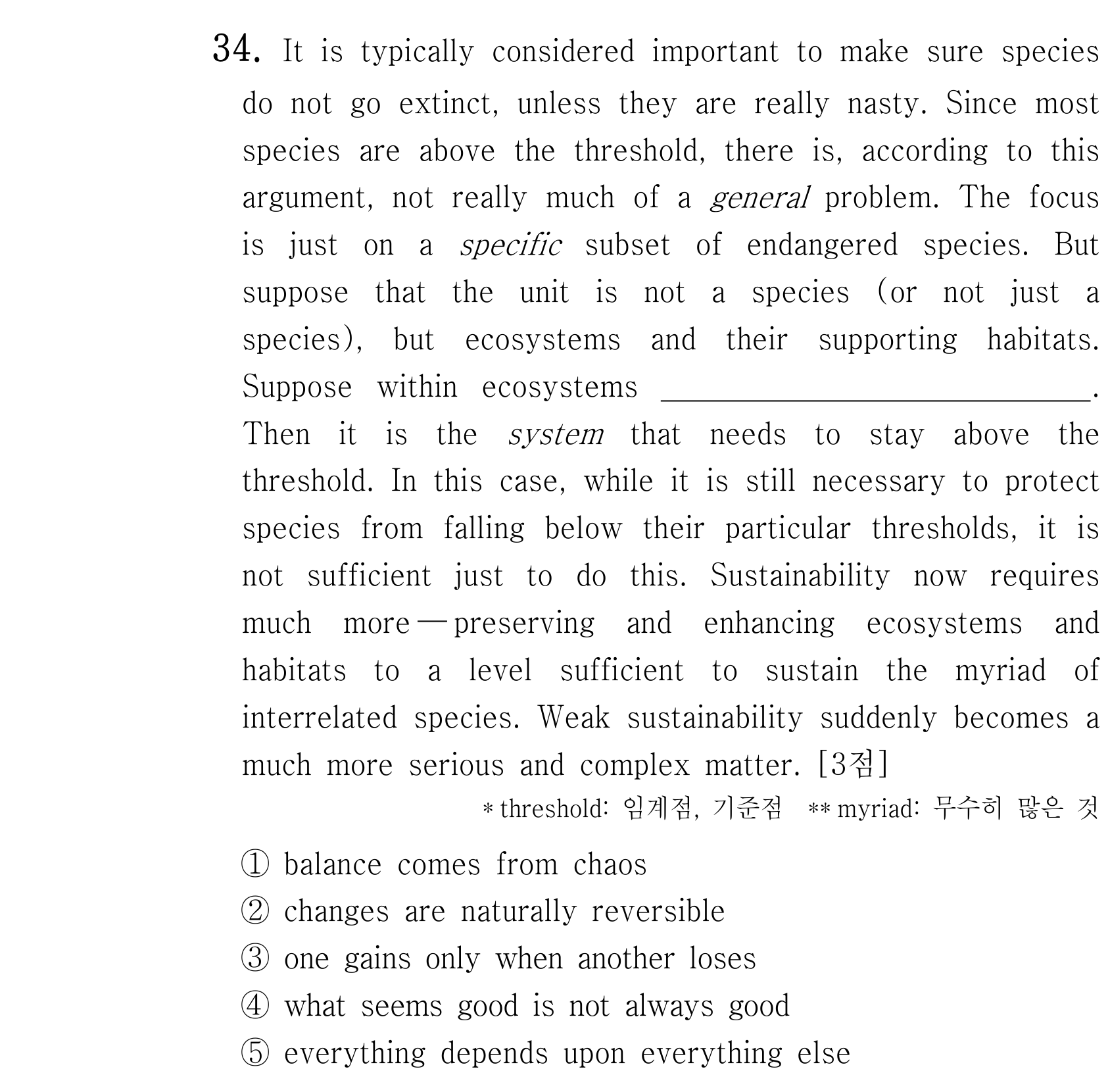
34번빈칸추론5It is typically considered important to make sure species do not go extinct, unless they…
It is typically considered important to make sure species do not go extinct, unless they are really nasty. Since most species are above the threshold, there is, according to this argument, not really much of a *general* problem. The focus is just on a *specific* subset of endangered species. But suppose that the unit is not a species (or not just a species), but ecosystems and their supporting habitats. Suppose within ecosystems everything depends upon everything else. Then it is the *system* that needs to stay above the threshold. In this case, while it is still necessary to protect species from falling below their particular thresholds, it is not sufficient just to do this. Sustainability now requires much more — preserving and enhancing ecosystems and habitats to a level sufficient to sustain the myriad of interrelated species. Weak sustainability suddenly becomes a much more serious and complex matter.
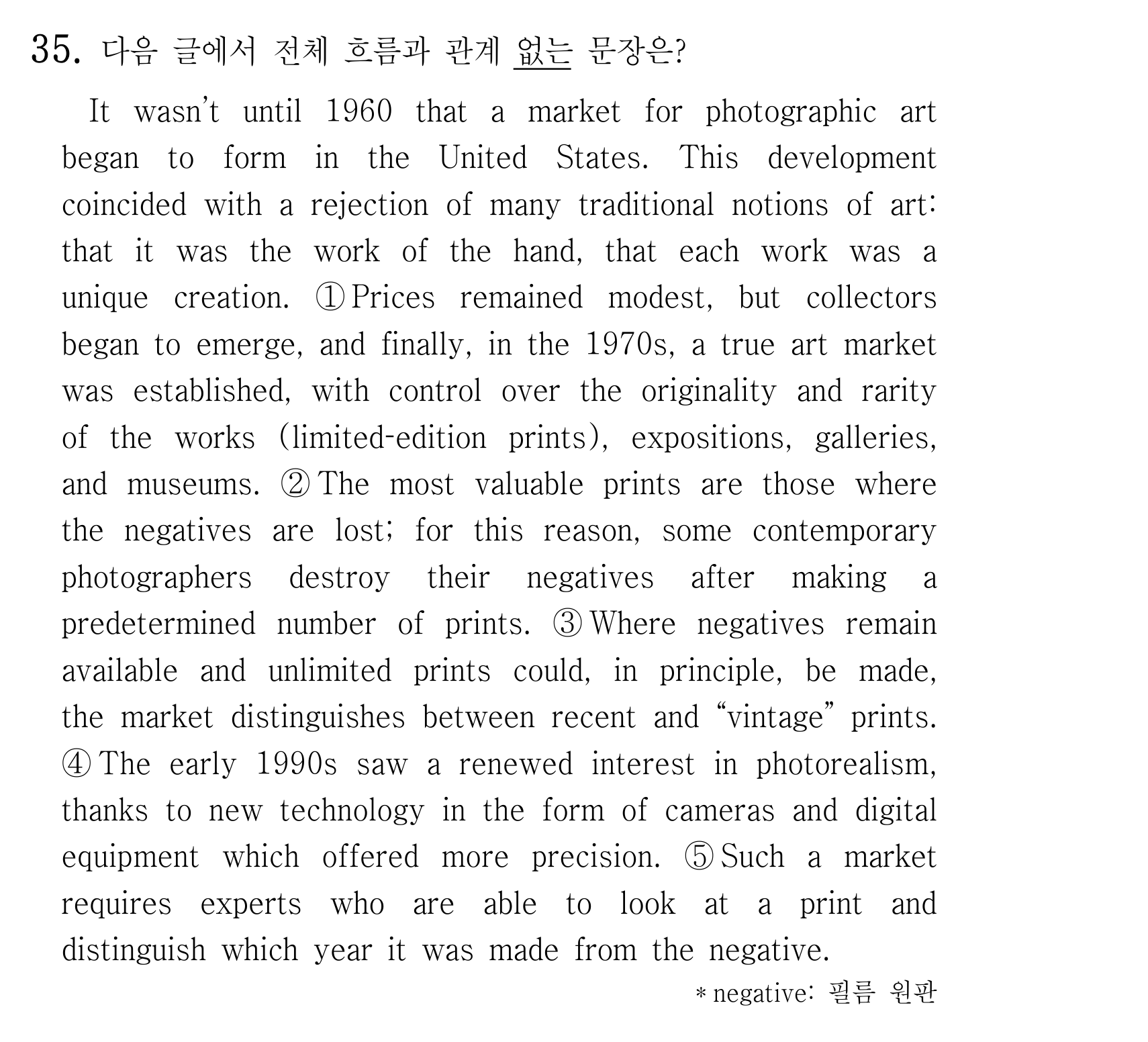
35번무관한문장It wasn’t until 1960 that a market for photographic art began to form in the United State…
It wasn’t until 1960 that a market for photographic art began to form in the United States. This development coincided with a rejection of many traditional notions of art: that it was the work of the hand, that each work was a unique creation. Prices remained modest, but collectors began to emerge, and finally, in the 1970s, a true art market was established, with control over the originality and rarity of the works (limited-edition prints), expositions, galleries, and museums. The most valuable prints are those where the negatives are lost; for this reason, some contemporary photographers destroy their negatives after making a predetermined number of prints. Where negatives remain available and unlimited prints could, in principle, be made, the market distinguishes between recent and “vintage” prints. Such a market requires experts who are able to look at a print and distinguish which year it was made from the negative.
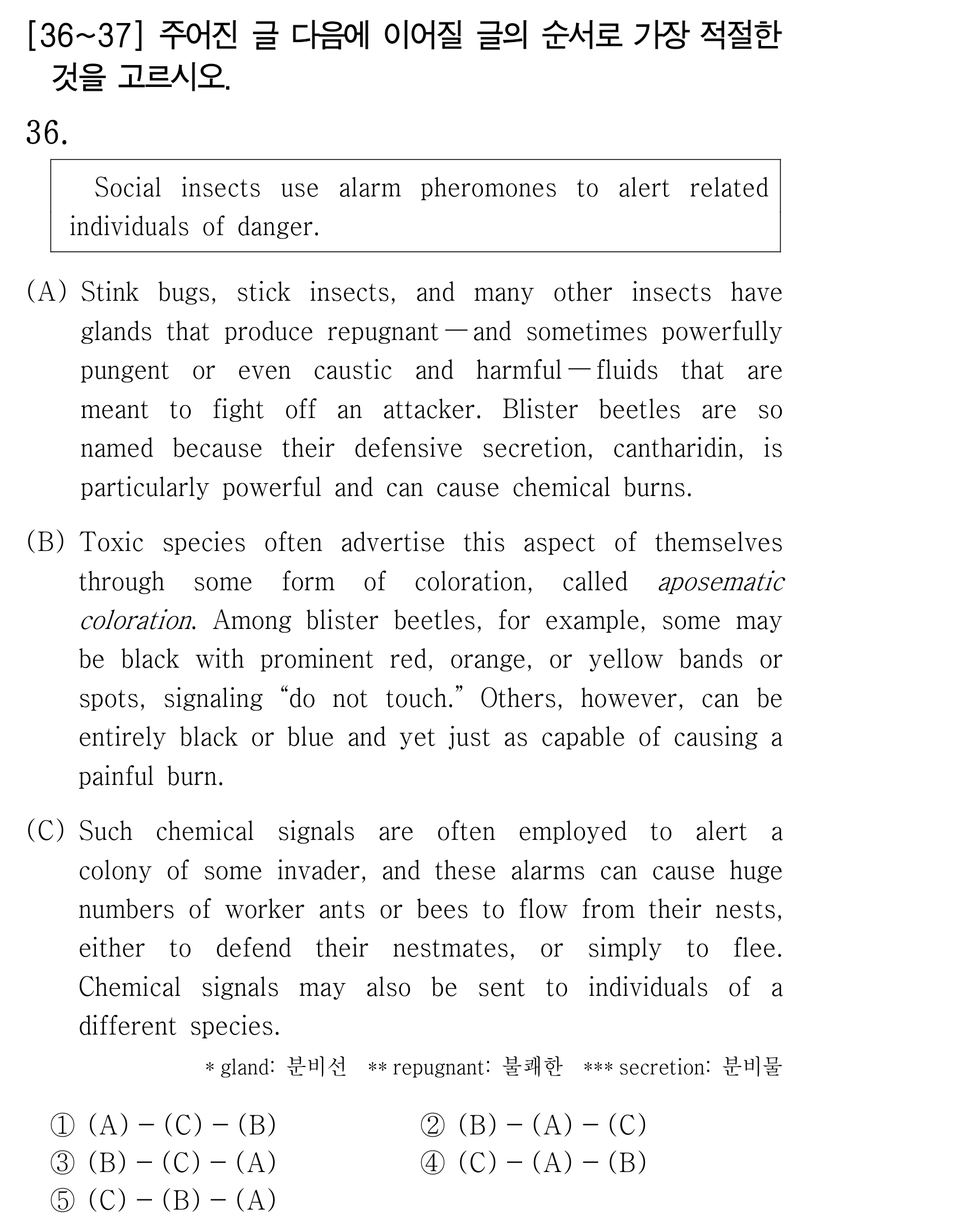
36번순서배열1Social insects use alarm pheromones to alert related individuals of danger.
Social insects use alarm pheromones to alert related individuals of danger. Such chemical signals are often employed to alert a colony of some invader, and these alarms can cause huge numbers of worker ants or bees to flow from their nests, either to defend their nestmates, or simply to flee. Chemical signals may also be sent to individuals of a different species. Stink bugs, stick insects, and many other insects have glands that produce repugnant — and sometimes powerfully pungent or even caustic and harmful — fluids that are meant to fight off an attacker. Blister beetles are so named because their defensive secretion, cantharidin, is particularly powerful and can cause chemical burns. Toxic species often advertise this aspect of themselves through some form of coloration, called *aposematic coloration*. Among blister beetles, for example, some may be black with prominent red, orange, or yellow bands or spots, signaling “do not touch.” Others, however, can be entirely black or blue and yet just as capable of causing a painful burn.
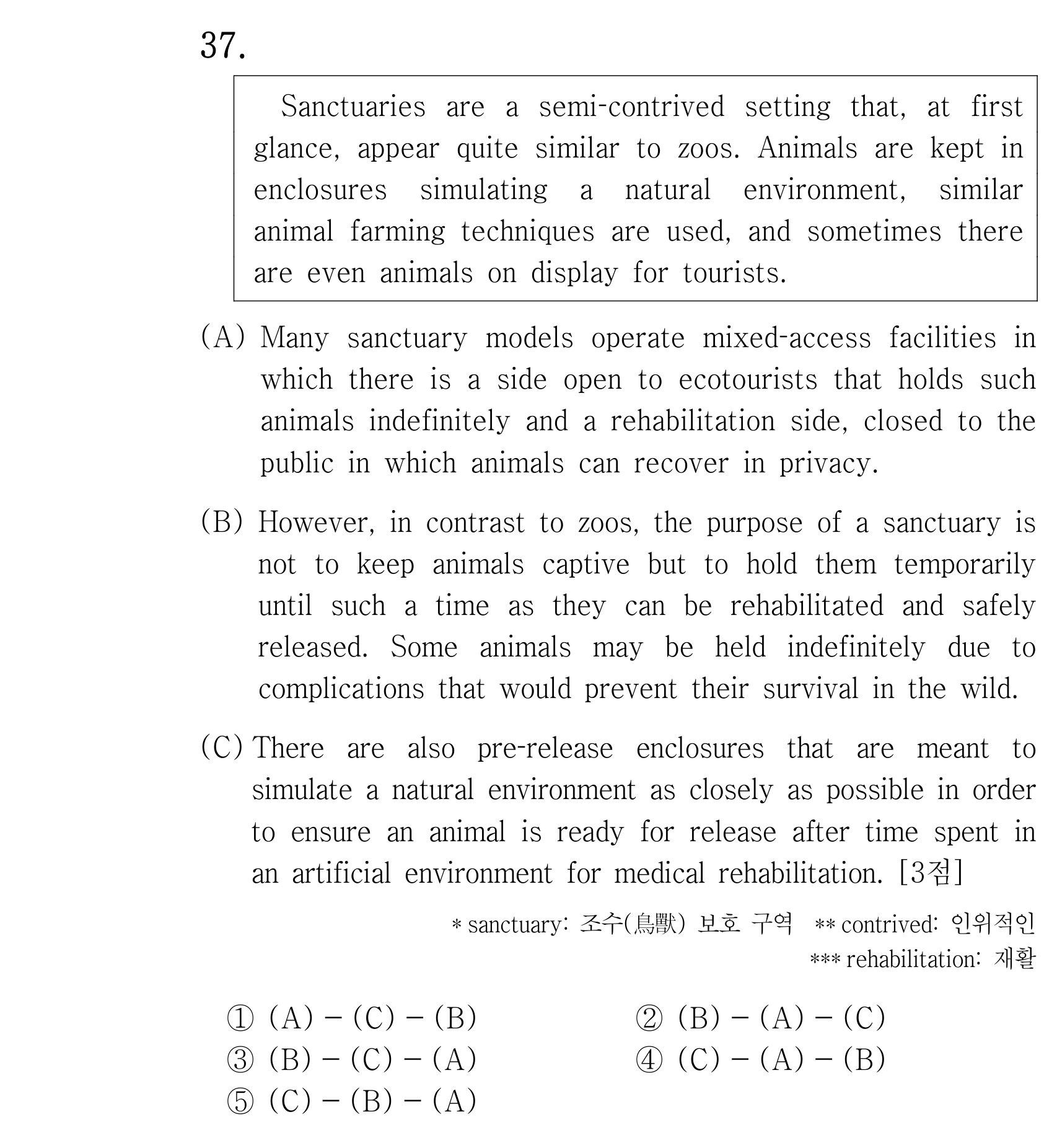
37번순서배열2Sanctuaries are a semi-contrived setting that, at first glance, appear quite similar to z…
Sanctuaries are a semi-contrived setting that, at first glance, appear quite similar to zoos. Animals are kept in enclosures simulating a natural environment, similar animal farming techniques are used, and sometimes there are even animals on display for tourists. However, in contrast to zoos, the purpose of a sanctuary is not to keep animals captive but to hold them temporarily until such a time as they can be rehabilitated and safely released. Some animals may be held indefinitely due to complications that would prevent their survival in the wild. Many sanctuary models operate mixed-access facilities in which there is a side open to ecotourists that holds such animals indefinitely and a rehabilitation side, closed to the public in which animals can recover in privacy. There are also pre-release enclosures that are meant to simulate a natural environment as closely as possible in order to ensure an animal is ready for release after time spent in an artificial environment for medical rehabilitation.
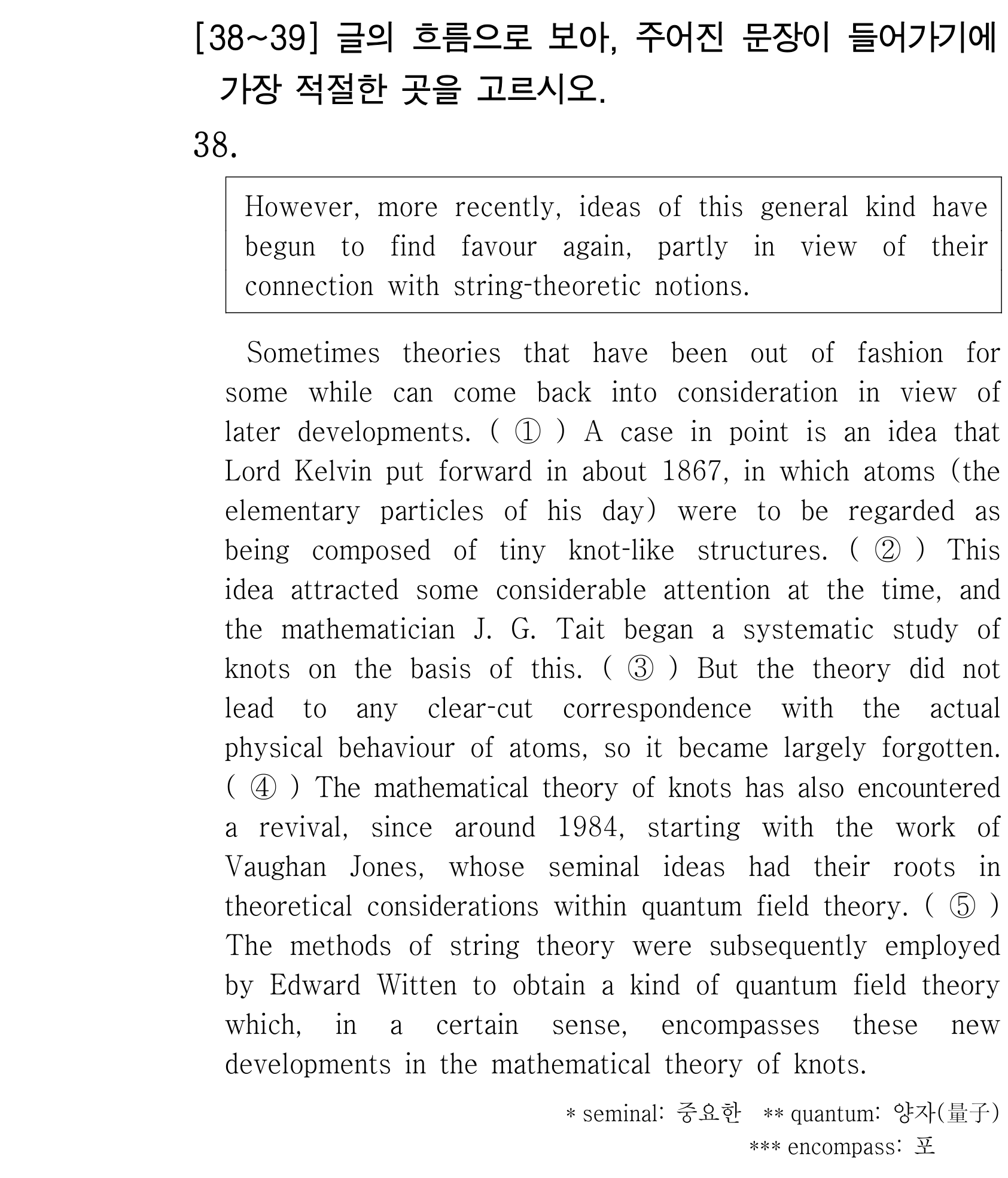
38번문장삽입1Sometimes theories that have been out of fashion for some while can come back into consid…
Sometimes theories that have been out of fashion for some while can come back into consideration in view of later developments. A case in point is an idea that Lord Kelvin put forward in about 1867, in which atoms (the elementary particles of his day) were to be regarded as being composed of tiny knot-like structures. This idea attracted some considerable attention at the time, and the mathematician J. G. Tait began a systematic study of knots on the basis of this. But the theory did not lead to any clear-cut correspondence with the actual physical behaviour of atoms, so it became largely forgotten. However, more recently, ideas of this general kind have begun to find favour again, partly in view of their connection with string-theoretic notions. The mathematical theory of knots has also encountered a revival, since around 1984, starting with the work of Vaughan Jones, whose seminal ideas had their roots in theoretical considerations within quantum field theory. The methods of string theory were subsequently employed by Edward Witten to obtain a kind of quantum field theory which, in a certain sense, encompasses these new developments in the mathematical theory of knots.
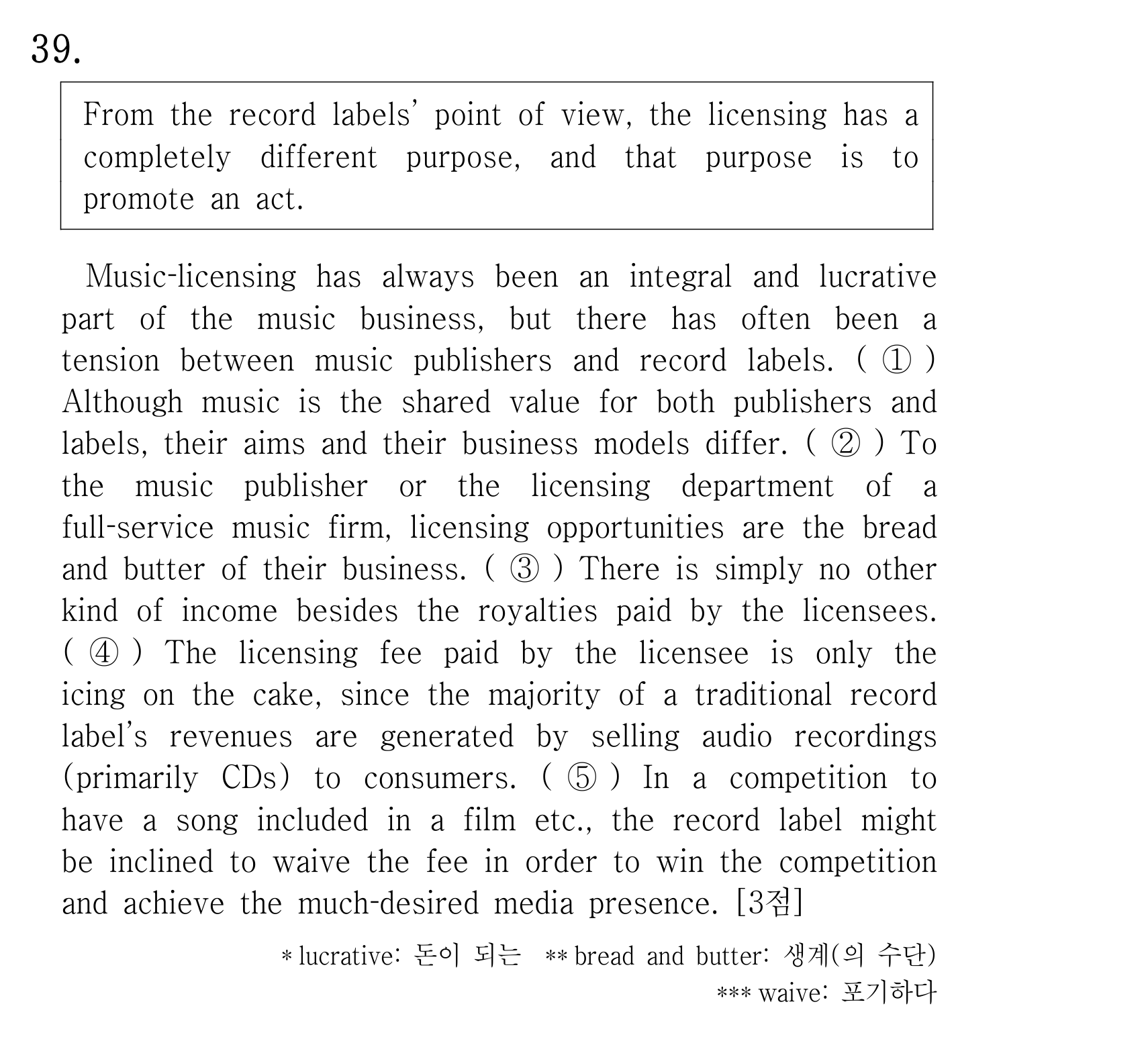
39번문장삽입2Music-licensing has always been an integral and lucrative part of the music business, but…
Music-licensing has always been an integral and lucrative part of the music business, but there has often been a tension between music publishers and record labels. Although music is the shared value for both publishers and labels, their aims and their business models differ. To the music publisher or the licensing department of a full-service music firm, licensing opportunities are the bread and butter of their business. There is simply no other kind of income besides the royalties paid by the licensees. From the record labels' point of view, the licensing has a completely different purpose, and that purpose is to promote an act. The licensing fee paid by the licensee is only the icing on the cake, since the majority of a traditional record label's revenues are generated by selling audio recordings (primarily CDs) to consumers. In a competition to have a song included in a film etc., the record label might be inclined to waive the fee in order to win the competition and achieve the much-desired media presence.
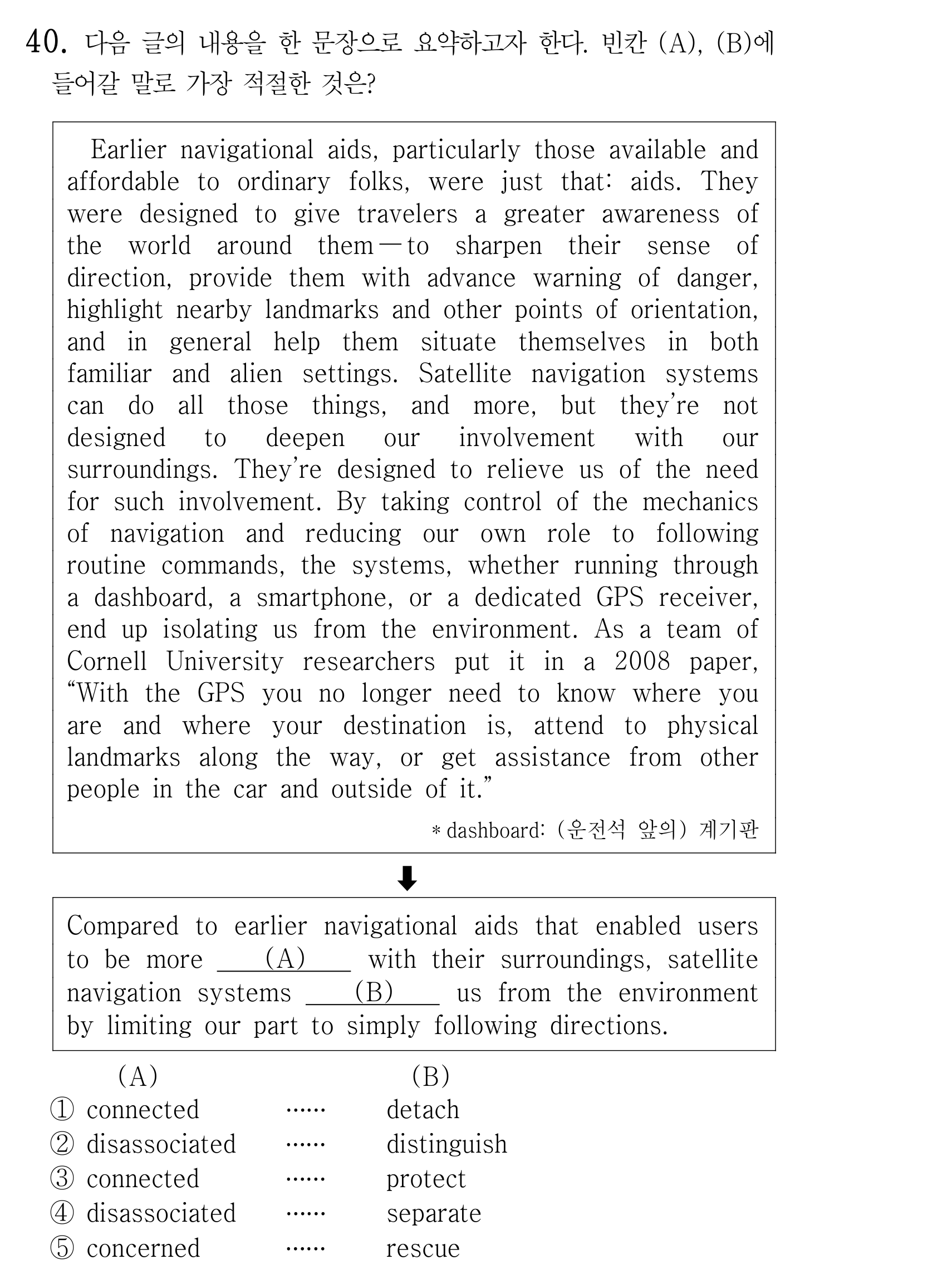
40번요약문완성Earlier navigational aids, particularly those available and affordable to ordinary folks,…
Earlier navigational aids, particularly those available and affordable to ordinary folks, were just that: aids. They were designed to give travelers a greater awareness of the world around them—to sharpen their sense of direction, provide them with advance warning of danger, highlight nearby landmarks and other points of orientation, and in general help them situate themselves in both familiar and alien settings. Satellite navigation systems can do all those things, and more, but they’re not designed to deepen our involvement with our surroundings. They’re designed to relieve us of the need for such involvement. By taking control of the mechanics of navigation and reducing our own role to following routine commands, the systems, whether running through a dashboard, a smartphone, or a dedicated GPS receiver, end up isolating us from the environment. As a team of Cornell University researchers put it in a 2008 paper, “With the GPS you no longer need to know where you are and where your destination is, attend to physical landmarks along the way, or get assistance from other people in the car and outside of it.”
Compared to earlier navigational aids that enabled users to be more (A) with their surroundings, satellite navigation systems (B) us from the environment by limiting our part to simply following directions.
41번장문_제목The speed at which we form language can carry almost as much meaning as the words we say.
The speed at which we form language can carry almost as much meaning as the words we say. Silence is not neutral or meaningless. If a job applicant hesitates too long before responding to a difficult question in a job interview, for example, we may think the applicant is at a loss for words because of being (a) unprepared. We might interpret an awkward silence following a confession of love as indication that the addressee does not feel the same way. Other non-verbal cues may help inform our interpretation of these silences. This is also a factor when we communicate online or via text. Most modern messaging services and apps tell us when a message has been read by its recipient, and so an uneasy type of silence can (b) arise when we know the recipient has read our message but, for whatever reason, has not responded. This is often referred to as leaving somebody ‘on read’ and is generally considered rude in online communication. Compared to face-to-face silences, where one can still read the other person’s expressions or body language, these online silences feel (c) acceptable and can be even more hurtful if sensitive or difficult topics are involved. For instance, a romantic interest leaving an invitation for a second date ‘on read’ might be even more (d) disheartening than a flat-out rejection in many cases. Social media has created a new kind of anxiety for humans. Waiting for a response makes us (e) insecure. As such, we are pressured by social media to respond quickly.
43번장문_순서(A) It was in the bleak midwinter, and a pair of wanderers struggled through the cold nig…
(A) It was in the bleak midwinter, and a pair of wanderers struggled through the cold night, seeking shelter. The father-to-be searched desperately for a safe place for his companion, who walked heavily, carrying new life inside her. They could not stay out in the bitter cold when her time came. Their names were Pepper and Cooper, a pair of beagles, wandering a rural highway near Bethel, Ohio. Gus Kiebel, a county wildlife officer, was driving home through the snowstorm when (a) his headlights revealed the dogs.
(B) “I’m not signing the dogs over to you if you’re going to separate them,” Gus said. The shelter worker promised him she’d keep the pair together. Over the next few days, Gus called the shelter to ensure that Pepper and Cooper were safe. Just after Christmas, the beagles were adopted as a pair by a loving family. Gus practiced kindness by giving shelter to a wandering couple, demonstrating the best of (b) himself. When kindness and love triumph over cruelty and the elements, it can feel like the greatest miracle of all.
(C) Gus couldn’t bring himself to leave the dogs out in the storm. That night, he prepared a warm bed with food and water close by. As a boy, (c) he had dreamed of owning a beagle, but keeping this pair was not an option — Gus already had a dog. However, Gus knew someone at the League for Animal Welfare, an animal shelter in nearby Batavia. The next morning, he took the dogs to the shelter to drop them off — on one condition.
(D) Their collars and tags suggested they belonged to someone, but why were they outside in such harsh weather? Gus stopped his truck and approached the two dogs, who didn’t try to flee. (d) He read their tags — Pepper and Cooper — but when he called the phone number, the man who answered said, “I gave them to another family. They’re not mine anymore.” When Gus asked where they were sent, the man paused and said, “I don’t know.” Then, (e) he hung up abruptly, leaving Gus feeling surprised and uneasy. The beagles had nowhere to go.
2025년 7월 고3 모의고사 변형문제 맛보기
이 시험 지문으로 실제로 만든 변형문제 3문항입니다. 같은 지문으로 유형을 바꿔 더 만들 수 있습니다.
20번 지문 · 어법 변형
다음 글의 밑줄 친 부분 중, 어법상 틀린 것은 모두 몇 개인가?
The idea of ①to cut out a budget category probably ②makes you nervously. But being mindful about your spending doesn't have to be an all-or-nothing game. Instead of ③forcing yourself to go entirely without, reduce spending on that category by just 10 percent each month. You won't see sudden, drastic change in your budget, but the shift ④will be a lot easier to stomach. Say you spent $148 at coffee shops last month. The idea of never buying coffee is ⑤enough to make you want to hide from your budget forever, but ⑥what if you challenged yourself to spend just 10 percent less on coffee this month? That's $14.80 less, for a total of $133.20. Then, next month, see if you can bring that expense down by 10 percent again to $119.88. ⑦By introduced incremental shifts instead of huge, radical changes, ⑧you're more likely to stick with your new, moderately reduced habits.- ①1개
- ②2개
- ③3개
- ④4개
- ⑤5개
21번 지문 · 빈칸추론 변형
다음 빈칸에 들어갈 말로 가장 적절한 것은?
Media coverage of sports is, by its very nature, ephemeral. The temporary loss of the here and now is embraced when we consume mediated sports coverage as a welcome break from the press of everyday demands. Yet, many sports fans recognize that contests that once seemed both urgent and critical often melt into the background in a week's time and are summarily forgotten. The ubiquity of sports contests and the blur of discussions about them across the contemporary mediascape contribute to this liquidity; a new "big game" is seemingly always around the corner and newly-fueled anticipation routinely supersedes reflection about results that have quickly faded in our memories and become trivial in the records of sports. However, rising above ubiquitous sporting competitions that quickly fade as ________________ are those holding promise to become ground-breaking moments in lived experience and common culture. These are the events and championships that define a sport, solidifying one's fanship, and serving as historical markers that bring order, meaning, and significance to the sports landscape.- ①a deliberate return to tradition
- ②a renewed appetite for records
- ③a pause in commercial coverage
- ④an urgent call for reflection
- ⑤a communal loss of memory
22번 지문 · 어휘 변형
다음 글의 밑줄 친 부분 중, 문맥상 낱말의 쓰임이 적절하지 않은 것은?
Making your marketing ①fun for customers is what makes them tell other people about you. This is the basis of viral marketing — the word of mouth that ultimately generates more business than all the advertising campaigns put together. Humor is good, but something that encourages customers to pass on messages to friends, business colleagues, family, and indeed anyone else will result in ②stronger customers' perception of your brand and increased awareness of what your company is all about. The message need not be too ③serious, either, or indeed be an overt marketing plug. Just passing the brand name along, and having it associated with something entertaining and fun, is quite ④sufficient. Your other marketing promotions will fill in the gaps, and anyway no single promotion will ever cover all the communication you want it to — the best you can hope for is that one communication will ⑤desensitize the customers to receiving a later one.- ①fun
- ②stronger
- ③serious
- ④sufficient
- ⑤desensitize
남은 시간
48:00



아직 28문제를 풀지 않았어요 (0/28)