2026학년도 6월 모의평가 영어
28문제 · 제한시간 48분
이 시험 한눈에 — 2026학년도 6월 모의평가 영어
18~45번 28문항을 유형별로 보면 목적 1 · 심경/분위기 1 · 주장 1 · 함축의미추론 1 · 요지/주장 1 · 주제 1 · 제목 1 · 도표 1 · 내용일치 1 · 실용문 1 · 어법 2 · 어휘 1 · 빈칸추론2 1 · 빈칸추론3 1 · 빈칸추론4 1 · 빈칸추론5 1 · 무관한문장 1 · 순서배열1 1 · 순서배열2 1 · 문장삽입1 1 · 문장삽입2 1 · 요약문완성 1 · 장문 5. 아래 지문으로 변형문제·단어장·정답표를 바로 만들 수 있습니다.
20번주장Our ability to respond to danger has been important for survival, so feeling worried in u…
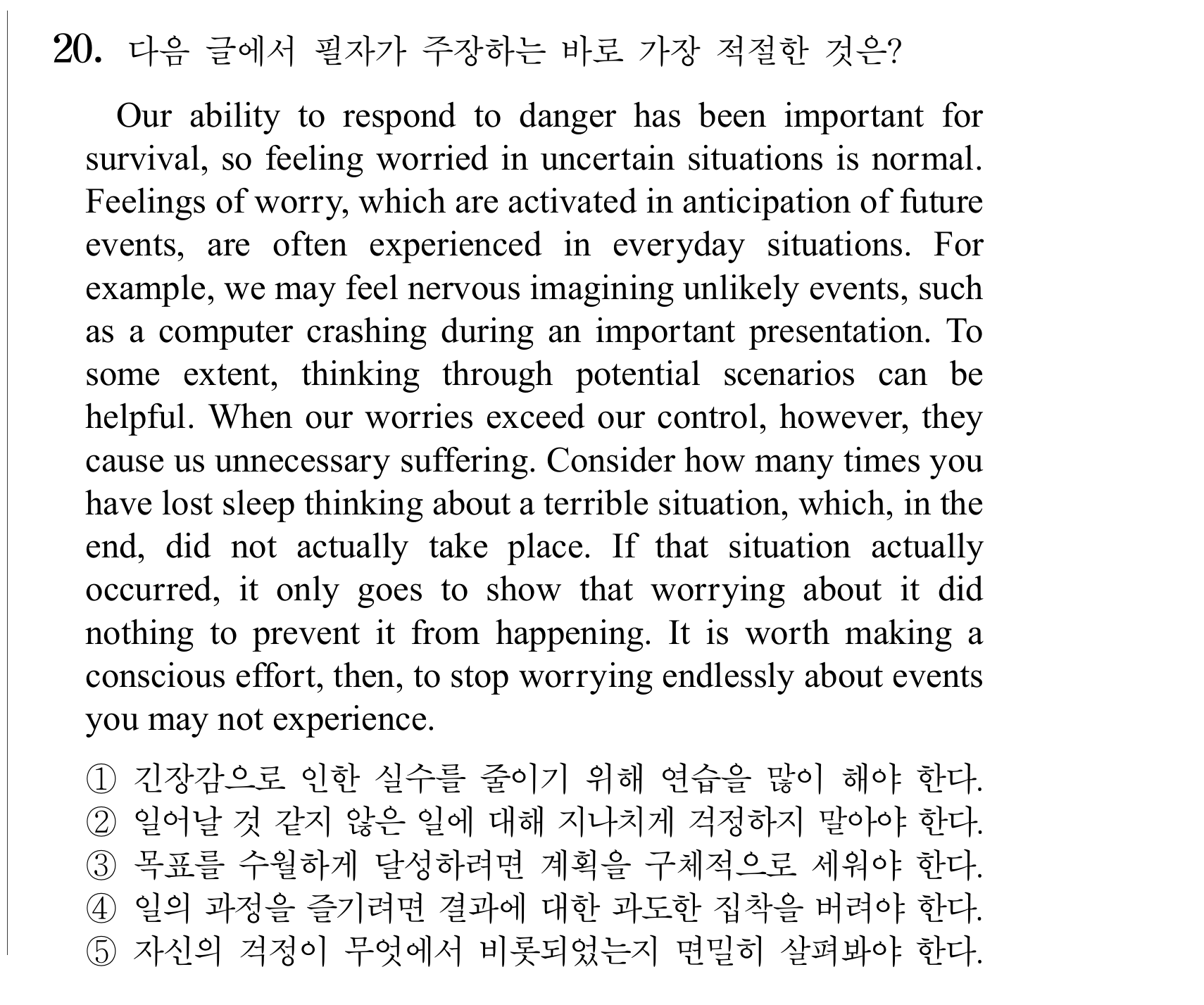
Our ability to respond to danger has been important for survival, so feeling worried in uncertain situations is normal. Feelings of worry, which are activated in anticipation of future events, are often experienced in everyday situations. For example, we may feel nervous imagining unlikely events, such as a computer crashing during an important presentation. To some extent, thinking through potential scenarios can be helpful. When our worries exceed our control, however, they cause us unnecessary suffering. Consider how many times you have lost sleep thinking about a terrible situation, which, in the end, did not actually take place. If that situation actually occurred, it only goes to show that worrying about it did nothing to prevent it from happening. It is worth making a conscious effort, then, to stop worrying endlessly about events you may not experience.
21번함축의미추론Basing your self-worth on climbing performance puts you at the whim of external factors.
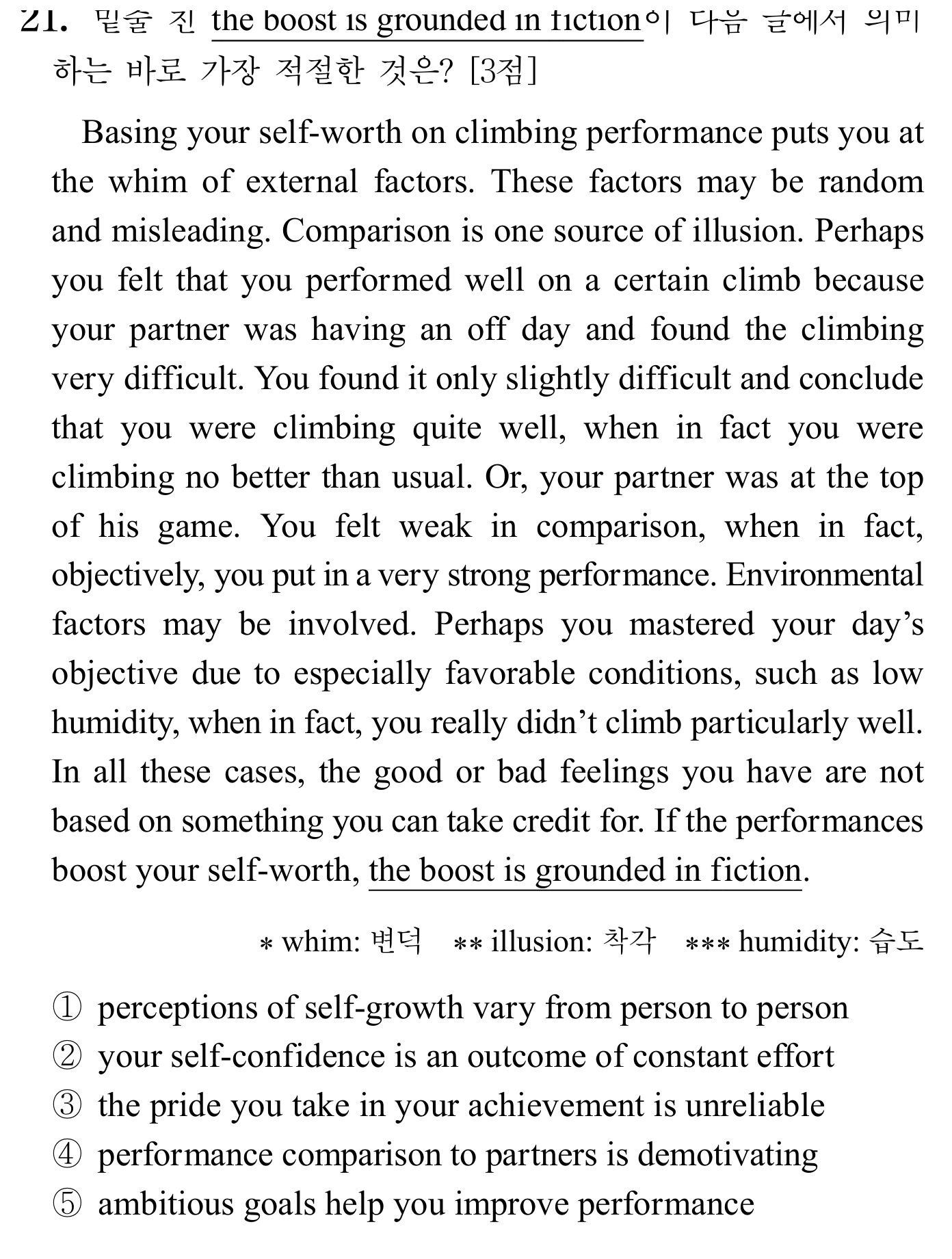
Basing your self-worth on climbing performance puts you at the whim of external factors. These factors may be random and misleading. Comparison is one source of illusion. Perhaps you felt that you performed well on a certain climb because your partner was having an off day and found the climbing very difficult. You found it only slightly difficult and conclude that you were climbing quite well, when in fact you were climbing no better than usual. Or, your partner was at the top of his game. You felt weak in comparison, when in fact, objectively, you put in a very strong performance. Environmental factors may be involved. Perhaps you mastered your day’s objective due to especially favorable conditions, such as low humidity, when in fact, you really didn’t climb particularly well. In all these cases, the good or bad feelings you have are not based on something you can take credit for. If the performances boost your self-worth, the boost is grounded in fiction.
22번요지/주장Information and meaning are, clearly, not the same thing.
Information and meaning are, clearly, not the same thing. The former refers to uninterpreted data or sensory states whose probability in a certain situation can be easily measured; the latter refers to the interpretation of the data or sensory states, including the special kinds of nuances and values that the information entails, or is intended to have, in the given situation. This applies to any type of information, from alarm signals to sophisticated statements. Take, for instance, a coin-tossing game in which it is decided that throwing three heads in a row constitutes a win. If a certain player ends up consistently with the desired outcome, defeating all who challenge that player, then we tend to interpret the outcome either as the work of Fortune, or else as clever and undetectable cheating on the part of the winning player. Interpretation is at the core of everything we do, think about, and feel.
23번주제The purpose of class discussions is to encourage you to be an active participant, not a p…
The purpose of class discussions is to encourage you to be an active participant, not a passive recorder. Much of the emphasis in a discussion is on getting students involved in thinking, reacting, and responding. These are important intellectual activities in the learning process, for through them you are supposed to discover and express your opinions. Writing is an invaluable tool for accomplishing these tasks. Unfortunately, too many times, when class discussion begins, pens and pencils go down. Admittedly, it is considerably more difficult to take notes from discussions than from lectures, for, unlike lectures, discussions tend to be disorganized and difficult to follow. Also, students usually don't know how much of what other students are saying is important. And if you are an active participant, it is not easy to take notes and formulate what you want to say. But note taking in discussions is not only manageable, it is also important. Note taking helps to keep you active and alert; it allows you to impose some organization on the discussion; and it can prepare you to speak.
24번제목Food, as we all know, is essential for human life.
Food, as we all know, is essential for human life. It also is the basis for several major industries found in many countries around the world such as in agriculture, food processing, food retailing and food service. For millennia, the focus of those involved with food as a human and economic phenomenon was on its production, preservation, distribution, pricing and other practical concerns. But in the late 18th century this began to change. Food became more than just a life necessity. Restaurants began to be developed, initially in France but eventually in other nations, as a distinct institution offering people dining choices and table service, the opportunity for socialization and, over time, a finer and finer atmosphere. The rise of restaurants eventually led to a class of diners who prided themselves on being critics of taste, food and cooking. Brillat-Savarin is probably the best known of the ‘culinary philosophers’ or, in today’s parlance, a ‘foodie’. One of Brillat-Savarin’s better known sayings was, ‘[t]ell me what you eat, and I’ll tell you who you are.’
29번어법Changes in the degree of closeness are quite important in managing emotional intensity.
Changes in the degree of closeness are quite important in managing emotional intensity. Take, for example, emotions induced by television. Closeness and familiarity are important in making the fictional environment more real. Accordingly, most TV shows are set in the present or in a time within the memory of the viewers. Most characters are supposed to be types with whom we are familiar. Such closeness and familiarity make it easier for us to perceive the imaginary story to be a real one. In other circumstances, such as when violence is shown on TV, the closeness variable is used to reduce emotional intensity. Television entertainment tends to place social problems involving violence in another time and place, letting us watch those fictionalized characters search for solutions to our problems in settings safely distanced from our own. When violence occurs in a contemporary setting, it is generally the product of the interaction of police and criminals — again, it is removed from the lives of good citizenry.
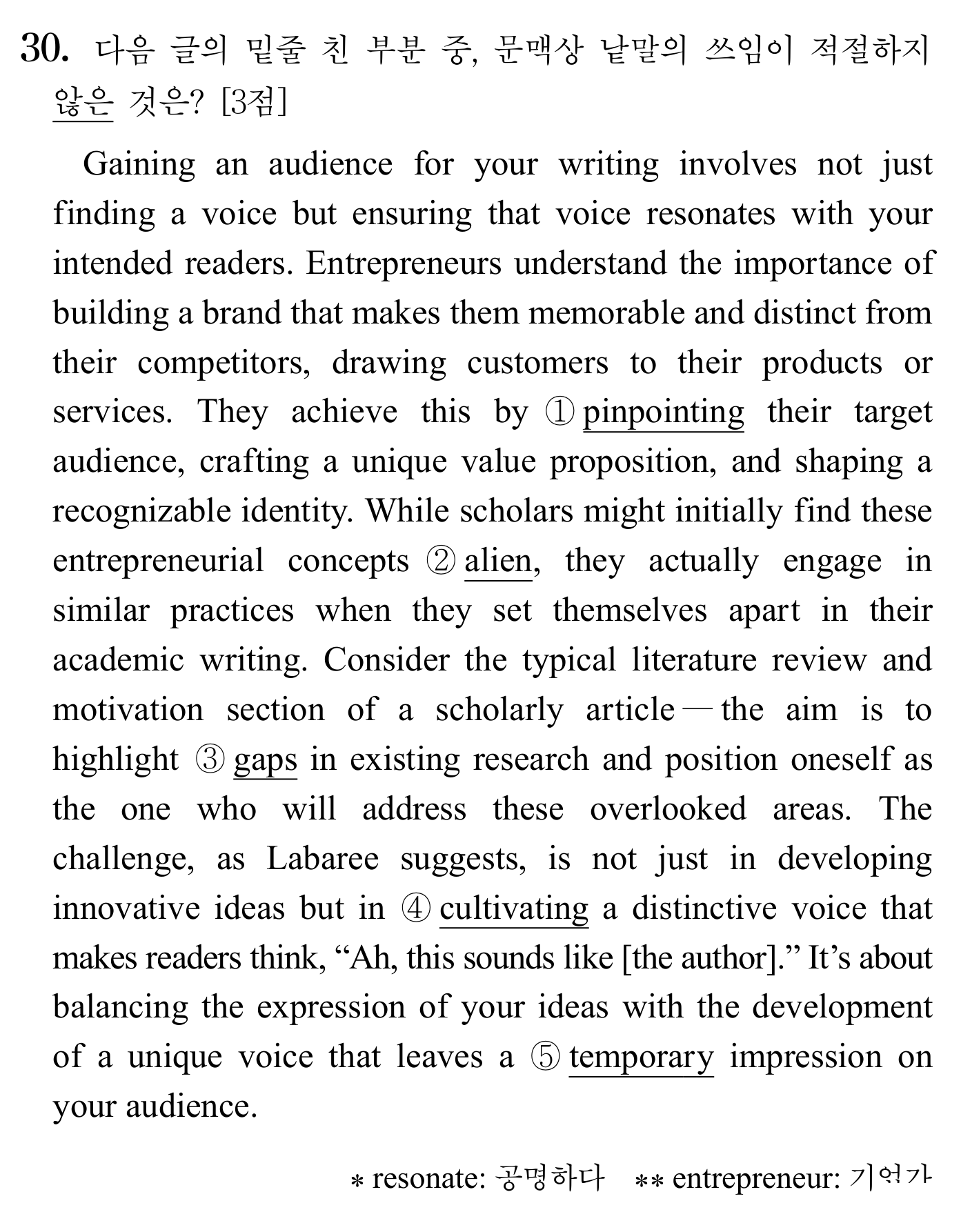
30번어휘Gaining an audience for your writing involves not just finding a voice but ensuring that…
Gaining an audience for your writing involves not just finding a voice but ensuring that voice resonates with your intended readers. Entrepreneurs understand the importance of building a brand that makes them memorable and distinct from their competitors, drawing customers to their products or services. They achieve this by pinpointing their target audience, crafting a unique value proposition, and shaping a recognizable identity. While scholars might initially find these entrepreneurial concepts alien, they actually engage in similar practices when they set themselves apart in their academic writing. Consider the typical literature review and motivation section of a scholarly article — the aim is to highlight gaps in existing research and position oneself as the one who will address these overlooked areas. The challenge, as Labaree suggests, is not just in developing innovative ideas but in cultivating a distinctive voice that makes readers think, “Ah, this sounds like [the author].” It’s about balancing the expression of your ideas with the development of a unique voice that leaves a lasting impression on your audience.
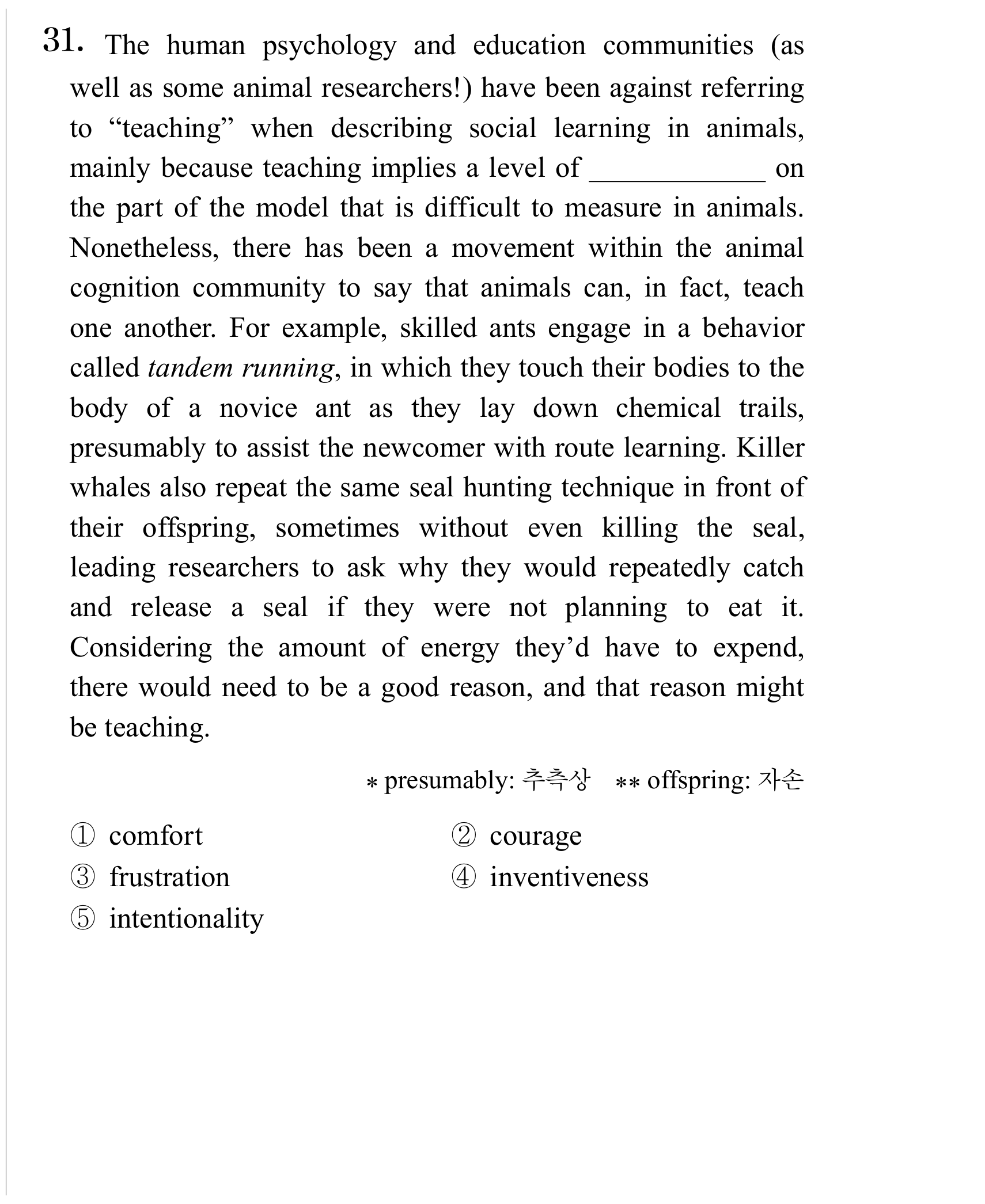
31번빈칸추론2The human psychology and education communities (as well as some animal researchers!) have…
The human psychology and education communities (as well as some animal researchers!) have been against referring to “teaching” when describing social learning in animals, mainly because teaching implies a level of intentionality on the part of the model that is difficult to measure in animals. Nonetheless, there has been a movement within the animal cognition community to say that animals can, in fact, teach one another. For example, skilled ants engage in a behavior called *tandem running*, in which they touch their bodies to the body of a novice ant as they lay down chemical trails, presumably to assist the newcomer with route learning. Killer whales also repeat the same seal hunting technique in front of their offspring, sometimes without even killing the seal, leading researchers to ask why they would repeatedly catch and release a seal if they were not planning to eat it. Considering the amount of energy they’d have to expend, there would need to be a good reason, and that reason might be teaching.
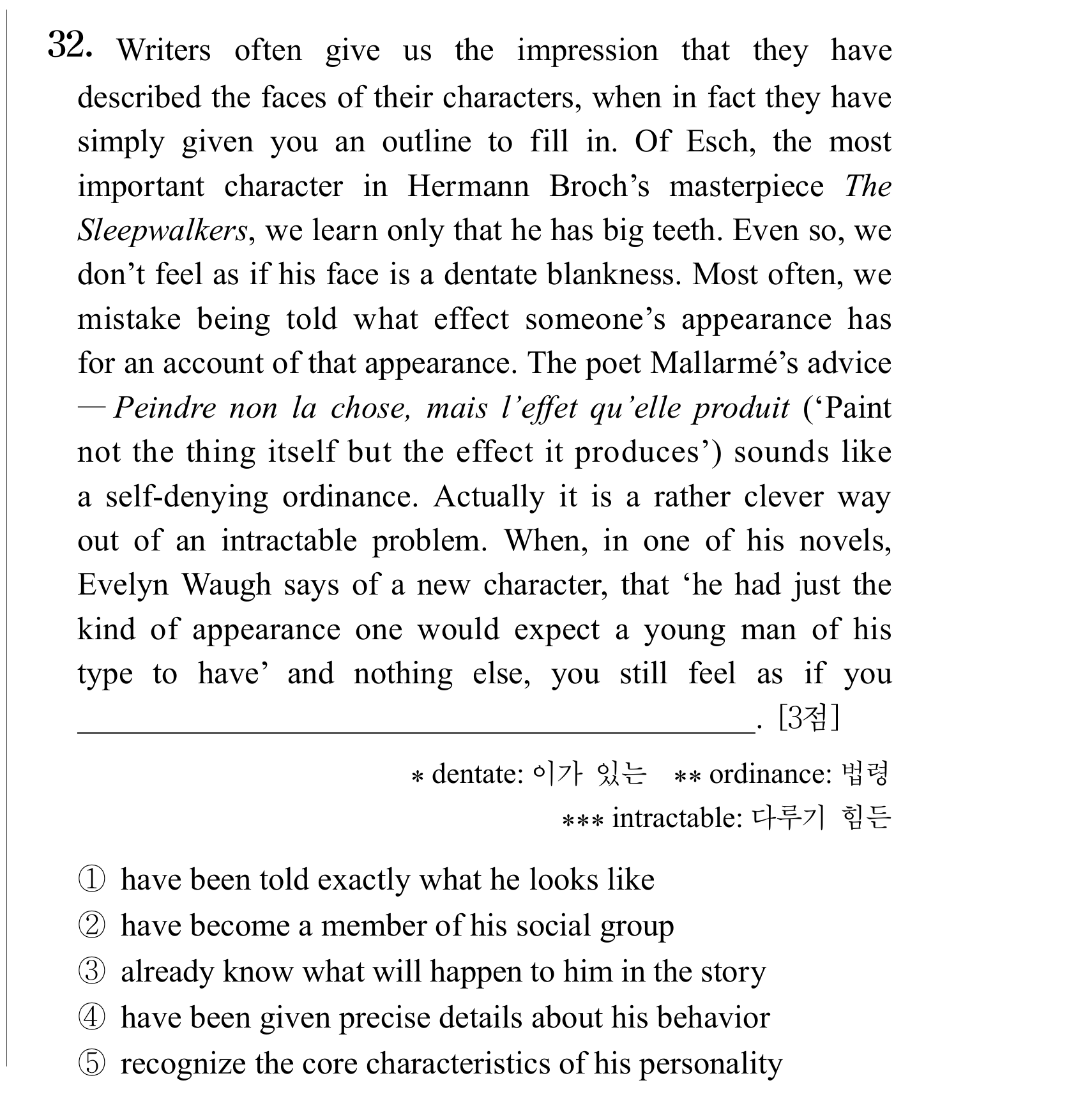
32번빈칸추론3Writers often give us the impression that they have described the faces of their characte…
Writers often give us the impression that they have described the faces of their characters, when in fact they have simply given you an outline to fill in. Of Esch, the most important character in Hermann Broch’s masterpiece The Sleepwalkers, we learn only that he has big teeth. Even so, we don’t feel as if his face is a dentate blankness. Most often, we mistake being told what effect someone’s appearance has for an account of that appearance. The poet Mallarmé’s advice — Peindre non la chose, mais l’effet qu’elle produit (‘Paint not the thing itself but the effect it produces’) sounds like a self-denying ordinance. Actually it is a rather clever way out of an intractable problem. When, in one of his novels, Evelyn Waugh says of a new character, that ‘he had just the kind of appearance one would expect a young man of his type to have’ and nothing else, you still feel as if you have been told exactly what he looks like.
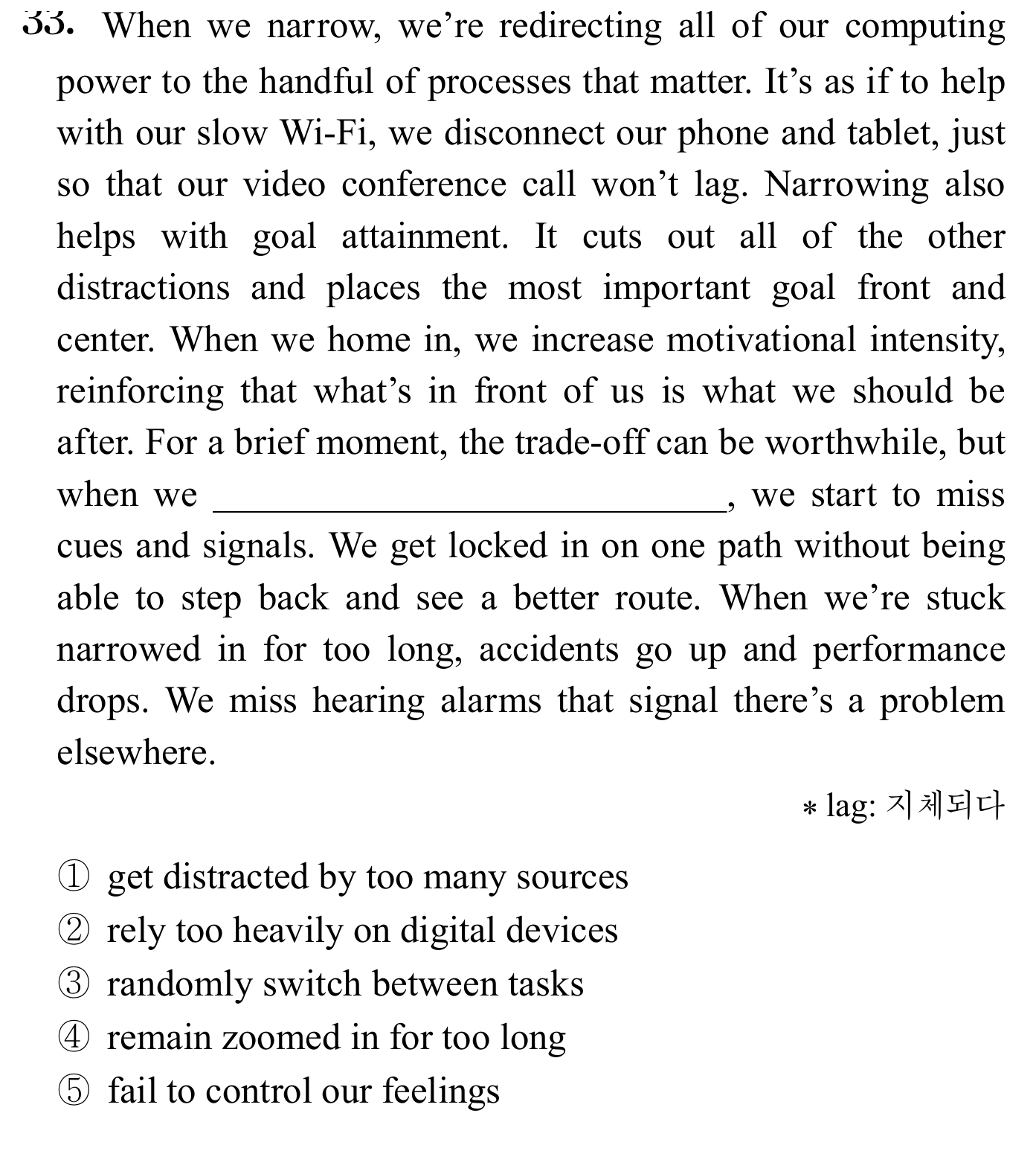
33번빈칸추론4When we narrow, we’re redirecting all of our computing power to the handful of processes…
When we narrow, we’re redirecting all of our computing power to the handful of processes that matter. It’s as if to help with our slow Wi-Fi, we disconnect our phone and tablet, just so that our video conference call won’t lag. Narrowing also helps with goal attainment. It cuts out all of the other distractions and places the most important goal front and center. When we home in, we increase motivational intensity, reinforcing that what’s in front of us is what we should be after. For a brief moment, the trade-off can be worthwhile, but when we remain zoomed in for too long, we start to miss cues and signals. We get locked in on one path without being able to step back and see a better route. When we’re stuck narrowed in for too long, accidents go up and performance drops. We miss hearing alarms that signal there’s a problem elsewhere.
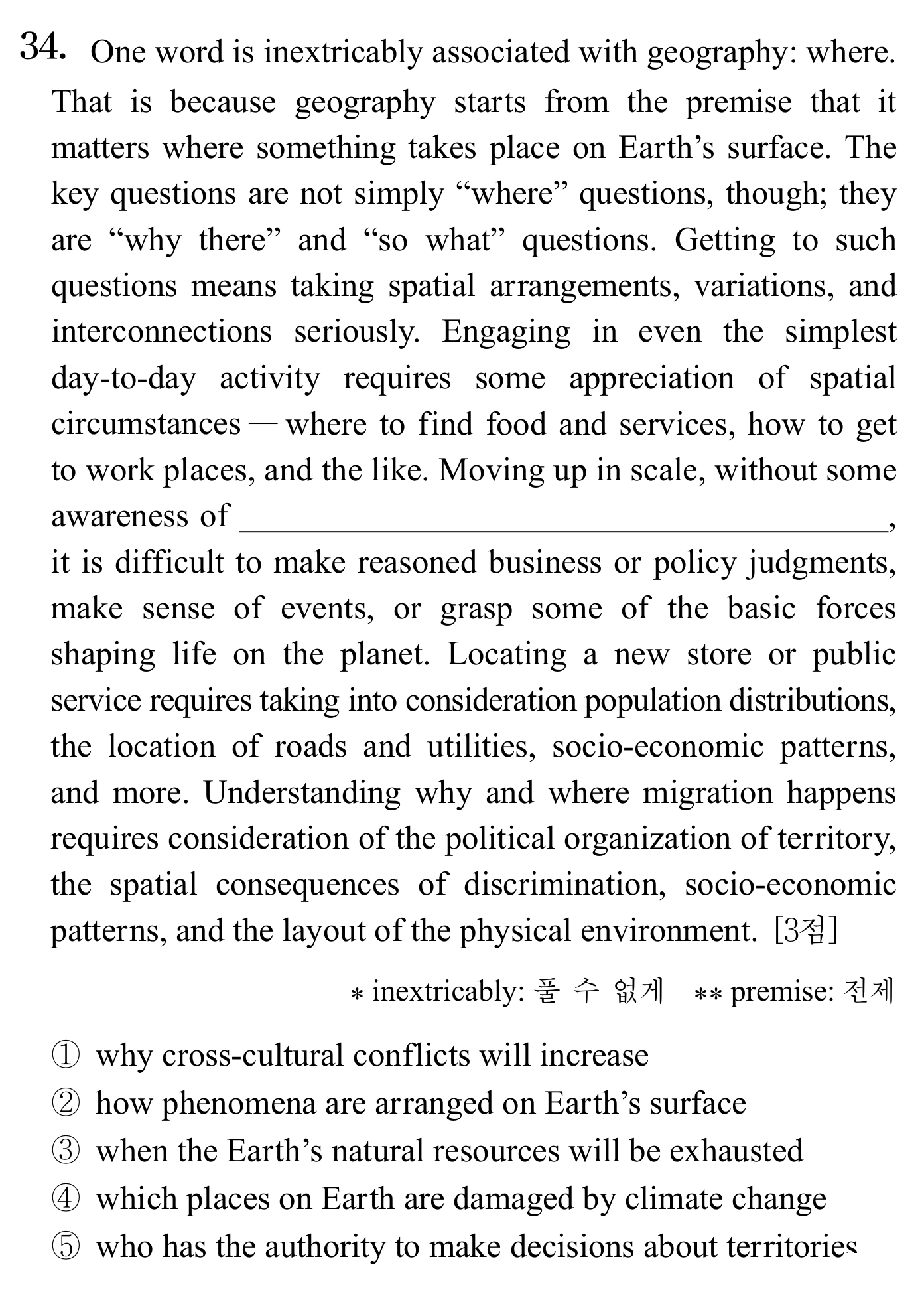
34번빈칸추론5One word is inextricably associated with geography: where.
One word is inextricably associated with geography: where. That is because geography starts from the premise that it matters where something takes place on Earth’s surface. The key questions are not simply “where” questions, though; they are “why there” and “so what” questions. Getting to such questions means taking spatial arrangements, variations, and interconnections seriously. Engaging in even the simplest day-to-day activity requires some appreciation of spatial circumstances — where to find food and services, how to get to work places, and the like. Moving up in scale, without some awareness of how phenomena are arranged on Earth's surface, it is difficult to make reasoned business or policy judgments, make sense of events, or grasp some of the basic forces shaping life on the planet. Locating a new store or public service requires taking into consideration population distributions, the location of roads and utilities, socio-economic patterns, and more. Understanding why and where migration happens requires consideration of the political organization of territory, the spatial consequences of discrimination, socio-economic patterns, and the layout of the physical environment.
35번무관한문장A genuine glacier must be permanent.
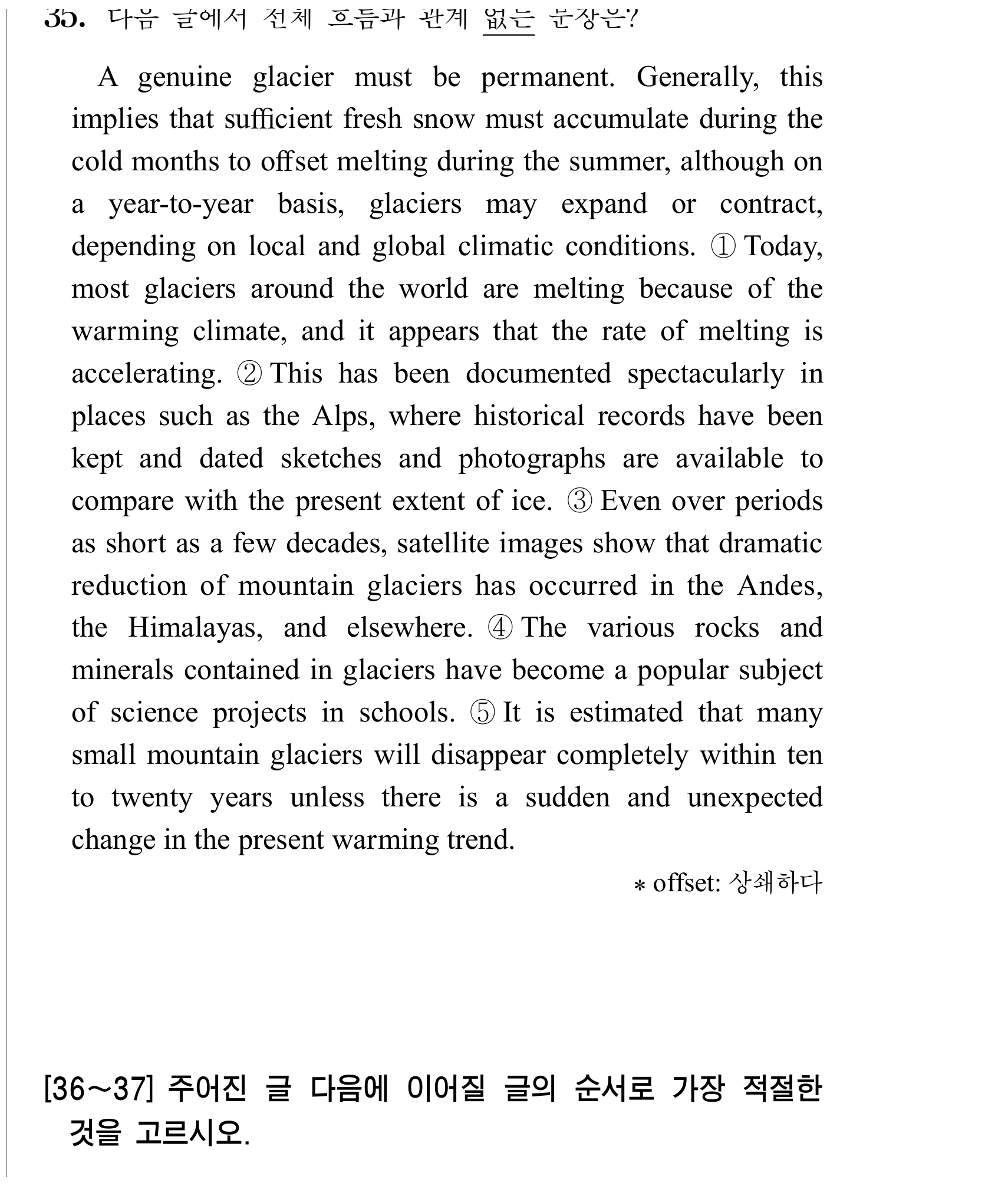
A genuine glacier must be permanent. Generally, this implies that sufficient fresh snow must accumulate during the cold months to offset melting during the summer, although on a year-to-year basis, glaciers may expand or contract, depending on local and global climatic conditions. Today, most glaciers around the world are melting because of the warming climate, and it appears that the rate of melting is accelerating. This has been documented spectacularly in places such as the Alps, where historical records have been kept and dated sketches and photographs are available to compare with the present extent of ice. Even over periods as short as a few decades, satellite images show that dramatic reduction of mountain glaciers has occurred in the Andes, the Himalayas, and elsewhere. It is estimated that many small mountain glaciers will disappear completely within ten to twenty years unless there is a sudden and unexpected change in the present warming trend.
36번순서배열1If we take an evolutionary look at our beginnings, we see a life in which high levels of…
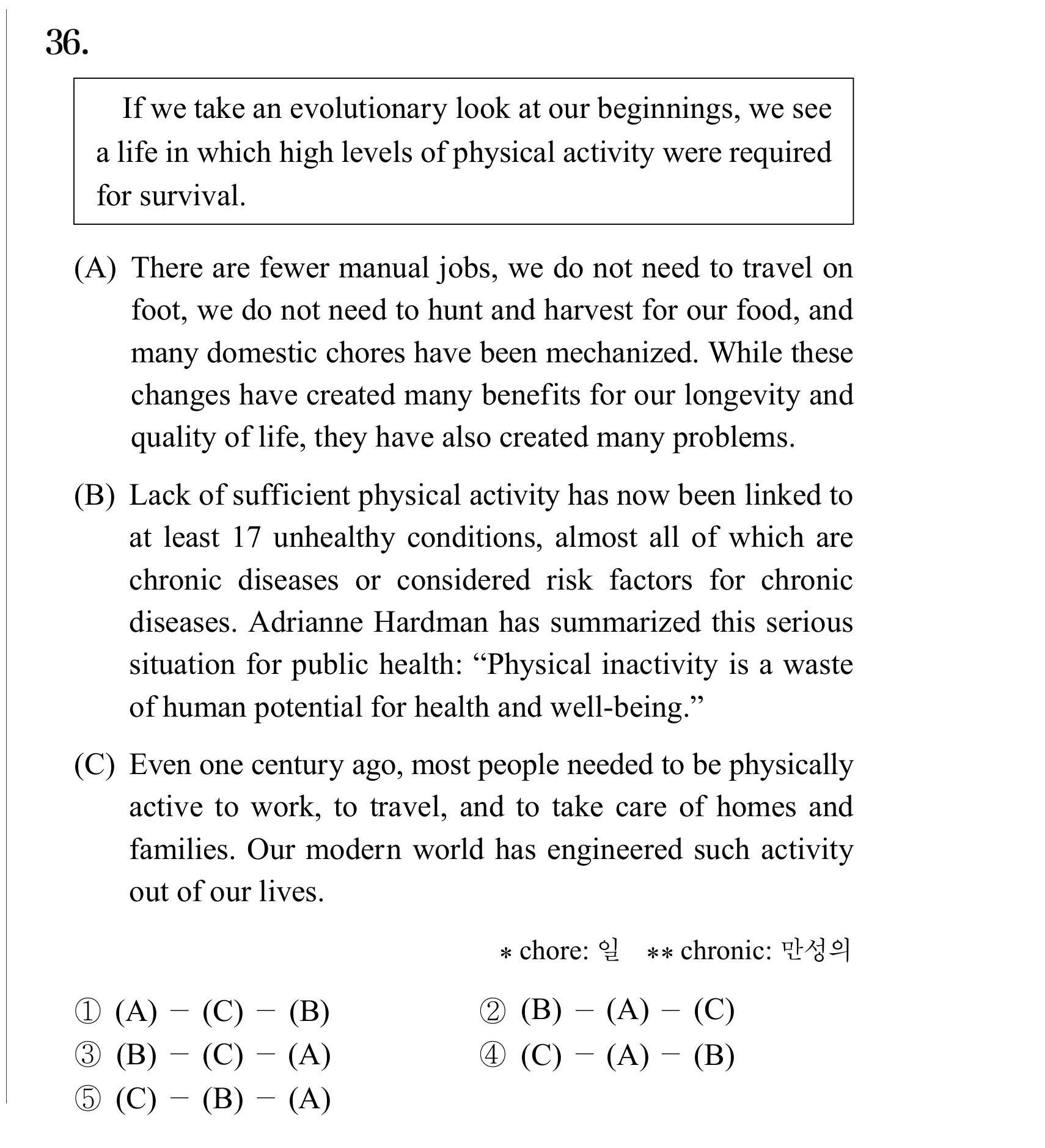
If we take an evolutionary look at our beginnings, we see a life in which high levels of physical activity were required for survival. Even one century ago, most people needed to be physically active to work, to travel, and to take care of homes and families. Our modern world has engineered such activity out of our lives. There are fewer manual jobs, we do not need to travel on foot, we do not need to hunt and harvest for our food, and many domestic chores have been mechanized. While these changes have created many benefits for our longevity and quality of life, they have also created many problems. Lack of sufficient physical activity has now been linked to at least 17 unhealthy conditions, almost all of which are chronic diseases or considered risk factors for chronic diseases. Adrianne Hardman has summarized this serious situation for public health: “Physical inactivity is a waste of human potential for health and well-being.”
37번순서배열2A good example of chaos is the magnetic pendulum sold as an executive toy.
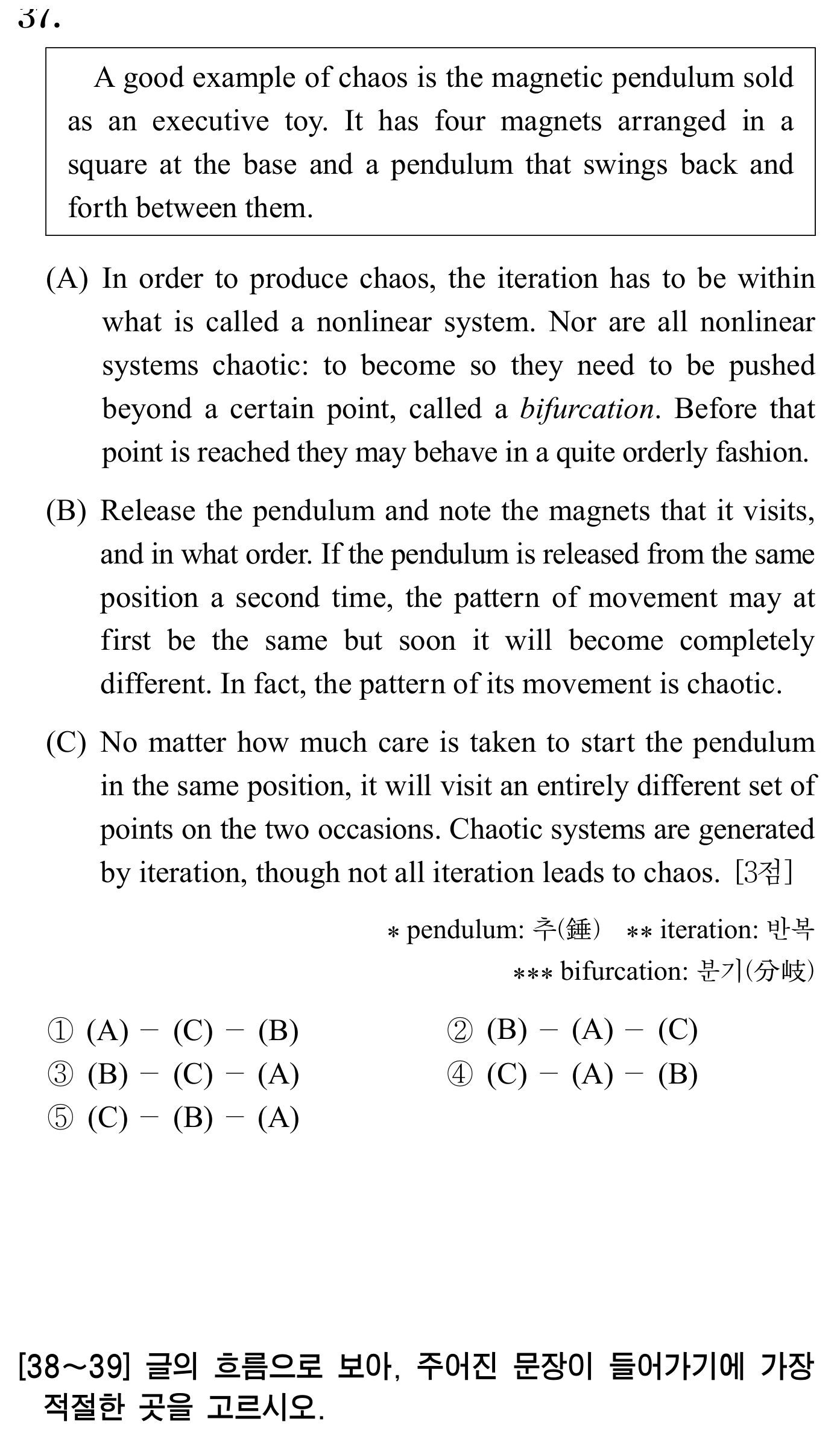
A good example of chaos is the magnetic pendulum sold as an executive toy. It has four magnets arranged in a square at the base and a pendulum that swings back and forth between them. Release the pendulum and note the magnets that it visits, and in what order. If the pendulum is released from the same position a second time, the pattern of movement may at first be the same but soon it will become completely different. In fact, the pattern of its movement is chaotic. No matter how much care is taken to start the pendulum in the same position, it will visit an entirely different set of points on the two occasions. Chaotic systems are generated by iteration, though not all iteration leads to chaos. In order to produce chaos, the iteration has to be within what is called a nonlinear system. Nor are all nonlinear systems chaotic: to become so they need to be pushed beyond a certain point, called a bifurcation. Before that point is reached they may behave in a quite orderly fashion.
38번문장삽입1Research finds that people show a strong visceral interest in and desire to approach and…
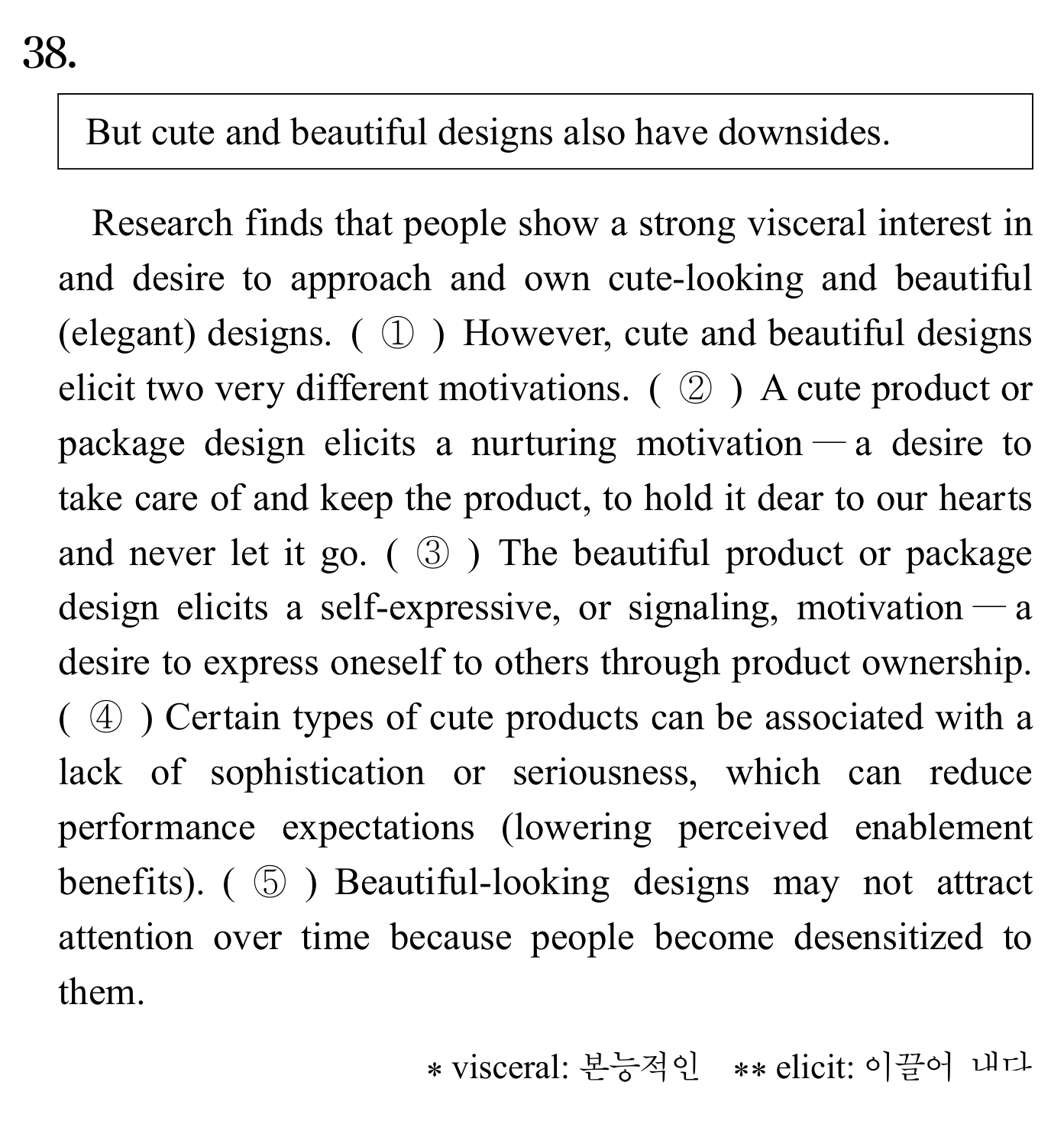
Research finds that people show a strong visceral interest in and desire to approach and own cute-looking and beautiful (elegant) designs. However, cute and beautiful designs elicit two very different motivations. A cute product or package design elicits a nurturing motivation — a desire to take care of and keep the product, to hold it dear to our hearts and never let it go. The beautiful product or package design elicits a self-expressive, or signaling, motivation — a desire to express oneself to others through product ownership. But cute and beautiful designs also have downsides. Certain types of cute products can be associated with a lack of sophistication or seriousness, which can reduce performance expectations (lowering perceived enablement benefits). Beautiful-looking designs may not attract attention over time because people become desensitized to them.
39번문장삽입2Researchers are studying how our everyday physical experiences in the world contribute to…
Researchers are studying how our everyday physical experiences in the world contribute to our understanding of mathematical concepts. The experience of walking along a path, for example, can be a metaphor for thinking about arithmetic. The path starts at some point 0 and as children walk along, every step takes them 1 unit further from the starting point; they can even take half steps or skip along two steps at a time. If they want to imagine what it might mean to add 5 and 9, they could think of first walking 9 steps and then walking 5 more. But that also helps them think about what 14-3 might mean because they can imagine walking backwards. They might be sitting still as they imagine all of this walking back and forth along their path; but they are reliving, at least in their imagination, the movement of their feet. If they close their eyes, they might even imagine the shape of the path, the smell of the trees, and the sound that is made when they step on the dried leaves.
40번요약문완성A serious deterioration in people’s working lives would be deeply disturbing to the socia…
A serious deterioration in people’s working lives would be deeply disturbing to the social order. Indeed, few consequences of technological change would be as dangerous. Today, the world of work is the main way that we share out the fruits of growth: for most people, their job is their main, if not their only, source of income. Technological unemployment would weaken that longstanding arrangement, encouraging an even more extreme version of inequality in which some people receive more income than others and many receive nothing at all. Nor would the disturbance be only economic. For many people, their work is both a source of income and of meaning. And with that in mind, the threat is even broader: not only that the labor market might be hollowed out, leaving some unable to find a good job and a reliable income, but that this sense of fulfilment that some people are fortunate to feel in their jobs might be hollowed out as well, leaving them unable to find purpose and live a satisfying life.
By creating unemployment, technology would upset the social order, affecting the (A) of wealth and possibly eliminating the emotional (B) that some discover in work.
41번장문_제목In technological design, an aspiration towards *seamlessness* aims to make the technologi…
In technological design, an aspiration towards *seamlessness* aims to make the technological experience for humans blend seamlessly into our everyday lives. Essentially, this aspiration aims towards experiences where people are no longer (a) aware of the technology, the interface or the differences between human-technology and human-human interaction. Considering the metaphor of seams in clothing, we can say that we aspire to seamless aesthetics by stitching the seams closely, pressing them flat and making sure they are (b) hidden on the inside so that we wear clothing rather than pieces of fabric. When designers and engineers talk about technological seamlessness, they are often referring to ease of use and convenience. For example, in interface design, an aspiration towards seamlessness (c) ensures the experience for the user flows and is not stressful or irritating. Most of us would have had experiences of (d) poor interface designs or apps in workplaces that make things more complicated and irritating, and have longed for more seamless interfaces. Technological seamlessness can also include less visible screens in new technologies, or virtual reality technologies with a seamless technological design. The aim is to immerse the user experience such that the visual interaction might be described as inside the screen rather than a body interacting with a digital console or object as separate entities. Similarly, seamlessness in humanoid robotic design aims to make humanoids (e) distinguishable from a human body.
---
(A) “Hi! I’m over here!” shouted Laura, waving brightly at Cathy at the entrance of Darlingdale Farmer’s Market. Seeing her friend, Cathy rushed over in delight. Cathy had recently moved into Laura’s town, and this was going to be (a) her first experience at a real farmer’s market. Born and raised in a big city, where large supermarkets were more common, Cathy had never had a chance to buy freshly-picked fruits or vegetables.
43번장문_순서(B) Carrying the bags of peaches, Cathy came back and noticed Laura holding a box of blue…
(B) Carrying the bags of peaches, Cathy came back and noticed Laura holding a box of blueberries and jars of jam. “Cathy, those peaches look delicious! I bought some blueberries. Would you like to go to my place and make blueberry pancakes together?” Laura asked. “Yes, that’s an excellent idea!” replied Cathy happily. As they walked out of the market, Cathy thanked her friend for the special experience, saying “(b) I really love this place! Thank you for the wonderful day.”
(C) Entering the market, Laura said, “Let me show you around. Are you ready?” Cathy answered excitedly, “Absolutely! I’m going to buy some fresh peaches!” The market was already crowded with people of all ages. “Cathy, you can taste the best of the season here,” said Laura. Cathy smiled and began to look around. Meanwhile, Laura found some strawberry jam for sale. She walked over to buy some. Curious to explore more, Cathy said, “While (c) you’re buying jam, I’ll look around the market and get some peaches.”
(D) Wandering away from Laura, Cathy began to search for peaches. Cathy walked past booths of fresh flowers and hand-made soaps, which smelled heavenly. From a fruit stand, (d) she picked out some beautiful, ripe peaches. The fruit seller told her, “Those peaches are a great choice because they’re only here until this week. If you miss them now, (e) you’ll have to wait another year for the season.” Hearing that, Cathy said, “Oh, I’ll get some more then! They’re really cheap!” She bought two bags of peaches.
2026학년도 6월 모의평가 영어 변형문제 맛보기
이 시험 지문으로 만든 변형문제가 아직 없습니다. 지문을 고르면 어법·빈칸·주제·어휘 등 유형별 변형문제를 바로 만들 수 있습니다.
이 시험으로 첫 변형문제 만들기 →남은 시간
48:00

아직 28문제를 풀지 않았어요 (0/28)