2025년 5월 고3 모의고사
28문제 · 제한시간 48분
이 시험 한눈에 — 2025년 5월 고3 모의고사
18~45번 28문항을 유형별로 보면 목적 1 · 심경/분위기 1 · 주장 1 · 함축의미추론 1 · 요지/주장 1 · 주제 1 · 제목 1 · 도표 1 · 내용일치 1 · 실용문 1 · 어법 2 · 어휘 1 · 빈칸추론2 1 · 빈칸추론3 1 · 빈칸추론4 1 · 빈칸추론5 1 · 무관한문장 1 · 순서배열1 1 · 순서배열2 1 · 문장삽입1 1 · 문장삽입2 1 · 요약문완성 1 · 장문 5. 아래 지문으로 변형문제·단어장·정답표를 바로 만들 수 있습니다.
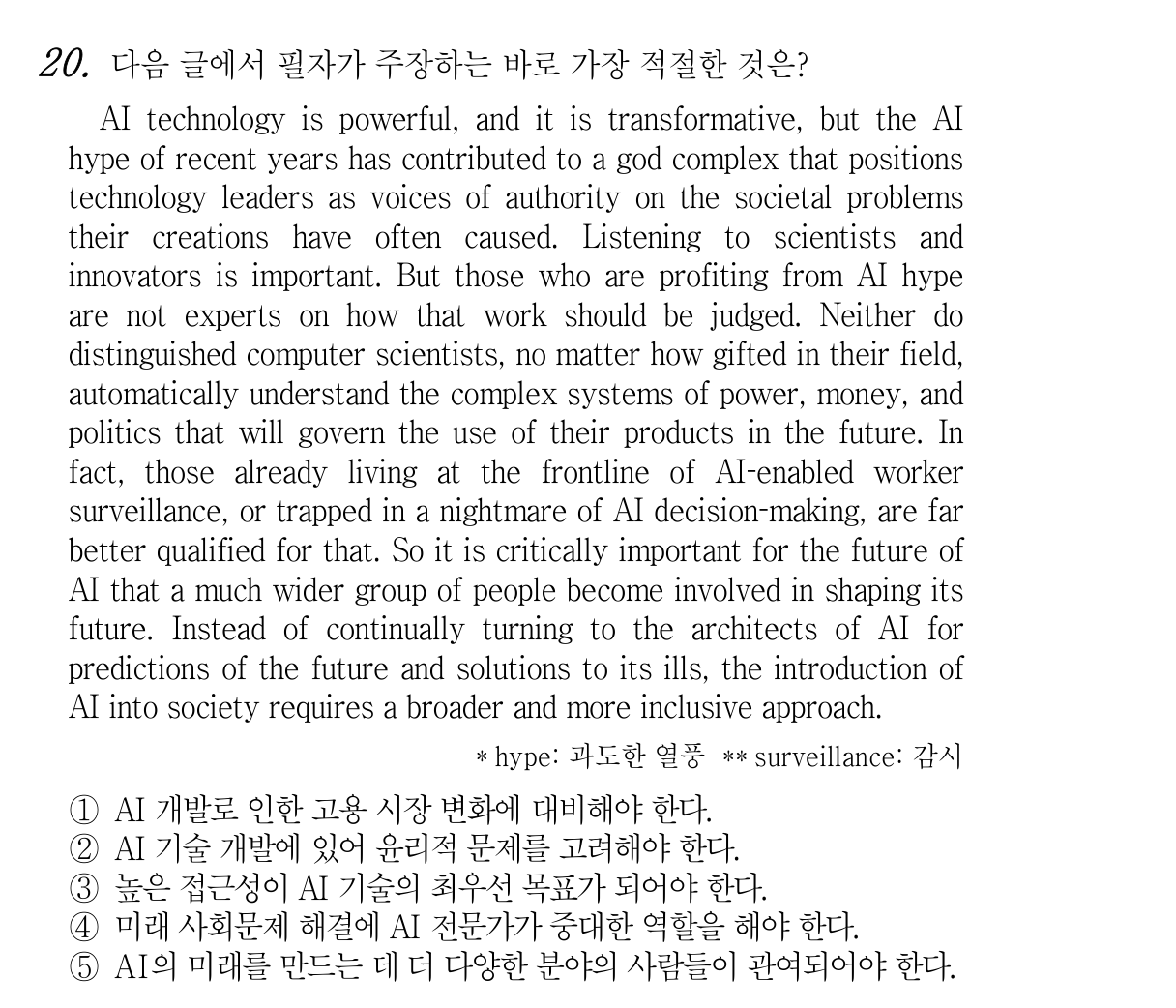
20번주장AI technology is powerful, and it is transformative, but the AI hype of recent years has…
AI technology is powerful, and it is transformative, but the AI hype of recent years has contributed to a god complex that positions technology leaders as voices of authority on the societal problems their creations have often caused. Listening to scientists and innovators is important. But those who are profiting from AI hype are not experts on how that work should be judged. Neither do distinguished computer scientists, no matter how gifted in their field, automatically understand the complex systems of power, money, and politics that will govern the use of their products in the future. In fact, those already living at the frontline of AI-enabled worker surveillance, or trapped in a nightmare of AI decision-making, are far better qualified for that. So it is critically important for the future of AI that a much wider group of people become involved in shaping its future. Instead of continually turning to the architects of AI for predictions of the future and solutions to its ills, the introduction of AI into society requires a broader and more inclusive approach.
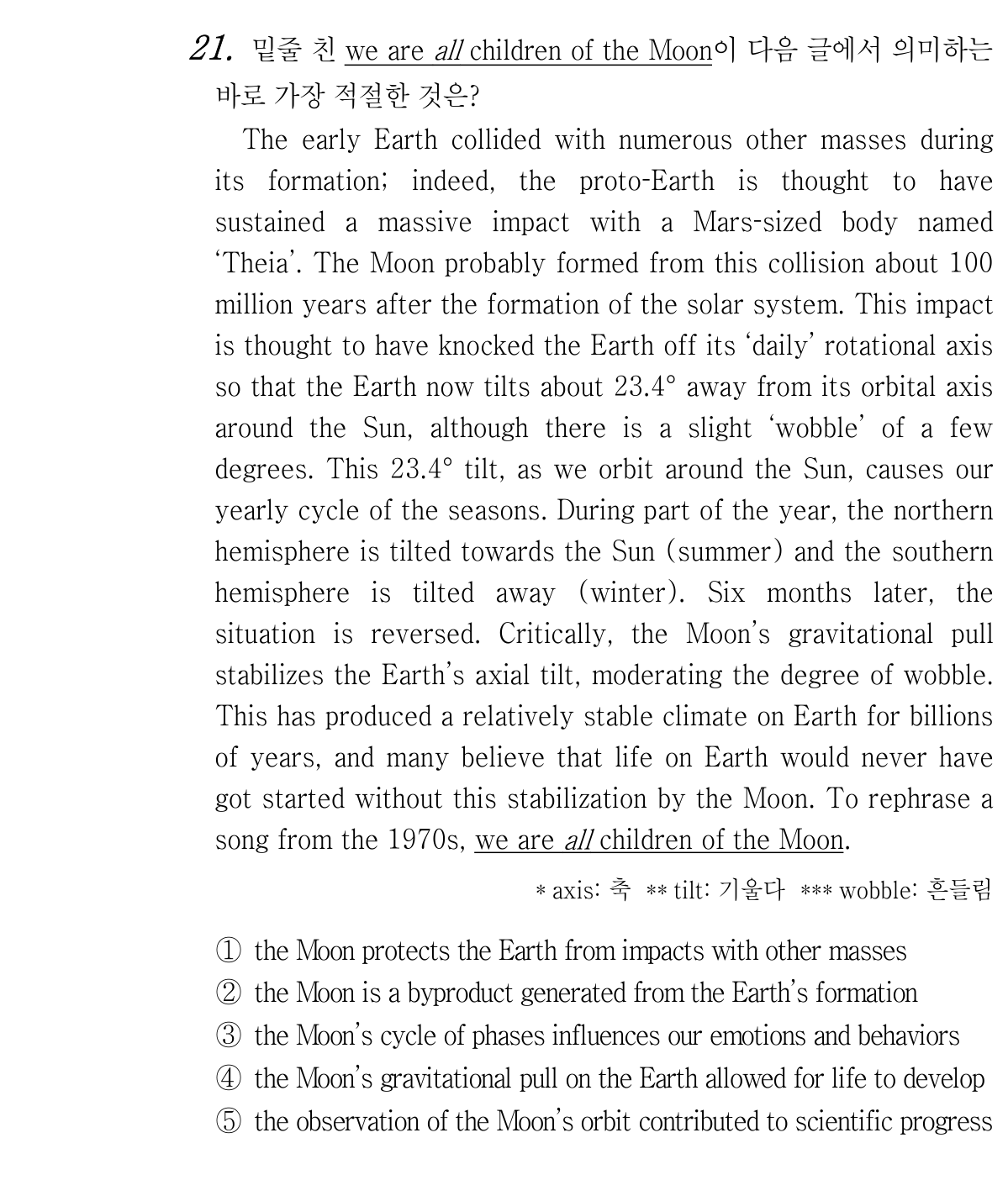
21번함축의미추론The early Earth collided with numerous other masses during its formation; indeed, the pro…
The early Earth collided with numerous other masses during its formation; indeed, the proto-Earth is thought to have sustained a massive impact with a Mars-sized body named ‘Theia’. The Moon probably formed from this collision about 100 million years after the formation of the solar system. This impact is thought to have knocked the Earth off its ‘daily’ rotational axis so that the Earth now tilts about 23.4° away from its orbital axis around the Sun, although there is a slight ‘wobble’ of a few degrees. This 23.4° tilt, as we orbit around the Sun, causes our yearly cycle of the seasons. During part of the year, the northern hemisphere is tilted towards the Sun (summer) and the southern hemisphere is tilted away (winter). Six months later, the situation is reversed. Critically, the Moon’s gravitational pull stabilizes the Earth’s axial tilt, moderating the degree of wobble. This has produced a relatively stable climate on Earth for billions of years, and many believe that life on Earth would never have got started without this stabilization by the Moon. To rephrase a song from the 1970s, we are *all* children of the Moon.
22번요지/주장Whether or not an observation is evidence for a person depends crucially on what the pers…
Whether or not an observation is evidence for a person depends crucially on what the person is bringing to the table in terms of background knowledge. The physician sees the Koplik spots *as* Koplik spots and thereby gains evidence for her belief that the patient is coming down with the measles. I, a nonexpert, see the same spots, but I do not see them *as* Koplik spots. Thus, they are not evidence for me, because they don't provide me with good reasons for believing that I am confronted with a case of the measles. Only observations that are seen *as* this or that can be evidence for (or against) some hypothesis. Another way of putting the same point is this: During the processing of sensory stimuli, we bring—often automatically—various categories, background knowledge, and similar things, to bear. Thus, categorized observations are what constitutes evidence. Some might worry that we are overintellectualizing evidence. However, it seems to us that in the empirical sciences, unconceptualized experiences hardly ever play a role as evidence.
23번주제Some multinational IT companies, which generate revenue through digital advertising and d…
Some multinational IT companies, which generate revenue through digital advertising and data collection, have been accused of exploiting loopholes in international tax regimes to shift profits to low-tax territories. This practice, known as profit shifting, allows corporations to pay minimal taxes in the countries where they operate, depriving governments of critical revenue. In response, several countries have attempted to impose digital services taxes on tech giants, but these efforts have been met with fierce resistance. Corporations argue that such taxes unfairly target their business models, while governments contend that they are necessary to level the playing field and ensure that corporations contribute their fair share to the public good. These disputes over taxation illustrate the broader challenge that governments face in regulating multinational corporations. Meanwhile, traditional regulatory frameworks, designed for nation-bound businesses, are often ill-equipped to address the complexities of global operations. As a result, corporations are frequently able to avoid or undermine regulations, operating in a legal gray area where national laws cannot easily reach them.
24번제목Time denial, rooted in a very human combination of pride and existential dread, is perhap…
Time denial, rooted in a very human combination of pride and existential dread, is perhaps the most common and forgivable form of what might be called *chronophobia*. But there are other, more toxic varieties that work together with the less harmful kind to create a prevalent, stubborn, and dangerous temporal illiteracy in our society. We in the twenty-first century would be shocked if an educated adult were unable to identify the continents on a world map, yet we are quite comfortable with widespread ignorance about anything but the most superficial highlights from the planet's long history: perhaps the Bering Strait, dinosaurs, or Pangaea. Most humans have no sense of temporal proportion — the *durations* of the great chapters in Earth's history, the *rates* of change during previous intervals of environmental instability, the *intrinsic timescales* of "natural capital" like groundwater systems. As a species, we have a childlike disinterest and partial disbelief in the time before our appearance on Earth. With no appetite for stories lacking humans, many people simply can't be bothered with natural history.
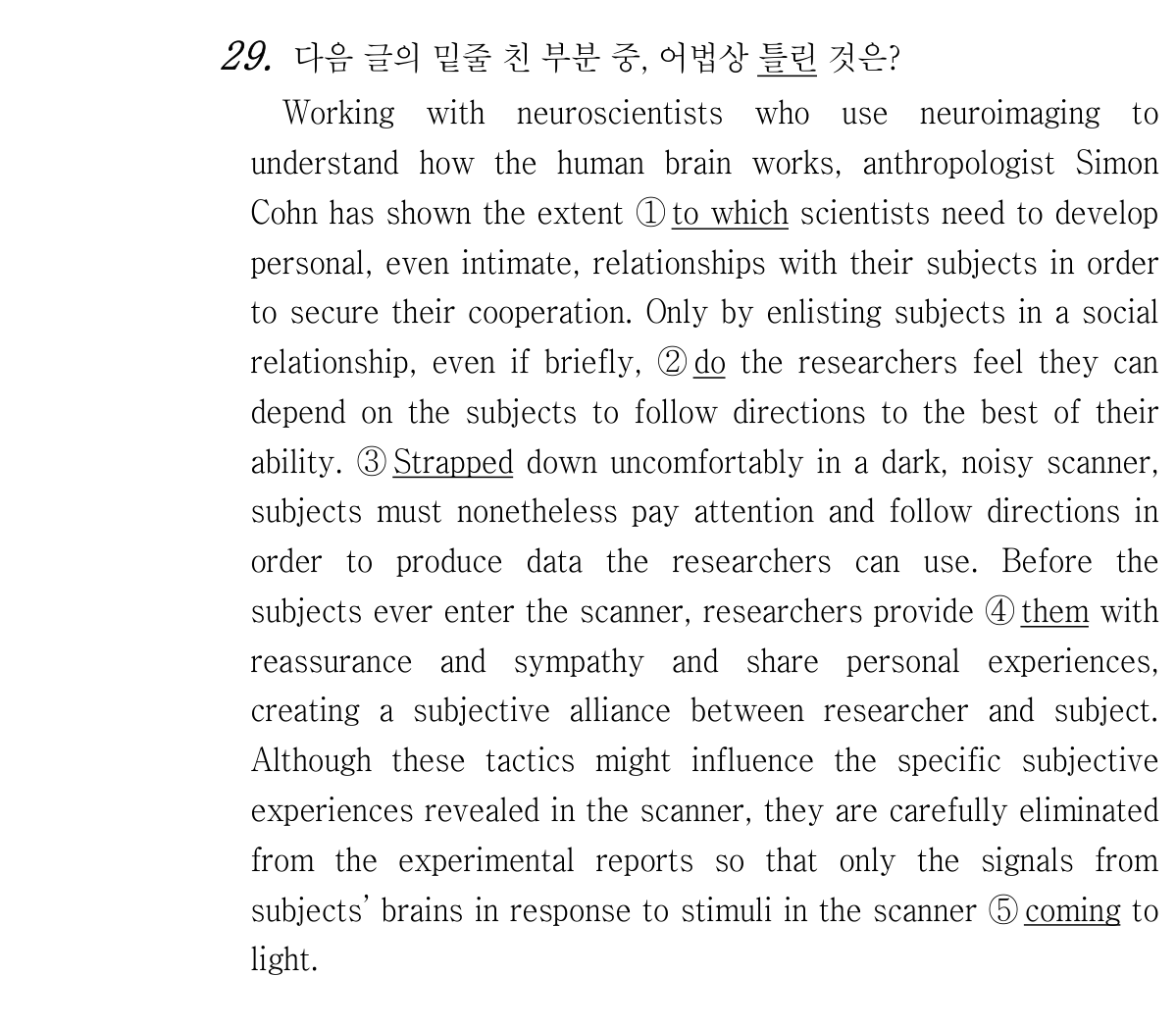
29번어법Working with neuroscientists who use neuroimaging to understand how the human brain works…
Working with neuroscientists who use neuroimaging to understand how the human brain works, anthropologist Simon Cohn has shown the extent to which scientists need to develop personal, even intimate, relationships with their subjects in order to secure their cooperation. Only by enlisting subjects in a social relationship, even if briefly, do the researchers feel they can depend on the subjects to follow directions to the best of their ability. Strapped down uncomfortably in a dark, noisy scanner, subjects must nonetheless pay attention and follow directions in order to produce data the researchers can use. Before the subjects ever enter the scanner, researchers provide them with reassurance and sympathy and share personal experiences, creating a subjective alliance between researcher and subject. Although these tactics might influence the specific subjective experiences revealed in the scanner, they are carefully eliminated from the experimental reports so that only the signals from subjects' brains in response to stimuli in the scanner come to light.
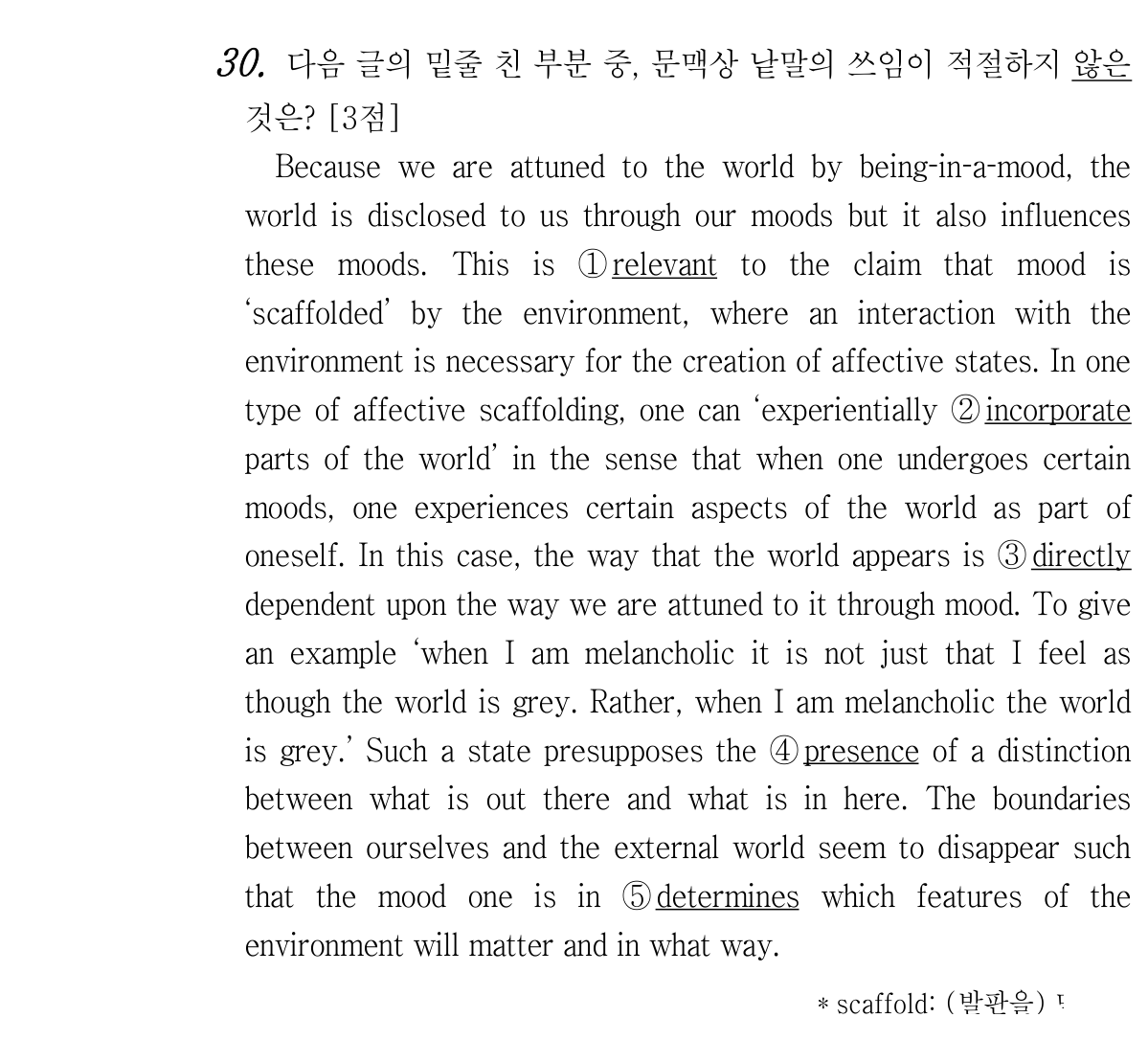
30번어휘Because we are attuned to the world by being-in-a-mood, the world is disclosed to us thro…
Because we are attuned to the world by being-in-a-mood, the world is disclosed to us through our moods but it also influences these moods. This is relevant to the claim that mood is ‘scaffolded’ by the environment, where an interaction with the environment is necessary for the creation of affective states. In one type of affective scaffolding, one can ‘experientially incorporate parts of the world’ in the sense that when one undergoes certain moods, one experiences certain aspects of the world as part of oneself. In this case, the way that the world appears is directly dependent upon the way we are attuned to it through mood. To give an example ‘when I am melancholic it is not just that I feel as though the world is grey. Rather, when I am melancholic the world is grey.’ Such a state presupposes the absence of a distinction between what is out there and what is in here. The boundaries between ourselves and the external world seem to disappear such that the mood one is in determines which features of the environment will matter and in what way.
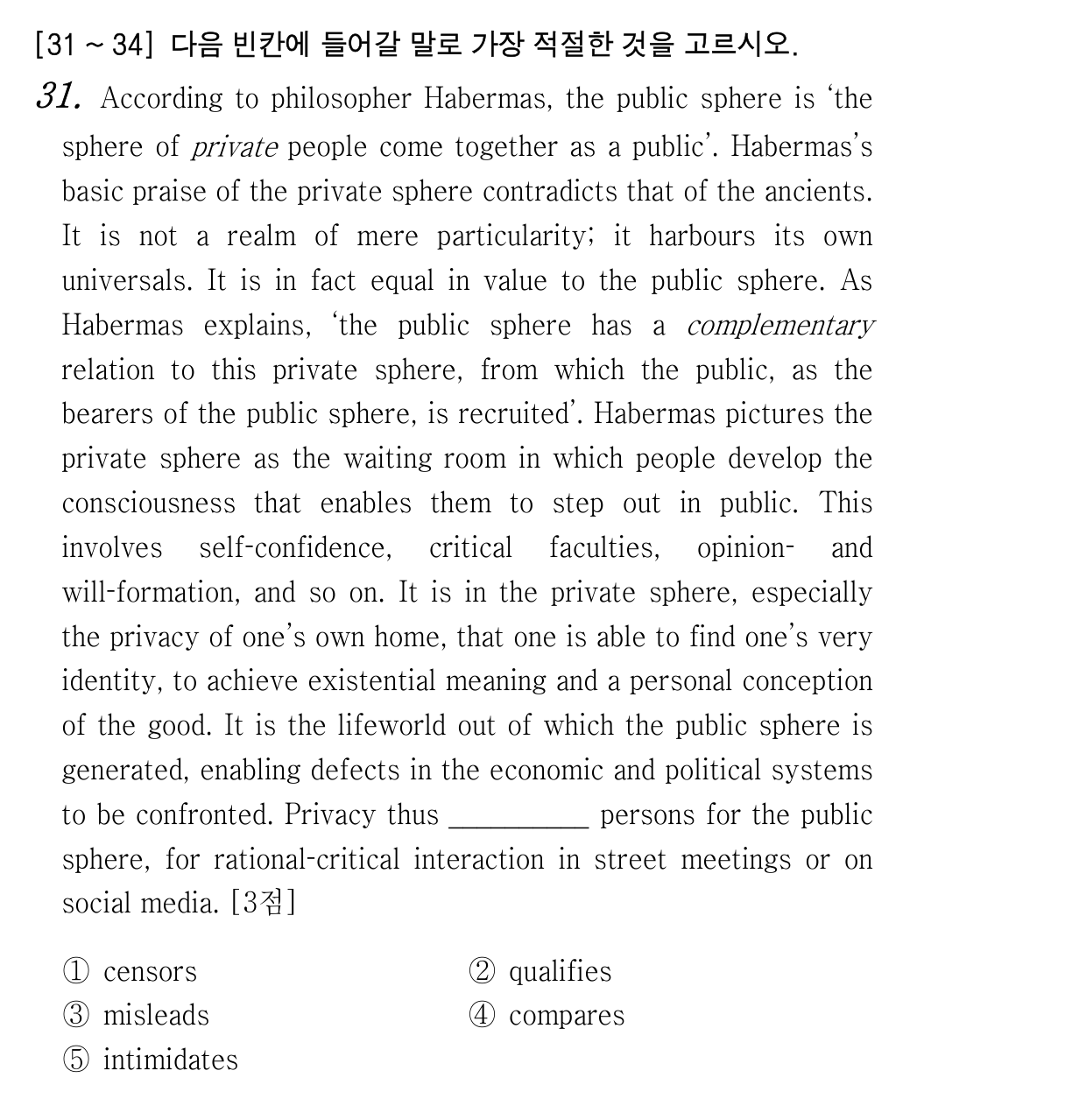
31번빈칸추론2According to philosopher Habermas, the public sphere is ‘the sphere of private people com…
According to philosopher Habermas, the public sphere is ‘the sphere of private people come together as a public’. Habermas’s basic praise of the private sphere contradicts that of the ancients. It is not a realm of mere particularity; it harbours its own universals. It is in fact equal in value to the public sphere. As Habermas explains, ‘the public sphere has a complementary relation to this private sphere, from which the public, as the bearers of the public sphere, is recruited’. Habermas pictures the private sphere as the waiting room in which people develop the consciousness that enables them to step out in public. This involves self-confidence, critical faculties, opinion- and will-formation, and so on. It is in the private sphere, especially the privacy of one’s own home, that one is able to find one’s very identity, to achieve existential meaning and a personal conception of the good. It is the lifeworld out of which the public sphere is generated, enabling defects in the economic and political systems to be confronted. Privacy thus qualifies persons for the public sphere, for rational-critical interaction in street meetings or on social media.
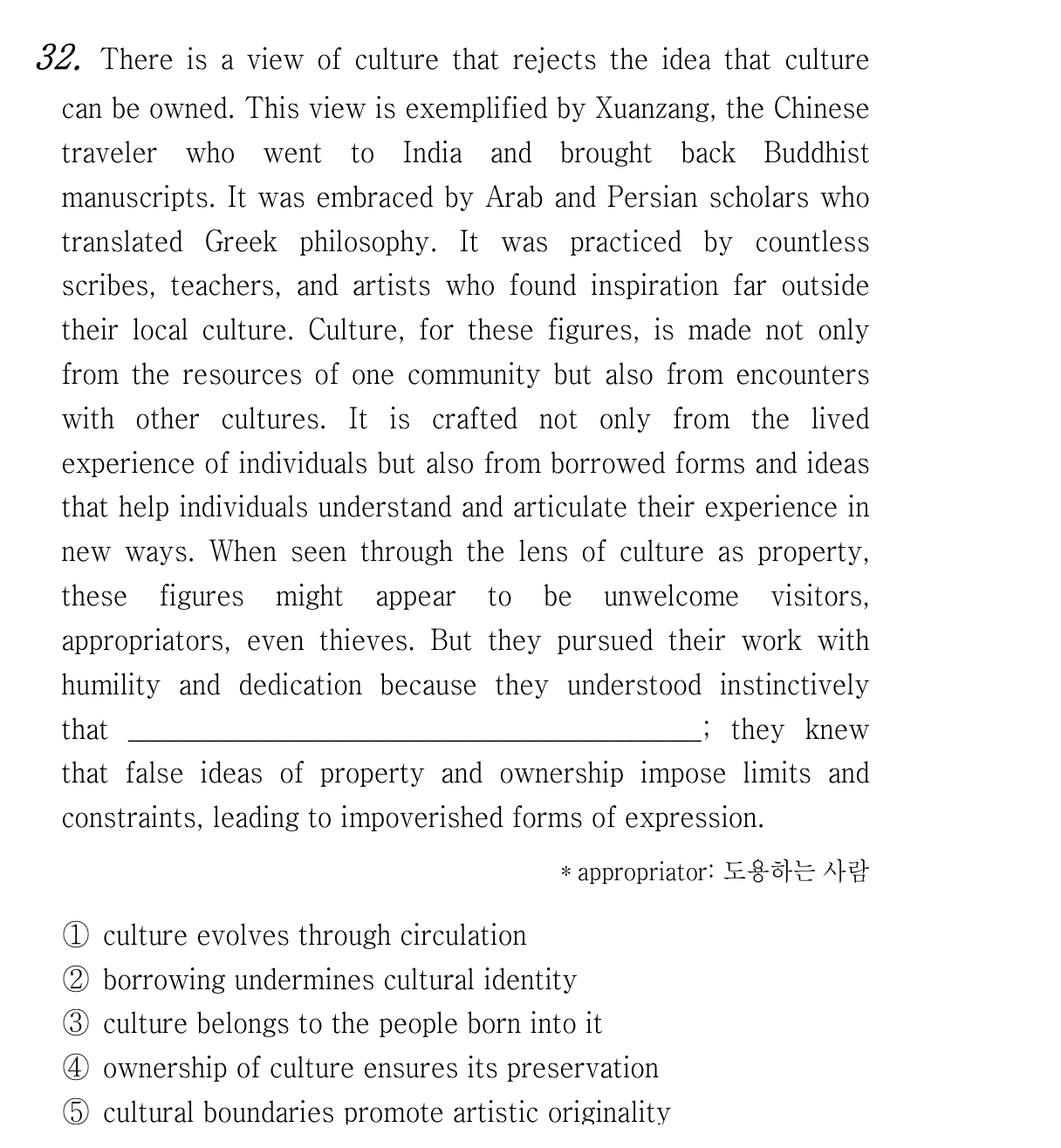
32번빈칸추론3There is a view of culture that rejects the idea that culture can be owned.
There is a view of culture that rejects the idea that culture can be owned. This view is exemplified by Xuanzang, the Chinese traveler who went to India and brought back Buddhist manuscripts. It was embraced by Arab and Persian scholars who translated Greek philosophy. It was practiced by countless scribes, teachers, and artists who found inspiration far outside their local culture. Culture, for these figures, is made not only from the resources of one community but also from encounters with other cultures. It is crafted not only from the lived experience of individuals but also from borrowed forms and ideas that help individuals understand and articulate their experience in new ways. When seen through the lens of culture as property, these figures might appear to be unwelcome visitors, appropriators, even thieves. But they pursued their work with humility and dedication because they understood instinctively that culture evolves through circulation; they knew that false ideas of property and ownership impose limits and constraints, leading to impoverished forms of expression.
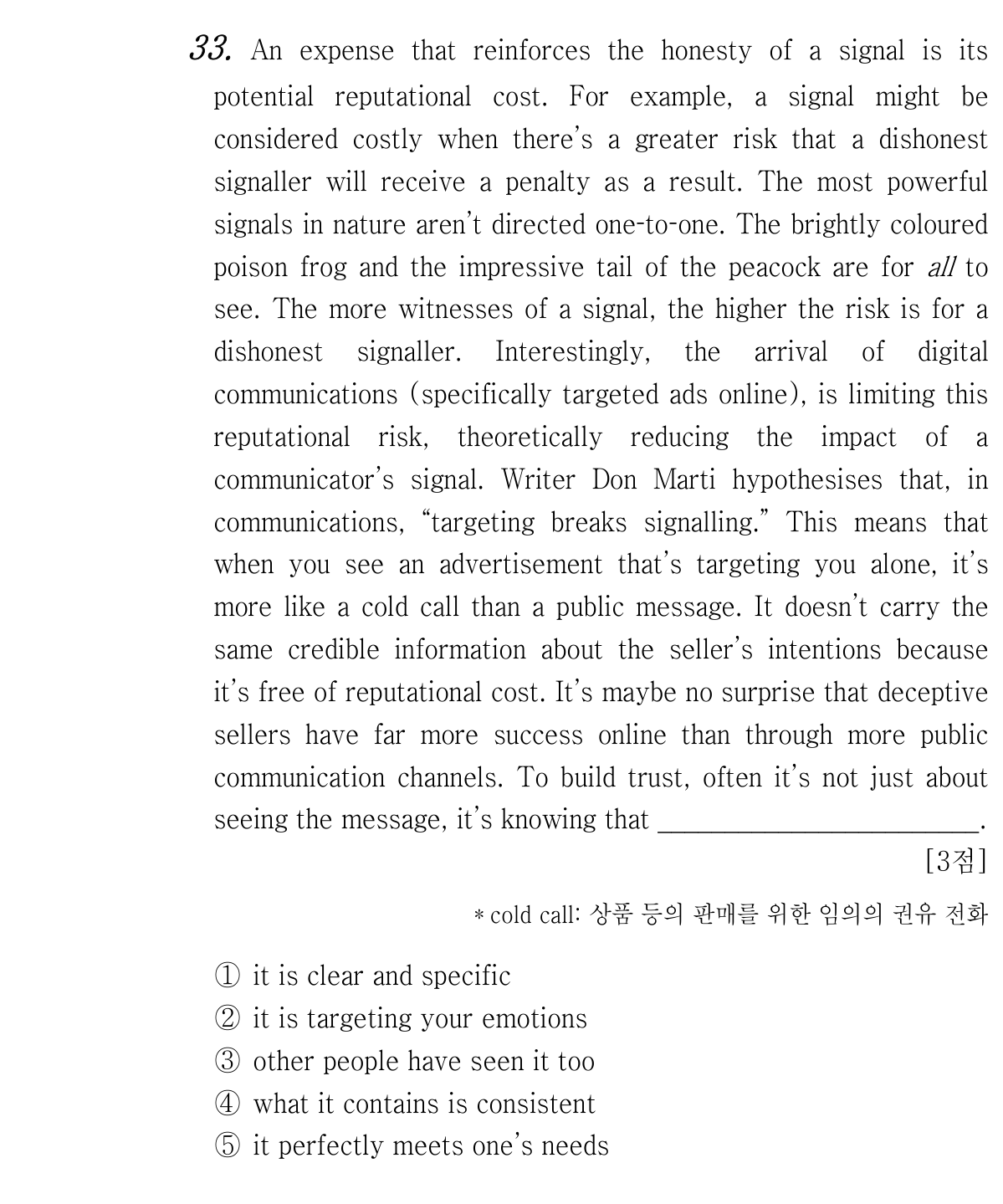
33번빈칸추론4An expense that reinforces the honesty of a signal is its potential reputational cost.
An expense that reinforces the honesty of a signal is its potential reputational cost. For example, a signal might be considered costly when there's a greater risk that a dishonest signaller will receive a penalty as a result. The most powerful signals in nature aren't directed one-to-one. The brightly coloured poison frog and the impressive tail of the peacock are for *all* to see. The more witnesses of a signal, the higher the risk is for a dishonest signaller. Interestingly, the arrival of digital communications (specifically targeted ads online), is limiting this reputational risk, theoretically reducing the impact of a communicator's signal. Writer Don Marti hypothesises that, in communications, "targeting breaks signalling." This means that when you see an advertisement that's targeting you alone, it's more like a cold call than a public message. It doesn't carry the same credible information about the seller's intentions because it's free of reputational cost. It's maybe no surprise that deceptive sellers have far more success online than through more public communication channels. To build trust, often it's not just about seeing the message, it's knowing that other people have seen it too.
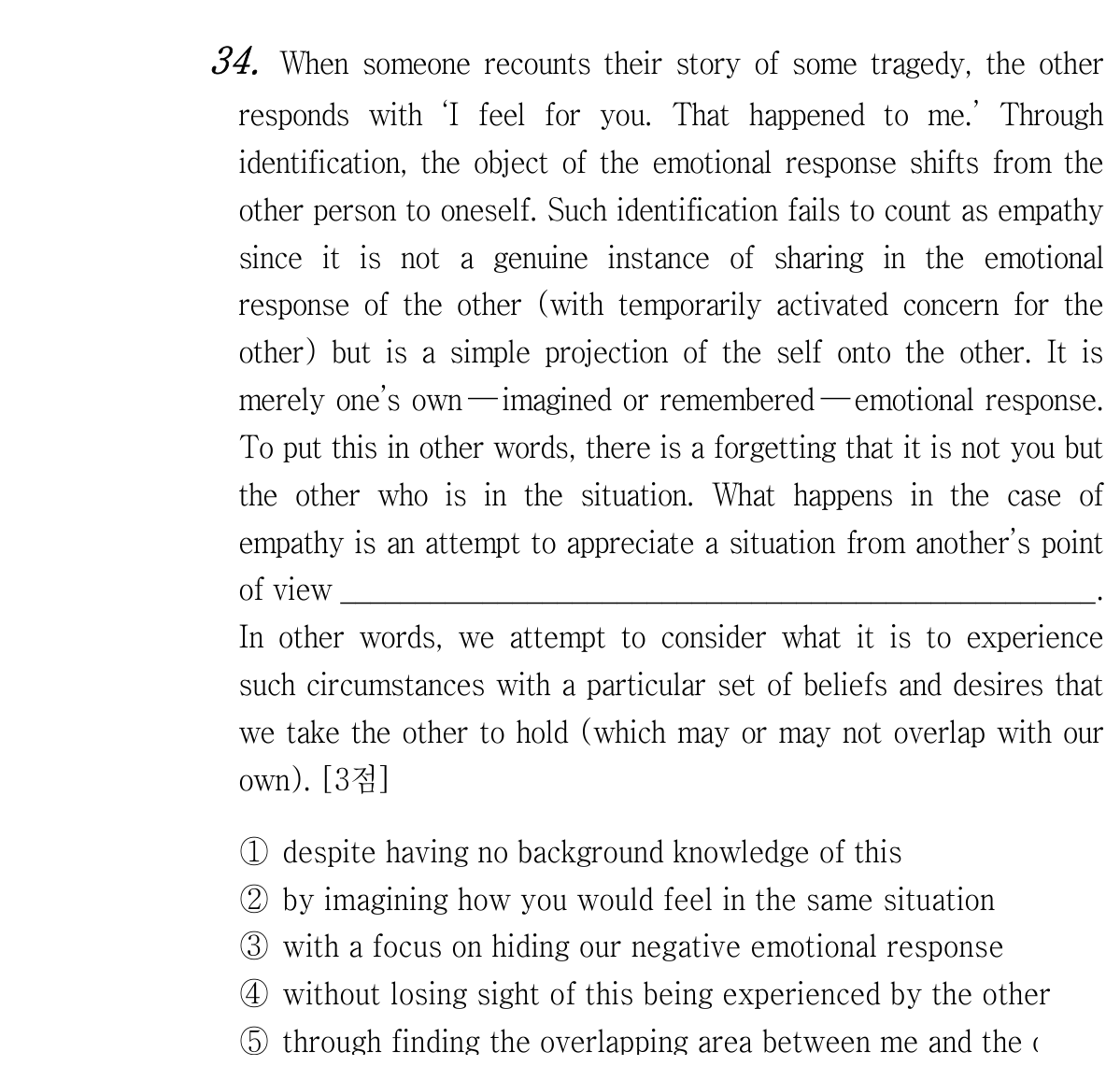
34번빈칸추론5When someone recounts their story of some tragedy, the other responds with ‘I feel for yo…
When someone recounts their story of some tragedy, the other responds with ‘I feel for you. That happened to me.’ Through identification, the object of the emotional response shifts from the other person to oneself. Such identification fails to count as empathy since it is not a genuine instance of sharing in the emotional response of the other (with temporarily activated concern for the other) but is a simple projection of the self onto the other. It is merely one’s own—imagined or remembered—emotional response. To put this in other words, there is a forgetting that it is not you but the other who is in the situation. What happens in the case of empathy is an attempt to appreciate a situation from another’s point of view without losing sight of this being experienced by the other. In other words, we attempt to consider what it is to experience such circumstances with a particular set of beliefs and desires that we take the other to hold (which may or may not overlap with our own).
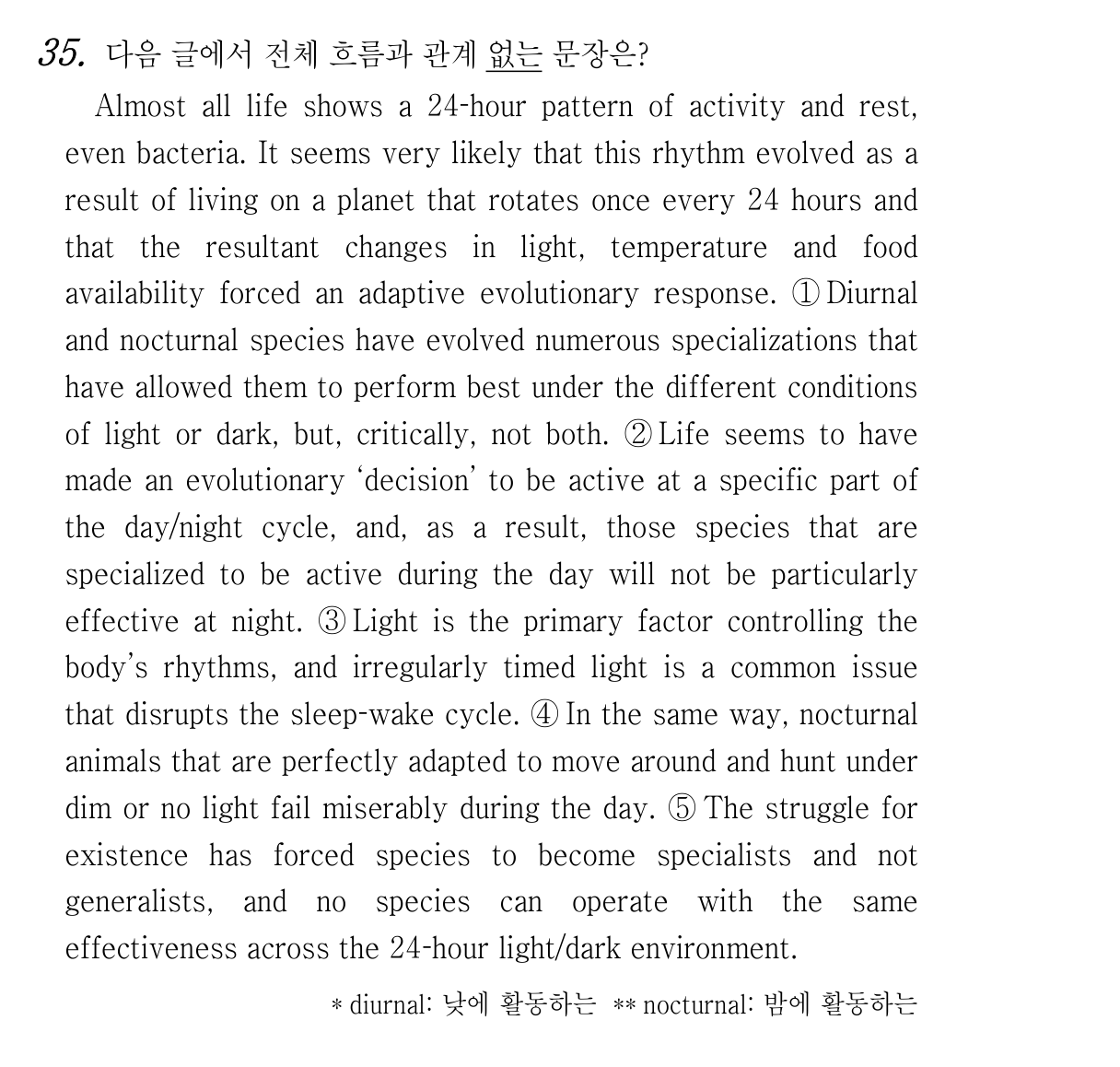
35번무관한문장Almost all life shows a 24-hour pattern of activity and rest, even bacteria.
Almost all life shows a 24-hour pattern of activity and rest, even bacteria. It seems very likely that this rhythm evolved as a result of living on a planet that rotates once every 24 hours and that the resultant changes in light, temperature and food availability forced an adaptive evolutionary response. Diurnal and nocturnal species have evolved numerous specializations that have allowed them to perform best under the different conditions of light or dark, but, critically, not both. Life seems to have made an evolutionary 'decision' to be active at a specific part of the day/night cycle, and, as a result, those species that are specialized to be active during the day will not be particularly effective at night. In the same way, nocturnal animals that are perfectly adapted to move around and hunt under dim or no light fail miserably during the day. The struggle for existence has forced species to become specialists and not generalists, and no species can operate with the same effectiveness across the 24-hour light/dark environment.
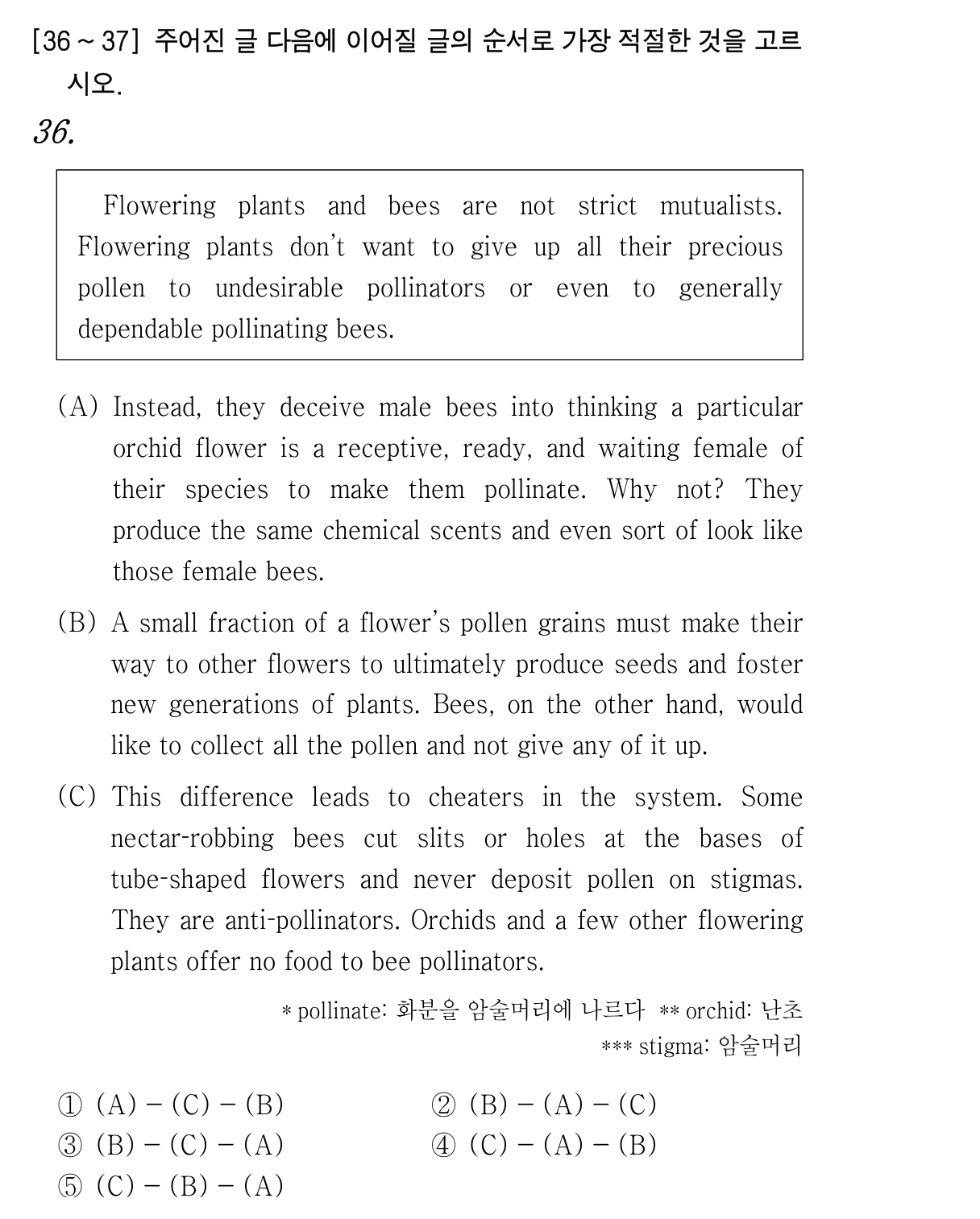
36번순서배열1Flowering plants and bees are not strict mutualists.
Flowering plants and bees are not strict mutualists. Flowering plants don’t want to give up all their precious pollen to undesirable pollinators or even to generally dependable pollinating bees. A small fraction of a flower’s pollen grains must make their way to other flowers to ultimately produce seeds and foster new generations of plants. Bees, on the other hand, would like to collect all the pollen and not give any of it up. This difference leads to cheaters in the system. Some nectar-robbing bees cut slits or holes at the bases of tube-shaped flowers and never deposit pollen on stigmas. They are anti-pollinators. Orchids and a few other flowering plants offer no food to bee pollinators. Instead, they deceive male bees into thinking a particular orchid flower is a receptive, ready, and waiting female of their species to make them pollinate. Why not? They produce the same chemical scents and even sort of look like those female bees.
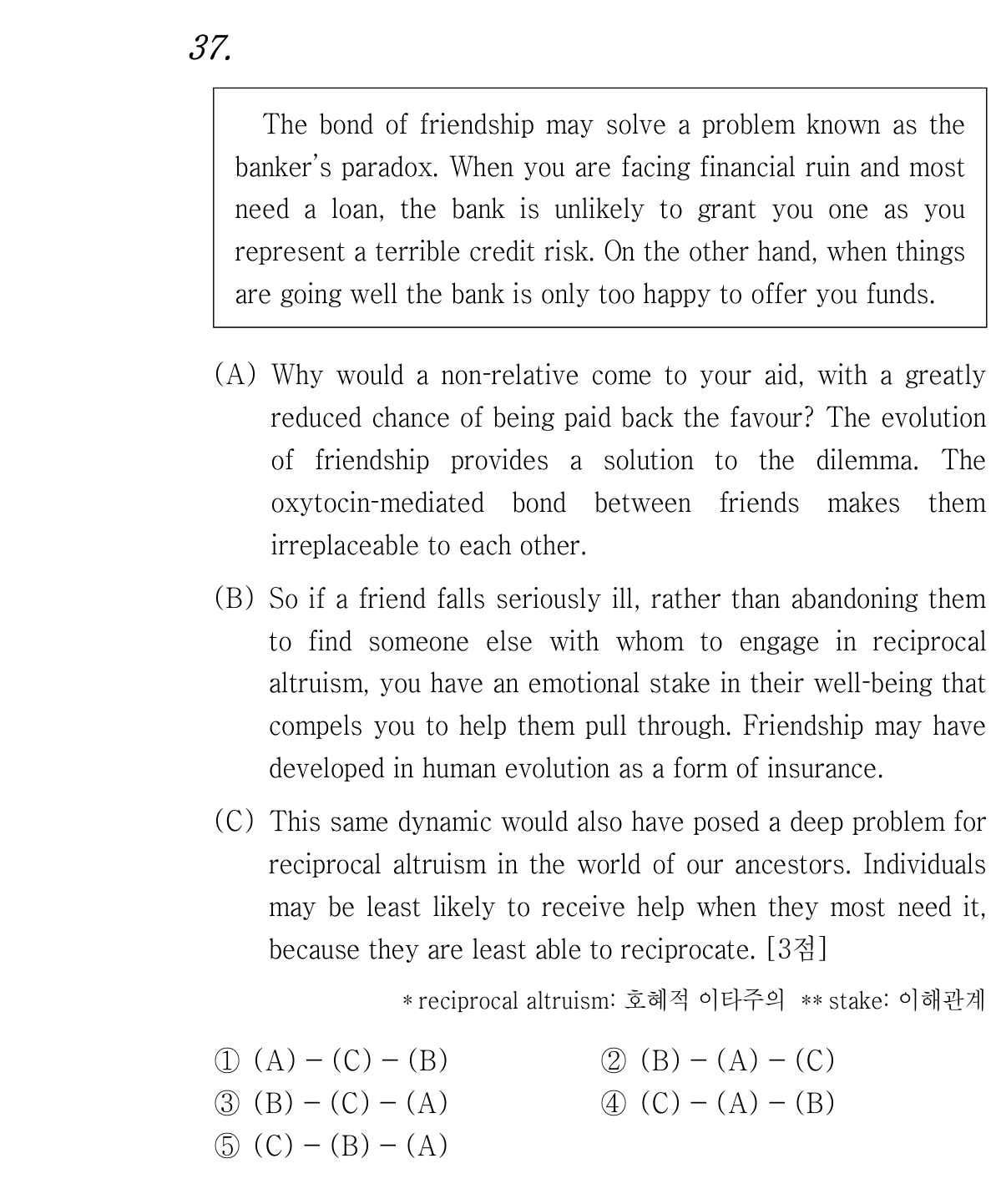
37번순서배열2The bond of friendship may solve a problem known as the banker’s paradox.
The bond of friendship may solve a problem known as the banker’s paradox. When you are facing financial ruin and most need a loan, the bank is unlikely to grant you one as you represent a terrible credit risk. On the other hand, when things are going well the bank is only too happy to offer you funds. This same dynamic would also have posed a deep problem for reciprocal altruism in the world of our ancestors. Individuals may be least likely to receive help when they most need it, because they are least able to reciprocate. Why would a non-relative come to your aid, with a greatly reduced chance of being paid back the favour? The evolution of friendship provides a solution to the dilemma. The oxytocin-mediated bond between friends makes them irreplaceable to each other. So if a friend falls seriously ill, rather than abandoning them to find someone else with whom to engage in reciprocal altruism, you have an emotional stake in their well-being that compels you to help them pull through. Friendship may have developed in human evolution as a form of insurance.
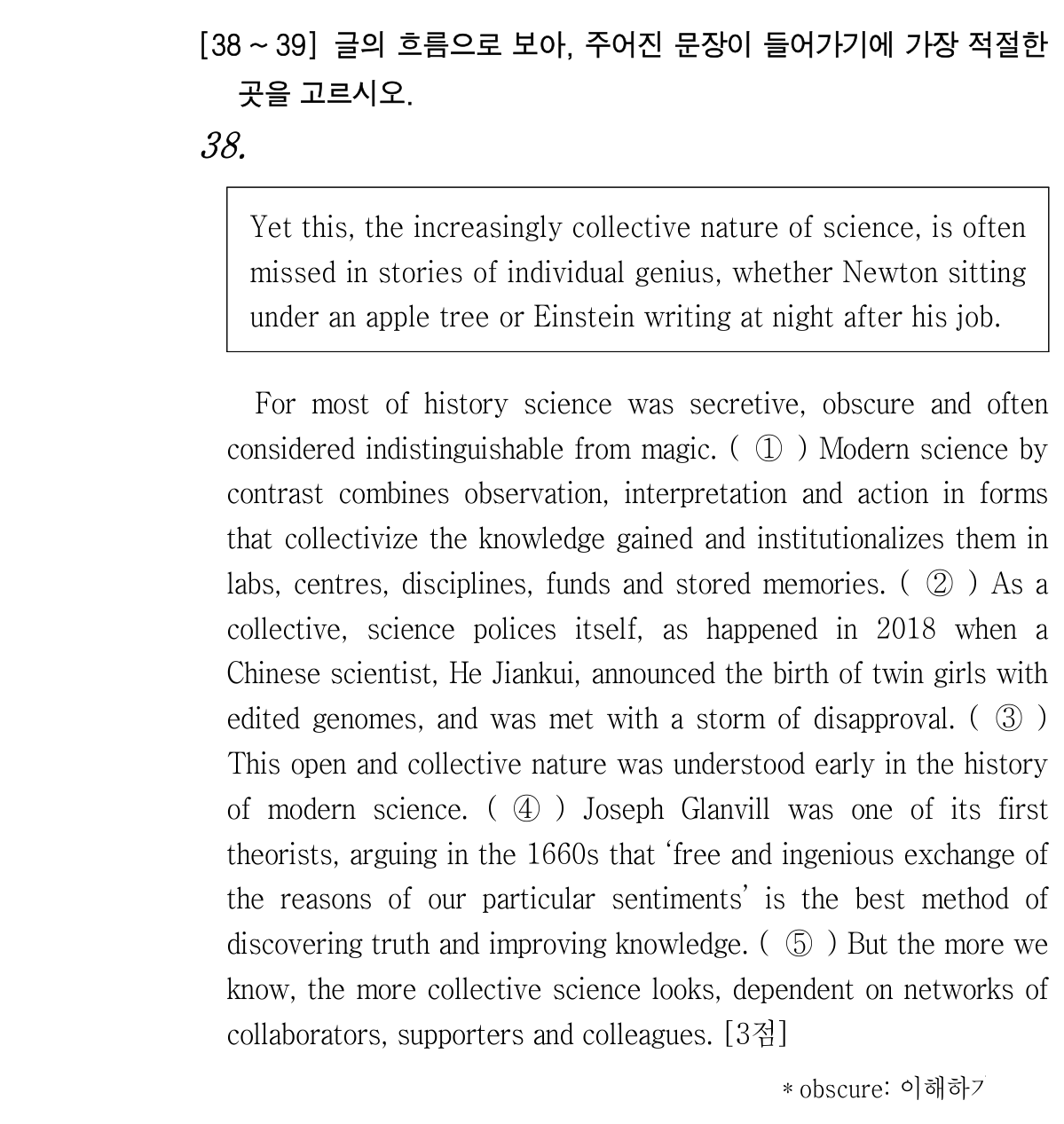
38번문장삽입1For most of history science was secretive, obscure and often considered indistinguishable…
For most of history science was secretive, obscure and often considered indistinguishable from magic. Modern science by contrast combines observation, interpretation and action in forms that collectivize the knowledge gained and institutionalizes them in labs, centres, disciplines, funds and stored memories. As a collective, science polices itself, as happened in 2018 when a Chinese scientist, He Jiankui, announced the birth of twin girls with edited genomes, and was met with a storm of disapproval. This open and collective nature was understood early in the history of modern science. Joseph Glanvill was one of its first theorists, arguing in the 1660s that ‘free and ingenious exchange of the reasons of our particular sentiments’ is the best method of discovering truth and improving knowledge. Yet this, the increasingly collective nature of science, is often missed in stories of individual genius, whether Newton sitting under an apple tree or Einstein writing at night after his job. But the more we know, the more collective science looks, dependent on networks of collaborators, supporters and colleagues.
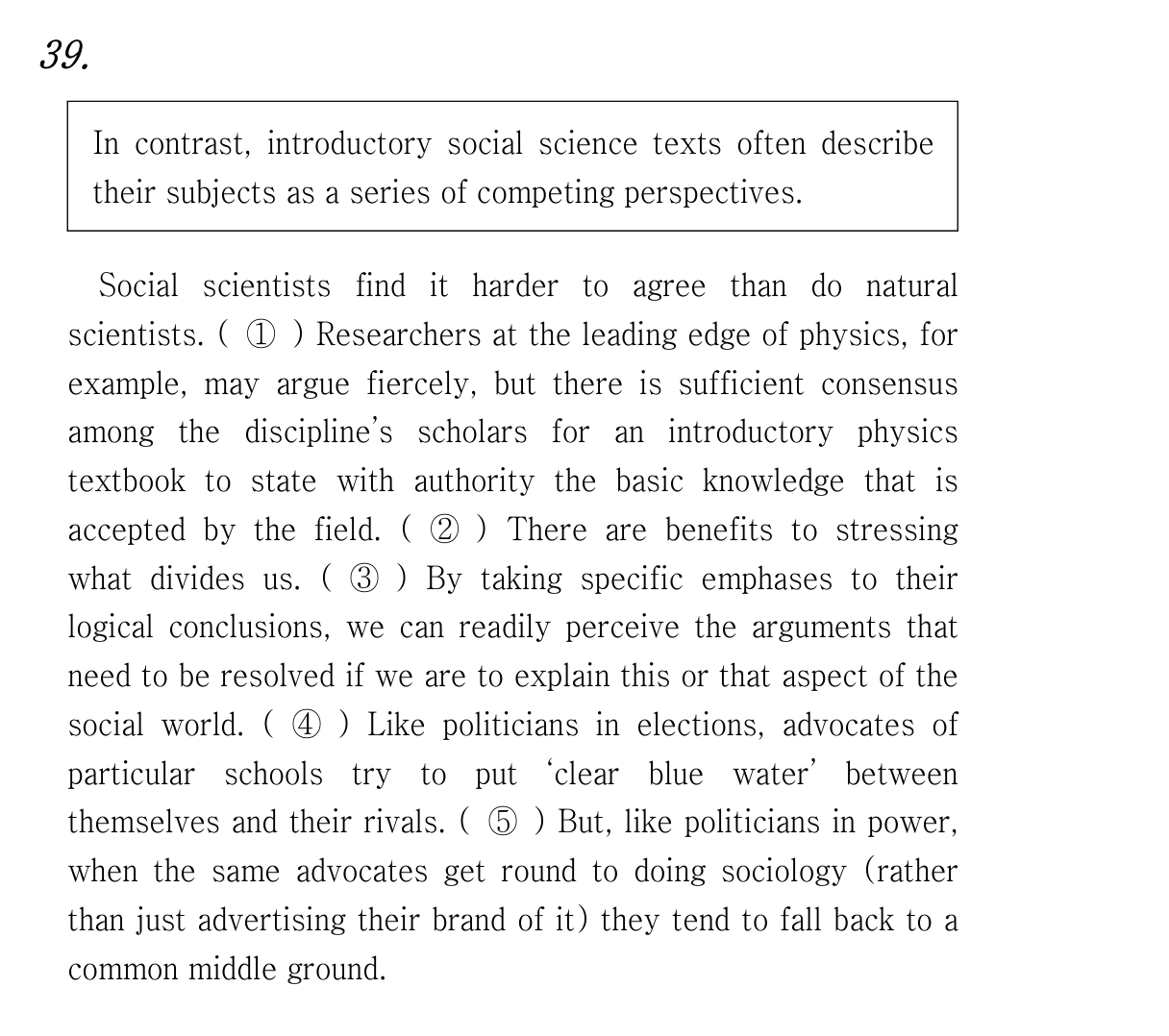
39번문장삽입2Social scientists find it harder to agree than do natural scientists.
Social scientists find it harder to agree than do natural scientists. Researchers at the leading edge of physics, for example, may argue fiercely, but there is sufficient consensus among the discipline's scholars for an introductory physics textbook to state with authority the basic knowledge that is accepted by the field. In contrast, introductory social science texts often describe their subjects as a series of competing perspectives. There are benefits to stressing what divides us. By taking specific emphases to their logical conclusions, we can readily perceive the arguments that need to be resolved if we are to explain this or that aspect of the social world. Like politicians in elections, advocates of particular schools try to put ‘clear blue water’ between themselves and their rivals. But, like politicians in power, when the same advocates get round to doing sociology (rather than just advertising their brand of it) they tend to fall back to a common middle ground.
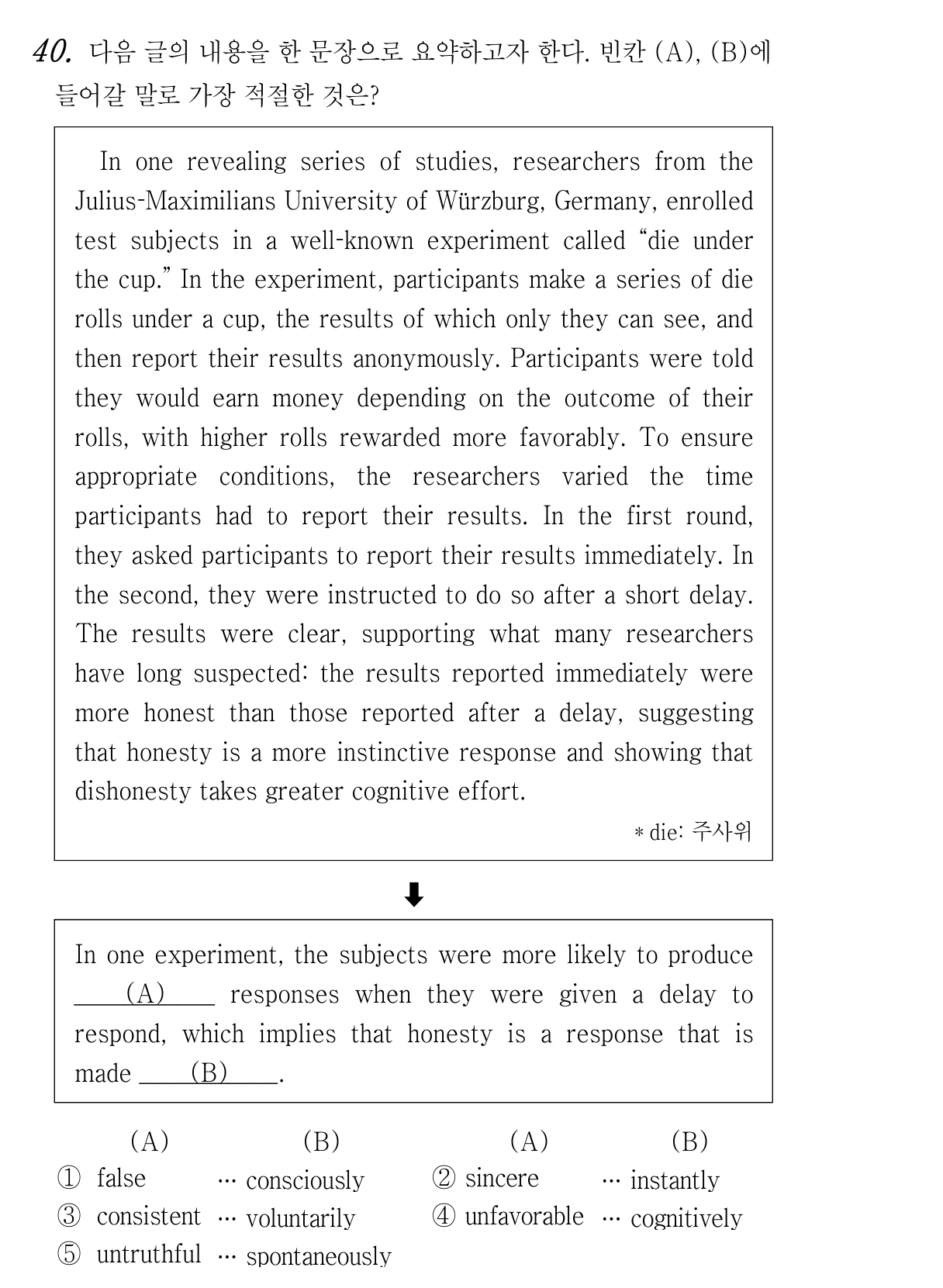
40번요약문완성In one revealing series of studies, researchers from the Julius-Maximilians University of…
In one revealing series of studies, researchers from the Julius-Maximilians University of Würzburg, Germany, enrolled test subjects in a well-known experiment called “die under the cup.” In the experiment, participants make a series of die rolls under a cup, the results of which only they can see, and then report their results anonymously. Participants were told they would earn money depending on the outcome of their rolls, with higher rolls rewarded more favorably. To ensure appropriate conditions, the researchers varied the time participants had to report their results. In the first round, they asked participants to report their results immediately. In the second, they were instructed to do so after a short delay. The results were clear, supporting what many researchers have long suspected: the results reported immediately were more honest than those reported after a delay, suggesting that honesty is a more instinctive response and showing that dishonesty takes greater cognitive effort.
In one experiment, the subjects were more likely to produce (A) responses when they were given a delay to respond, which implies that honesty is a response that is made (B).
41번장문_제목Our ability to simulate the future — which gives Present You a chance to walk in Future Y…
Our ability to simulate the future — which gives Present You a chance to walk in Future You’s shoes — provides human brains with a huge evolutionary advantage, but it also has some limitations. For one, the simulations don’t predict emotional (a) intensity well. We imagine it’s scary skydiving, but it’s *definitely* scarier once a 200-pound man strapped to your back slowly pushes your toes to the edge. Jumping out of a plane is just an idea that’s somewhat disconnected from reality until it’s actually happening. In the same way, what Future You will be thinking and feeling is just an (b) abstract idea until Future You becomes Present You.
When we make a decision to put something off, we can simulate what the consequences of that decision will be — we’ll have less time to work on something, people might get frustrated with us, and we might run into unexpected problems. But the simulation of what our procrastination will feel like is usually more charitable than the reality — we (c) overestimate the stress it will cause, the guilt we’ll feel for continuing the pattern, or the disappointment that will stem from a missed opportunity. So, even the best human simulators have limitations. Procrastinators’ simulators are (d) weak in general, and they struggle to consider the consequences of their choices. They’re more concerned about what they’re doing and how they’re feeling in this moment and less concerned about the future. As a result, they keep (e) prioritizing what they want right now over what they’ll need in the future.
43번장문_순서(A) A gardener saw his young son sitting quietly, his eyes filled with tears.
(A) A gardener saw his young son sitting quietly, his eyes filled with tears. Concerned, he gently asked, “What’s troubling you, son?” The boy looked up and said, with (a) his voice trembling, “My classmates mock me every time I lose a race. They laugh and say that I am slow and weak.” The father paused, then spoke softly, “Come with me, son. Let’s spend some time in the garden together.”
(B) The father smiled and replied, “Remember, son. Sometimes, the ‘dirt’, or difficult things we face, actually makes us stronger, just like the plant that grew with dirty water. People may try to bring you down, but there is nothing wrong with you. Let their words make you stronger and wiser.” The boy listened, realizing that (b) he should try to turn the harsh words of others into strength and wisdom, just as his father had taught him.
(C) In the days that followed, the father and son tended to their plants with care. The son observed how his plant seemed to thrive just as much as his father’s, if not more. Weeks later, the father asked, “Why don’t (c) you come and see the two flowers?” The boy found that his flower was even healthier than his father’s and exclaimed, “How is that possible?”
(D) The father led his son to a small section of their garden, where he took out a handful of flower seeds. Smiling, he said, “Let’s try an experiment. I’ll plant one seed, and (d) you’ll plant another. I’ll water mine with clean water from the lake, and you’ll use dirty water from the pond for yours. Let’s see how they grow.” He carefully pressed one seed into the soil, making sure it was just deep enough to sprout. Watching his father, the boy copied (e) his movements, determined to do it perfectly.
2025년 5월 고3 모의고사 변형문제 맛보기
이 시험 지문으로 실제로 만든 변형문제 3문항입니다. 같은 지문으로 유형을 바꿔 더 만들 수 있습니다.
20번 지문 · 어법 변형
다음 글의 밑줄 친 부분 중, 어법상 틀린 것은 모두 몇 개인가?
AI technology is powerful, and it is transformative, but the AI hype of recent years has contributed to a god complex that ①positions technology leaders as voices of authority on the societal problems their creations have often caused. ②Listened to scientists and innovators is important. But those who are profiting from AI hype are not experts on ③how should that work be judged. ④Neither do distinguished computer scientists, ⑤no matter how gifted in their field, automatically understand the complex systems of power, money, and politics ⑥what will govern the use of their products in the future. In fact, those already living at the frontline of AI-enabled worker surveillance, or ⑦trapping in a nightmare of AI decision-making, are far better qualified for that. So it is critically important for the future of AI that a much wider group of people ⑧become involved in shaping its future. Instead of continually turning to the architects of AI for predictions of the future and solutions to its ills, the introduction of AI into society requires a broader and more inclusive approach.- ①1개
- ②2개
- ③3개
- ④4개
- ⑤5개
21번 지문 · 빈칸추론 변형
다음 빈칸에 들어갈 말로 가장 적절한 것은?
The early Earth collided with numerous other masses during its formation; indeed, the proto-Earth is thought to have sustained a massive impact with a Mars-sized body named ‘Theia’. The Moon probably formed from this collision about 100 million years after the formation of the solar system. This impact is thought to have knocked the Earth off its ‘daily’ rotational axis so that the Earth now tilts about 23.4° away from its orbital axis around the Sun, although there is a slight ‘wobble’ of a few degrees. This 23.4° tilt, as we orbit around the Sun, causes our yearly cycle of the seasons. During part of the year, the northern hemisphere is tilted towards the Sun (summer) and the southern hemisphere is tilted away (winter). Six months later, the situation is reversed. Critically, the Moon’s gravitational pull stabilizes the Earth’s axial tilt, moderating the degree of wobble. This has produced a ________________ on Earth for billions of years, and many believe that life on Earth would never have got started without this stabilization by the Moon. To rephrase a song from the 1970s, we are *all* children of the Moon.- ①a gradually warming atmosphere
- ②a repeating cycle of ice ages
- ③a stronger seasonal contrast
- ④a slightly wobbling orbit
- ⑤a fairly steady climate
22번 지문 · 어휘 변형
다음 글의 밑줄 친 부분 중, 문맥상 낱말의 쓰임이 적절하지 않은 것은?
Whether or not an observation is evidence for a person depends ①marginally on what the person is bringing to the table in terms of background knowledge. The physician sees the Koplik spots *as* Koplik spots and thereby ②gains evidence for her belief that the patient is coming down with the measles. I, a nonexpert, see the same spots, but I do not see them *as* Koplik spots. Thus, they are not evidence for me, because they don't provide me with good reasons for believing that I am confronted with a case of the measles. Only observations that are seen *as* this or that can be evidence for (or against) some hypothesis. Another way of putting the same point is this: During the processing of sensory stimuli, we bring—often automatically—various categories, background knowledge, and similar things, to bear. Thus, ③categorized observations are what constitutes evidence. Some might ④worry that we are overintellectualizing evidence. However, it seems to us that in the empirical sciences, ⑤unconceptualized experiences hardly ever play a role as evidence.- ①marginally
- ②gains
- ③categorized
- ④worry
- ⑤unconceptualized
남은 시간
48:00


아직 28문제를 풀지 않았어요 (0/28)