2025년 3월 고3 모의고사
28문제 · 제한시간 48분
이 시험 한눈에 — 2025년 3월 고3 모의고사
18~45번 28문항을 유형별로 보면 목적 1 · 심경/분위기 1 · 주장 1 · 함축의미추론 1 · 요지/주장 1 · 주제 1 · 제목 1 · 도표 1 · 내용일치 1 · 실용문 1 · 어법 2 · 어휘 1 · 빈칸추론2 1 · 빈칸추론3 1 · 빈칸추론4 1 · 빈칸추론5 1 · 무관한문장 1 · 순서배열1 1 · 순서배열2 1 · 문장삽입1 1 · 문장삽입2 1 · 요약문완성 1 · 장문 5. 아래 지문으로 변형문제·단어장·정답표를 바로 만들 수 있습니다.
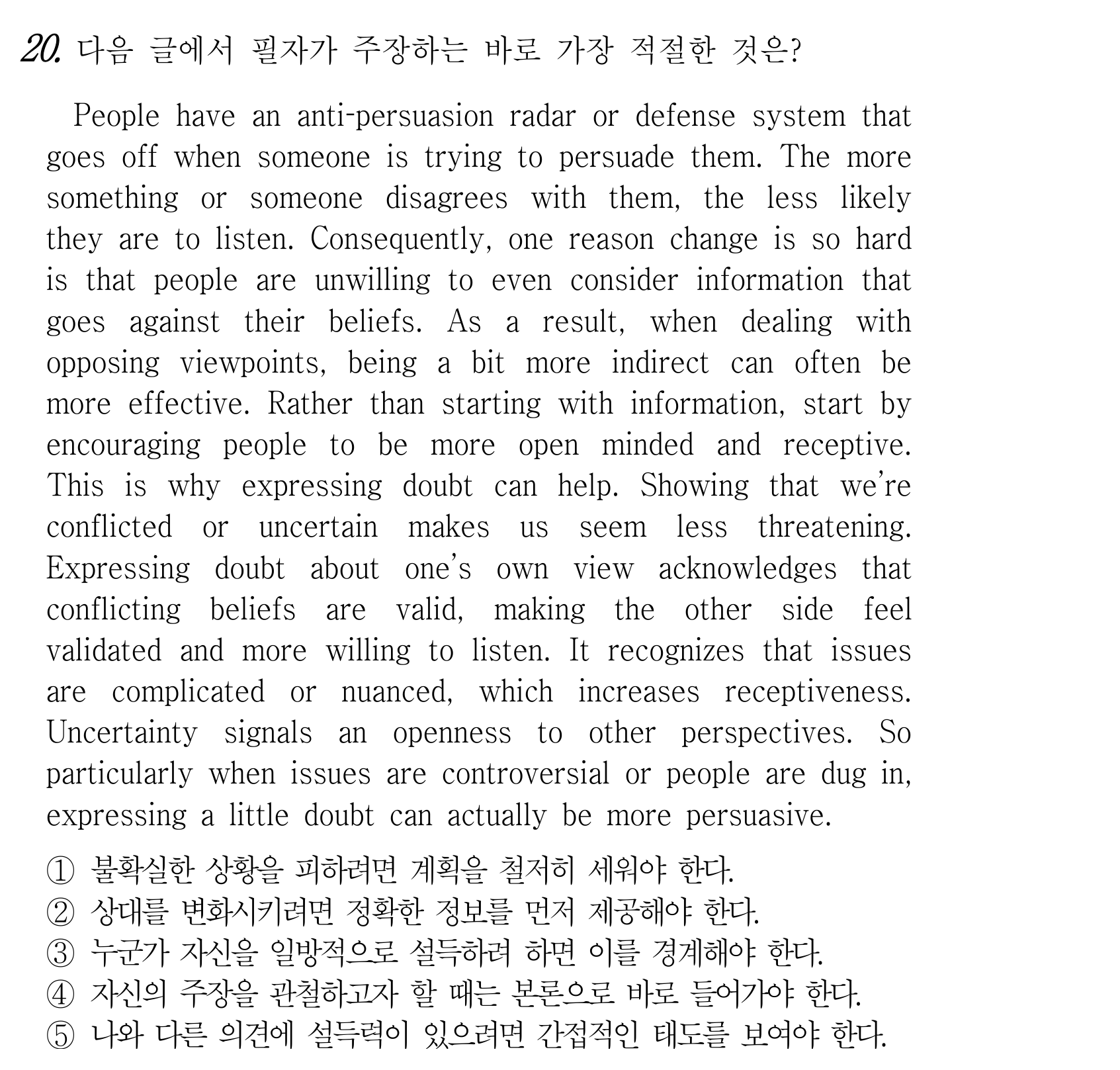
20번주장People have an anti-persuasion radar or defense system that goes off when someone is tryi…
People have an anti-persuasion radar or defense system that goes off when someone is trying to persuade them. The more something or someone disagrees with them, the less likely they are to listen. Consequently, one reason change is so hard is that people are unwilling to even consider information that goes against their beliefs. As a result, when dealing with opposing viewpoints, being a bit more indirect can often be more effective. Rather than starting with information, start by encouraging people to be more open minded and receptive. This is why expressing doubt can help. Showing that we're conflicted or uncertain makes us seem less threatening. Expressing doubt about one's own view acknowledges that conflicting beliefs are valid, making the other side feel validated and more willing to listen. It recognizes that issues are complicated or nuanced, which increases receptiveness. Uncertainty signals an openness to other perspectives. So particularly when issues are controversial or people are dug in, expressing a little doubt can actually be more persuasive.
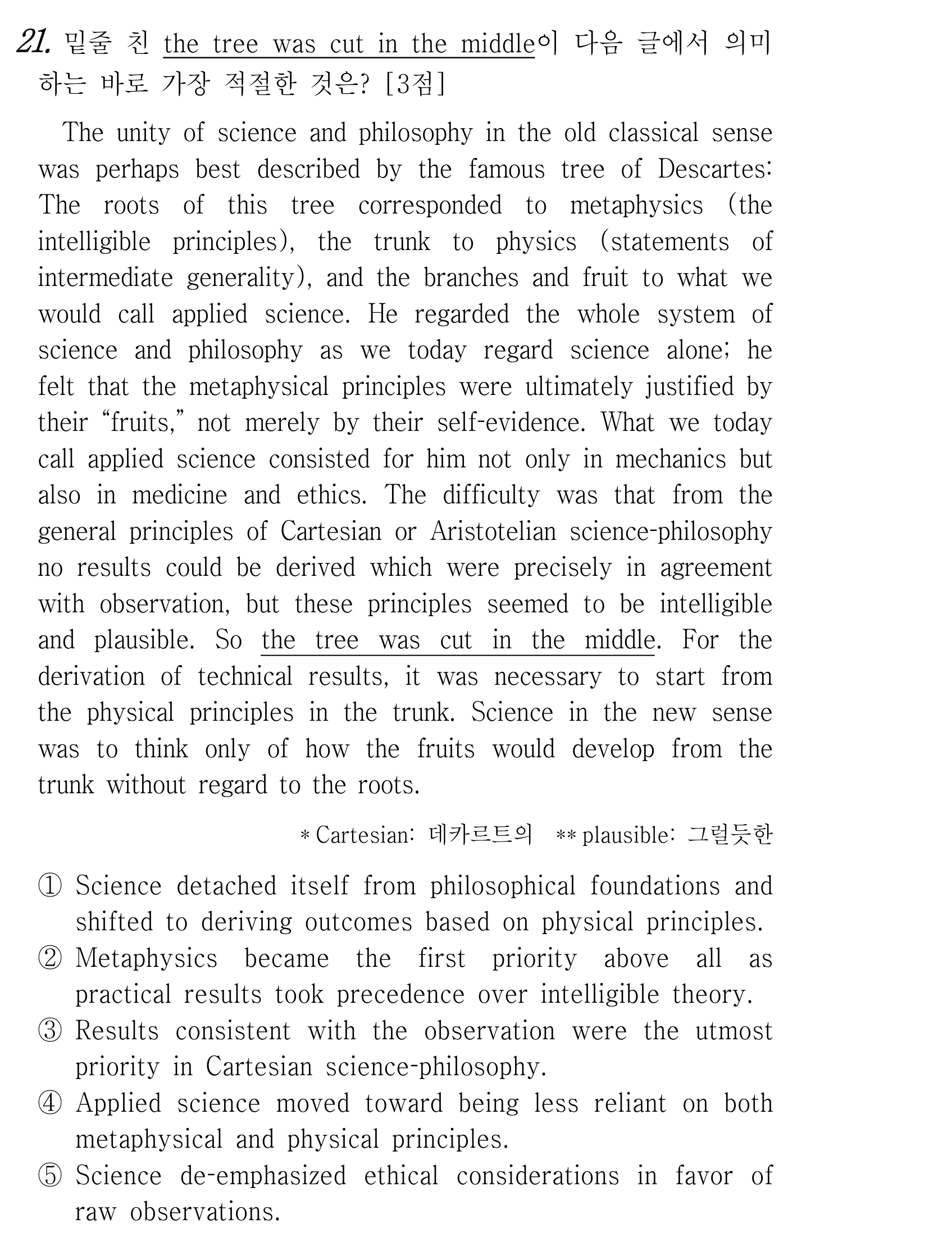
21번함축의미추론The unity of science and philosophy in the old classical sense was perhaps best described…
The unity of science and philosophy in the old classical sense was perhaps best described by the famous tree of Descartes: The roots of this tree corresponded to metaphysics (the intelligible principles), the trunk to physics (statements of intermediate generality), and the branches and fruit to what we would call applied science. He regarded the whole system of science and philosophy as we today regard science alone; he felt that the metaphysical principles were ultimately justified by their "fruits," not merely by their self-evidence. What we today call applied science consisted for him not only in mechanics but also in medicine and ethics. The difficulty was that from the general principles of Cartesian or Aristotelian science-philosophy no results could be derived which were precisely in agreement with observation, but these principles seemed to be intelligible and plausible. So the tree was cut in the middle. For the derivation of technical results, it was necessary to start from the physical principles in the trunk. Science in the new sense was to think only of how the fruits would develop from the trunk without regard to the roots.
22번요지/주장Good narrative writing is often as much technique as it is talent, sometimes more.
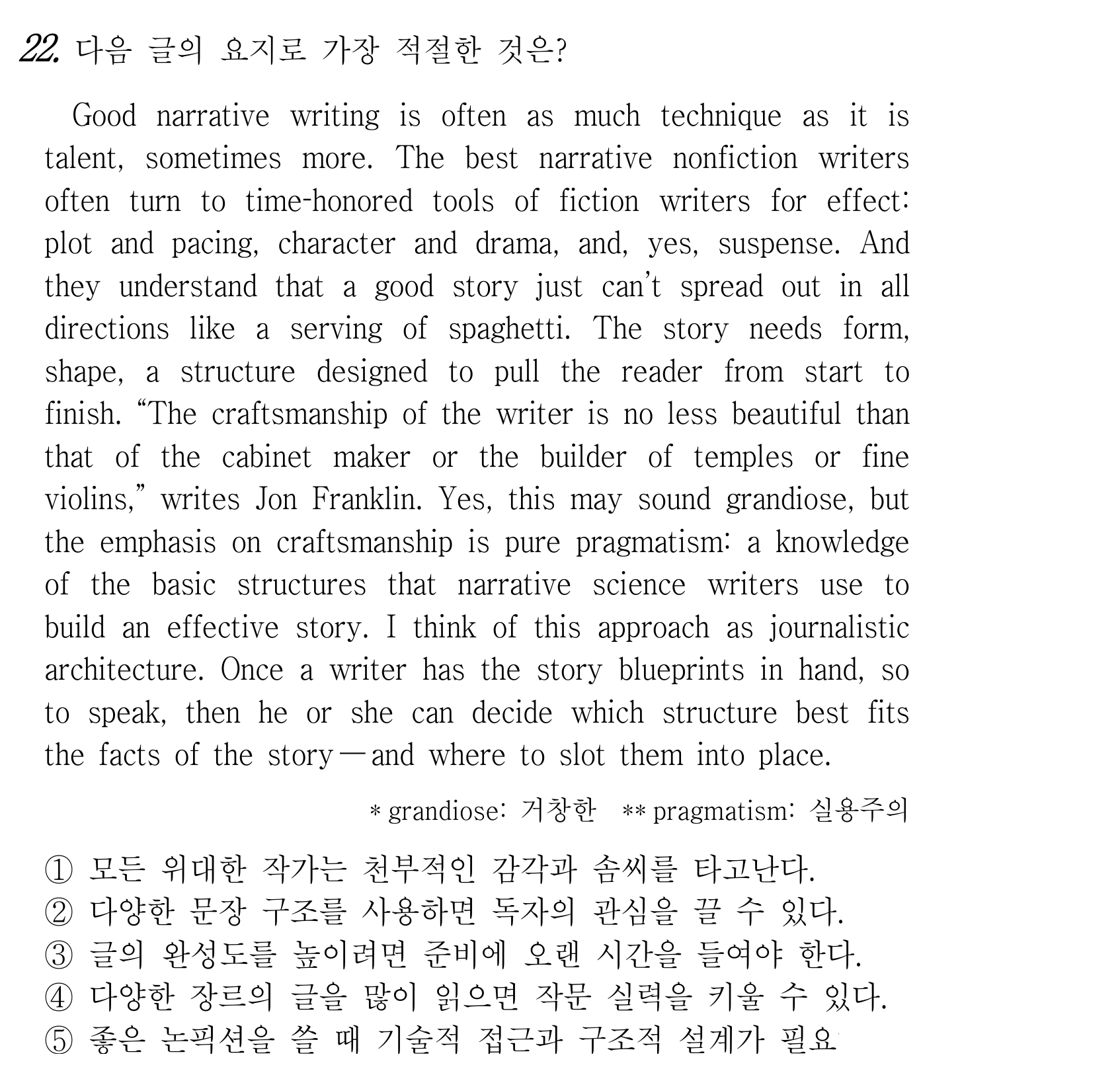
Good narrative writing is often as much technique as it is talent, sometimes more. The best narrative nonfiction writers often turn to time-honored tools of fiction writers for effect: plot and pacing, character and drama, and, yes, suspense. And they understand that a good story just can't spread out in all directions like a serving of spaghetti. The story needs form, shape, a structure designed to pull the reader from start to finish. "The craftsmanship of the writer is no less beautiful than that of the cabinet maker or the builder of temples or fine violins," writes Jon Franklin. Yes, this may sound grandiose, but the emphasis on craftsmanship is pure pragmatism: a knowledge of the basic structures that narrative science writers use to build an effective story. I think of this approach as journalistic architecture. Once a writer has the story blueprints in hand, so to speak, then he or she can decide which structure best fits the facts of the story — and where to slot them into place.
23번주제If you want to bring something into shared reality for the purpose of social coordination…
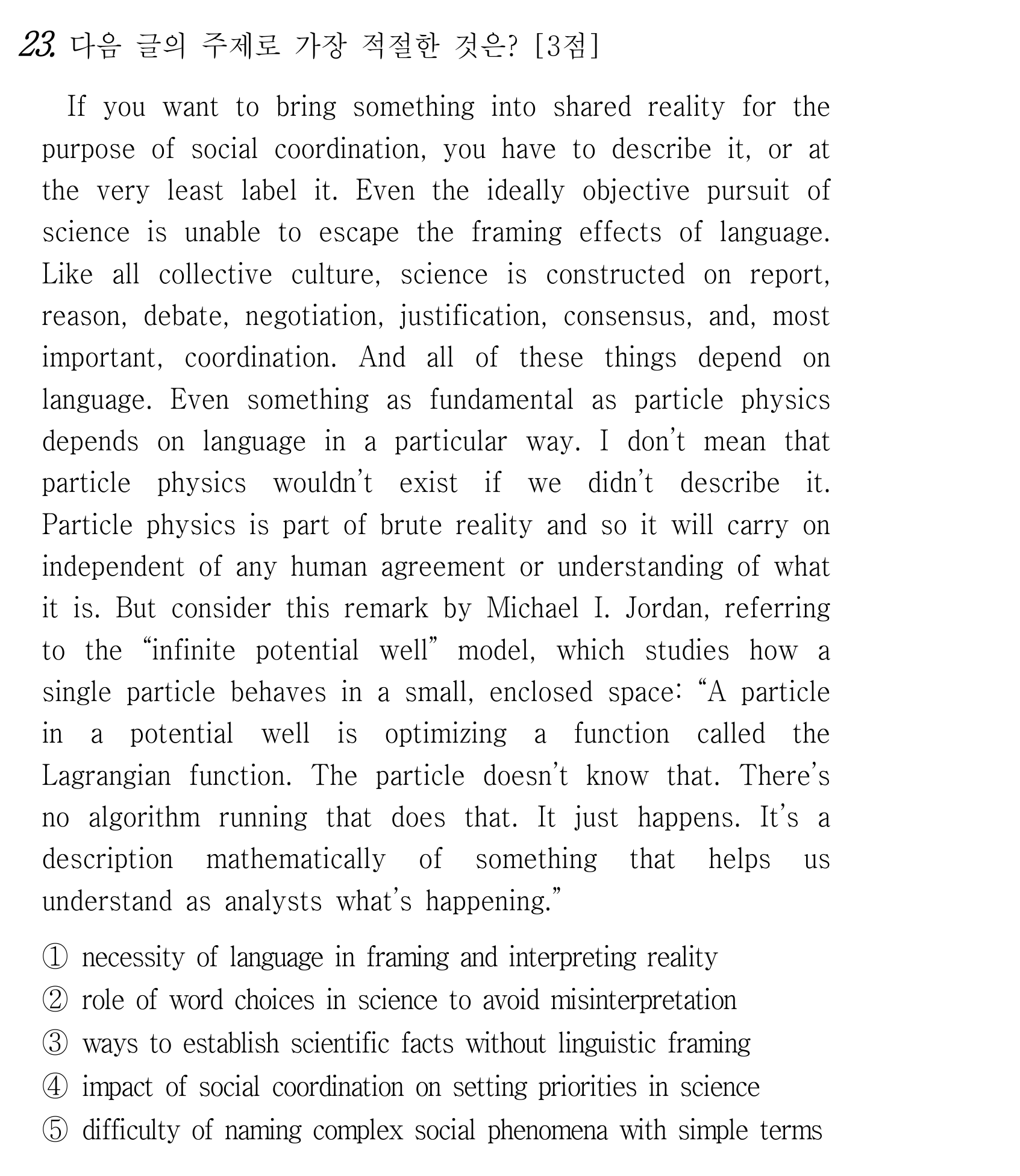
If you want to bring something into shared reality for the purpose of social coordination, you have to describe it, or at the very least label it. Even the ideally objective pursuit of science is unable to escape the framing effects of language. Like all collective culture, science is constructed on report, reason, debate, negotiation, justification, consensus, and, most important, coordination. And all of these things depend on language. Even something as fundamental as particle physics depends on language in a particular way. I don't mean that particle physics wouldn't exist if we didn't describe it. Particle physics is part of brute reality and so it will carry on independent of any human agreement or understanding of what it is. But consider this remark by Michael I. Jordan, referring to the "infinite potential well" model, which studies how a single particle behaves in a small, enclosed space: "A particle in a potential well is optimizing a function called the Lagrangian function. The particle doesn't know that. There's no algorithm running that does that. It just happens. It's a description mathematically of something that helps us understand as analysts what's happening."
24번제목In fact, humans are known to have the largest and most visible sclera — the “whites” of t…
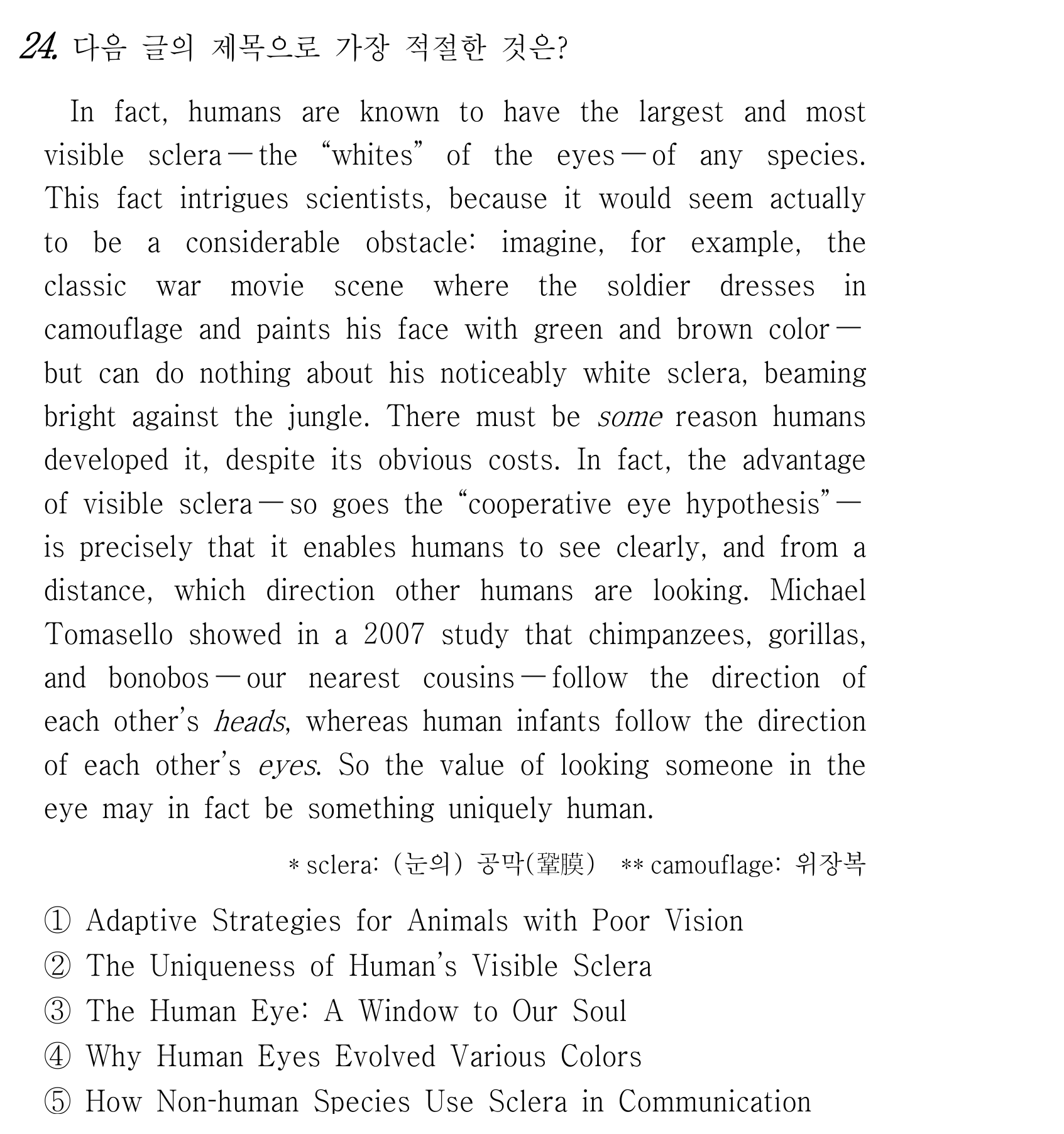
In fact, humans are known to have the largest and most visible sclera — the “whites” of the eyes — of any species. This fact intrigues scientists, because it would seem actually to be a considerable obstacle: imagine, for example, the classic war movie scene where the soldier dresses in camouflage and paints his face with green and brown color — but can do nothing about his noticeably white sclera, beaming bright against the jungle. There must be *some* reason humans developed it, despite its obvious costs. In fact, the advantage of visible sclera — so goes the “cooperative eye hypothesis” — is precisely that it enables humans to see clearly, and from a distance, which direction other humans are looking. Michael Tomasello showed in a 2007 study that chimpanzees, gorillas, and bonobos — our nearest cousins — follow the direction of each other’s *heads*, whereas human infants follow the direction of each other’s *eyes*. So the value of looking someone in the eye may in fact be something uniquely human.
29번어법We lack a sufficient vocabulary for making sense of the sources of error.
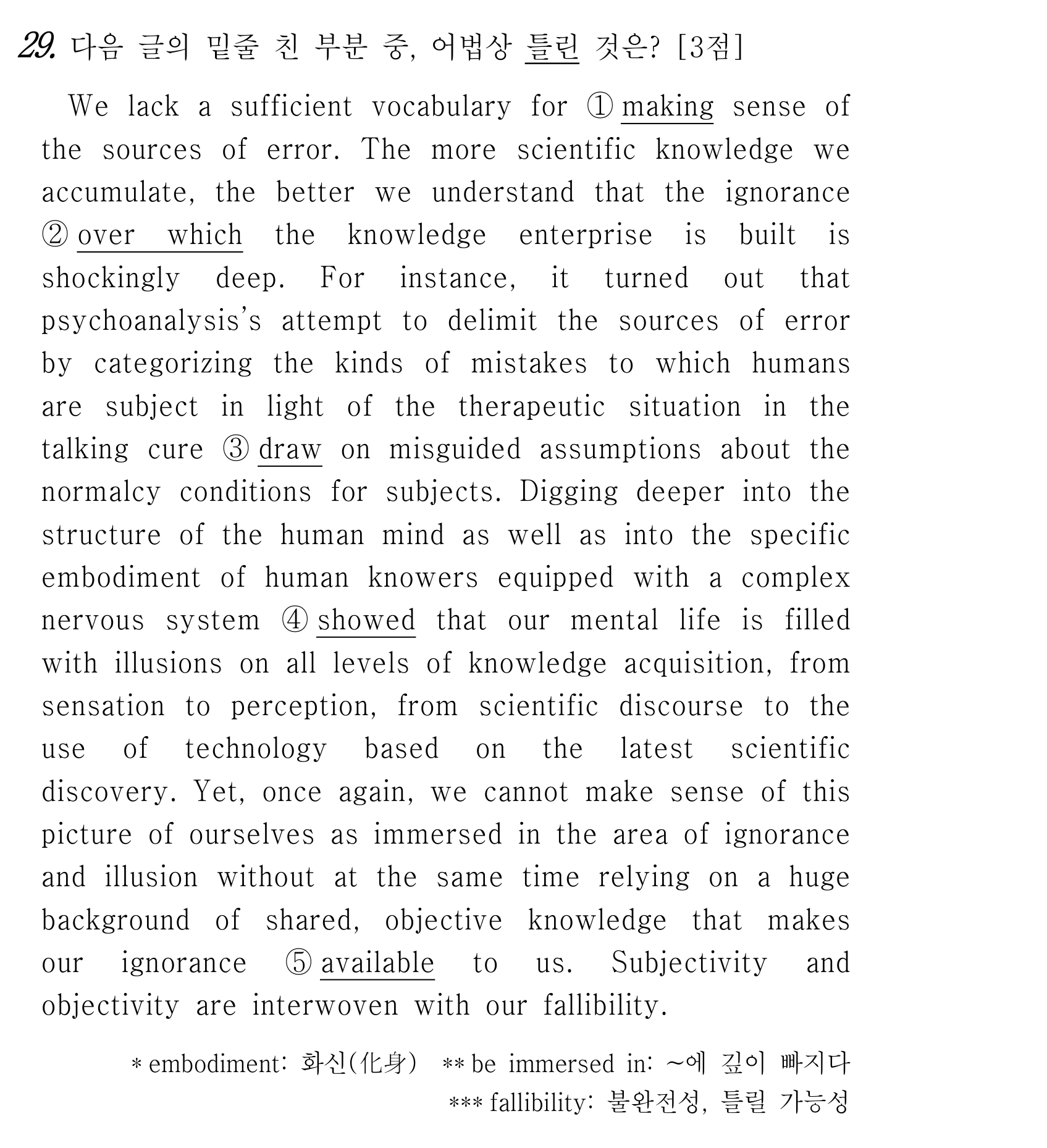
We lack a sufficient vocabulary for making sense of the sources of error. The more scientific knowledge we accumulate, the better we understand that the ignorance over which the knowledge enterprise is built is shockingly deep. For instance, it turned out that psychoanalysis's attempt to delimit the sources of error by categorizing the kinds of mistakes to which humans are subject in light of the therapeutic situation in the talking cure drew on misguided assumptions about the normalcy conditions for subjects. Digging deeper into the structure of the human mind as well as into the specific embodiment of human knowers equipped with a complex nervous system showed that our mental life is filled with illusions on all levels of knowledge acquisition, from sensation to perception, from scientific discourse to the use of technology based on the latest scientific discovery. Yet, once again, we cannot make sense of this picture of ourselves as immersed in the area of ignorance and illusion without at the same time relying on a huge background of shared, objective knowledge that makes our ignorance available to us. Subjectivity and objectivity are interwoven with our fallibility.
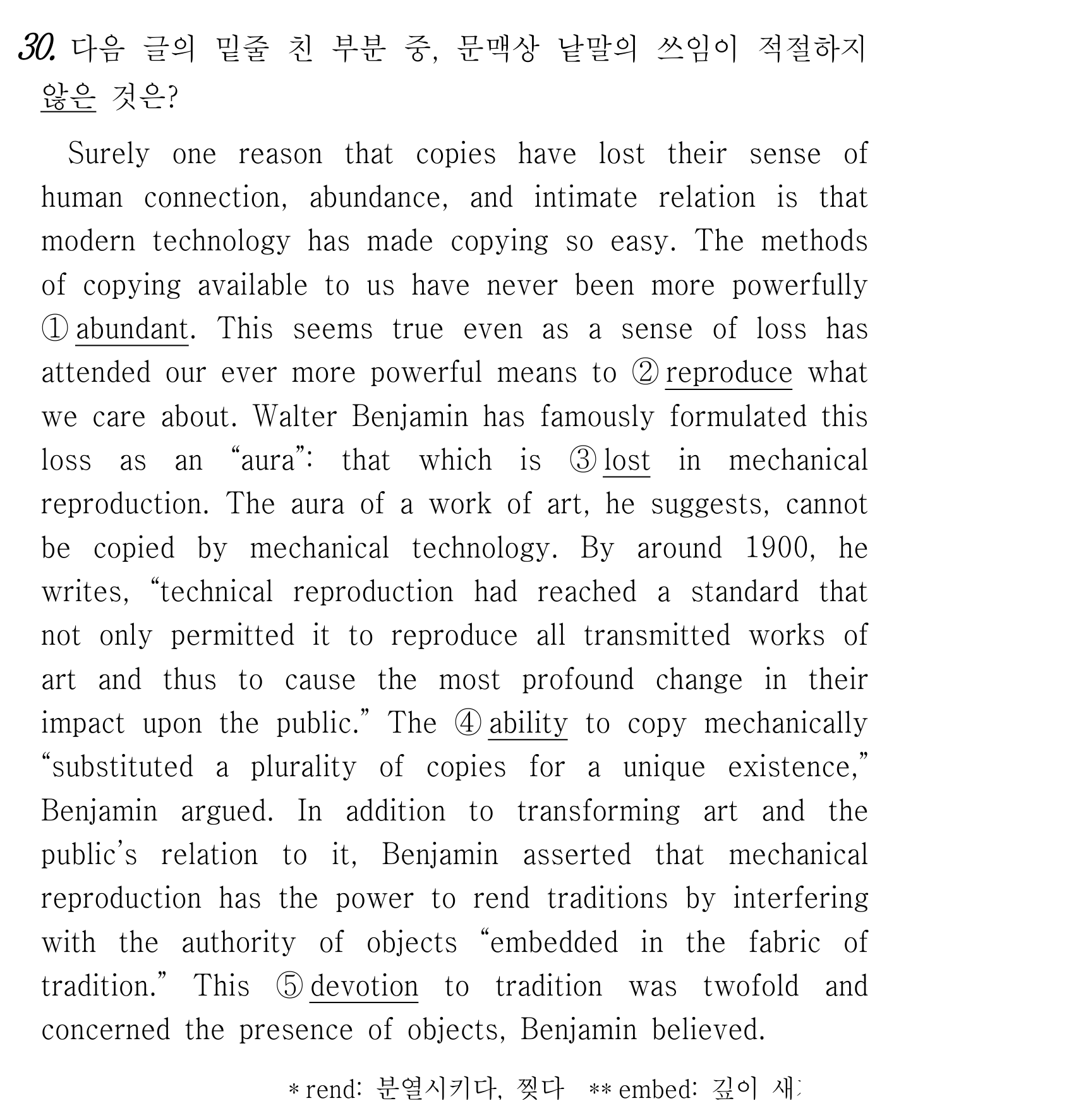
30번어휘Surely one reason that copies have lost their sense of human connection, abundance, and i…
Surely one reason that copies have lost their sense of human connection, abundance, and intimate relation is that modern technology has made copying so easy. The methods of copying available to us have never been more powerfully abundant. This seems true even as a sense of loss has attended our ever more powerful means to reproduce what we care about. Walter Benjamin has famously formulated this loss as an "aura": that which is lost in mechanical reproduction. The aura of a work of art, he suggests, cannot be copied by mechanical technology. By around 1900, he writes, "technical reproduction had reached a standard that not only permitted it to reproduce all transmitted works of art and thus to cause the most profound change in their impact upon the public." The ability to copy mechanically "substituted a plurality of copies for a unique existence," Benjamin argued. In addition to transforming art and the public's relation to it, Benjamin asserted that mechanical reproduction has the power to rend traditions by interfering with the authority of objects "embedded in the fabric of tradition." This challenge to tradition was twofold and concerned the presence of objects, Benjamin believed.
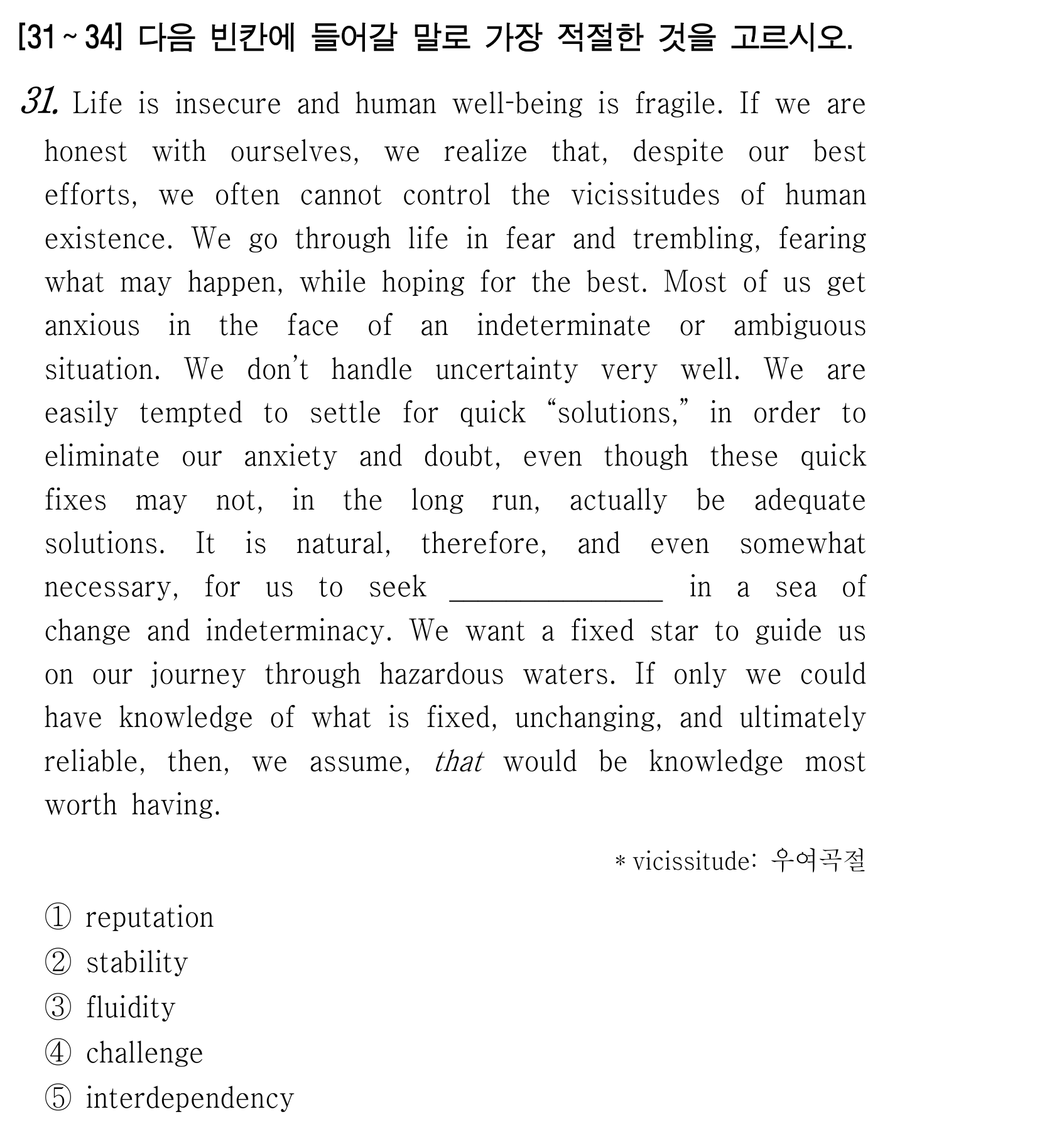
31번빈칸추론2Life is insecure and human well-being is fragile.
Life is insecure and human well-being is fragile. If we are honest with ourselves, we realize that, despite our best efforts, we often cannot control the vicissitudes of human existence. We go through life in fear and trembling, fearing what may happen, while hoping for the best. Most of us get anxious in the face of an indeterminate or ambiguous situation. We don't handle uncertainty very well. We are easily tempted to settle for quick “solutions,” in order to eliminate our anxiety and doubt, even though these quick fixes may not, in the long run, actually be adequate solutions. It is natural, therefore, and even somewhat necessary, for us to seek stability in a sea of change and indeterminacy. We want a fixed star to guide us on our journey through hazardous waters. If only we could have knowledge of what is fixed, unchanging, and ultimately reliable, then, we assume, that would be knowledge most worth having.
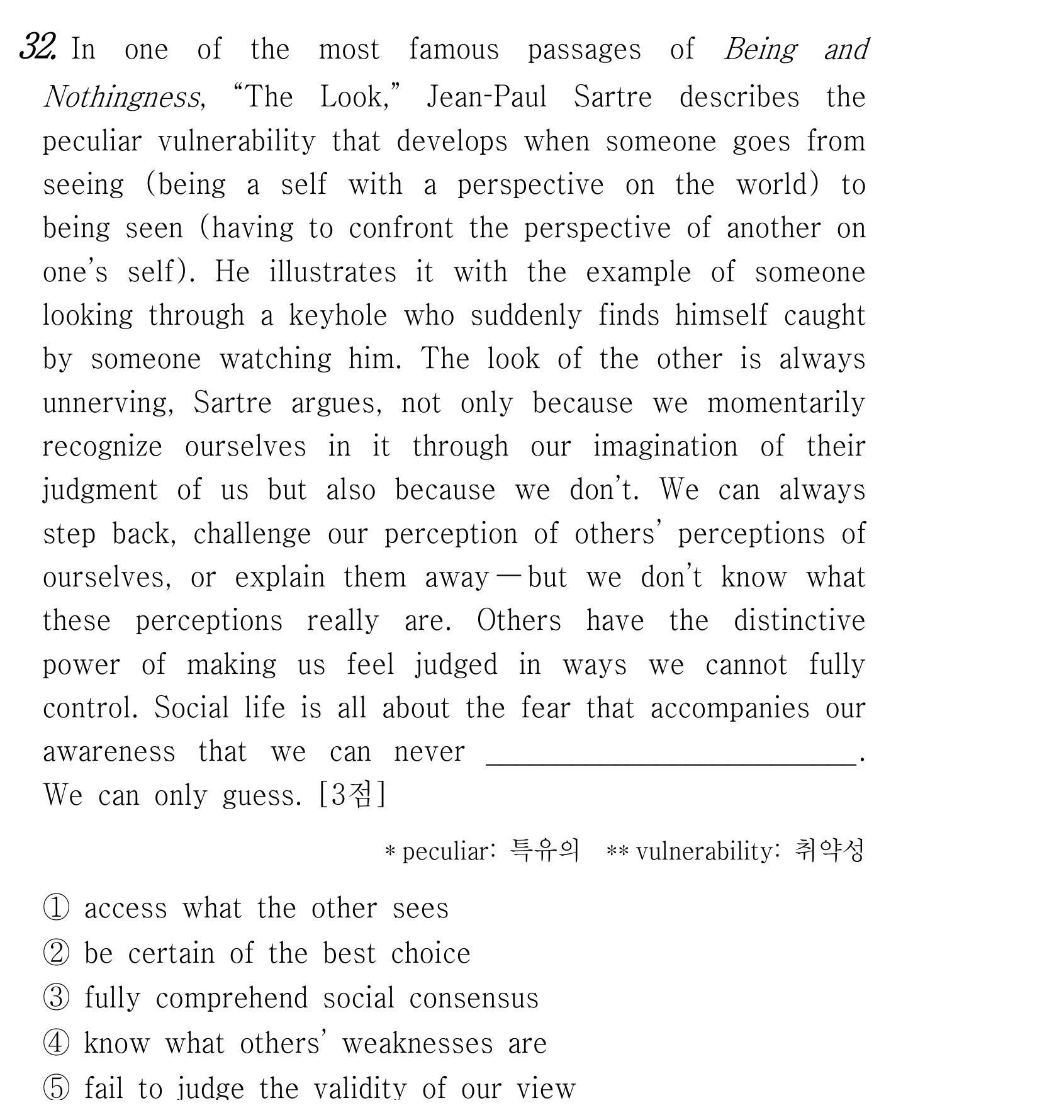
32번빈칸추론3In one of the most famous passages of Being and Nothingness, “The Look,” Jean-Paul Sartre…
In one of the most famous passages of Being and Nothingness, “The Look,” Jean-Paul Sartre describes the peculiar vulnerability that develops when someone goes from seeing (being a self with a perspective on the world) to being seen (having to confront the perspective of another on one’s self). He illustrates it with the example of someone looking through a keyhole who suddenly finds himself caught by someone watching him. The look of the other is always unnerving, Sartre argues, not only because we momentarily recognize ourselves in it through our imagination of their judgment of us but also because we don’t. We can always step back, challenge our perception of others’ perceptions of ourselves, or explain them away — but we don’t know what these perceptions really are. Others have the distinctive power of making us feel judged in ways we cannot fully control. Social life is all about the fear that accompanies our awareness that we can never access what the other sees. We can only guess.
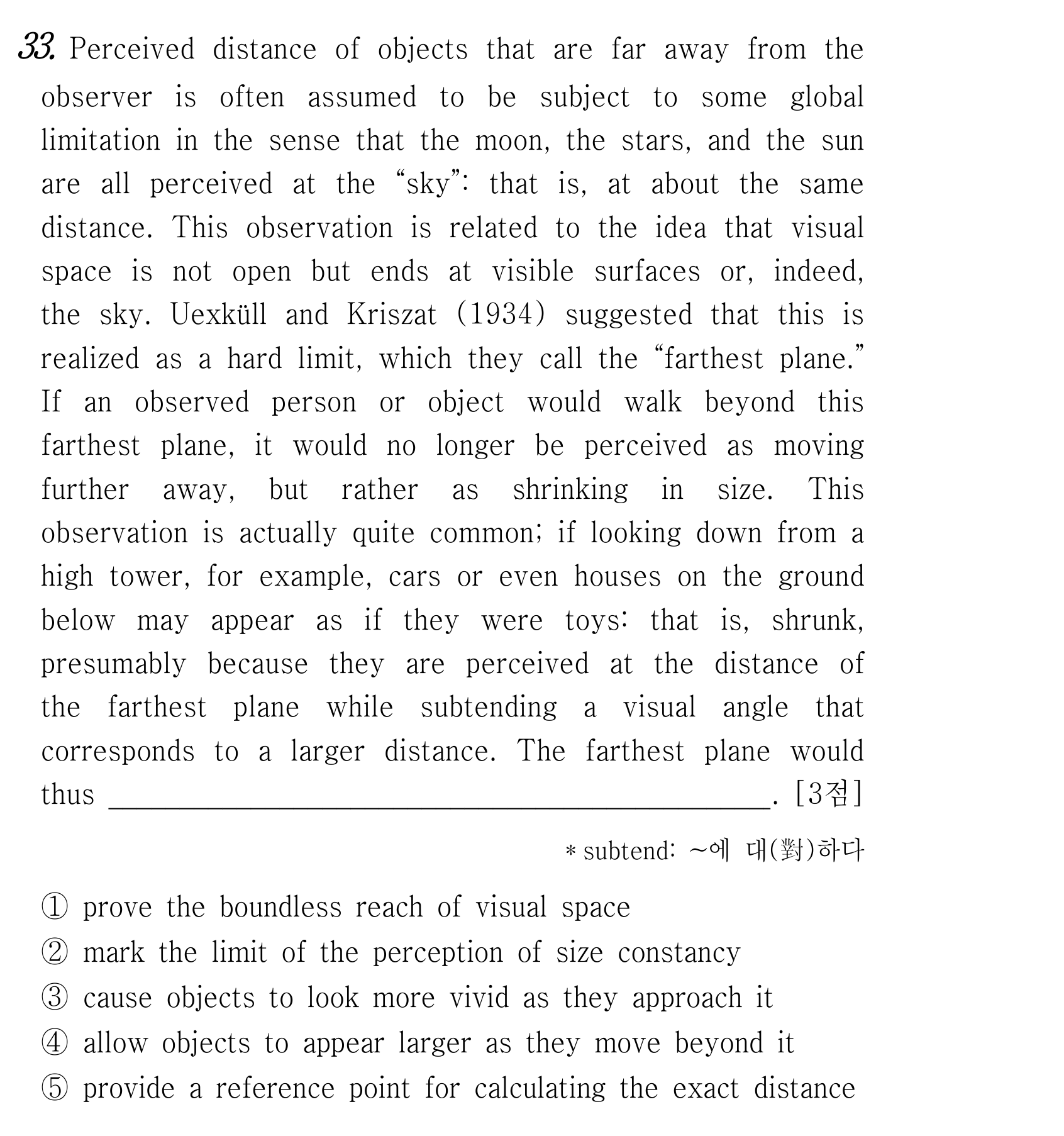
33번빈칸추론4Perceived distance of objects that are far away from the observer is often assumed to be…
Perceived distance of objects that are far away from the observer is often assumed to be subject to some global limitation in the sense that the moon, the stars, and the sun are all perceived at the "sky": that is, at about the same distance. This observation is related to the idea that visual space is not open but ends at visible surfaces or, indeed, the sky. Uexküll and Kriszat (1934) suggested that this is realized as a hard limit, which they call the "farthest plane." If an observed person or object would walk beyond this farthest plane, it would no longer be perceived as moving further away, but rather as shrinking in size. This observation is actually quite common; if looking down from a high tower, for example, cars or even houses on the ground below may appear as if they were toys: that is, shrunk, presumably because they are perceived at the distance of the farthest plane while subtending a visual angle that corresponds to a larger distance. The farthest plane would thus mark the limit of the perception of size constancy.
34번빈칸추론5In both the arts and the sciences, an aesthetics of simplicity facilitates the precise co…
In both the arts and the sciences, an aesthetics of simplicity facilitates the precise communication of messages. Both are also fairly systematic. Although many people believe that art is by definition wild and intuitive, while only science is methodologically disciplined, there is a great deal of evidence — including from artists talking about their own practices — to suggest that art is often created methodically and systematically, and that frameworks and forms permit creativity to flow. Instead of being liberating, freedom without limits is almost paralysing, because without frameworks we end up in a vacuum in which our actions generate no response. As the Danish poet and filmmaker Jørgen Leth has put it many times, 'the rules of the game' are a prerequisite for artistic freedom. They provide a solid form or structure that enables the artist to make use of 'the gifts of chance' (to use Leth's expression), and in which a part of the world can be exhibited in a non-chaotic manner. In order to create beauty, the artist must restrict him- or herself.
35번무관한문장Cultural storage and transmission require humans to accomplish the work of storing knowle…
Cultural storage and transmission require humans to accomplish the work of storing knowledge and passing it on to the next generation by means other than DNA. To that end, humans developed techniques of memorization, of transmitting knowledge through education and by using external memory devices. The Chauvet cave was such a device, a place that humans returned to generation after generation, cooperating on a project that none of them could have accomplished alone. Each generation of artists learned techniques and continued the work of previous ones, preserving and improving what their predecessors had worked on. For us, the idea that humans might work on a single system of caves for thousands of years in the same style is almost unimaginable. But these early humans were highly conscious of the importance of storing and preserving knowledge and of passing down ideas.
36번순서배열1What would a language be like if it didn't make *any* simplifications or generalizations?
What would a language be like if it didn't make *any* simplifications or generalizations? It would be a language in which every word was a proper noun. Because you don't want to gloss over the differences between snakes that are slightly different in some respect, every snake must have its own name. Furthermore, every event must have its own verb, because not every occasion of thinking or dancing or talking is identical. There might be some superintelligent race of beings that could know such a language, but they would have to know virtually everything in the world to learn all these names. Human language has taken a different route — many fewer names, with a loss of precision, but a basic vocabulary that is readily acquired. However, this fact is not simply a compromise with our limited cognitive capacity. By using the same word for different objects, we're communicating information about those things. Calling two different-looking things "spider" communicates that they probably have eight legs, weave nests, eat insects, and other noticeable details, which we would not know if we gave them all their own separate names.
37번순서배열2Self-regulation has been suggested as an alternative way to hold the tech industry to acc…
Self-regulation has been suggested as an alternative way to hold the tech industry to account. But when tech lobbyists speak of self-regulation, they are not describing it as it is understood by professionals like doctors. Unlike in medicine, there are no mandatory ethical qualifications for working as a software engineer or technology executive. There is no enforceable industry code of conduct. There is no obligatory certification. There is no duty to put the public ahead of profit. There are few consequences for serious moral failings; no real fear of being suspended or struck off. Recent years have seen an explosion of AI ethics charters and the like, filled with well-meaning generalities about the responsible use of powerful computers. But without consequences for violating them, these charters are just toothless statements of aspiration. The tech industry is basically saying: trust us. But blind trust is not how we govern doctors, lawyers, bankers, pilots or anyone else in unelected positions of social responsibility. Tech is the exception, and it’s not clear why.
38번문장삽입1We experience emotions as different bodily sensations, such as a beating heart and sweaty…
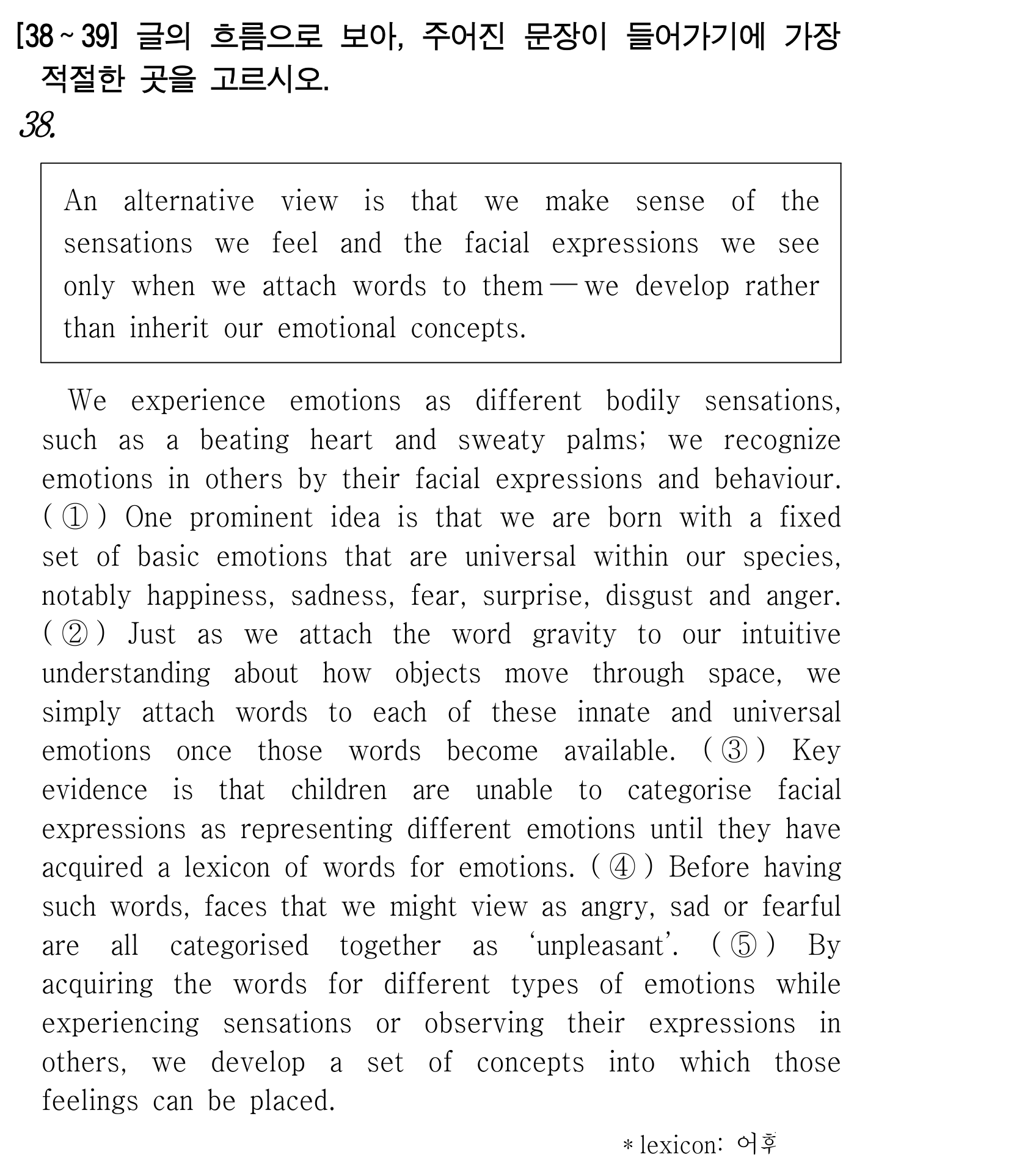
We experience emotions as different bodily sensations, such as a beating heart and sweaty palms; we recognize emotions in others by their facial expressions and behaviour. One prominent idea is that we are born with a fixed set of basic emotions that are universal within our species, notably happiness, sadness, fear, surprise, disgust and anger. Just as we attach the word gravity to our intuitive understanding about how objects move through space, we simply attach words to each of these innate and universal emotions once those words become available. An alternative view is that we make sense of the sensations we feel and the facial expressions we see only when we attach words to them — we develop rather than inherit our emotional concepts. Key evidence is that children are unable to categorise facial expressions as representing different emotions until they have acquired a lexicon of words for emotions. Before having such words, faces that we might view as angry, sad or fearful are all categorised together as ‘unpleasant’. By acquiring the words for different types of emotions while experiencing sensations or observing their expressions in others, we develop a set of concepts into which those feelings can be placed.
39번문장삽입2Everyone likes to think of themselves as behaving in an unbiased fashion most of the time.
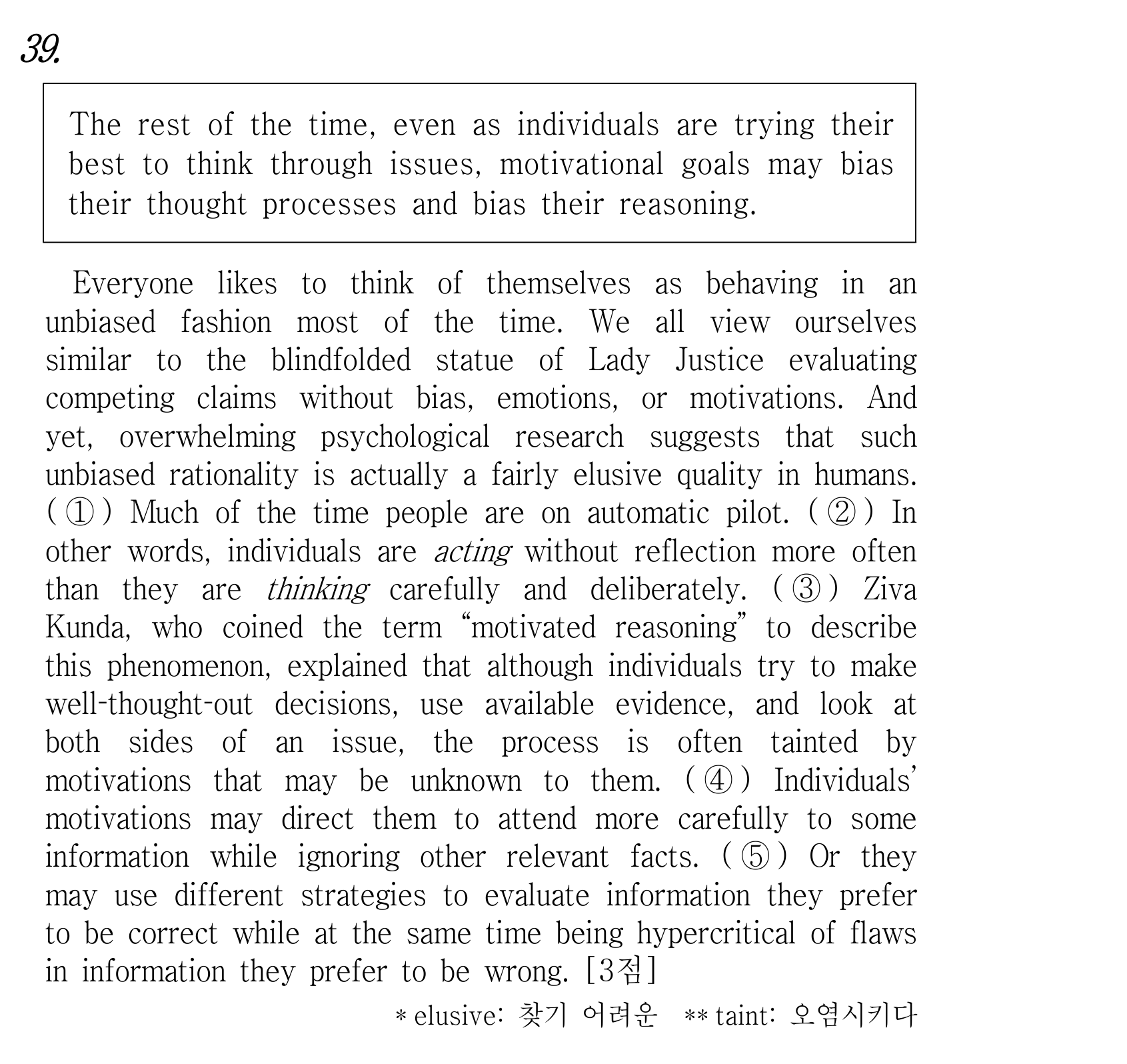
Everyone likes to think of themselves as behaving in an unbiased fashion most of the time. We all view ourselves similar to the blindfolded statue of Lady Justice evaluating competing claims without bias, emotions, or motivations. And yet, overwhelming psychological research suggests that such unbiased rationality is actually a fairly elusive quality in humans. Much of the time people are on automatic pilot. In other words, individuals are acting without reflection more often than they are thinking carefully and deliberately. The rest of the time, even as individuals are trying their best to think through issues, motivational goals may bias their thought processes and bias their reasoning. Ziva Kunda, who coined the term “motivated reasoning” to describe this phenomenon, explained that although individuals try to make well-thought-out decisions, use available evidence, and look at both sides of an issue, the process is often tainted by motivations that may be unknown to them. Individuals’ motivations may direct them to attend more carefully to some information while ignoring other relevant facts. Or they may use different strategies to evaluate information they prefer to be correct while at the same time being hypercritical of flaws in information they prefer to be wrong.
40번요약문완성It may be assumed that meta-algorithmics, that is, the creation of algorithms that genera…
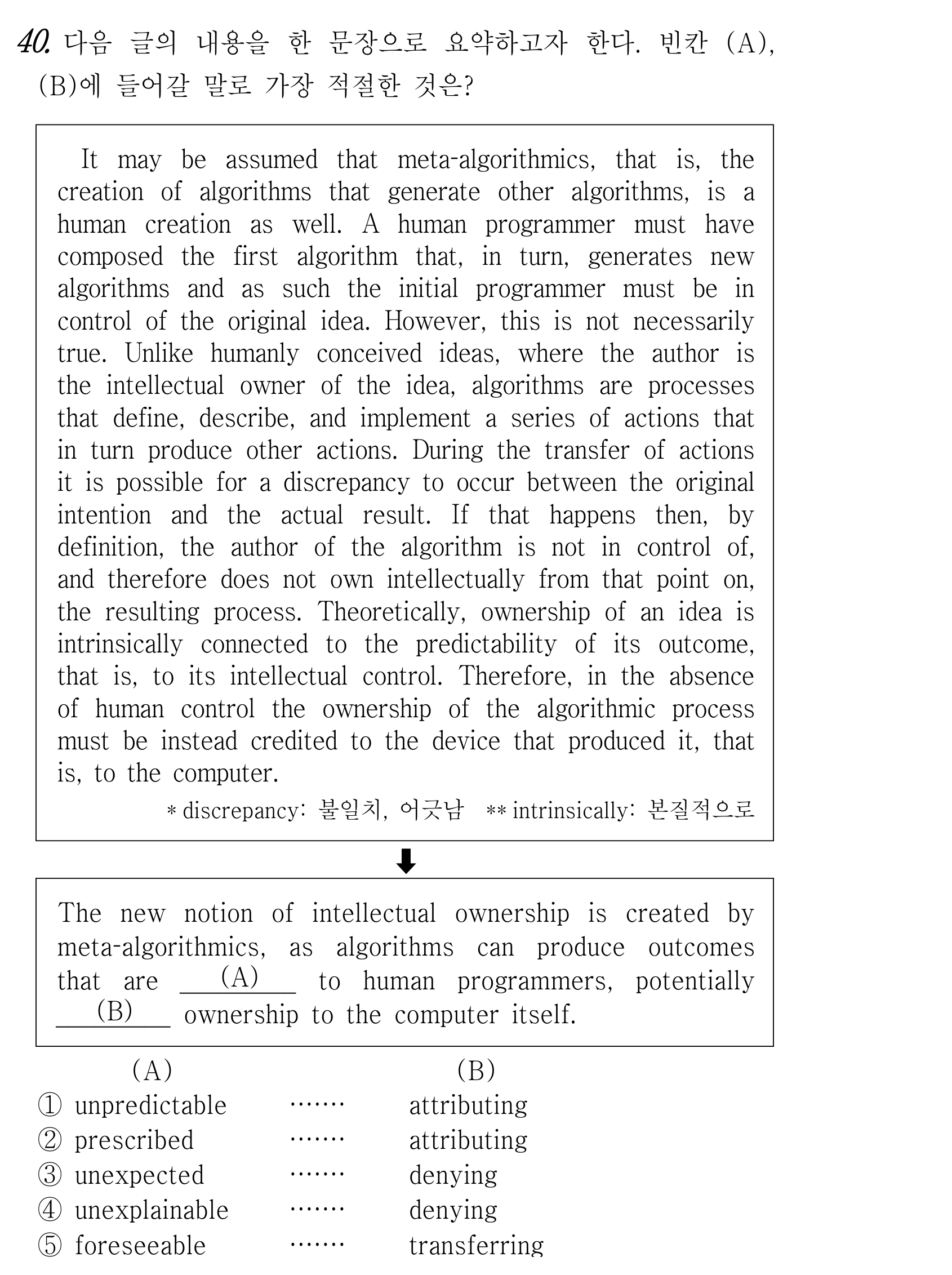
It may be assumed that meta-algorithmics, that is, the creation of algorithms that generate other algorithms, is a human creation as well. A human programmer must have composed the first algorithm that, in turn, generates new algorithms and as such the initial programmer must be in control of the original idea. However, this is not necessarily true. Unlike humanly conceived ideas, where the author is the intellectual owner of the idea, algorithms are processes that define, describe, and implement a series of actions that in turn produce other actions. During the transfer of actions it is possible for a discrepancy to occur between the original intention and the actual result. If that happens then, by definition, the author of the algorithm is not in control of, and therefore does not own intellectually from that point on, the resulting process. Theoretically, ownership of an idea is intrinsically connected to the predictability of its outcome, that is, to its intellectual control. Therefore, in the absence of human control the ownership of the algorithmic process must be instead credited to the device that produced it, that is, to the computer.
The new notion of intellectual ownership is created by meta-algorithmics, as algorithms can produce outcomes that are (A) to human programmers, potentially (B) ownership to the computer itself.
41번장문_제목Translating a literary text is challenging, and it’s often said there will be an inevitab…
Translating a literary text is challenging, and it’s often said there will be an inevitable loss in translation. But that challenge frequently inspires creative re-renderings that offer the prospect of a (a) gain in translation as well. A washing-machine manual doesn’t present the same challenges, nor therefore does it inspire the (b) same creativity either. But where, in terms of the opposition between literary and nonliterary language, might we position philosophy’s language? Might philosophy want to avoid a translatory economy that aims for a gain in translation but risks a loss? Philosophy wishes to convey its truths intact, without loss — and without gain either, or at least it might (c) hesitate to offer its truths to translation without further clarification of what a gain, and indeed a gain in depth, actually means. It cannot be a matter of offsetting “stylistic losses.” The loss philosophy fears is a loss of meaning, the compromising of a truth. Thus, philosophy might (d) refuse to be placed on the side of nonliterary language, and express itself in unstylish language, like Badiou’s mathematical writing, so that no translator is prompted to rude and bold acts of creative rewriting. If philosophy wishes to increase its range and avoid being restricted to a national or regional tradition, it (e) needs a translation model that conveys philosophical truths to the world without any “economic” fluctuations of loss and gain.
43번장문_순서(A) In a small town known for its flourishing academic community, two brothers, James and…
(A) In a small town known for its flourishing academic community, two brothers, James and Daniel Carter, stood out for their exceptional effort and talent. James and (a) his younger brother, Daniel, both applied for the Spark Fellowship. The Spark Fellowship was a highly respected program that selects and supports outstanding students every two years. Unsurprisingly, both brothers advanced to the final round.
(B) Without Daniel knowing, James went to the selection committee. (b) He told the committee, "Daniel has always been the more dedicated and talented one. He will excel in this program like no one else." Meanwhile, Daniel had the same idea as his older brother. He believed that his brother was the more ideal and deserving candidate. (c) He also decided to visit and speak to the committee.
(C) However, the program had a strict rule: only one family member could be selected in the same year. This posed a challenge to the selection committee, who thought it almost impossible to choose between the two equally impressive candidates. The committee gathered together, struggling all day long to decide. When James found out about this rule, (d) he tried to seek a way to demonstrate Daniel's exceptional talent to the selection committee.
(D) Not long after James had left, Daniel showed up at the selection committee and advocated for his brother, saying "James' leadership and vision make (e) him the perfect choice. He deserves this chance more than I do." Moved by their selflessness, the committee made an exception by selecting both brothers in the same year, for the first time in its history. Their story inspired others, showing that true success lies not only in individual achievements but also in supporting and encouraging others.
2025년 3월 고3 모의고사 변형문제 맛보기
이 시험 지문으로 실제로 만든 변형문제 3문항입니다. 같은 지문으로 유형을 바꿔 더 만들 수 있습니다.
20번 지문 · 어법 변형
다음 글의 밑줄 친 부분 중, 어법상 틀린 것은 모두 몇 개인가?
People have an anti-persuasion radar or defense system ①that goes off when someone is trying to persuade them. The more something or someone disagrees with them, the less likely they are to listen. Consequently, one reason change is so hard is that people are ②unwilling to even consider information that goes against their beliefs. As a result, when ③dealing with opposing viewpoints, being a bit more indirect can often be more effective. Rather than starting with information, ④start by encourage people to be more open minded and receptive. This is why expressing doubt can help. Showing that we're conflicted or uncertain ⑤makes us to seem less threatening. Expressing doubt about one's own view acknowledges that conflicting beliefs are valid, ⑥making the other side feel validated and more willing to listen. It recognizes that issues are complicated or nuanced, ⑦which increases receptiveness. Uncertainty signals an openness to other perspectives. So particularly ⑧when issues are controversial or people are dug in, expressing a little doubt can actually be more persuasive.- ①1개
- ②2개
- ③3개
- ④4개
- ⑤5개
21번 지문 · 빈칸추론 변형
다음 빈칸에 들어갈 말로 가장 적절한 것은?
The unity of science and philosophy in the old classical sense was perhaps best described by the famous tree of Descartes: The roots of this tree corresponded to metaphysics (the intelligible principles), the trunk to physics (statements of intermediate generality), and the branches and fruit to what we would call applied science. He regarded the whole system of science and philosophy as we today regard science alone; he felt that the metaphysical principles were ultimately justified by their "fruits," not merely by their self-evidence. What we today call applied science consisted for him not only in mechanics but also in medicine and ethics. The difficulty was that from the general principles of Cartesian or Aristotelian science-philosophy no results could be derived which were precisely in agreement with observation, but these principles seemed to be intelligible and plausible. So the tree was cut in the middle. For the derivation of technical results, it was necessary to start from the physical principles in the trunk. Science in the new sense was to think only of how the fruits would develop from the trunk ________________.- ①in constant dialogue with metaphysical principles
- ②by testing the roots against the branches
- ③while setting aside the foundational principles
- ④after justifying the trunk through self-evidence
- ⑤with ethics placed ahead of mechanics
22번 지문 · 어휘 변형
다음 글의 밑줄 친 부분 중, 문맥상 낱말의 쓰임이 적절하지 않은 것은?
Good narrative writing is often as much technique as it is talent, sometimes more. The best narrative nonfiction writers often turn to ①time-honored tools of fiction writers for effect: plot and pacing, character and drama, and, yes, suspense. And they understand that a good story just can't spread out in all directions like a serving of spaghetti. The story needs form, shape, a structure designed to pull the reader from start to finish. "The craftsmanship of the writer is no less beautiful than that of the cabinet maker or the builder of temples or fine violins," writes Jon Franklin. Yes, this may sound ②modest, but the emphasis on craftsmanship is pure ③pragmatism: a knowledge of the basic structures that narrative science writers use to build an ④effective story. I think of this approach as journalistic architecture. Once a writer has the story blueprints in hand, so to speak, then he or she can decide which structure best ⑤fits the facts of the story — and where to slot them into place.- ①time-honored
- ②modest
- ③pragmatism
- ④effective
- ⑤fits
남은 시간
48:00


아직 28문제를 풀지 않았어요 (0/28)