2023년 11월 고3 전국연합 영어 모의고사
28문제 · 제한시간 48분
이 시험 한눈에 — 2023년 11월 고3 전국연합 영어 모의고사
18~45번 28문항을 유형별로 보면 목적 1 · 심경/분위기 1 · 주장 1 · 함축의미추론 1 · 요지/주장 1 · 주제 1 · 제목 1 · 도표 1 · 내용일치 1 · 실용문 1 · 어법 2 · 어휘 1 · 빈칸추론2 1 · 빈칸추론3 1 · 빈칸추론4 1 · 빈칸추론5 1 · 무관한문장 1 · 순서배열1 1 · 순서배열2 1 · 문장삽입1 1 · 문장삽입2 1 · 요약문완성 1 · 장문 5. 아래 지문으로 변형문제·단어장·정답표를 바로 만들 수 있습니다.
20번주장Values alone do not create and build culture.
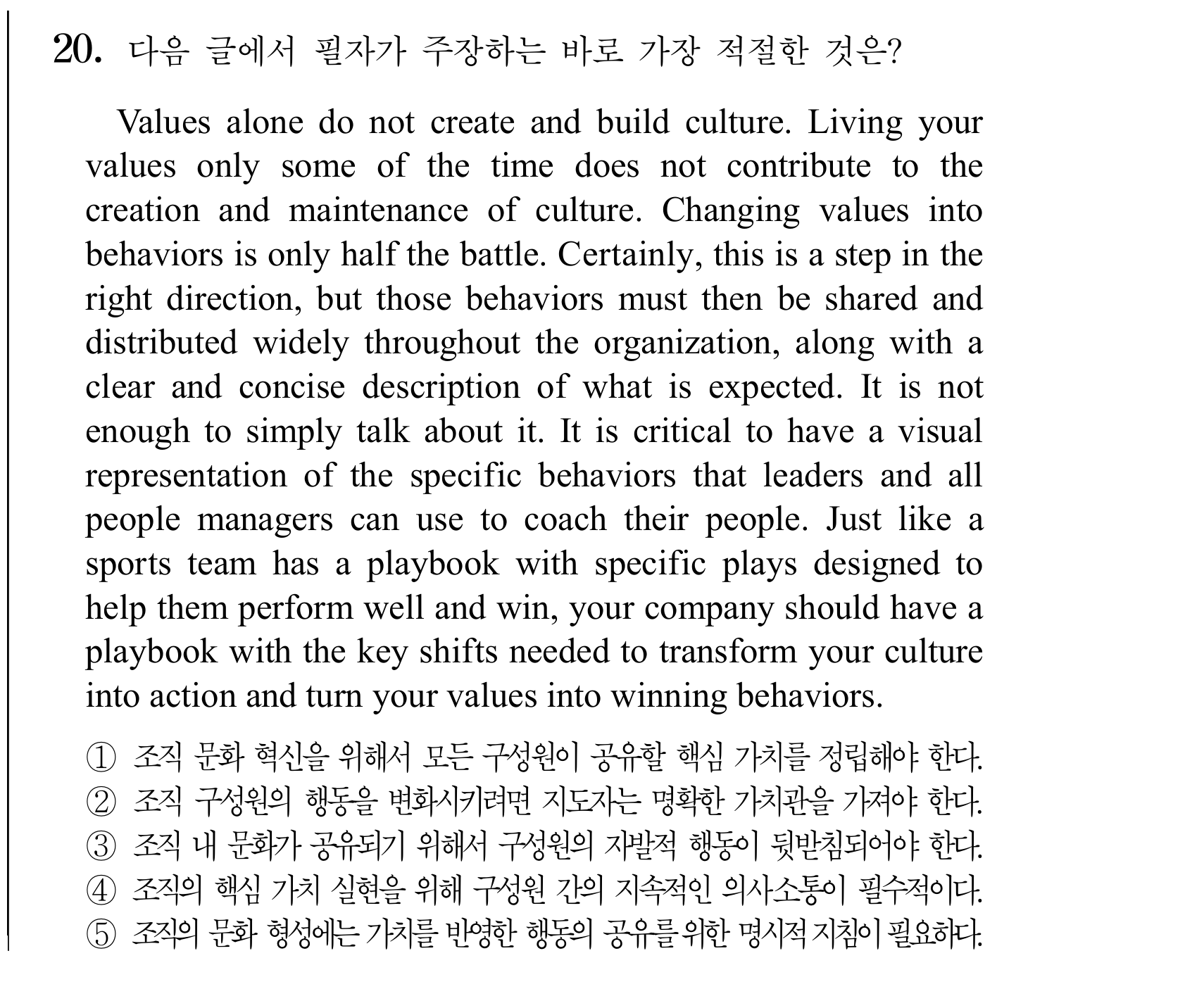
Values alone do not create and build culture. Living your values only some of the time does not contribute to the creation and maintenance of culture. Changing values into behaviors is only half the battle. Certainly, this is a step in the right direction, but those behaviors must then be shared and distributed widely throughout the organization, along with a clear and concise description of what is expected. It is not enough to simply talk about it. It is critical to have a visual representation of the specific behaviors that leaders and all people managers can use to coach their people. Just like a sports team has a playbook with specific plays designed to help them perform well and win, your company should have a playbook with the key shifts needed to transform your culture into action and turn your values into winning behaviors.
21번함축의미추론How you focus your attention plays a critical role in how you deal with stress.
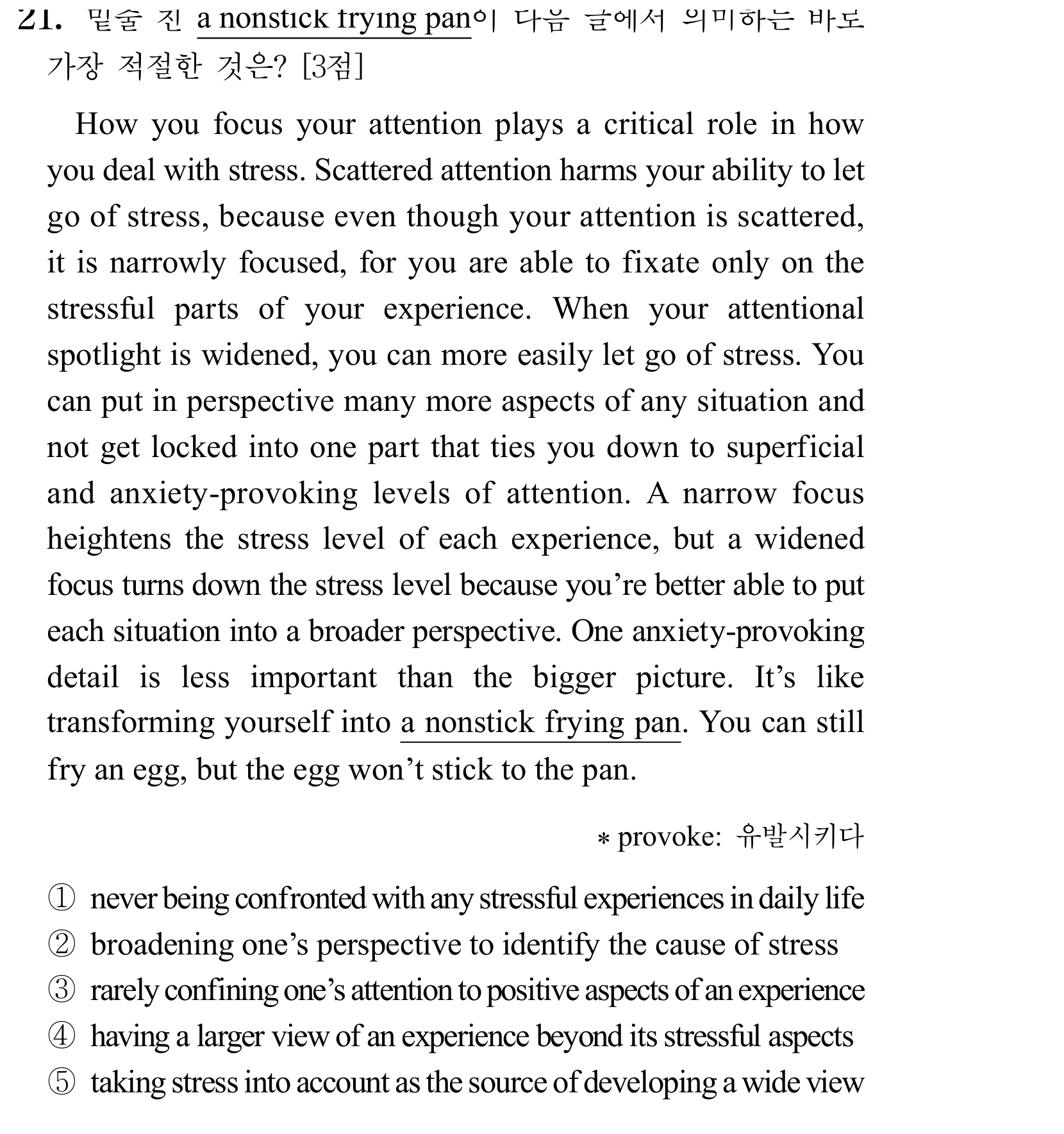
How you focus your attention plays a critical role in how you deal with stress. Scattered attention harms your ability to let go of stress, because even though your attention is scattered, it is narrowly focused, for you are able to fixate only on the stressful parts of your experience. When your attentional spotlight is widened, you can more easily let go of stress. You can put in perspective many more aspects of any situation and not get locked into one part that ties you down to superficial and anxiety-provoking levels of attention. A narrow focus heightens the stress level of each experience, but a widened focus turns down the stress level because you’re better able to put each situation into a broader perspective. One anxiety-provoking detail is less important than the bigger picture. It’s like transforming yourself into a nonstick frying pan. You can still fry an egg, but the egg won’t stick to the pan.
22번요지/주장Being able to prioritize your responses allows you to connect more deeply with individual…
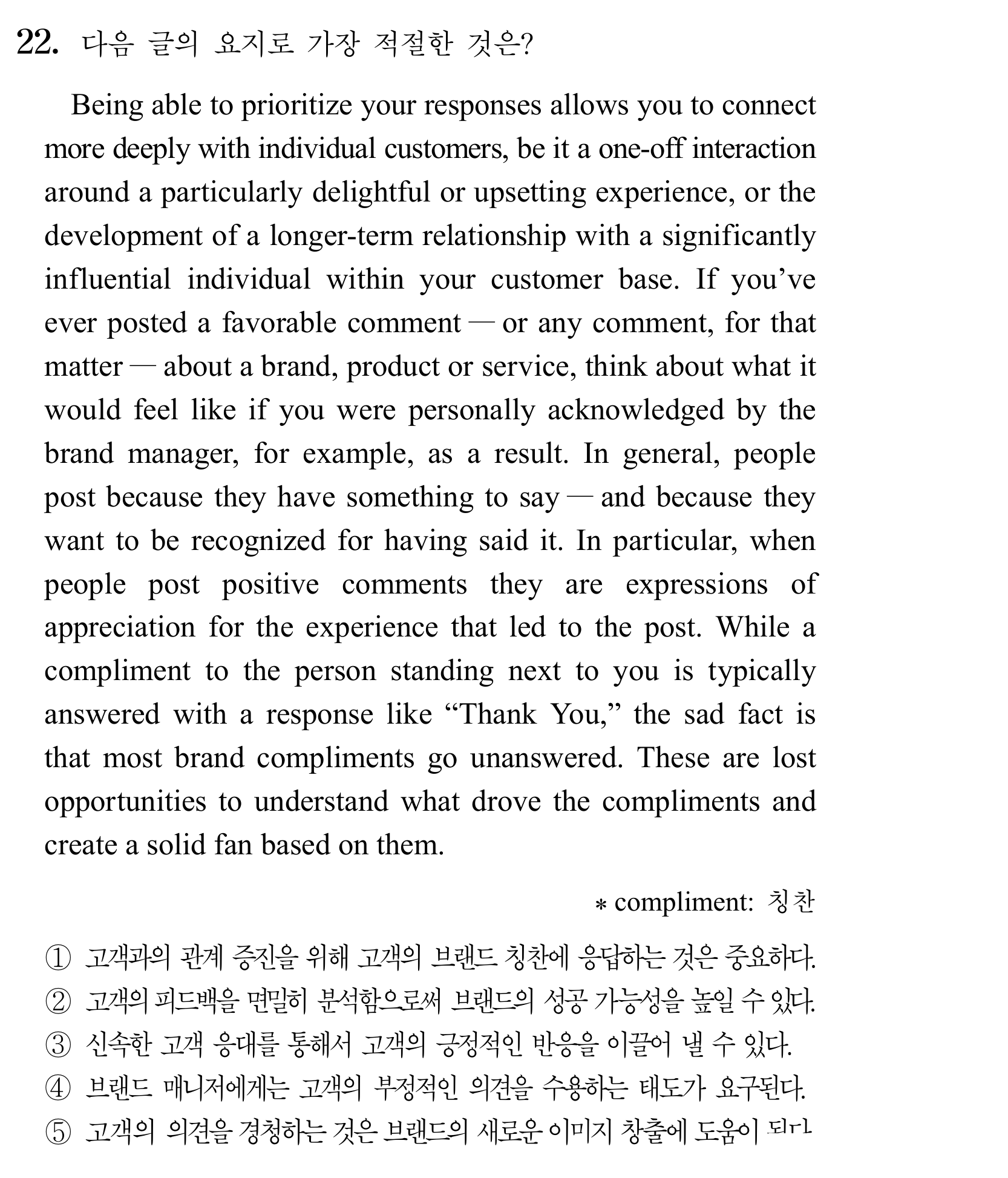
Being able to prioritize your responses allows you to connect more deeply with individual customers, be it a one-off interaction around a particularly delightful or upsetting experience, or the development of a longer-term relationship with a significantly influential individual within your customer base. If you’ve ever posted a favorable comment — or any comment, for that matter — about a brand, product or service, think about what it would feel like if you were personally acknowledged by the brand manager, for example, as a result. In general, people post because they have something to say — and because they want to be recognized for having said it. In particular, when people post positive comments they are expressions of appreciation for the experience that led to the post. While a compliment to the person standing next to you is typically answered with a response like “Thank You,” the sad fact is that most brand compliments go unanswered. These are lost opportunities to understand what drove the compliments and create a solid fan based on them.
23번주제Managers of natural resources typically face market incentives that provide financial rew…
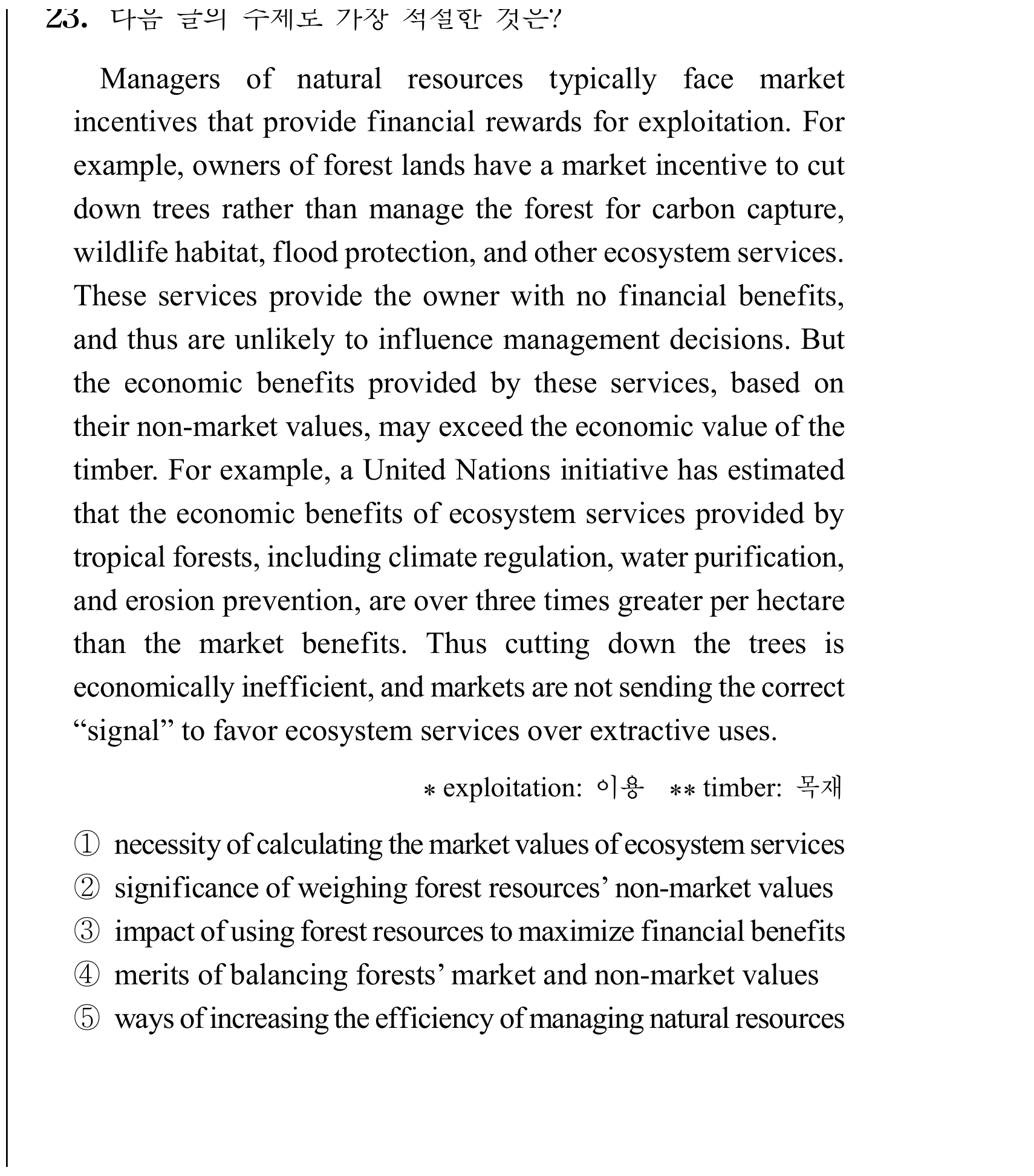
Managers of natural resources typically face market incentives that provide financial rewards for exploitation. For example, owners of forest lands have a market incentive to cut down trees rather than manage the forest for carbon capture, wildlife habitat, flood protection, and other ecosystem services. These services provide the owner with no financial benefits, and thus are unlikely to influence management decisions. But the economic benefits provided by these services, based on their non-market values, may exceed the economic value of the timber. For example, a United Nations initiative has estimated that the economic benefits of ecosystem services provided by tropical forests, including climate regulation, water purification, and erosion prevention, are over three times greater per hectare than the market benefits. Thus cutting down the trees is economically inefficient, and markets are not sending the correct “signal” to favor ecosystem services over extractive uses.
24번제목The concept of overtourism rests on a particular assumption about people and places commo…
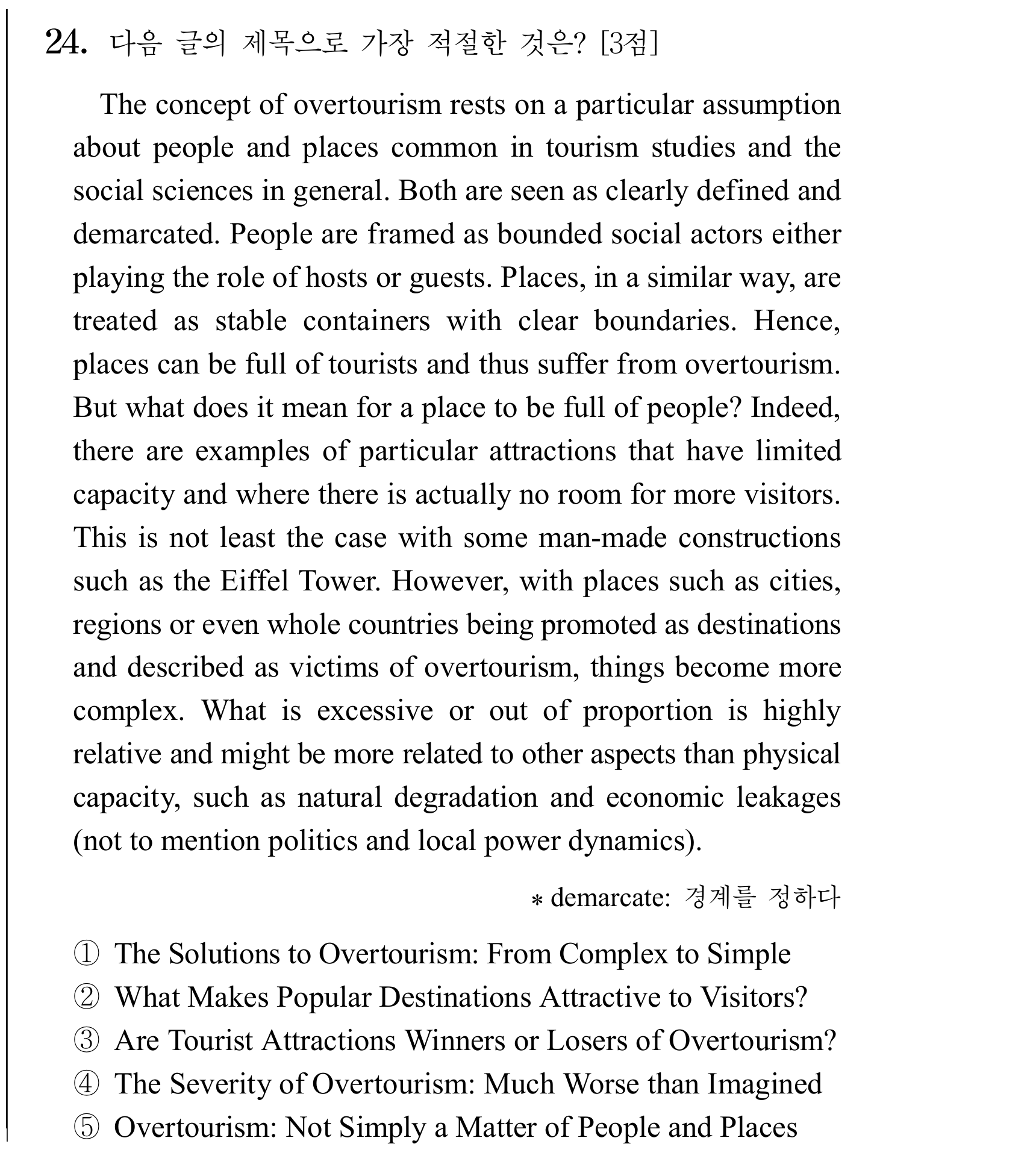
The concept of overtourism rests on a particular assumption about people and places common in tourism studies and the social sciences in general. Both are seen as clearly defined and demarcated. People are framed as bounded social actors either playing the role of hosts or guests. Places, in a similar way, are treated as stable containers with clear boundaries. Hence, places can be full of tourists and thus suffer from overtourism. But what does it mean for a place to be full of people? Indeed, there are examples of particular attractions that have limited capacity and where there is actually no room for more visitors. This is not least the case with some man-made constructions such as the Eiffel Tower. However, with places such as cities, regions or even whole countries being promoted as destinations and described as victims of overtourism, things become more complex. What is excessive or out of proportion is highly relative and might be more related to other aspects than physical capacity, such as natural degradation and economic leakages (not to mention politics and local power dynamics).
29번어법A number of studies provide substantial evidence of an innate human disposition to respon…
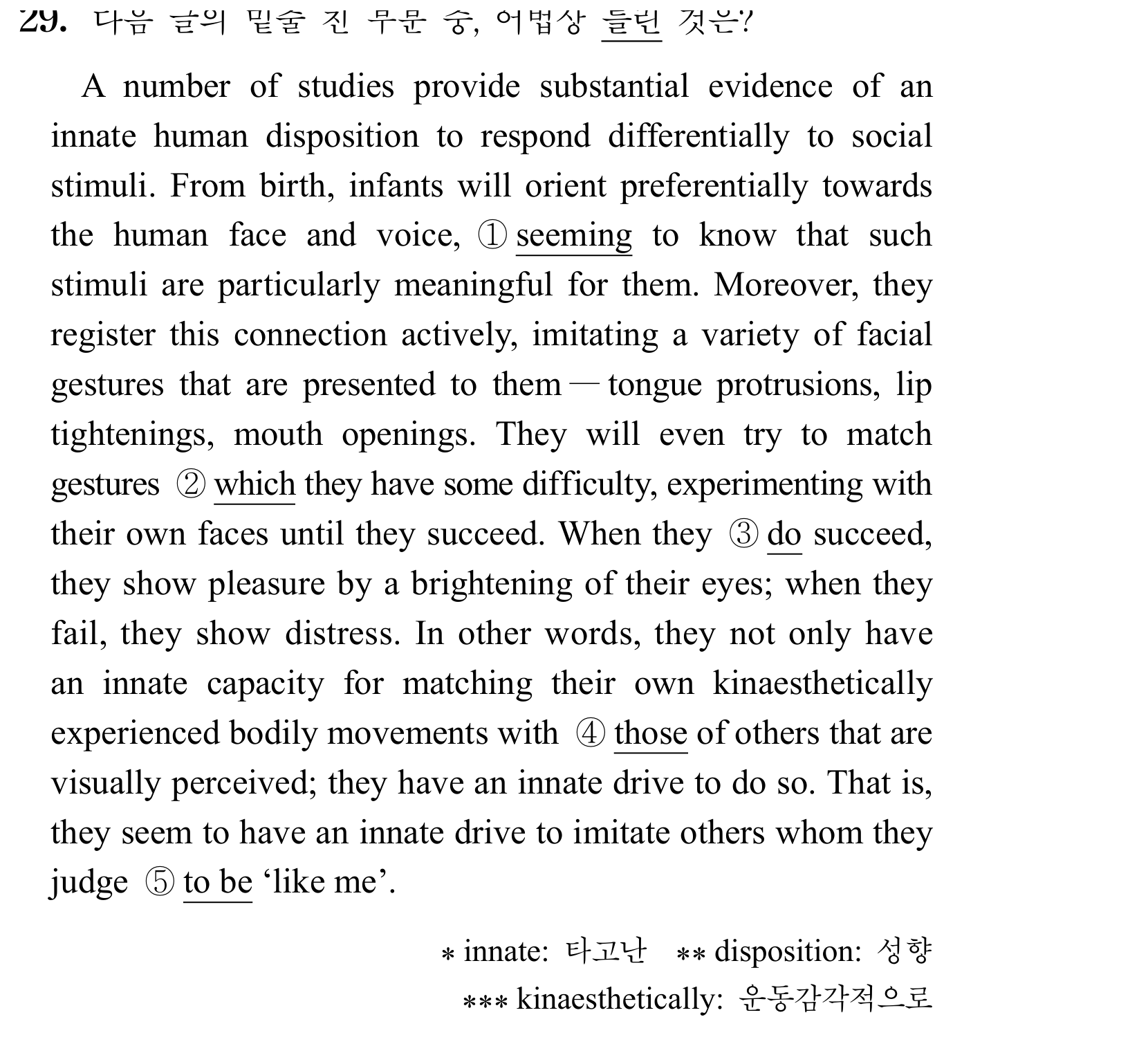
A number of studies provide substantial evidence of an innate human disposition to respond differentially to social stimuli. From birth, infants will orient preferentially towards the human face and voice, seeming to know that such stimuli are particularly meaningful for them. Moreover, they register this connection actively, imitating a variety of facial gestures that are presented to them — tongue protrusions, lip tightenings, mouth openings. They will even try to match gestures which they have some difficulty, experimenting with their own faces until they succeed. When they do succeed, they show pleasure by a brightening of their eyes; when they fail, they show distress. In other words, they not only have an innate capacity for matching their own kinaesthetically experienced bodily movements with those of others that are visually perceived; they have an innate drive to do so. That is, they seem to have an innate drive to imitate others whom they judge to be ‘like me’.
30번어휘Bazaar economies feature an apparently flexible price-setting mechanism that sits atop mo…
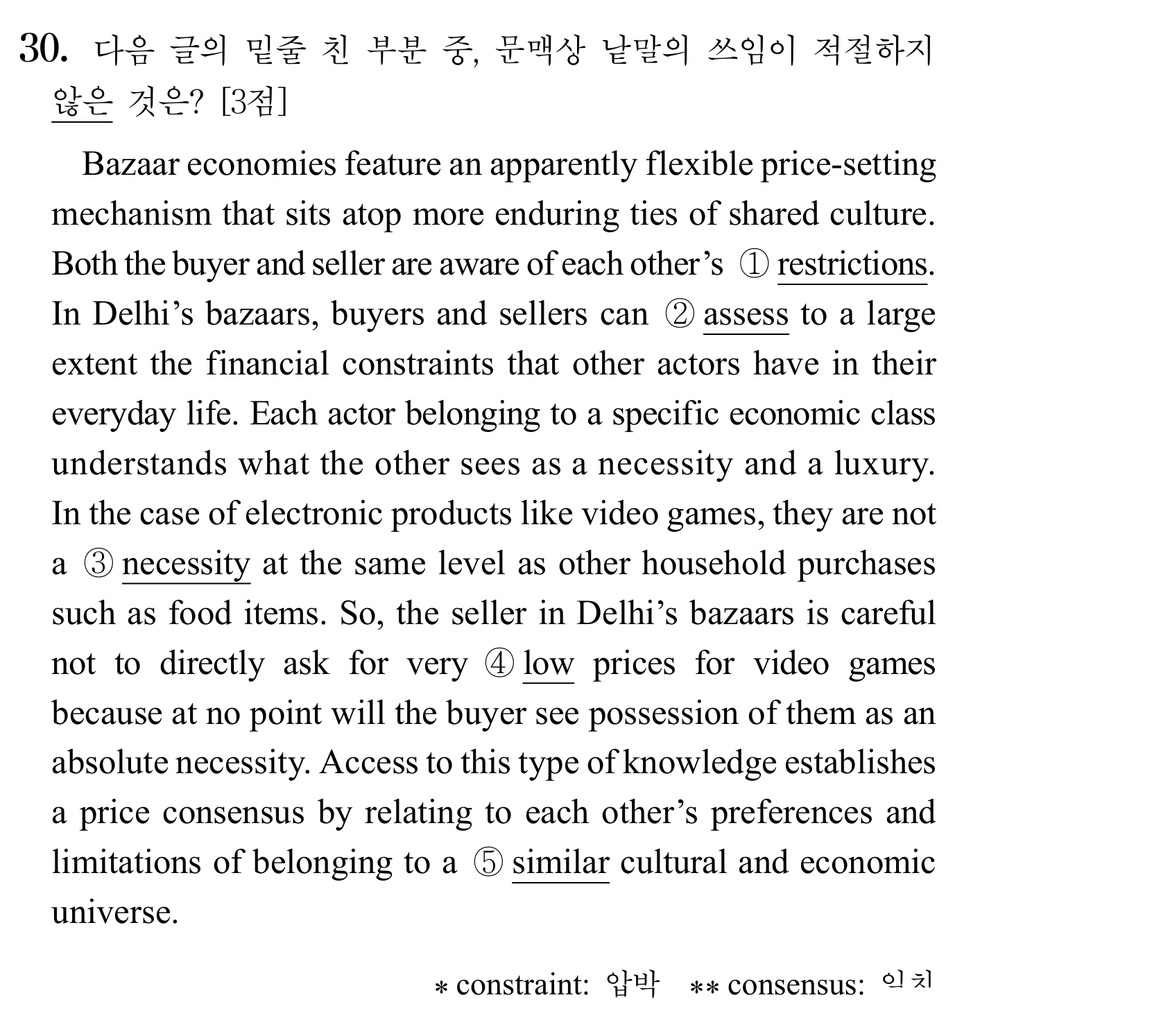
Bazaar economies feature an apparently flexible price-setting mechanism that sits atop more enduring ties of shared culture. Both the buyer and seller are aware of each other’s restrictions. In Delhi’s bazaars, buyers and sellers can assess to a large extent the financial constraints that other actors have in their everyday life. Each actor belonging to a specific economic class understands what the other sees as a necessity and a luxury. In the case of electronic products like video games, they are not a necessity at the same level as other household purchases such as food items. So, the seller in Delhi’s bazaars is careful not to directly ask for very high prices for video games because at no point will the buyer see possession of them as an absolute necessity. Access to this type of knowledge establishes a price consensus by relating to each other’s preferences and limitations of belonging to a similar cultural and economic universe.
31번빈칸추론2Over the last decade the attention given to how children learn to read has foregrounded t…
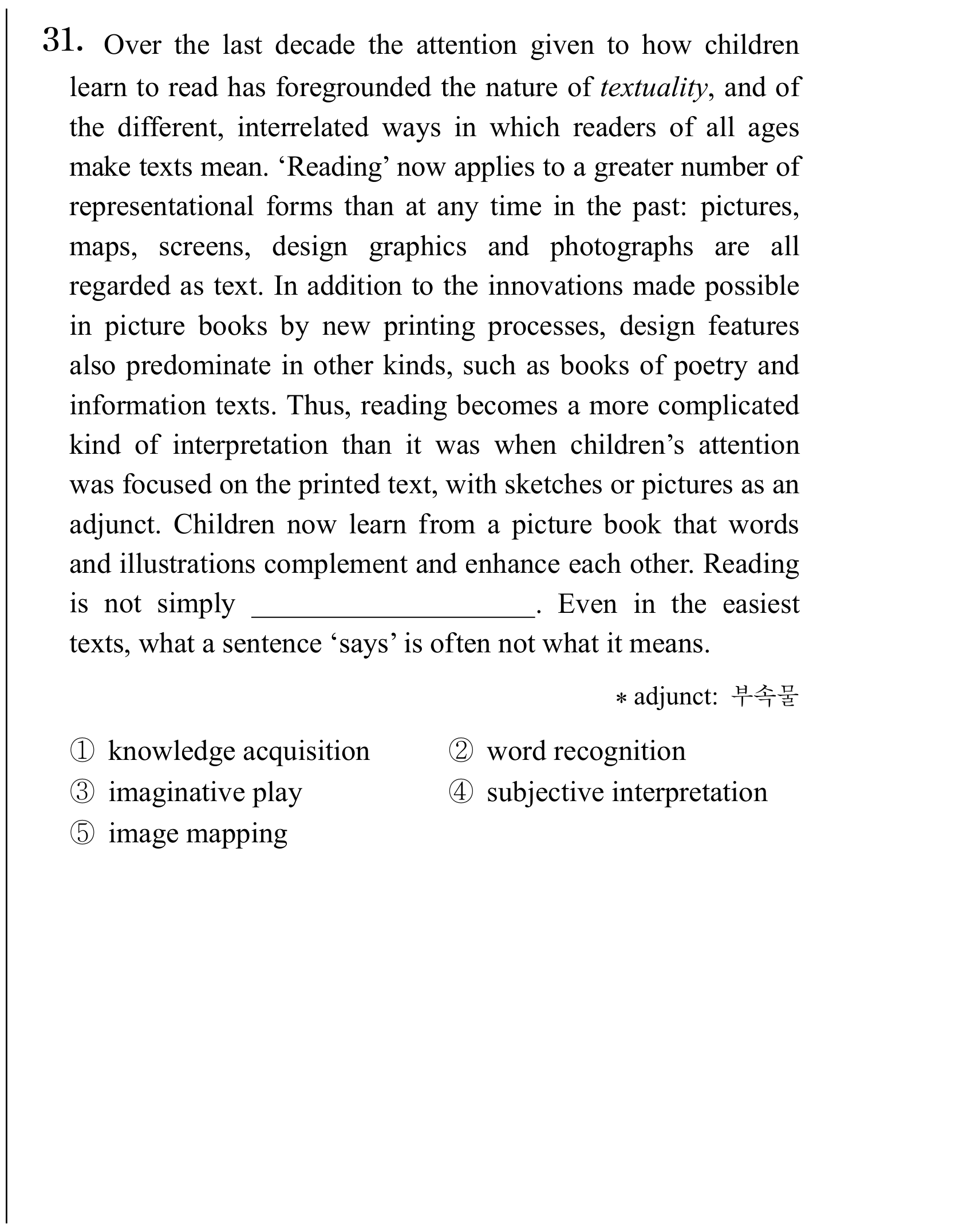
Over the last decade the attention given to how children learn to read has foregrounded the nature of textuality, and of the different, interrelated ways in which readers of all ages make texts mean. ‘Reading’ now applies to a greater number of representational forms than at any time in the past: pictures, maps, screens, design graphics and photographs are all regarded as text. In addition to the innovations made possible in picture books by new printing processes, design features also predominate in other kinds, such as books of poetry and information texts. Thus, reading becomes a more complicated kind of interpretation than it was when children’s attention was focused on the printed text, with sketches or pictures as an adjunct. Children now learn from a picture book that words and illustrations complement and enhance each other. Reading is not simply decoding. Even in the easiest texts, what a sentence ‘says’ is often not what it means.
32번빈칸추론3A musical score within any film can add an additional layer to the film text, which goes…
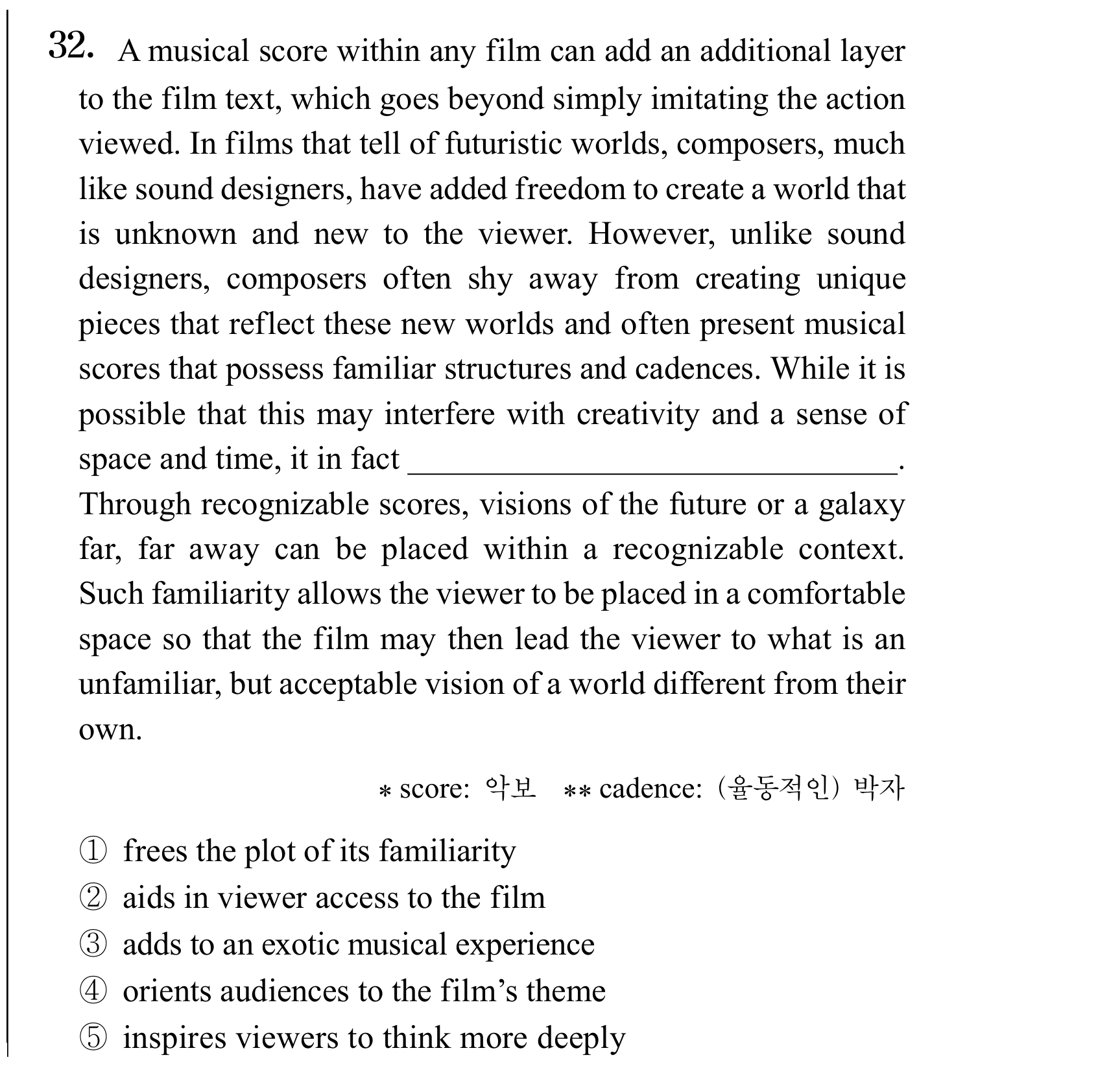
A musical score within any film can add an additional layer to the film text, which goes beyond simply imitating the action viewed. In films that tell of futuristic worlds, composers, much like sound designers, have added freedom to create a world that is unknown and new to the viewer. However, unlike sound designers, composers often shy away from creating unique pieces that reflect these new worlds and often present musical scores that possess familiar structures and cadences. While it is possible that this may interfere with creativity and a sense of space and time, it in fact aids in viewer access to the film. Through recognizable scores, visions of the future or a galaxy far, far away can be placed within a recognizable context. Such familiarity allows the viewer to be placed in a comfortable space so that the film may then lead the viewer to what is an unfamiliar, but acceptable vision of a world different from their own.
33번빈칸추론4There have been psychological studies in which subjects were shown photographs of people'…
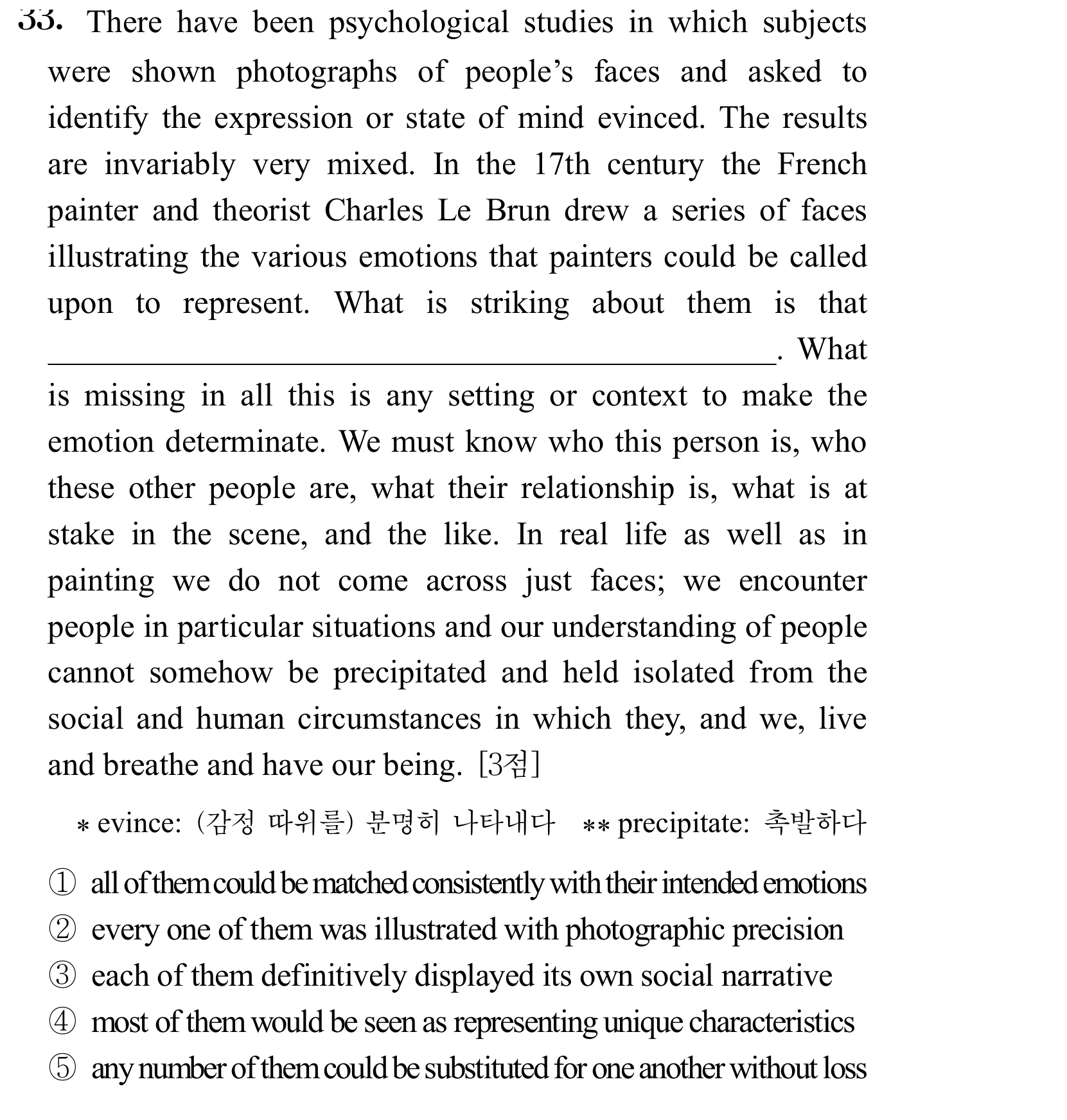
There have been psychological studies in which subjects were shown photographs of people's faces and asked to identify the expression or state of mind evinced. The results are invariably very mixed. In the 17th century the French painter and theorist Charles Le Brun drew a series of faces illustrating the various emotions that painters could be called upon to represent. What is striking about them is that any number of them could be substituted for one another without loss. What is missing in all this is any setting or context to make the emotion determinate. We must know who this person is, who these other people are, what their relationship is, what is at stake in the scene, and the like. In real life as well as in painting we do not come across just faces; we encounter people in particular situations and our understanding of people cannot somehow be precipitated and held isolated from the social and human circumstances in which they, and we, live and breathe and have our being.
34번빈칸추론5Everyone who drives, walks, or swipes a transit card in a city views herself as a transpo…
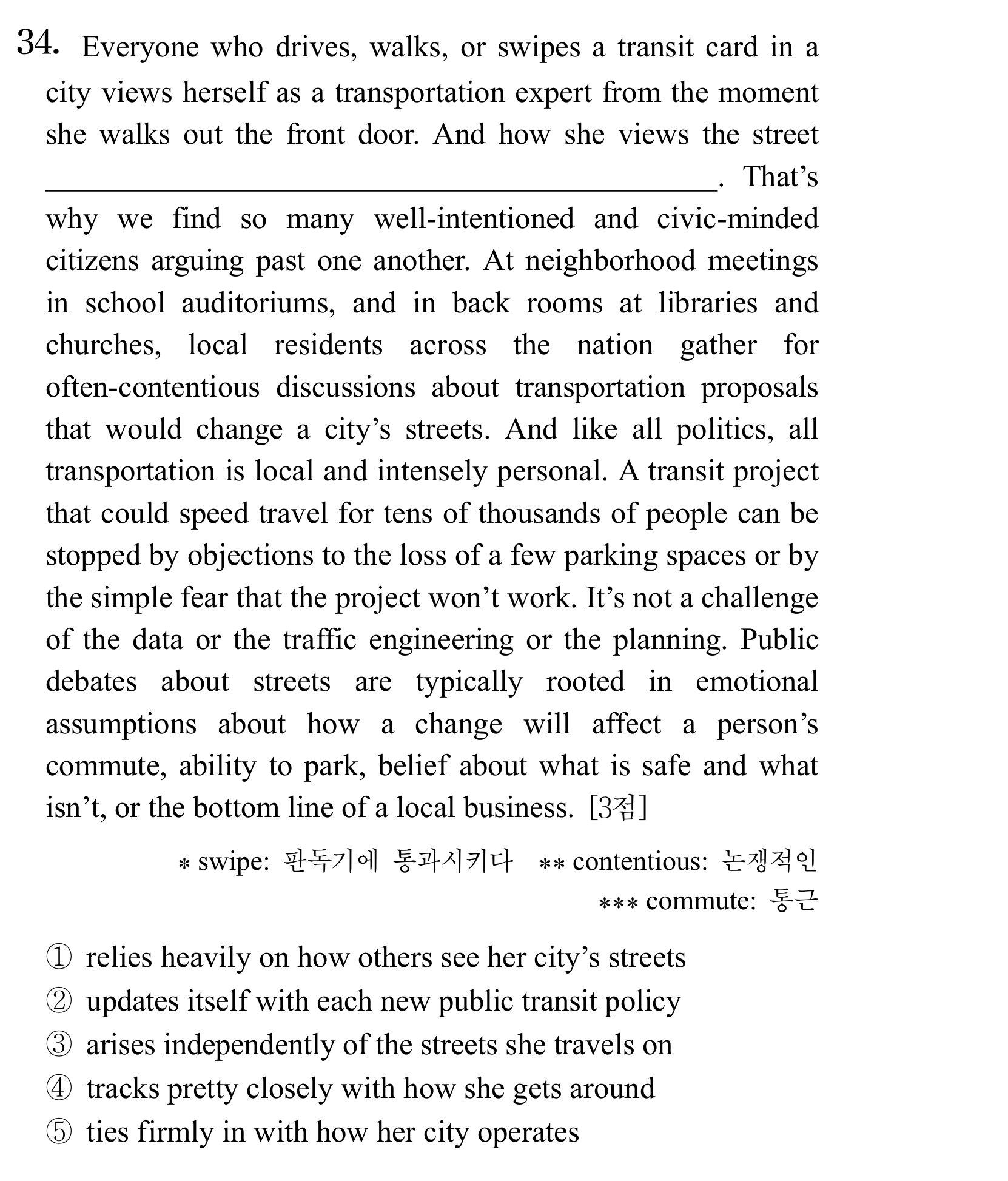
Everyone who drives, walks, or swipes a transit card in a city views herself as a transportation expert from the moment she walks out the front door. And how she views the street tracks pretty closely with how she gets around. That’s why we find so many well-intentioned and civic-minded citizens arguing past one another. At neighborhood meetings in school auditoriums, and in back rooms at libraries and churches, local residents across the nation gather for often-contentious discussions about transportation proposals that would change a city’s streets. And like all politics, all transportation is local and intensely personal. A transit project that could speed travel for tens of thousands of people can be stopped by objections to the loss of a few parking spaces or by the simple fear that the project won’t work. It’s not a challenge of the data or the traffic engineering or the planning. Public debates about streets are typically rooted in emotional assumptions about how a change will affect a person’s commute, ability to park, belief about what is safe and what isn’t, or the bottom line of a local business.
35번무관한문장Speaking fast is a high-risk proposition.
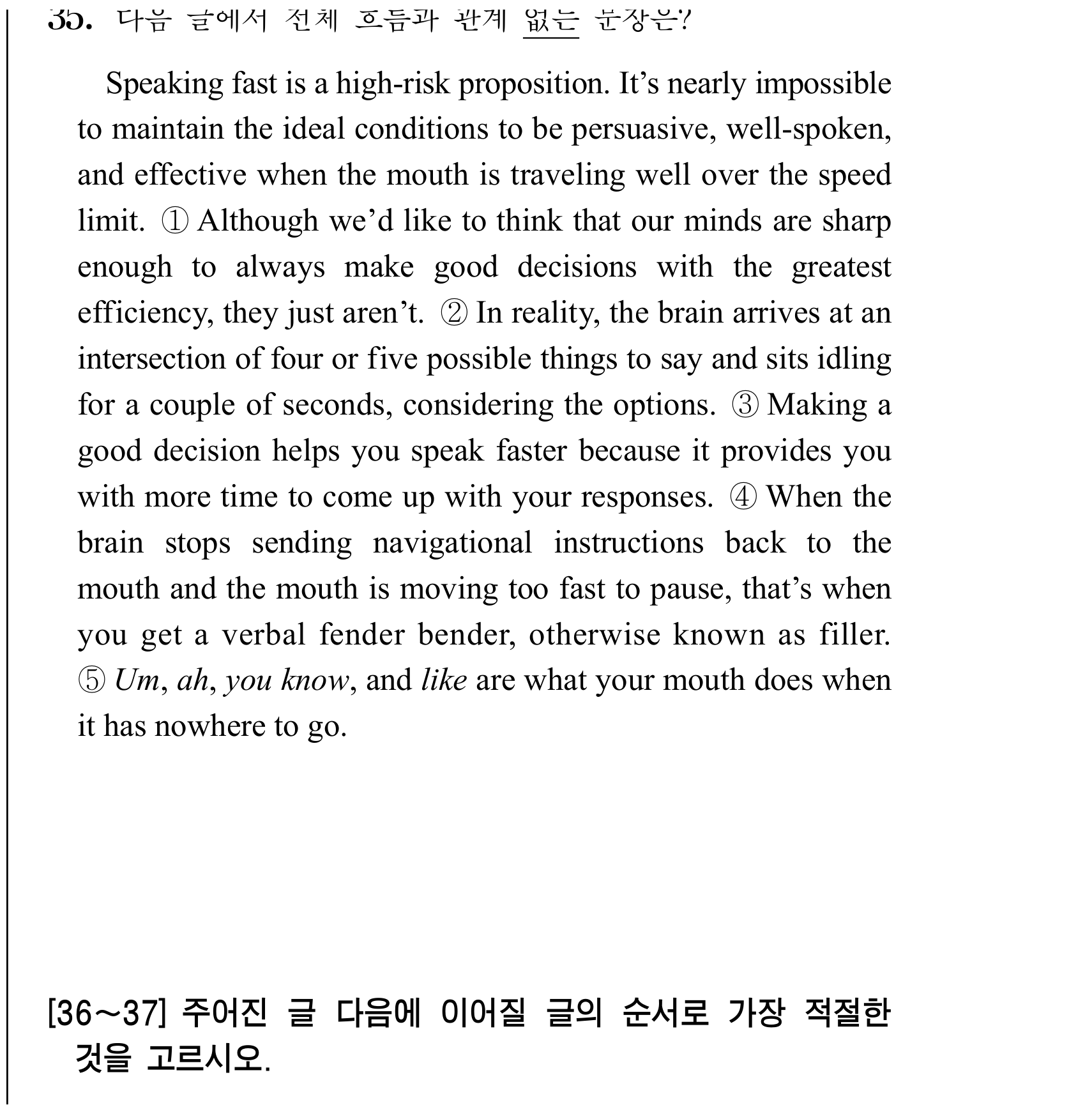
Speaking fast is a high-risk proposition. It’s nearly impossible to maintain the ideal conditions to be persuasive, well-spoken, and effective when the mouth is traveling well over the speed limit. Although we’d like to think that our minds are sharp enough to always make good decisions with the greatest efficiency, they just aren’t. In reality, the brain arrives at an intersection of four or five possible things to say and sits idling for a couple of seconds, considering the options. When the brain stops sending navigational instructions back to the mouth and the mouth is moving too fast to pause, that’s when you get a verbal fender bender, otherwise known as filler. Um, ah, you know, and like are what your mouth does when it has nowhere to go.
36번순서배열1Negotiation can be defined as an attempt to explore and reconcile conflicting positions i…
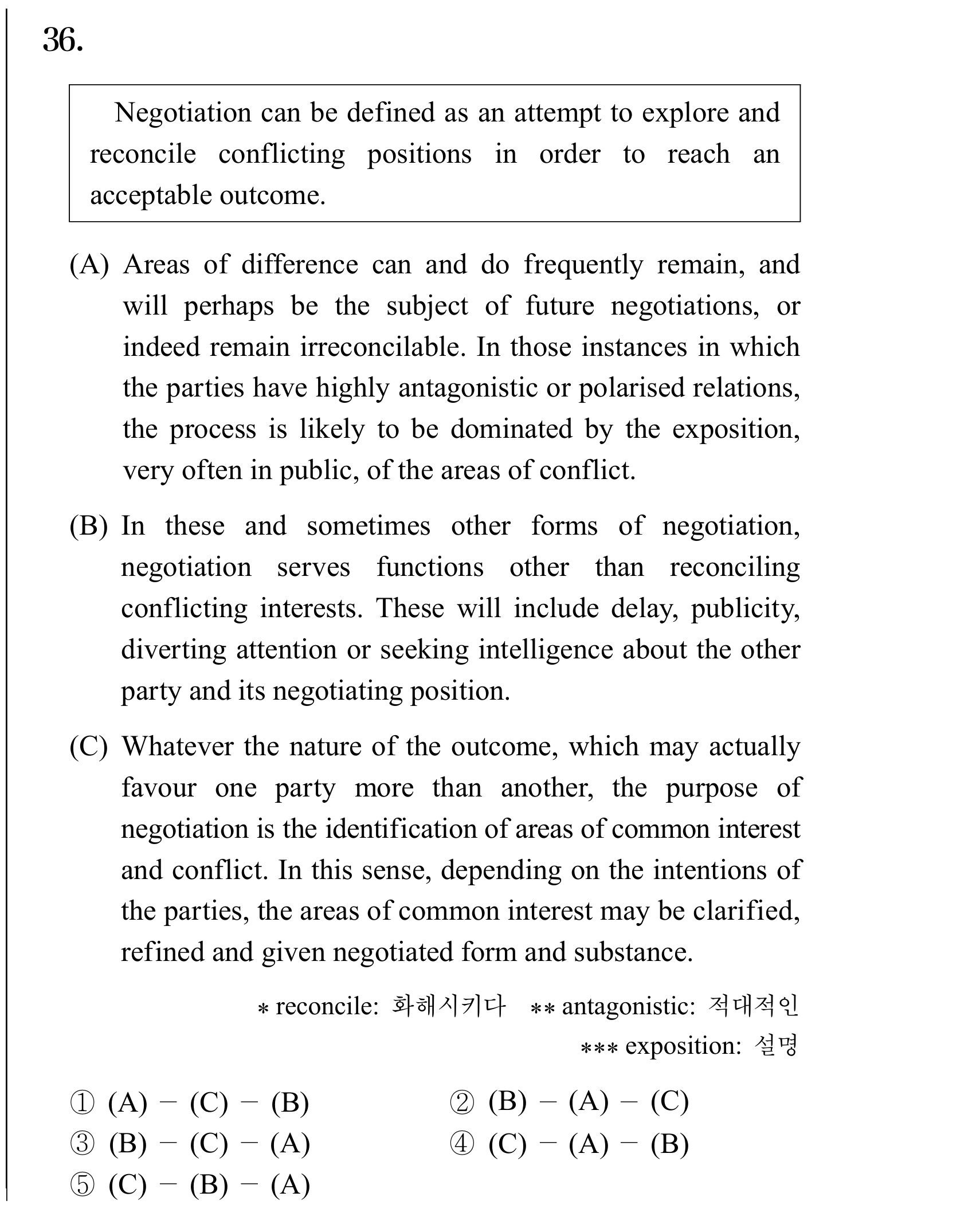
Negotiation can be defined as an attempt to explore and reconcile conflicting positions in order to reach an acceptable outcome. Whatever the nature of the outcome, which may actually favour one party more than another, the purpose of negotiation is the identification of areas of common interest and conflict. In this sense, depending on the intentions of the parties, the areas of common interest may be clarified, refined and given negotiated form and substance. Areas of difference can and do frequently remain, and will perhaps be the subject of future negotiations, or indeed remain irreconcilable. In those instances in which the parties have highly antagonistic or polarised relations, the process is likely to be dominated by the exposition, very often in public, of the areas of conflict. In these and sometimes other forms of negotiation, negotiation serves functions other than reconciling conflicting interests. These will include delay, publicity, diverting attention or seeking intelligence about the other party and its negotiating position.
37번순서배열2Norms emerge in groups as a result of people conforming to the behavior of others.
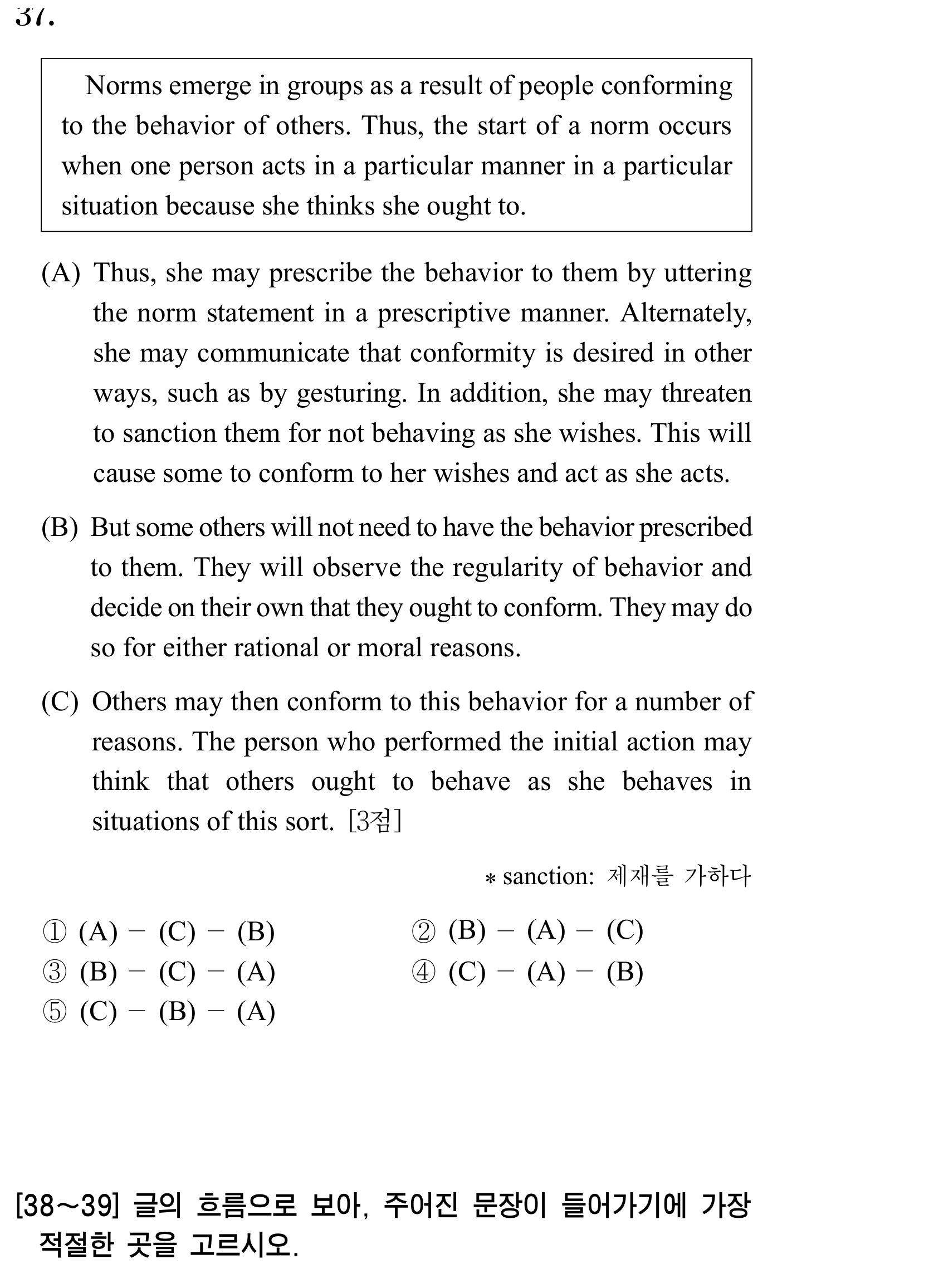
Norms emerge in groups as a result of people conforming to the behavior of others. Thus, the start of a norm occurs when one person acts in a particular manner in a particular situation because she thinks she ought to. Others may then conform to this behavior for a number of reasons. The person who performed the initial action may think that others ought to behave as she behaves in situations of this sort. Thus, she may prescribe the behavior to them by uttering the norm statement in a prescriptive manner. Alternately, she may communicate that conformity is desired in other ways, such as by gesturing. In addition, she may threaten to sanction them for not behaving as she wishes. This will cause some to conform to her wishes and act as she acts. But some others will not need to have the behavior prescribed to them. They will observe the regularity of behavior and decide on their own that they ought to conform. They may do so for either rational or moral reasons.
38번문장삽입1Science is sometimes described as a winner-take-all contest, meaning that there are no re…
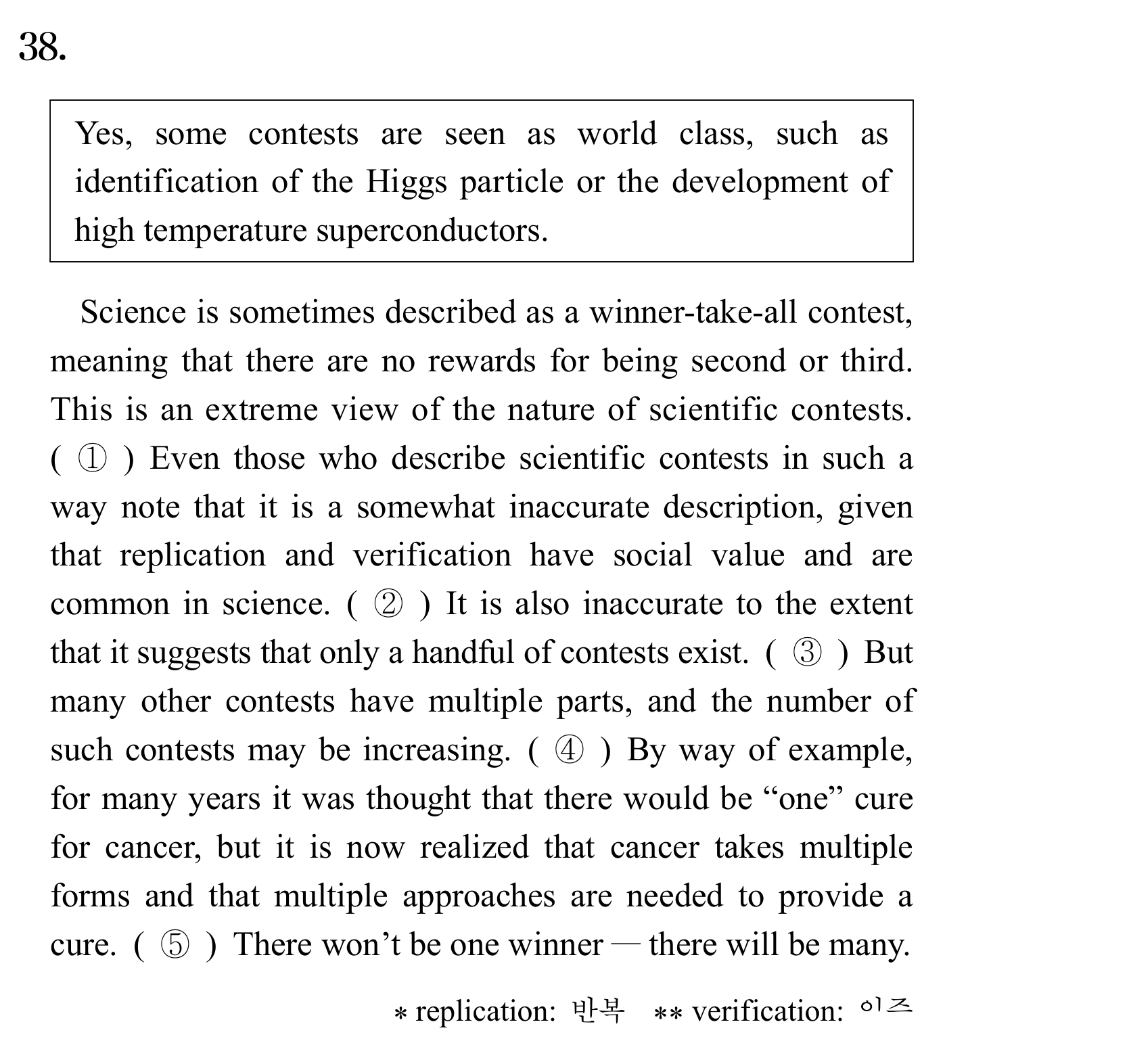
Science is sometimes described as a winner-take-all contest, meaning that there are no rewards for being second or third. This is an extreme view of the nature of scientific contests. Yes, some contests are seen as world class, such as identification of the Higgs particle or the development of high temperature superconductors. Even those who describe scientific contests in such a way note that it is a somewhat inaccurate description, given that replication and verification have social value and are common in science. It is also inaccurate to the extent that it suggests that only a handful of contests exist. But many other contests have multiple parts, and the number of such contests may be increasing. By way of example, for many years it was thought that there would be “one” cure for cancer, but it is now realized that cancer takes multiple forms and that multiple approaches are needed to provide a cure. There won’t be one winner — there will be many.
39번문장삽입2Misprints in a book or in any written message usually have a negative impact on the conte…
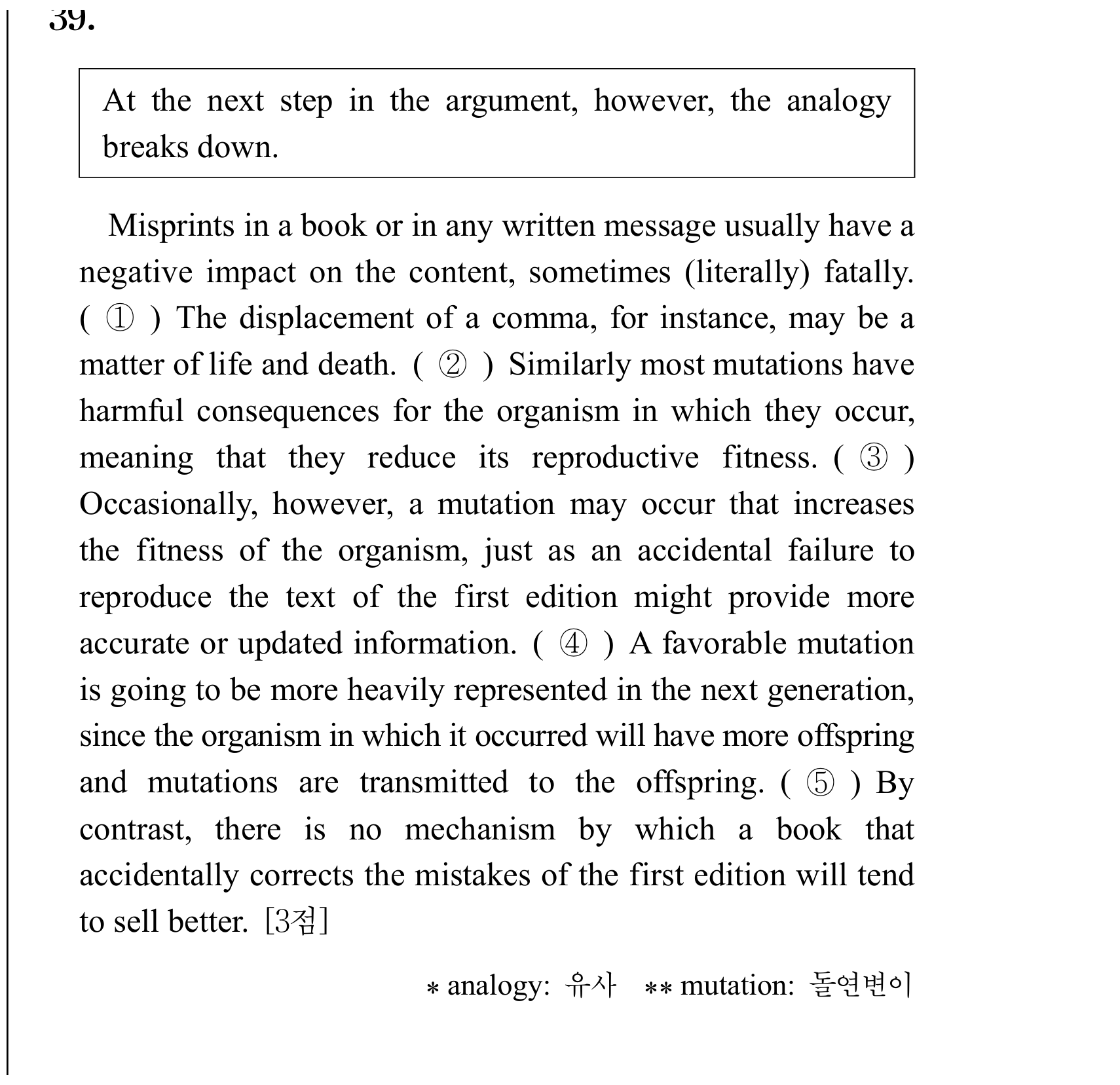
Misprints in a book or in any written message usually have a negative impact on the content, sometimes (literally) fatally. The displacement of a comma, for instance, may be a matter of life and death. Similarly most mutations have harmful consequences for the organism in which they occur, meaning that they reduce its reproductive fitness. At the next step in the argument, however, the analogy breaks down. Occasionally, however, a mutation may occur that increases the fitness of the organism, just as an accidental failure to reproduce the text of the first edition might provide more accurate or updated information. A favorable mutation is going to be more heavily represented in the next generation, since the organism in which it occurred will have more offspring and mutations are transmitted to the offspring. By contrast, there is no mechanism by which a book that accidentally corrects the mistakes of the first edition will tend to sell better.
40번요약문완성Even those with average talent can produce notable work in the various sciences, so long…
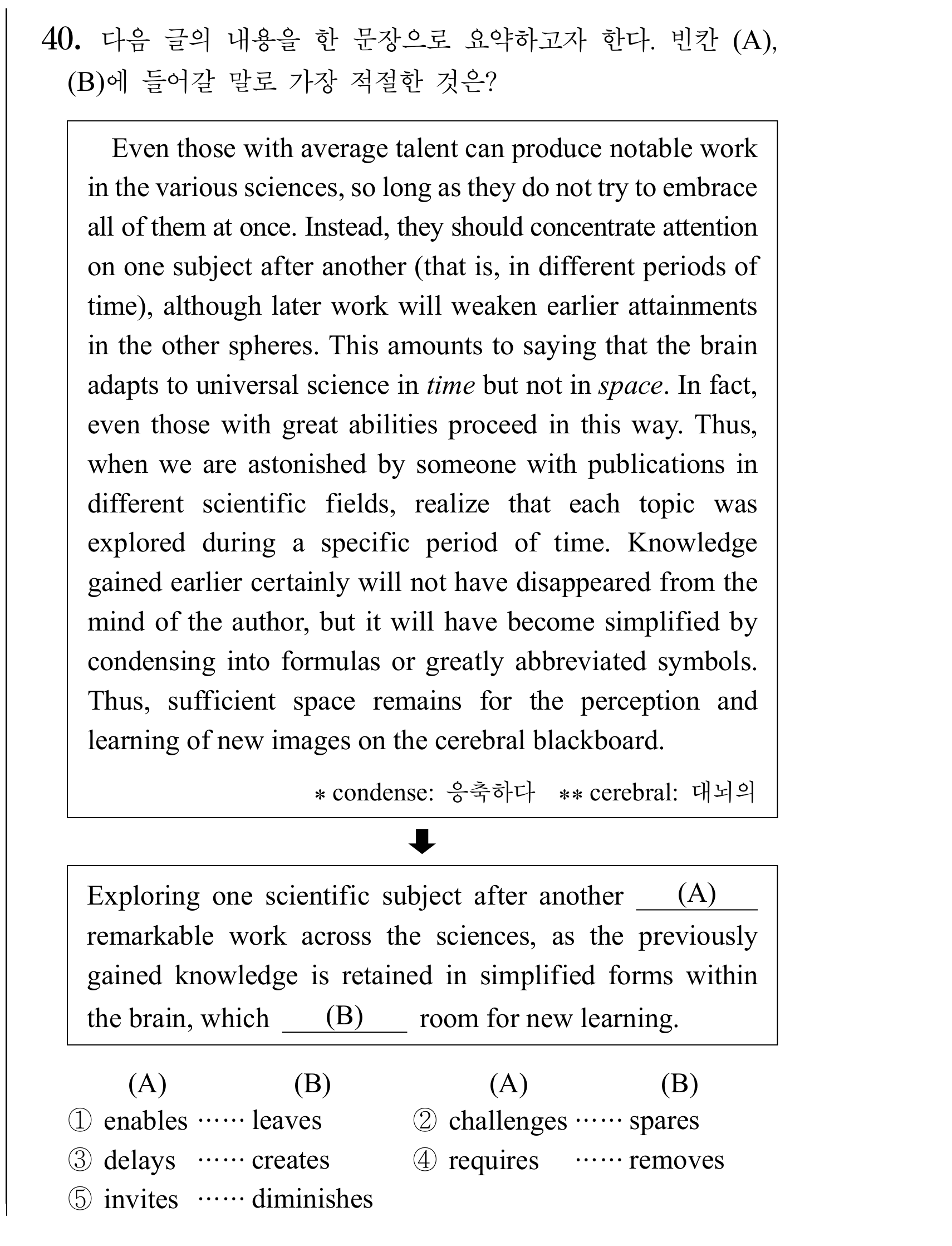
Even those with average talent can produce notable work in the various sciences, so long as they do not try to embrace all of them at once. Instead, they should concentrate attention on one subject after another (that is, in different periods of time), although later work will weaken earlier attainments in the other spheres. This amounts to saying that the brain adapts to universal science in time but not in space. In fact, even those with great abilities proceed in this way. Thus, when we are astonished by someone with publications in different scientific fields, realize that each topic was explored during a specific period of time. Knowledge gained earlier certainly will not have disappeared from the mind of the author, but it will have become simplified by condensing into formulas or greatly abbreviated symbols. Thus, sufficient space remains for the perception and learning of new images on the cerebral blackboard.
41번장문_제목One way to avoid contributing to overhyping a story would be to say nothing.
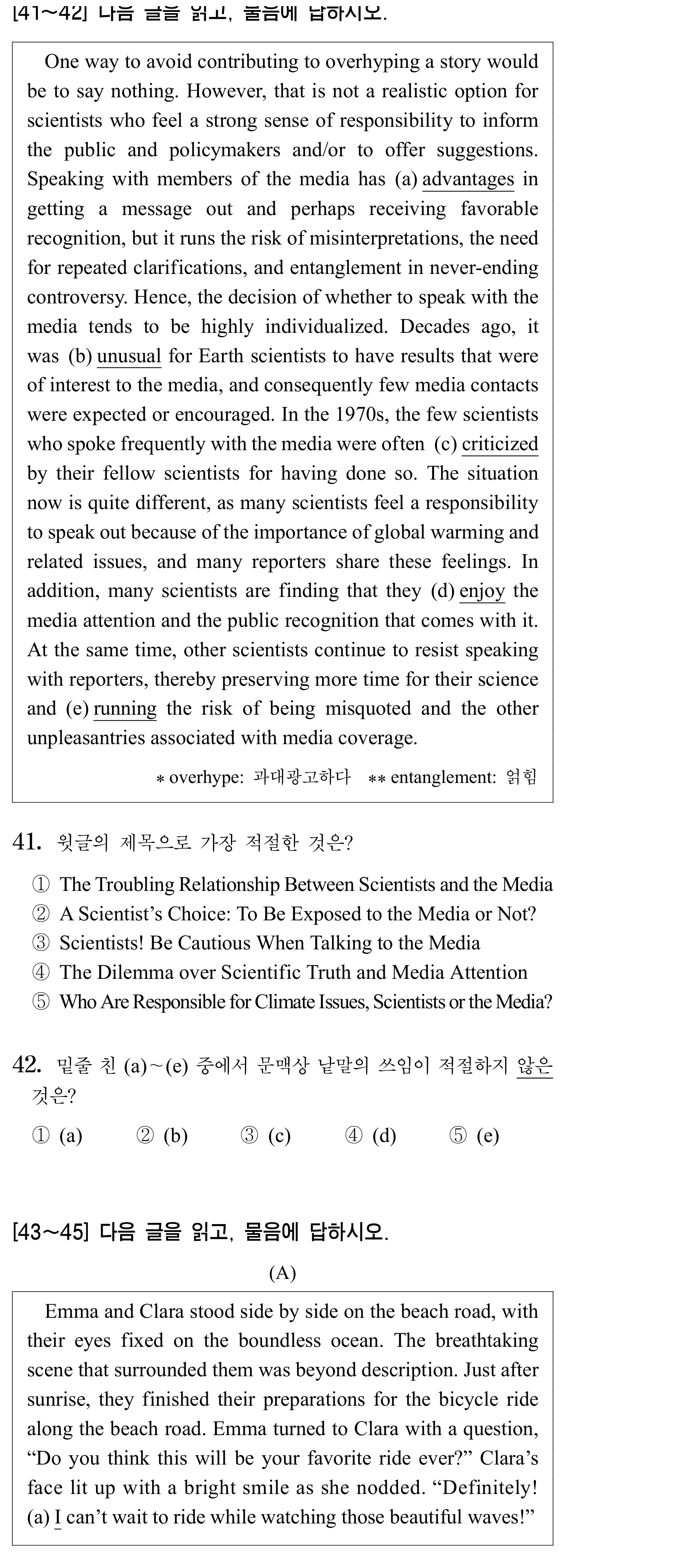
One way to avoid contributing to overhyping a story would be to say nothing. However, that is not a realistic option for scientists who feel a strong sense of responsibility to inform the public and policymakers and/or to offer suggestions. Speaking with members of the media has (a) advantages in getting a message out and perhaps receiving favorable recognition, but it runs the risk of misinterpretations, the need for repeated clarifications, and entanglement in never-ending controversy. Hence, the decision of whether to speak with the media tends to be highly individualized. Decades ago, it was (b) unusual for Earth scientists to have results that were of interest to the media, and consequently few media contacts were expected or encouraged. In the 1970s, the few scientists who spoke frequently with the media were often (c) criticized by their fellow scientists for having done so. The situation now is quite different, as many scientists feel a responsibility to speak out because of the importance of global warming and related issues, and many reporters share these feelings. In addition, many scientists are finding that they (d) enjoy the media attention and the public recognition that comes with it. At the same time, other scientists continue to resist speaking with reporters, thereby preserving more time for their science and (e) running the risk of being misquoted and the other unpleasantries associated with media coverage.
43번장문_순서(A) Emma and Clara stood side by side on the beach road, with their eyes fixed on the bou…
(A) Emma and Clara stood side by side on the beach road, with their eyes fixed on the boundless ocean. The breathtaking scene that surrounded them was beyond description. Just after sunrise, they finished their preparations for the bicycle ride along the beach road. Emma turned to Clara with a question, “Do you think this will be your favorite ride ever?” Clara’s face lit up with a bright smile as she nodded. “Definitely! (a) I can’t wait to ride while watching those beautiful waves!”
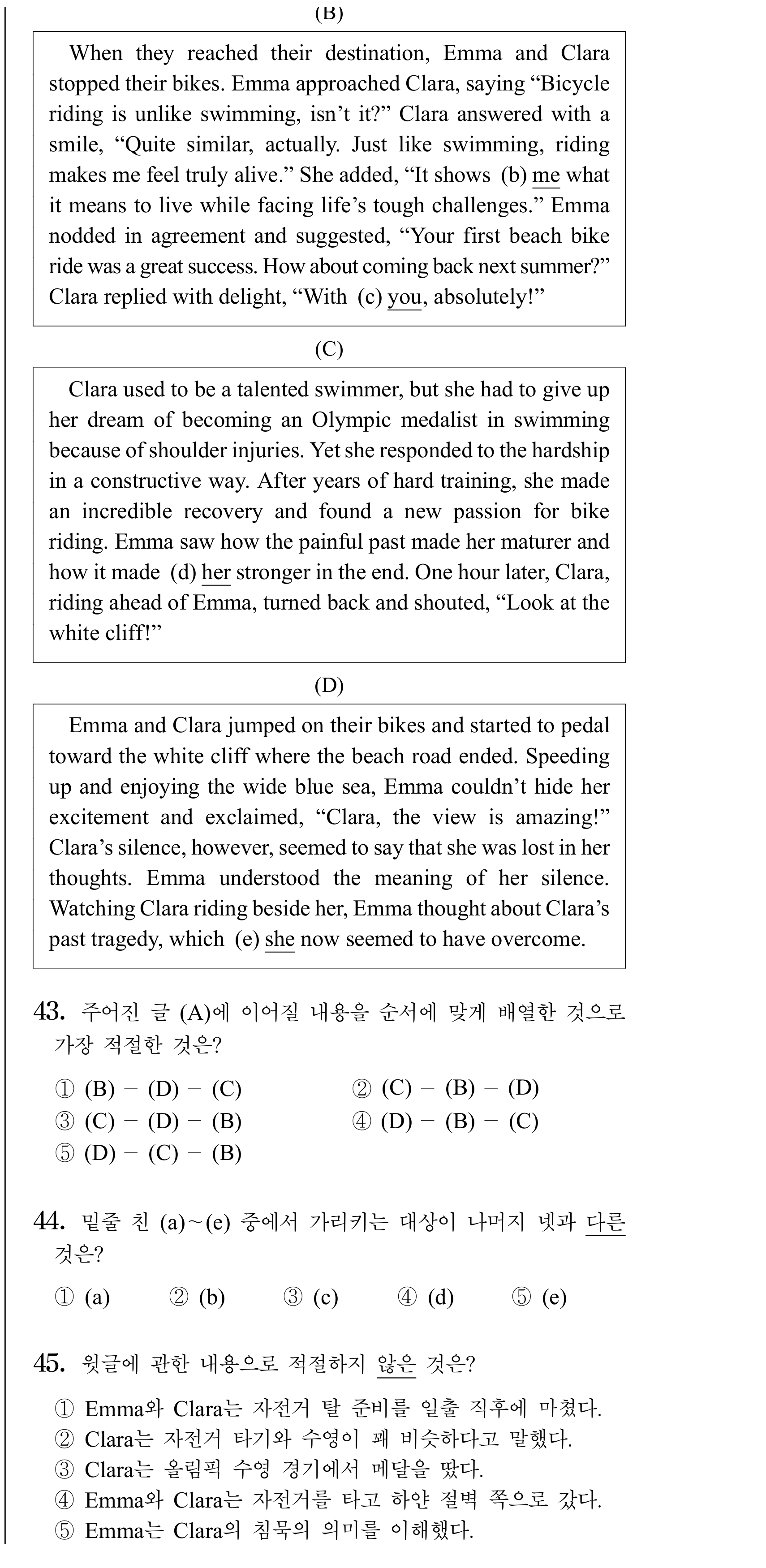
(B) When they reached their destination, Emma and Clara stopped their bikes. Emma approached Clara, saying “Bicycle riding is unlike swimming, isn’t it?” Clara answered with a smile, “Quite similar, actually. Just like swimming, riding makes me feel truly alive.” She added, “It shows (b) me what it means to live while facing life’s tough challenges.” Emma nodded in agreement and suggested, “Your first beach bike ride was a great success. How about coming back next summer?” Clara replied with delight, “With (c) you, absolutely!”
(C) Clara used to be a talented swimmer, but she had to give up her dream of becoming an Olympic medalist in swimming because of shoulder injuries. Yet she responded to the hardship in a constructive way. After years of hard training, she made an incredible recovery and found a new passion for bike riding. Emma saw how the painful past made her maturer and how it made (d) her stronger in the end. One hour later, Clara, riding ahead of Emma, turned back and shouted, “Look at the white cliff!”
(D) Emma and Clara jumped on their bikes and started to pedal toward the white cliff where the beach road ended. Speeding up and enjoying the wide blue sea, Emma couldn’t hide her excitement and exclaimed, “Clara, the view is amazing!” Clara’s silence, however, seemed to say that she was lost in her thoughts. Emma understood the meaning of her silence. Watching Clara riding beside her, Emma thought about Clara’s past tragedy, which (e) she now seemed to have overcome.
2023년 11월 고3 전국연합 영어 모의고사 변형문제 맛보기
이 시험 지문으로 만든 변형문제가 아직 없습니다. 지문을 고르면 어법·빈칸·주제·어휘 등 유형별 변형문제를 바로 만들 수 있습니다.
이 시험으로 첫 변형문제 만들기 →남은 시간
48:00
아직 28문제를 풀지 않았어요 (0/28)