2022년 3월 고3 전국연합 영어 모의고사
28문제 · 제한시간 48분
이 시험 한눈에 — 2022년 3월 고3 전국연합 영어 모의고사
18~45번 28문항을 유형별로 보면 목적 1 · 심경/분위기 1 · 주장 1 · 함축의미추론 1 · 요지/주장 1 · 주제 1 · 제목 1 · 도표 1 · 내용일치 1 · 실용문 1 · 어법 2 · 어휘 1 · 빈칸추론2 1 · 빈칸추론3 1 · 빈칸추론4 1 · 빈칸추론5 1 · 무관한문장 1 · 순서배열1 1 · 순서배열2 1 · 문장삽입1 1 · 문장삽입2 1 · 요약문완성 1 · 장문 5. 아래 지문으로 변형문제·단어장·정답표를 바로 만들 수 있습니다.
20번주장Conflicts between the goals of science and the need to protect the rights and welfare of…
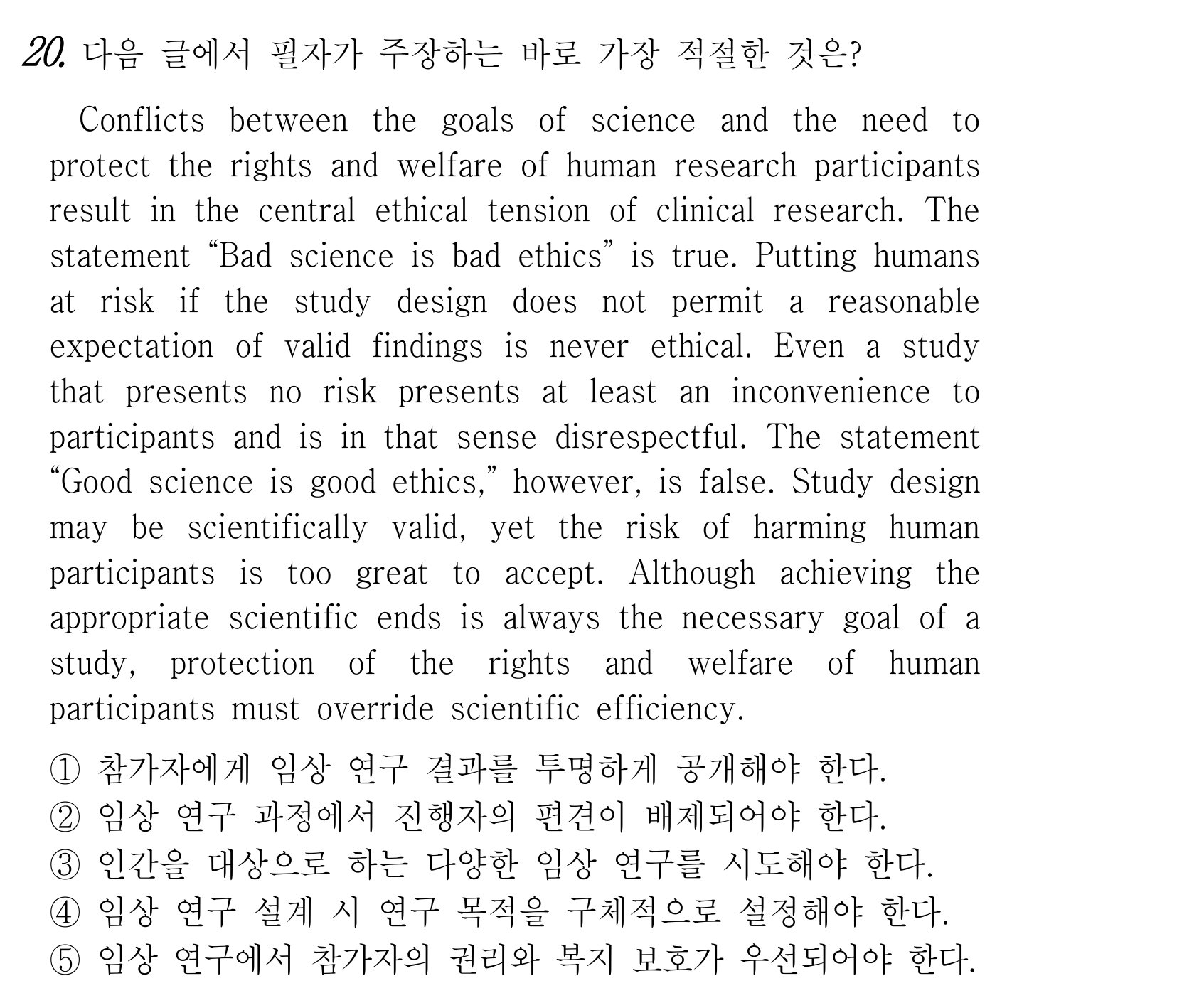
Conflicts between the goals of science and the need to protect the rights and welfare of human research participants result in the central ethical tension of clinical research. The statement “Bad science is bad ethics” is true. Putting humans at risk if the study design does not permit a reasonable expectation of valid findings is never ethical. Even a study that presents no risk presents at least an inconvenience to participants and is in that sense disrespectful. The statement “Good science is good ethics,” however, is false. Study design may be scientifically valid, yet the risk of harming human participants is too great to accept. Although achieving the appropriate scientific ends is always the necessary goal of a study, protection of the rights and welfare of human participants must override scientific efficiency.
21번함축의미추론Thomas Edison’s name is synonymous with invention, and his most famous invention, the ele…
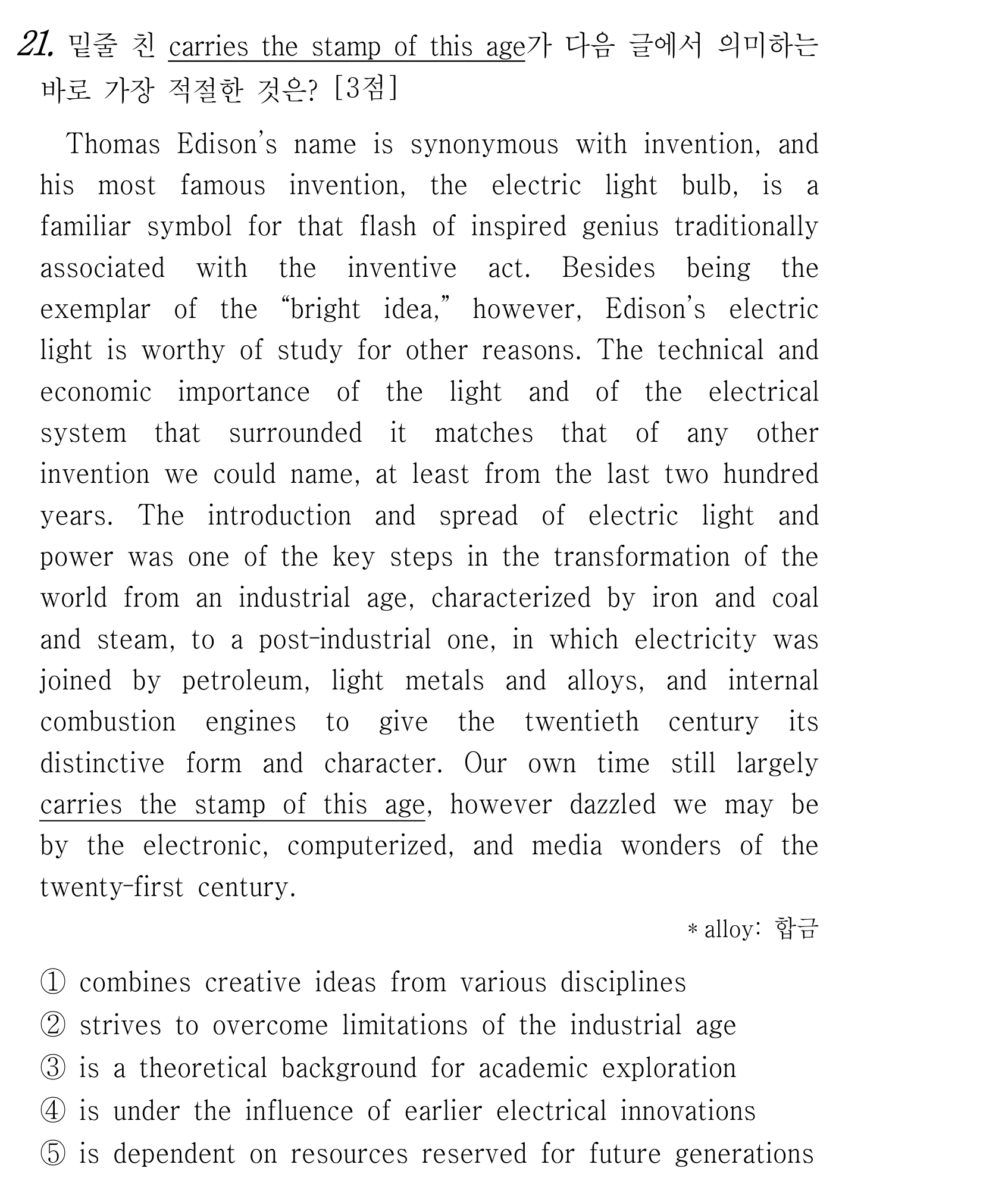
Thomas Edison’s name is synonymous with invention, and his most famous invention, the electric light bulb, is a familiar symbol for that flash of inspired genius traditionally associated with the inventive act. Besides being the exemplar of the “bright idea,” however, Edison’s electric light is worthy of study for other reasons. The technical and economic importance of the light and of the electrical system that surrounded it matches that of any other invention we could name, at least from the last two hundred years. The introduction and spread of electric light and power was one of the key steps in the transformation of the world from an industrial age, characterized by iron and coal and steam, to a post-industrial one, in which electricity was joined by petroleum, light metals and alloys, and internal combustion engines to give the twentieth century its distinctive form and character. Our own time still largely carries the stamp of this age, however dazzled we may be by the electronic, computerized, and media wonders of the twenty-first century.
22번요지/주장Just imagine that we have invented special glasses that give us the power to see the odor…
Just imagine that we have invented special glasses that give us the power to see the odorous world the way that other organisms perceive it. Put your pair on and walk outside for just a moment. As the bright sunlight hits our eyes, we would encounter a world far different from what we would normally expect. The air is full of molecules carried by breezes. Chemical signals would flood our eyes just as surely as sounds overwhelm our ears at a cocktail party. Stare at any plant and you would see compounds being released into the air from leaves, bark, and roots. A squirrel in a tree exudes carbon dioxide and other compounds with each breath. Glance along its brown body and notice that specific points (scent glands) appear to be slowly releasing chemical signals. If we could translate these signals into language, we would see phrases, sentences, statements, songs, and other messages waiting to be intercepted and interpreted.
23번주제Skills-based approaches to teaching critical thinking now have a long history and literat…
Skills-based approaches to teaching critical thinking now have a long history and literature, but what has become clear through more than 25 years of work on critical thinking theory and pedagogy is that teaching students a set of thinking skills does not seem to be enough. Students may learn to write an adequate article critique in one class, but fail to use those skills in another. They may learn how to evaluate research methodology in other students’ research designs, but completely miss the flaws in their own. They may learn to recognize thinking biases in the classroom, but still use badly flawed reasoning in their own decision making. Too often students think our courses are either about memorizing a great deal of material, or about learning the rules for and playing one more idiosyncratic academic game. Students regularly fail to understand what we are trying to teach them or they fail to transfer and generalize thinking skills across contexts and classes.
24번제목As much as we like to think of ourselves as being different and special, humans are a par…
As much as we like to think of ourselves as being different and special, humans are a part of Earth’s biosphere, created within and by it. Ultimately, it is the living, breathing elements of this world that we need more than inanimate supplies, such as coal, gas, or bauxite ore. We can live without cars or beer cans, but we cannot without food and oxygen. As nations around the globe try to band together to attack the problems of greenhouse gas emissions and the shrinking availability of fresh drinking water, in all corners of the world thousands of species quietly go extinct. E. O. Wilson, the renowned Harvard biologist, recently presented the problem our species faces in a succinct law: “If you save the living environment, the biodiversity that we have left, you will also automatically save the physical environment, too. But if you only save the physical environment, you will ultimately lose both.”
29번어법We don't know what ancient Greek music sounded like, because there are no examples of it…
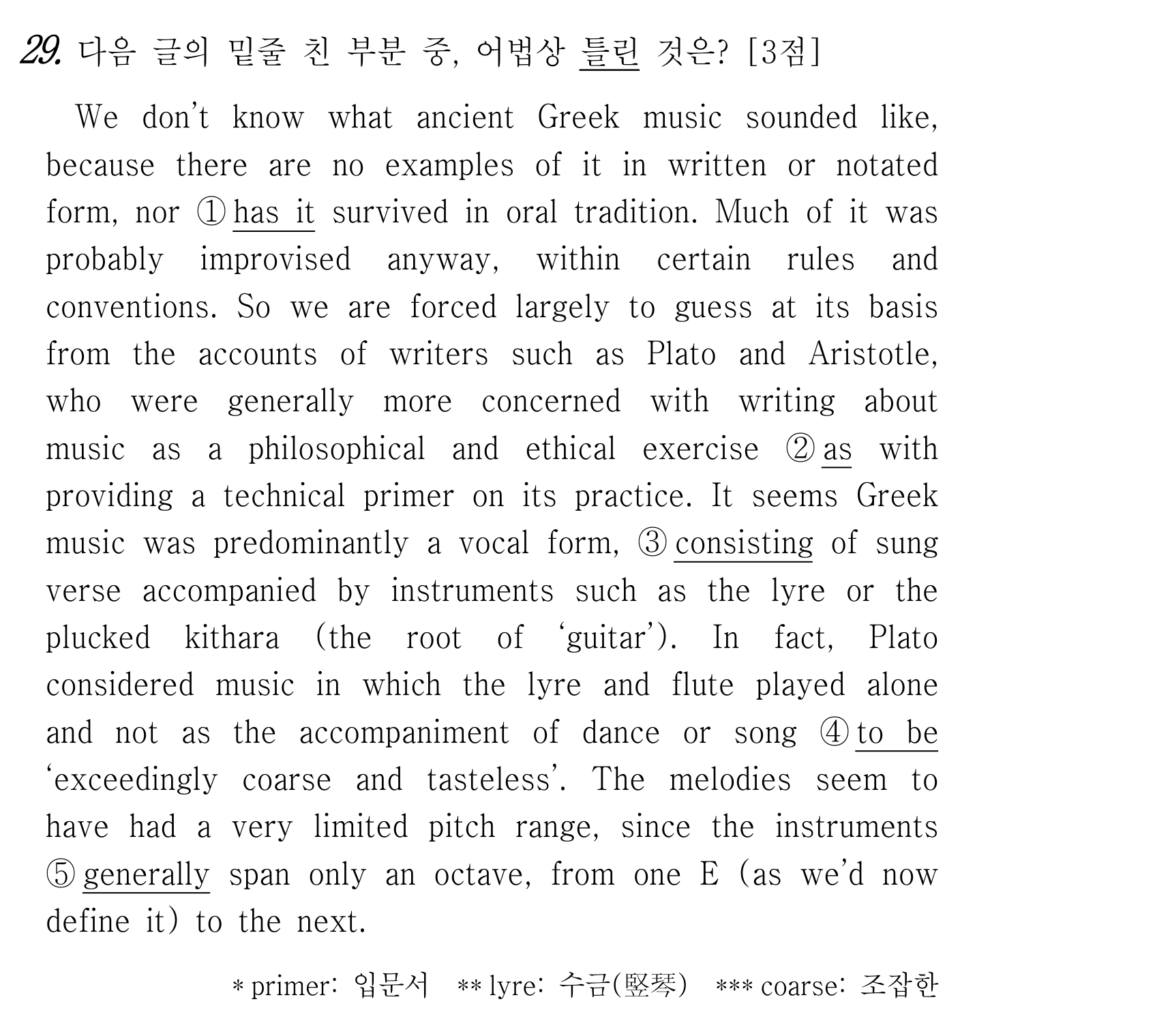
We don't know what ancient Greek music sounded like, because there are no examples of it in written or notated form, nor has it survived in oral tradition. Much of it was probably improvised anyway, within certain rules and conventions. So we are forced largely to guess at its basis from the accounts of writers such as Plato and Aristotle, who were generally more concerned with writing about music as a philosophical and ethical exercise rather than with providing a technical primer on its practice. It seems Greek music was predominantly a vocal form, consisting of sung verse accompanied by instruments such as the lyre or the plucked kithara (the root of ‘guitar’). In fact, Plato considered music in which the lyre and flute played alone and not as the accompaniment of dance or song to be ‘exceedingly coarse and tasteless’. The melodies seem to have had a very limited pitch range, since the instruments generally span only an octave, from one E (as we’d now define it) to the next.
30번어휘Just as there’s a tendency to glorify technological progress, there’s a countertendency t…
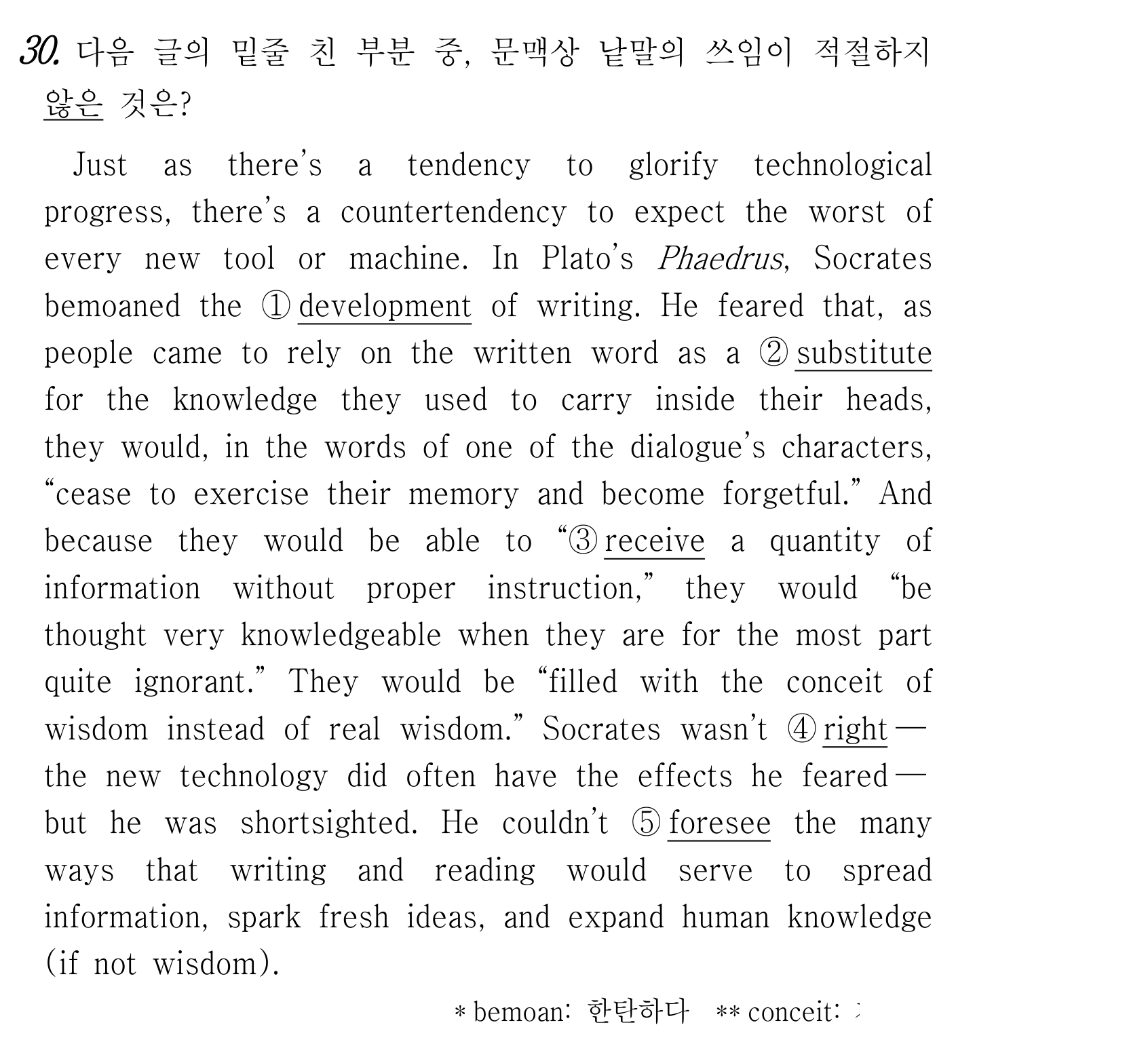
Just as there’s a tendency to glorify technological progress, there’s a countertendency to expect the worst of every new tool or machine. In Plato’s Phaedrus, Socrates bemoaned the development of writing. He feared that, as people came to rely on the written word as a substitute for the knowledge they used to carry inside their heads, they would, in the words of one of the dialogue’s characters, “cease to exercise their memory and become forgetful.” And because they would be able to receive a quantity of information without proper instruction, they would “be thought very knowledgeable when they are for the most part quite ignorant.” They would be “filled with the conceit of wisdom instead of real wisdom.” Socrates wasn’t wrong — the new technology did often have the effects he feared — but he was shortsighted. He couldn’t foresee the many ways that writing and reading would serve to spread information, spark fresh ideas, and expand human knowledge (if not wisdom).
31번빈칸추론2In the Indian language of pali, mettā means benevolence, kindness or tenderness.
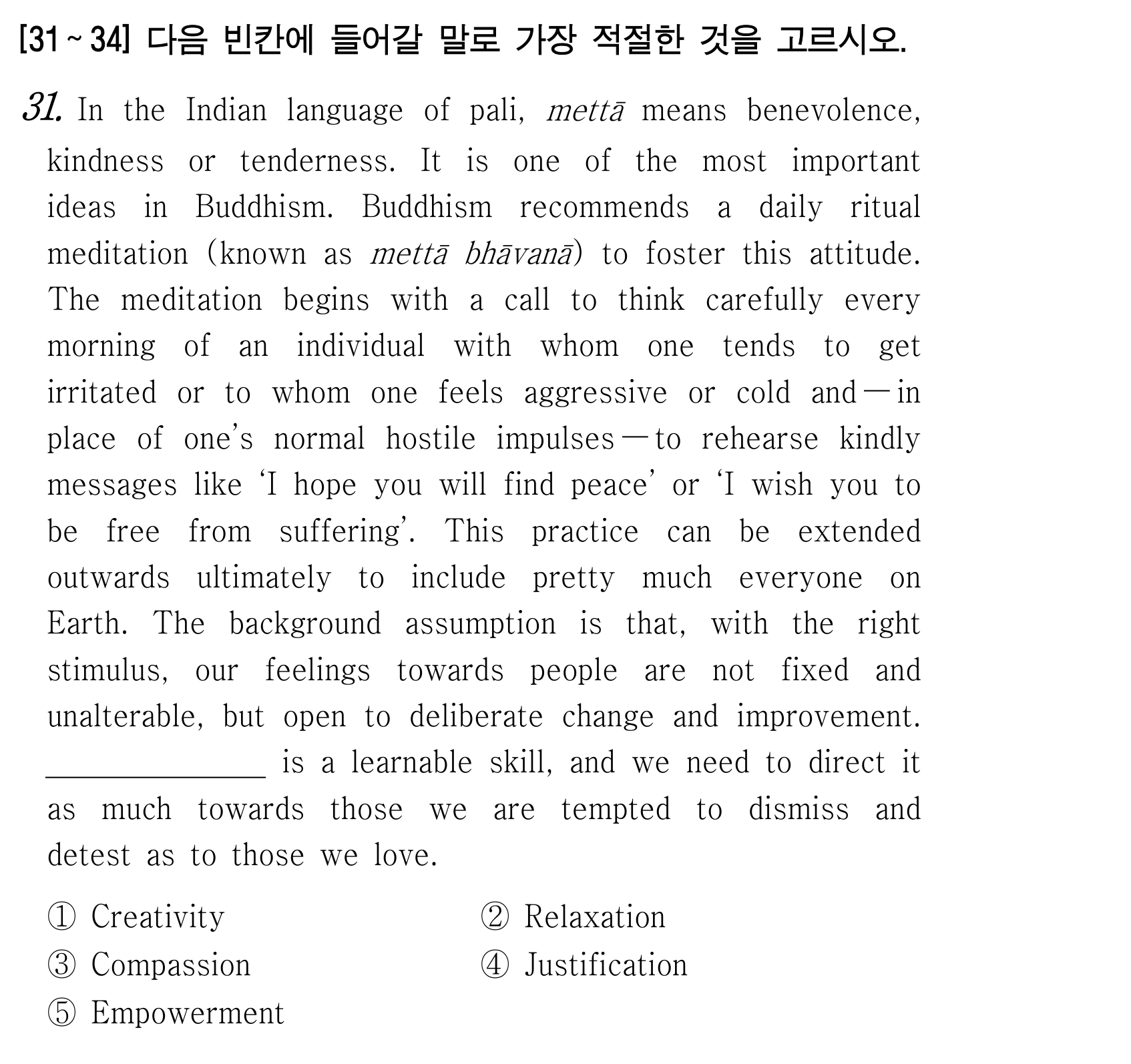
In the Indian language of pali, mettā means benevolence, kindness or tenderness. It is one of the most important ideas in Buddhism. Buddhism recommends a daily ritual meditation (known as mettā bhāvanā) to foster this attitude. The meditation begins with a call to think carefully every morning of an individual with whom one tends to get irritated or to whom one feels aggressive or cold—in place of one’s normal hostile impulses—to rehearse kindly messages like ‘I hope you will find peace’ or ‘I wish you to be free from suffering’. This practice can be extended outwards ultimately to include pretty much everyone on Earth. The background assumption is that, with the right stimulus, our feelings towards people are not fixed and unalterable, but open to deliberate change and improvement. Compassion is a learnable skill, and we need to direct it as much towards those we are tempted to dismiss and detest as to those we love.
32번빈칸추론3When trying to understand the role of the sun in ancient journeys, the sources become few…
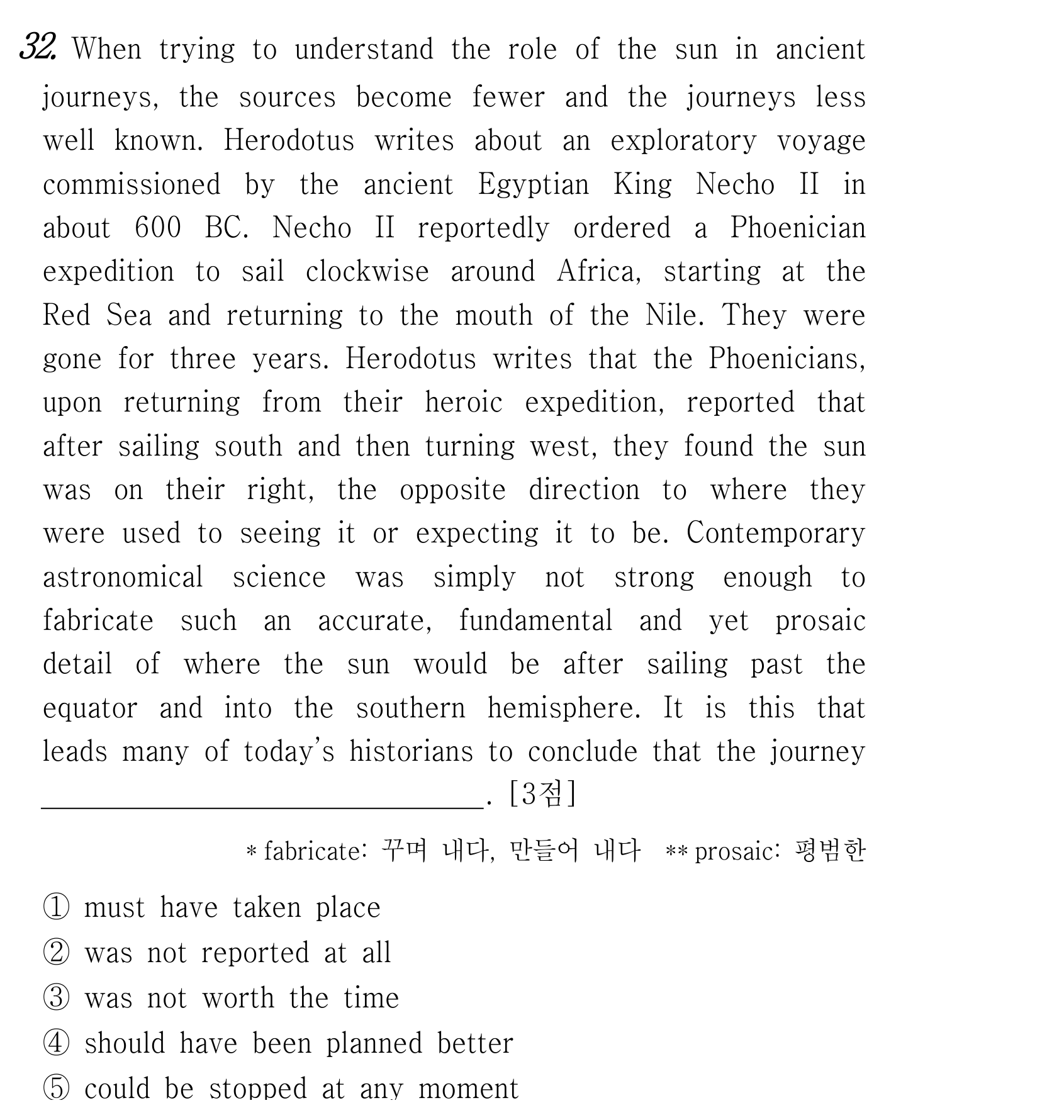
When trying to understand the role of the sun in ancient journeys, the sources become fewer and the journeys less well known. Herodotus writes about an exploratory voyage commissioned by the ancient Egyptian King Necho II in about 600 BC. Necho II reportedly ordered a Phoenician expedition to sail clockwise around Africa, starting at the Red Sea and returning to the mouth of the Nile. They were gone for three years. Herodotus writes that the Phoenicians, upon returning from their heroic expedition, reported that after sailing south and then turning west, they found the sun was on their right, the opposite direction to where they were used to seeing it or expecting it to be. Contemporary astronomical science was simply not strong enough to fabricate such an accurate, fundamental and yet prosaic detail of where the sun would be after sailing past the equator and into the southern hemisphere. It is this that leads many of today’s historians to conclude that the journey must have taken place.
33번빈칸추론4Gordon Allport argued that history records many individuals who were not content with an…
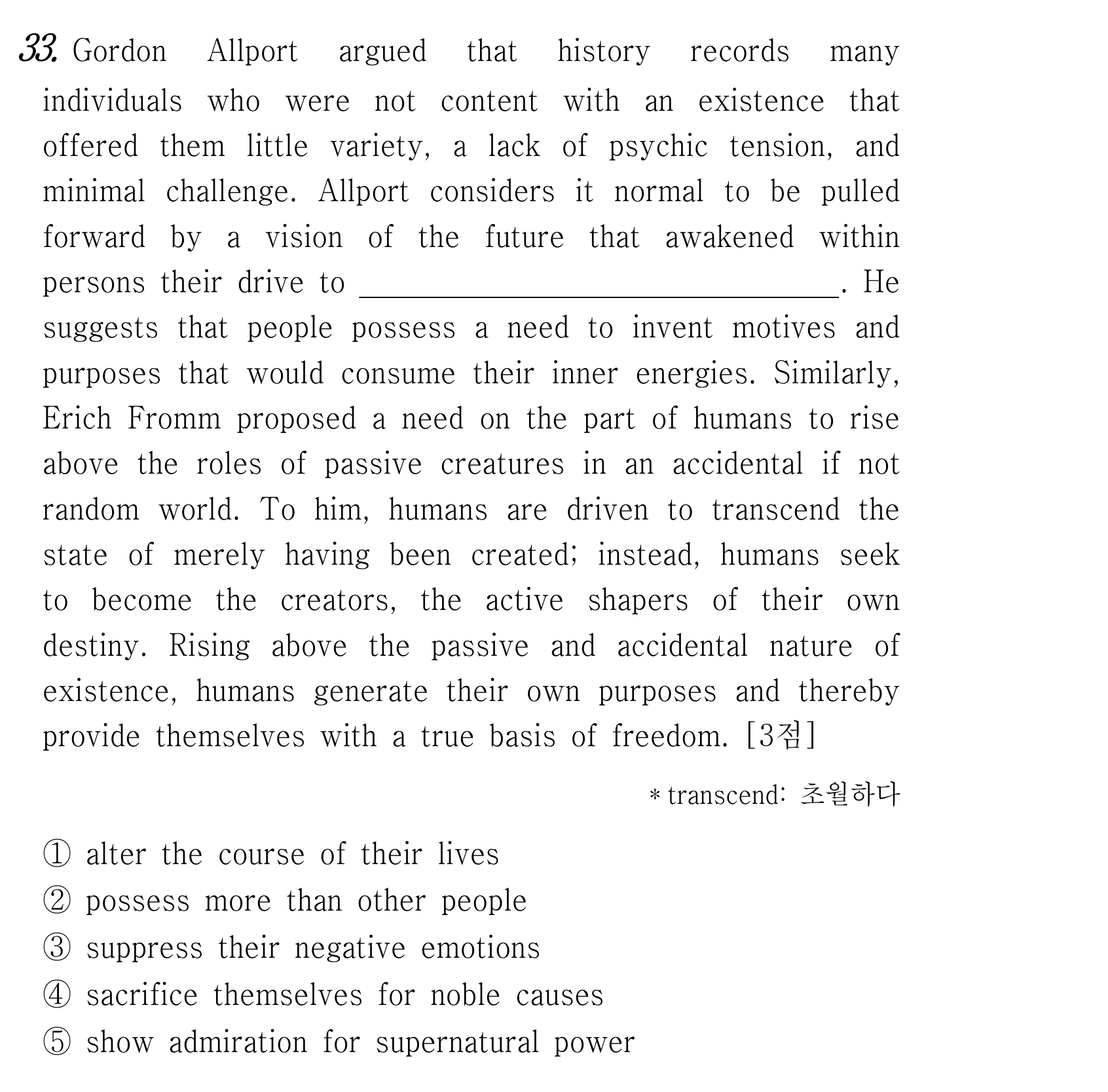
Gordon Allport argued that history records many individuals who were not content with an existence that offered them little variety, a lack of psychic tension, and minimal challenge. Allport considers it normal to be pulled forward by a vision of the future that awakened within persons their drive to alter the course of their lives. He suggests that people possess a need to invent motives and purposes that would consume their inner energies. Similarly, Erich Fromm proposed a need on the part of humans to rise above the roles of passive creatures in an accidental if not random world. To him, humans are driven to transcend the state of merely having been created; instead, humans seek to become the creators, the active shapers of their own destiny. Rising above the passive and accidental nature of existence, humans generate their own purposes and thereby provide themselves with a true basis of freedom.
34번빈칸추론5The history of perspective in Western painting matters because of what it reveals for the…
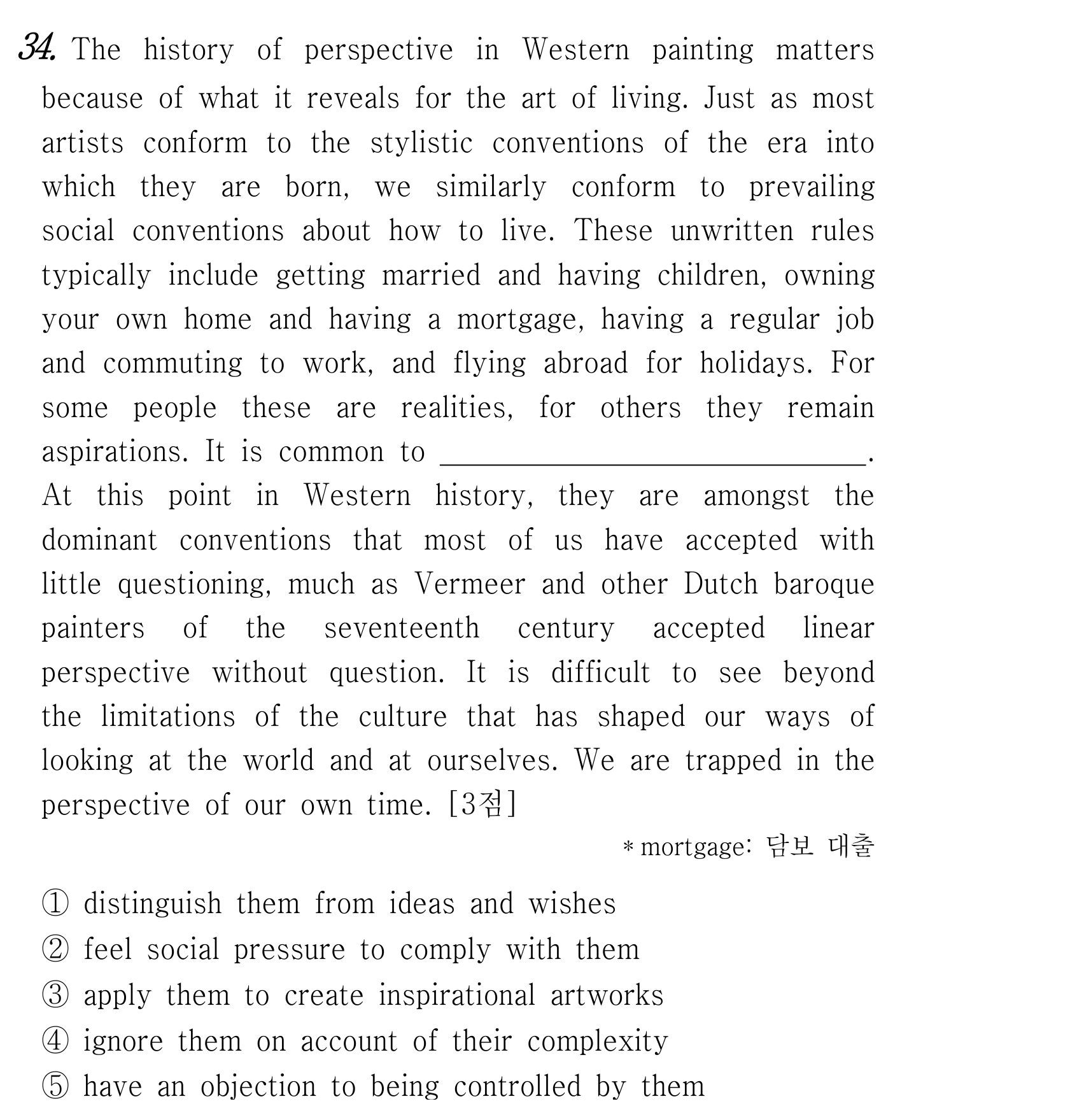
The history of perspective in Western painting matters because of what it reveals for the art of living. Just as most artists conform to the stylistic conventions of the era into which they are born, we similarly conform to prevailing social conventions about how to live. These unwritten rules typically include getting married and having children, owning your own home and having a mortgage, having a regular job and commuting to work, and flying abroad for holidays. For some people these are realities, for others they remain aspirations. It is common to feel social pressure to comply with them. At this point in Western history, they are amongst the dominant conventions that most of us have accepted with little questioning, much as Vermeer and other Dutch baroque painters of the seventeenth century accepted linear perspective without question. It is difficult to see beyond the limitations of the culture that has shaped our ways of looking at the world and at ourselves. We are trapped in the perspective of our own time.
35번무관한문장When approaching practical music making for the first time in the classroom, it is a good…
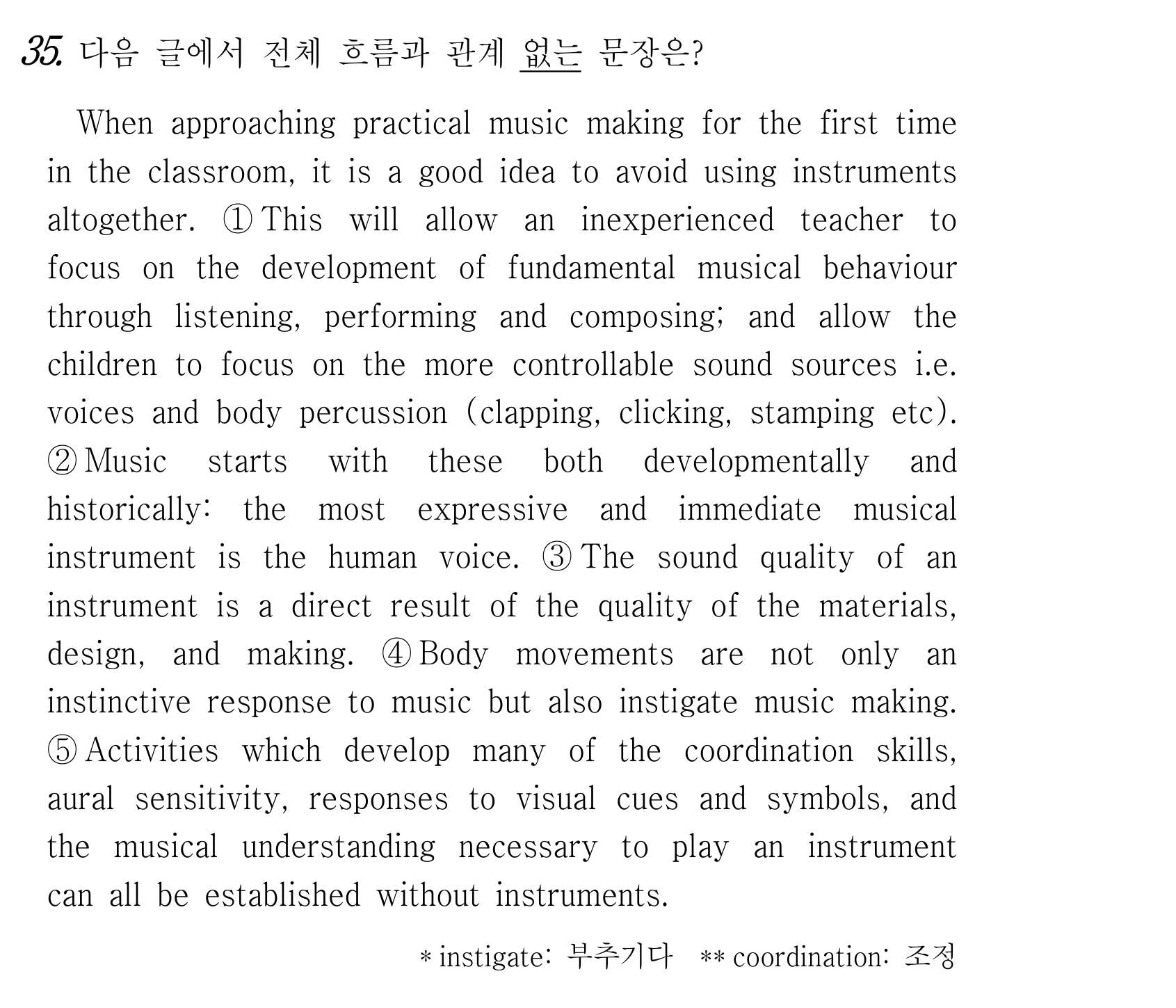
When approaching practical music making for the first time in the classroom, it is a good idea to avoid using instruments altogether. This will allow an inexperienced teacher to focus on the development of fundamental musical behaviour through listening, performing and composing; and allow the children to focus on the more controllable sound sources i.e. voices and body percussion (clapping, clicking, stamping etc). Music starts with these both developmentally and historically: the most expressive and immediate musical instrument is the human voice. Body movements are not only an instinctive response to music but also instigate music making. Activities which develop many of the coordination skills, aural sensitivity, responses to visual cues and symbols, and the musical understanding necessary to play an instrument can all be established without instruments.
36번순서배열1Anger and empathy—like matter and antimatter—can’t exist in the same place at the same ti…
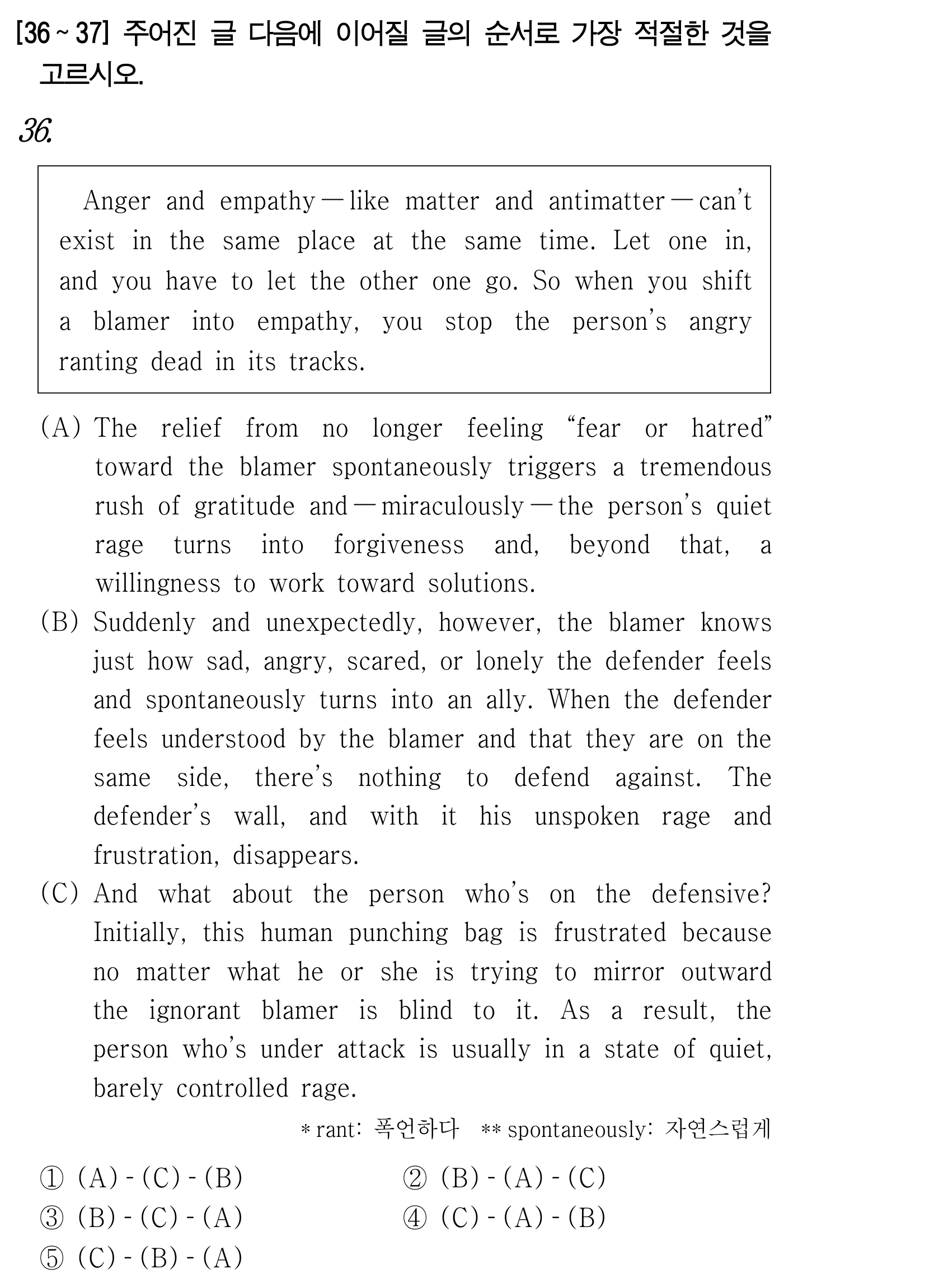
Anger and empathy—like matter and antimatter—can’t exist in the same place at the same time. Let one in, and you have to let the other one go. So when you shift a blamer into empathy, you stop the person’s angry ranting dead in its tracks. And what about the person who’s on the defensive? Initially, this human punching bag is frustrated because no matter what he or she is trying to mirror outward the ignorant blamer is blind to it. As a result, the person who’s under attack is usually in a state of quiet, barely controlled rage. Suddenly and unexpectedly, however, the blamer knows just how sad, angry, scared, or lonely the defender feels and spontaneously turns into an ally. When the defender feels understood by the blamer and that they are on the same side, there’s nothing to defend against. The defender’s wall, and with it his unspoken rage and frustration, disappears. The relief from no longer feeling “fear or hatred” toward the blamer spontaneously triggers a tremendous rush of gratitude and—miraculously—the person’s quiet rage turns into forgiveness and, beyond that, a willingness to work toward solutions.
37번순서배열2When a young child sees clouds moving across the sky, the clouds may seem alive and indep…
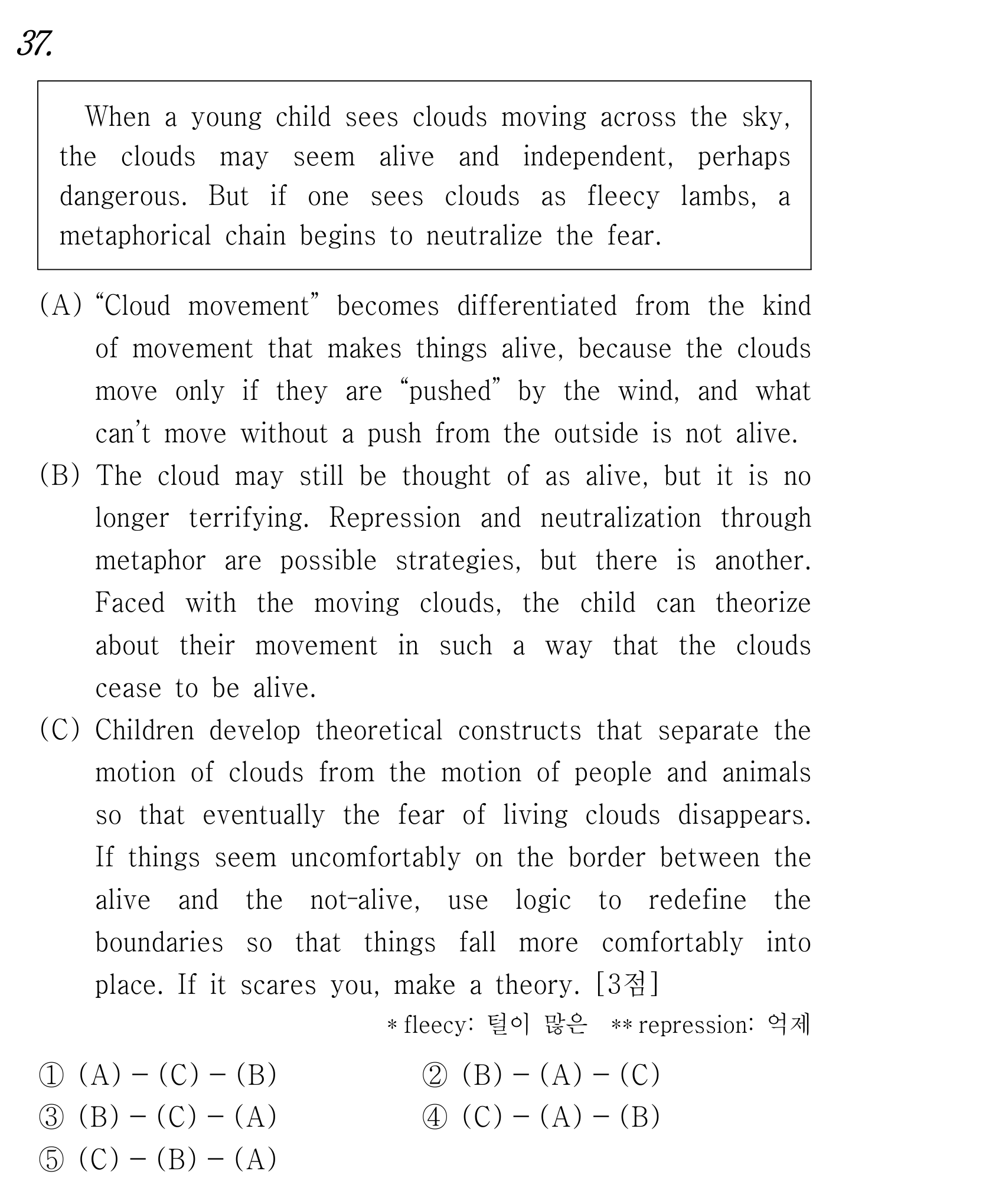
When a young child sees clouds moving across the sky, the clouds may seem alive and independent, perhaps dangerous. But if one sees clouds as fleecy lambs, a metaphorical chain begins to neutralize the fear. The cloud may still be thought of as alive, but it is no longer terrifying. Repression and neutralization through metaphor are possible strategies, but there is another. Faced with the moving clouds, the child can theorize about their movement in such a way that the clouds cease to be alive. "Cloud movement" becomes differentiated from the kind of movement that makes things alive, because the clouds move only if they are "pushed" by the wind, and what can't move without a push from the outside is not alive. Children develop theoretical constructs that separate the motion of clouds from the motion of people and animals so that eventually the fear of living clouds disappears. If things seem uncomfortably on the border between the alive and the not-alive, use logic to redefine the boundaries so that things fall more comfortably into place. If it scares you, make a theory.
38번문장삽입1Many of the ritualized displays performed by animals look so bizarre to us that we wonder…
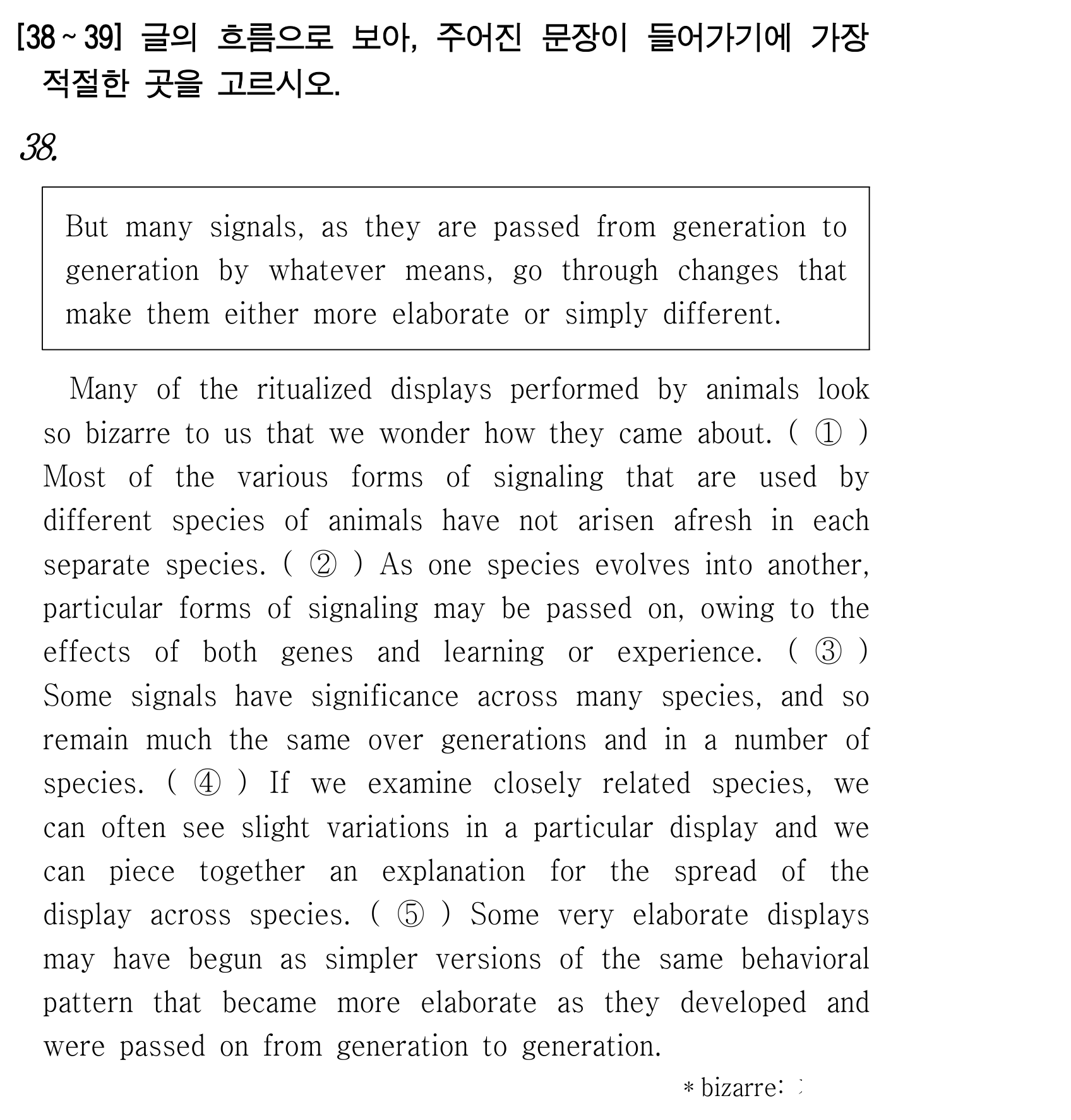
Many of the ritualized displays performed by animals look so bizarre to us that we wonder how they came about. Most of the various forms of signaling that are used by different species of animals have not arisen afresh in each separate species. As one species evolves into another, particular forms of signaling may be passed on, owing to the effects of both genes and learning or experience. But many signals, as they are passed from generation to generation by whatever means, go through changes that make them either more elaborate or simply different. Some signals have significance across many species, and so remain much the same over generations and in a number of species. If we examine closely related species, we can often see slight variations in a particular display and we can piece together an explanation for the spread of the display across species. Some very elaborate displays may have begun as simpler versions of the same behavioral pattern that became more elaborate as they developed and were passed on from generation to generation.
39번문장삽입2If the goal is to figure out how best to cover a set curriculum—to fill students with fac…
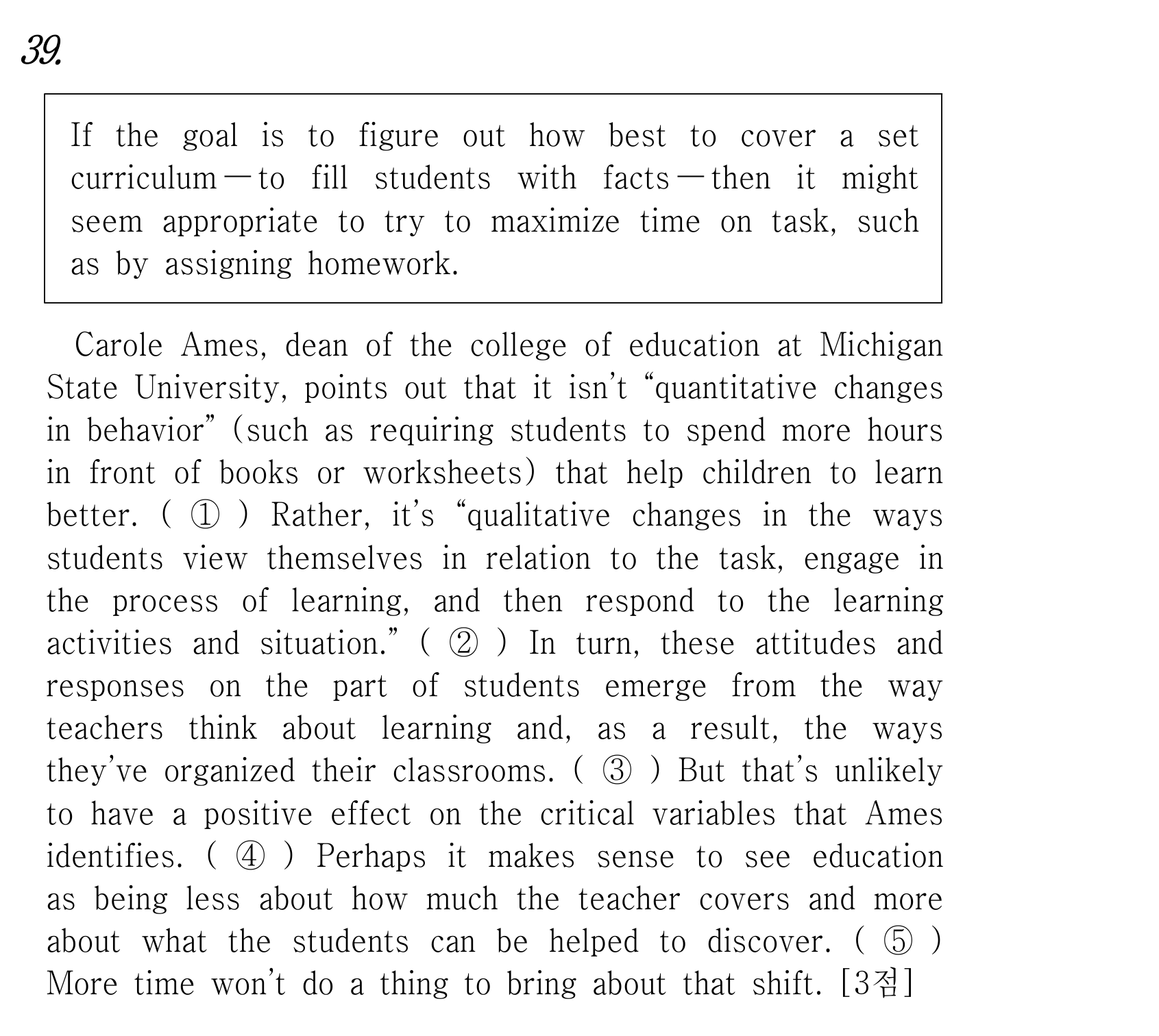
If the goal is to figure out how best to cover a set curriculum—to fill students with facts—then it might seem appropriate to try to maximize time on task, such as by assigning homework. Carole Ames, dean of the college of education at Michigan State University, points out that it isn’t “quantitative changes in behavior” (such as requiring students to spend more hours in front of books or worksheets) that help children to learn better. Rather, it’s “qualitative changes in the ways students view themselves in relation to the task, engage in the process of learning, and then respond to the learning activities and situation.” In turn, these attitudes and responses on the part of students emerge from the way teachers think about learning and, as a result, the ways they’ve organized their classrooms. But that’s unlikely to have a positive effect on the critical variables that Ames identifies. Perhaps it makes sense to see education as being less about how much the teacher covers and more about what the students can be helped to discover. More time won’t do a thing to bring about that shift.
40번요약문완성Why would languages and religions increase rapidly around the equator, and why is their f…
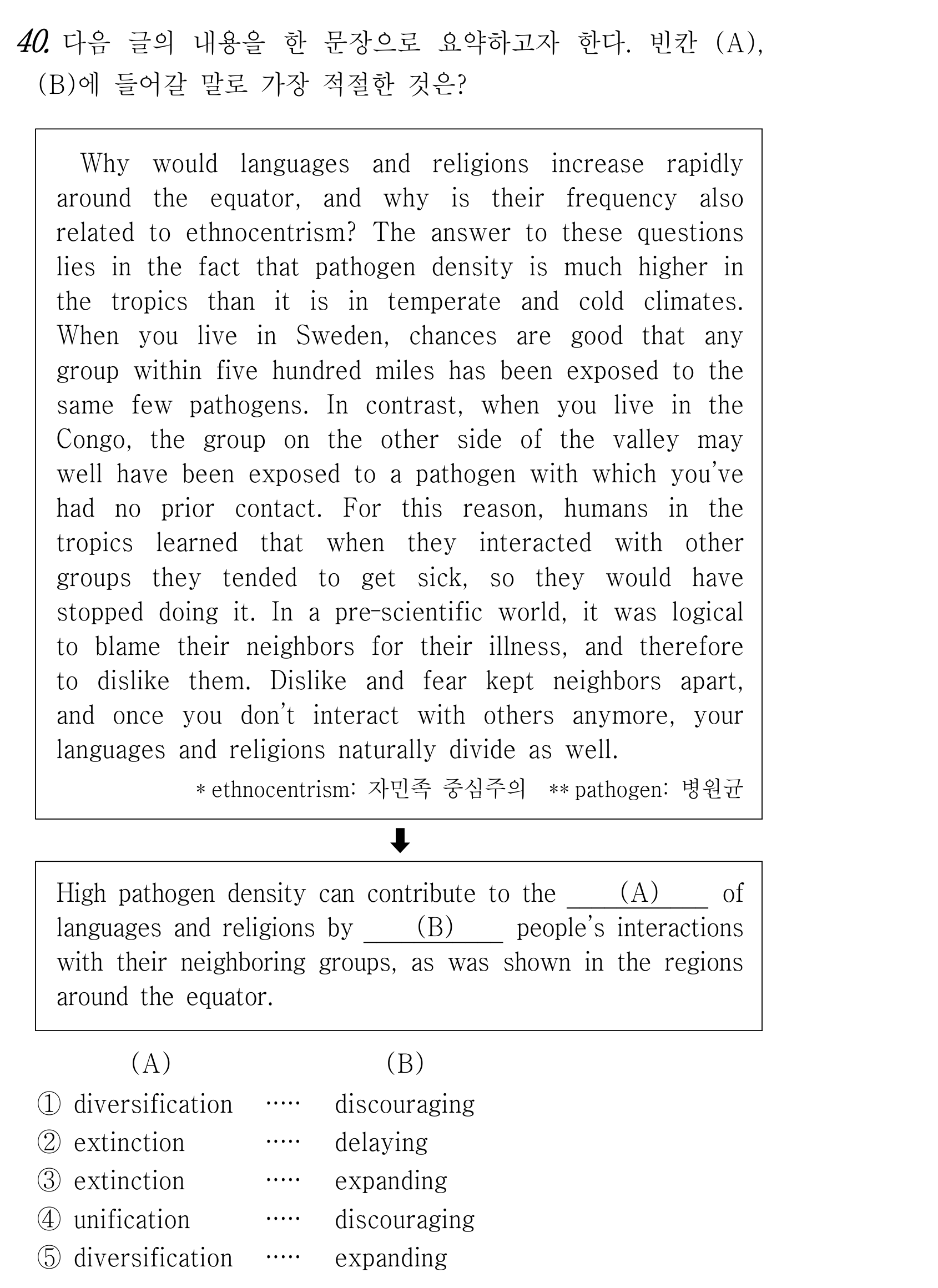
Why would languages and religions increase rapidly around the equator, and why is their frequency also related to ethnocentrism? The answer to these questions lies in the fact that pathogen density is much higher in the tropics than it is in temperate and cold climates. When you live in Sweden, chances are good that any group within five hundred miles has been exposed to the same few pathogens. In contrast, when you live in the Congo, the group on the other side of the valley may well have been exposed to a pathogen with which you’ve had no prior contact. For this reason, humans in the tropics learned that when they interacted with other groups they tended to get sick, so they would have stopped doing it. In a pre-scientific world, it was logical to blame their neighbors for their illness, and therefore to dislike them. Dislike and fear kept neighbors apart, and once you don’t interact with others anymore, your languages and religions naturally divide as well.
41번장문_제목In *What a Plant Knows*, the biologist Daniel Chamovitz describes sophisticated informati…
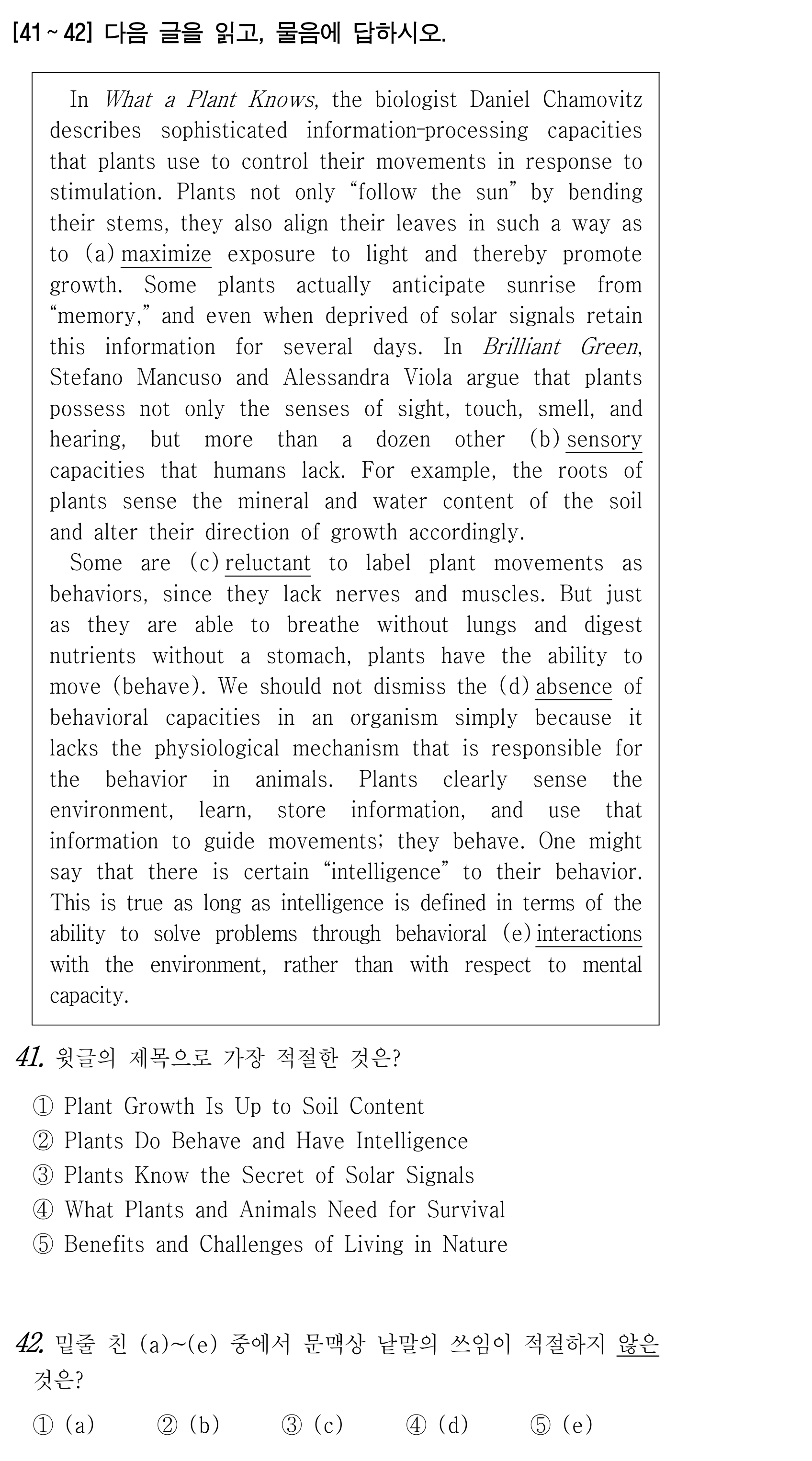
In *What a Plant Knows*, the biologist Daniel Chamovitz describes sophisticated information-processing capacities that plants use to control their movements in response to stimulation. Plants not only “follow the sun” by bending their stems, they also align their leaves in such a way as to (a) maximize exposure to light and thereby promote growth. Some plants actually anticipate sunrise from “memory,” and even when deprived of solar signals retain this information for several days. In *Brilliant Green*, Stefano Mancuso and Alessandra Viola argue that plants possess not only the senses of sight, touch, smell, and hearing, but more than a dozen other (b) sensory capacities that humans lack. For example, the roots of plants sense the mineral and water content of the soil and alter their direction of growth accordingly.
Some are (c) reluctant to label plant movements as behaviors, since they lack nerves and muscles. But just as they are able to breathe without lungs and digest nutrients without a stomach, plants have the ability to move (behave). We should not dismiss the (d) absence of behavioral capacities in an organism simply because it lacks the physiological mechanism that is responsible for the behavior in animals. Plants clearly sense the environment, learn, store information, and use that information to guide movements; they behave. One might say that there is certain “intelligence” to their behavior. This is true as long as intelligence is defined in terms of the ability to solve problems through behavioral (e) interactions with the environment, rather than with respect to mental capacity.
2022년 3월 고3 전국연합 영어 모의고사 변형문제 맛보기
이 시험 지문으로 만든 변형문제가 아직 없습니다. 지문을 고르면 어법·빈칸·주제·어휘 등 유형별 변형문제를 바로 만들 수 있습니다.
이 시험으로 첫 변형문제 만들기 →남은 시간
48:00
아직 28문제를 풀지 않았어요 (0/28)