2021년 3월 고2 전국연합 영어 모의고사
28문제 · 제한시간 48분
이 시험 한눈에 — 2021년 3월 고2 전국연합 영어 모의고사
18~45번 28문항을 유형별로 보면 목적 1 · 심경/분위기 1 · 주장 1 · 함축의미추론 1 · 요지/주장 1 · 주제 1 · 제목 1 · 도표 1 · 내용일치 1 · 실용문 1 · 어법 2 · 어휘 1 · 빈칸추론2 1 · 빈칸추론3 1 · 빈칸추론4 1 · 빈칸추론5 1 · 무관한문장 1 · 순서배열1 1 · 순서배열2 1 · 문장삽입1 1 · 문장삽입2 1 · 요약문완성 1 · 장문 5. 아래 지문으로 변형문제·단어장·정답표를 바로 만들 수 있습니다.
18번목적My name is Anthony Thompson and I am writing on behalf of the residents’ association.
My name is Anthony Thompson and I am writing on behalf of the residents’ association. Our recycling program has been working well thanks to your participation. However, a problem has recently occurred that needs your attention. Because there is no given day for recycling, residents are putting their recycling out at any time. This makes the recycling area messy, which requires extra labor and cost. To deal with this problem, the residents’ association has decided on a day to recycle. I would like to let you know that you can put out your recycling on Wednesdays only. I am sure it will make our apartment complex look much more pleasant. Thank you in advance for your cooperation.
19번심경/분위기It was a day I was due to give a presentation at work, not something I’d do often.
It was a day I was due to give a presentation at work, not something I’d do often. As I stood up to begin, I froze. A chilly ‘pins-and-needles’ feeling crept over me, starting in my hands. Time seemed to stand still as I struggled to start speaking, and I felt a pressure around my throat, as though my voice was trapped and couldn’t come out. Gazing around at the blur of faces, I realized they were all waiting for me to begin, but by now I knew I couldn’t continue.
20번주장No matter what your situation, whether you are an insider or an outsider, you need to bec…
No matter what your situation, whether you are an insider or an outsider, you need to become the voice that challenges yesterday's answers. Think about the characteristics that make outsiders valuable to an organization. They are the people who have the perspective to see problems that the insiders are too close to really notice. They are the ones who have the freedom to point out these problems and criticize them without risking their job or their career. Part of adopting an outsider mentality is forcing yourself to look around your organization with this disassociated, less emotional perspective. If you didn't know your coworkers and feel bonded to them by your shared experiences, what would you think of them? You may not have the job security or confidence to speak your mind to management, but you can make these "outsider" assessments of your organization on your own and use what you determine to advance your career.
21번함축의미추론The known fact of contingencies, without knowing precisely what those contingencies will…
The known fact of contingencies, without knowing precisely what those contingencies will be, shows that disaster preparation is not the same thing as disaster rehearsal. No matter how many mock disasters are staged according to prior plans, the real disaster will never mirror any one of them. Disaster-preparation planning is more like training for a marathon than training for a high-jump competition or a sprinting event. Marathon runners do not practice by running the full course of twenty-six miles; rather, they get into shape by running shorter distances and building up their endurance with cross-training. If they have prepared successfully, then they are in optimal condition to run the marathon over its predetermined course and length, assuming a range of weather conditions, predicted or not. This is normal marathon preparation.
23번주제Before the modern scientific era, creativity was attributed to a superhuman force; all no…
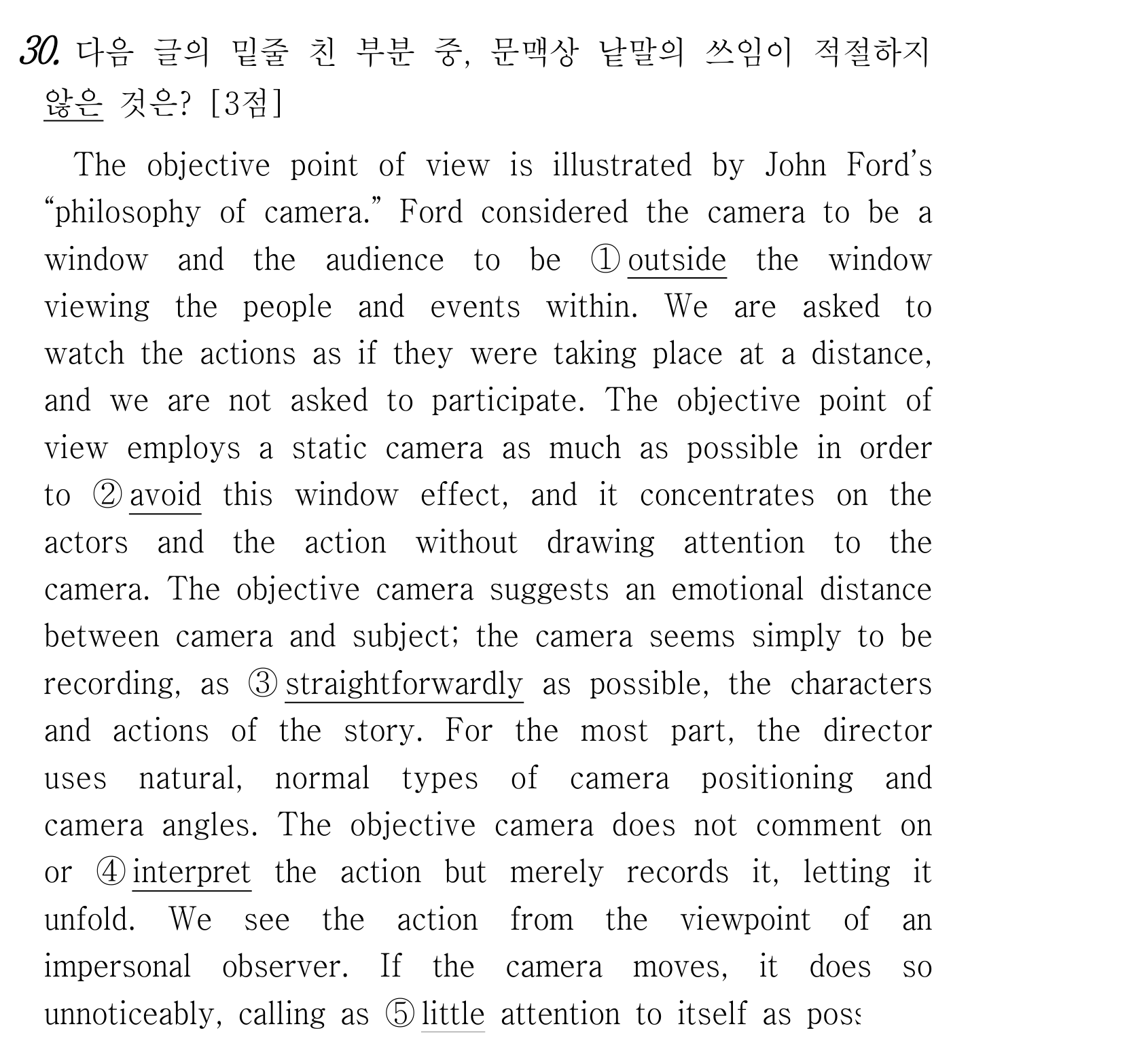
Before the modern scientific era, creativity was attributed to a superhuman force; all novel ideas originated with the gods. After all, how could a person create something that did not exist before the divine act of creation? In fact, the Latin meaning of the verb “inspire” is “to breathe into,” reflecting the belief that creative inspiration was similar to the moment in creation when God first breathed life into man. Plato argued that the poet was possessed by divine inspiration, and Plotin wrote that art could only be beautiful if it descended from God. The artist’s job was not to imitate nature but rather to reveal the sacred and transcendent qualities of nature. Art could only be a pale imitation of the perfection of the world of ideas. Greek artists did not blindly imitate what they saw in reality; instead they tried to represent the pure, true forms underlying reality, resulting in a sort of compromise between abstraction and accuracy.
24번제목Some beginning researchers mistakenly believe that a good hypothesis is one that is guara…
Some beginning researchers mistakenly believe that a good hypothesis is one that is guaranteed to be right (e.g., alcohol will slow down reaction time). However, if we already know your hypothesis is true before you test it, testing your hypothesis won't tell us anything new. Remember, research is supposed to produce new knowledge. To get new knowledge, you, as a researcher-explorer, need to leave the safety of the shore (established facts) and venture into uncharted waters (as Einstein said, “If we knew what we were doing, it would not be called research, would it?”). If your predictions about what will happen in these uncharted waters are wrong, that's okay: Scientists are allowed to make mistakes (as Bates said, “Research is the process of going up alleys to see if they are blind”). Indeed, scientists often learn more from predictions that do not turn out than from those that do.
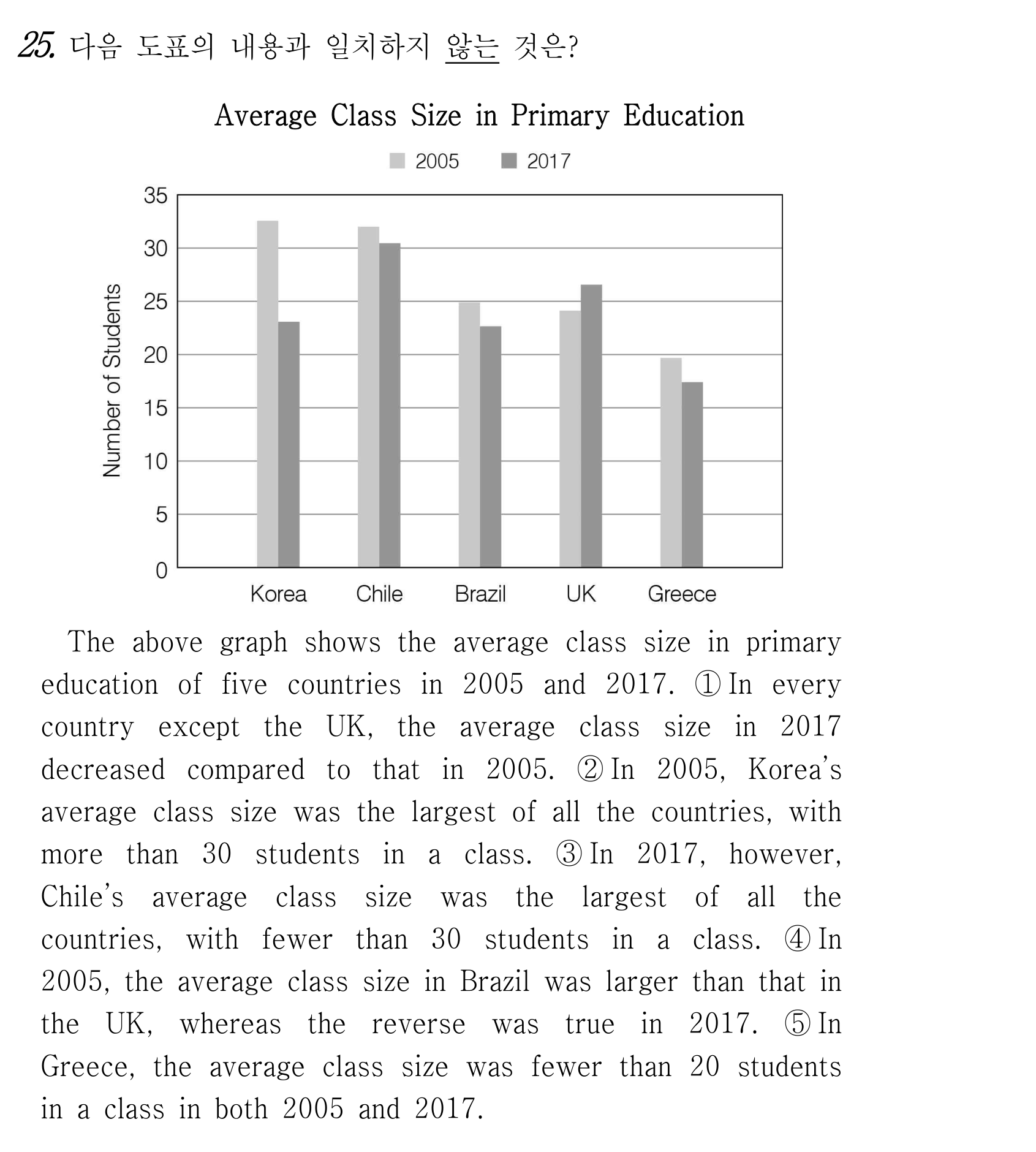
25번도표The above graph shows the average class size in primary education of five countries in 20…
The above graph shows the average class size in primary education of five countries in 2005 and 2017. ① In every country except the UK, the average class size in 2017 decreased compared to that in 2005. ② In 2005, Korea’s average class size was the largest of all the countries, with more than 30 students in a class. ③ In 2017, however, Chile’s average class size was the largest of all the countries, with fewer than 30 students in a class. ④ In 2005, the average class size in Brazil was larger than that in the UK, whereas the reverse was true in 2017. ⑤ In Greece, the average class size was fewer than 20 students in a class in both 2005 and 2017.
26번내용일치Grey County 2021 Job Fair April 28, 2:00 p.m.
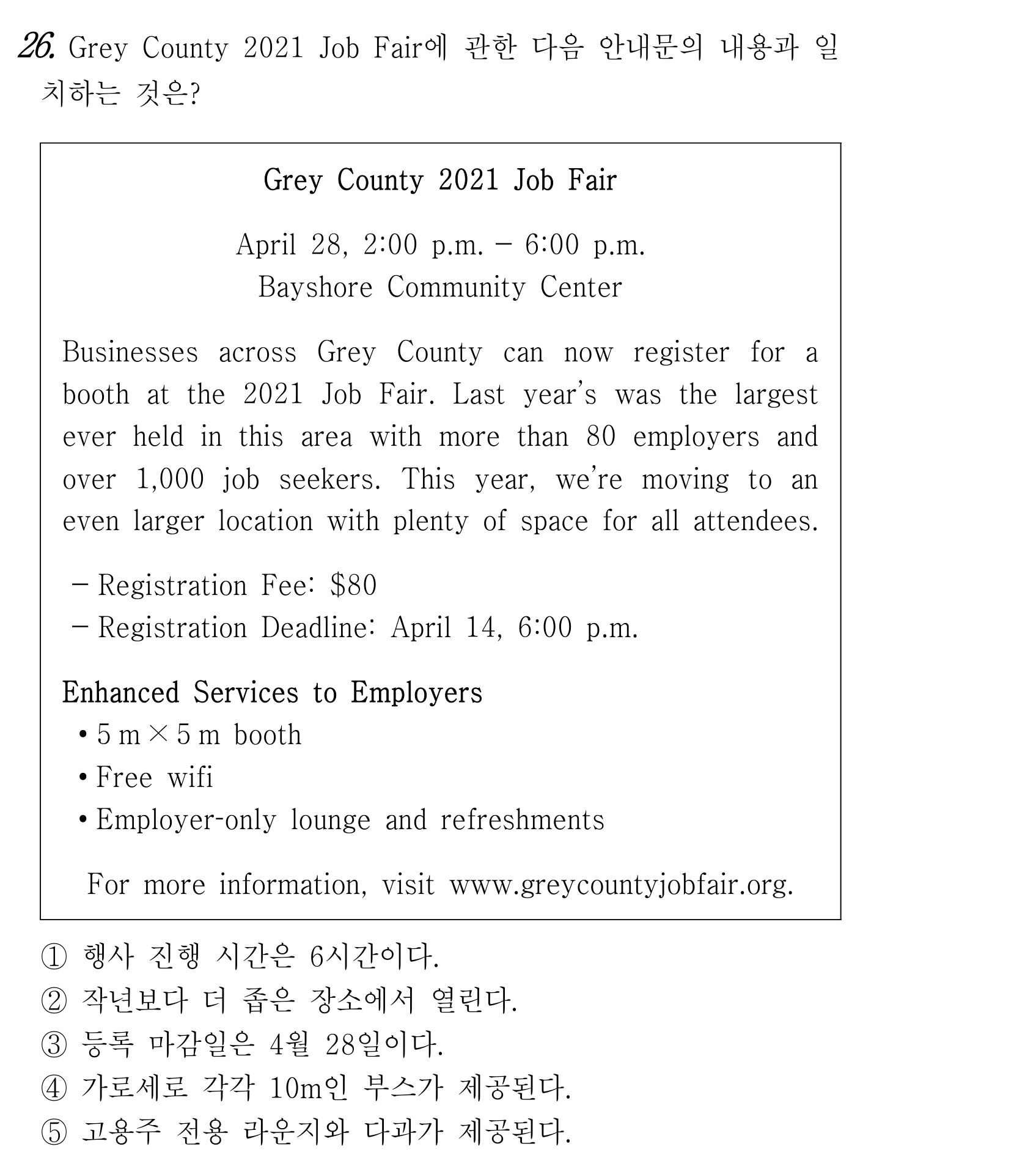
Grey County 2021 Job Fair
April 28, 2:00 p.m. - 6:00 p.m. Bayshore Community Center
Businesses across Grey County can now register for a booth at the 2021 Job Fair. Last year's was the largest ever held in this area with more than 80 employers and over 1,000 job seekers. This year, we're moving to an even larger location with plenty of space for all attendees.
- Registration Fee: $80 - Registration Deadline: April 14, 6:00 p.m.
Enhanced Services to Employers • 5 m × 5 m booth • Free wifi • Employer-only lounge and refreshments
For more information, visit www.greycountyjobfair.org.
27번실용문The Riverside Escape The Riverside Escape is a city-wide escape game played on your smart…
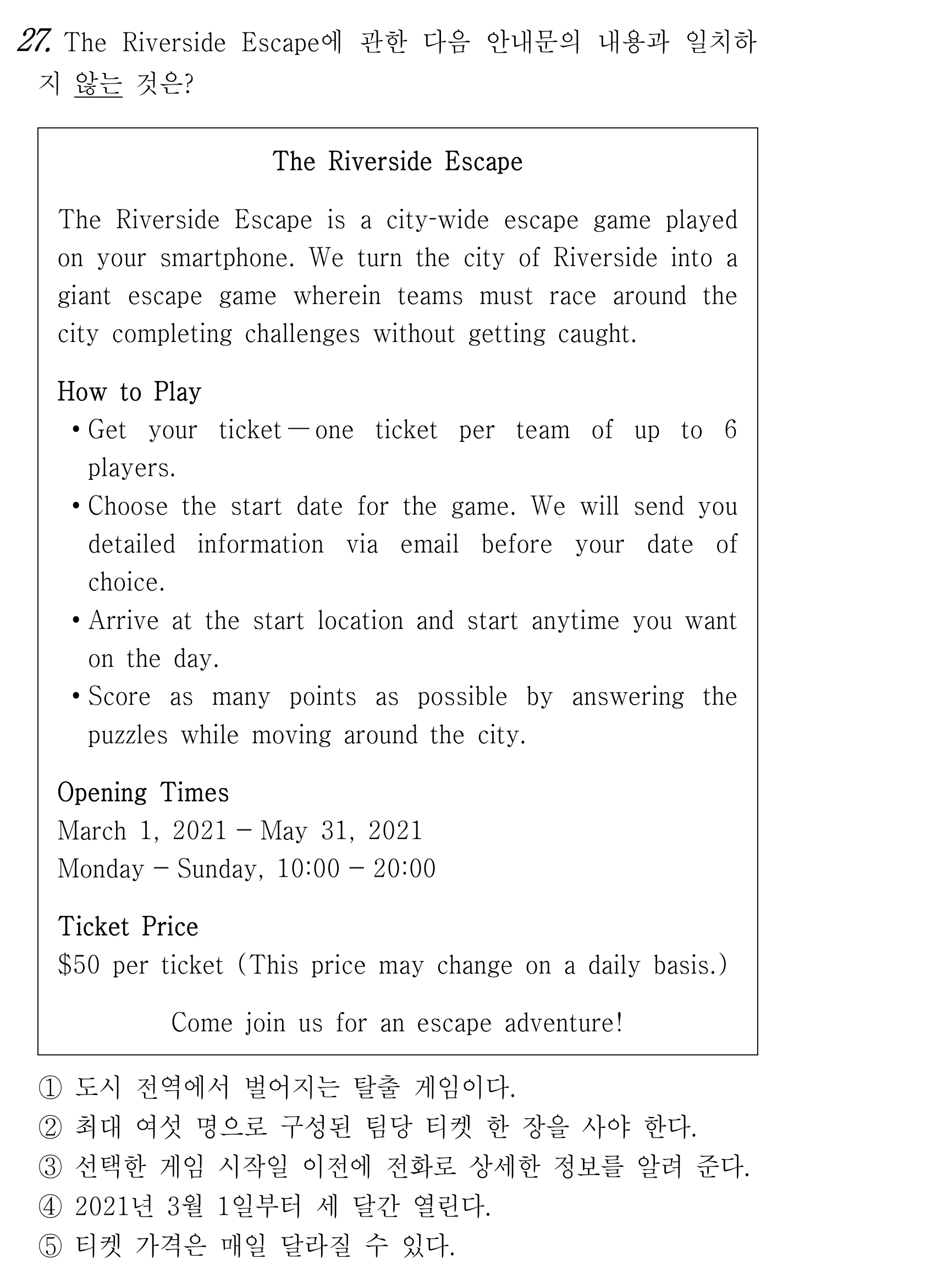
The Riverside Escape
The Riverside Escape is a city-wide escape game played on your smartphone. We turn the city of Riverside into a giant escape game wherein teams must race around the city completing challenges without getting caught.
How to Play • Get your ticket — one ticket per team of up to 6 players. • Choose the start date for the game. We will send you detailed information via email before your date of choice. • Arrive at the start location and start anytime you want on the day. • Score as many points as possible by answering the puzzles while moving around the city.
Opening Times March 1, 2021 – May 31, 2021 Monday – Sunday, 10:00 – 20:00
Ticket Price $50 per ticket (This price may change on a daily basis.)
Come join us for an escape adventure!
31번빈칸추론2Even the most respectable of all musical institutions, the symphony orchestra, carries in…
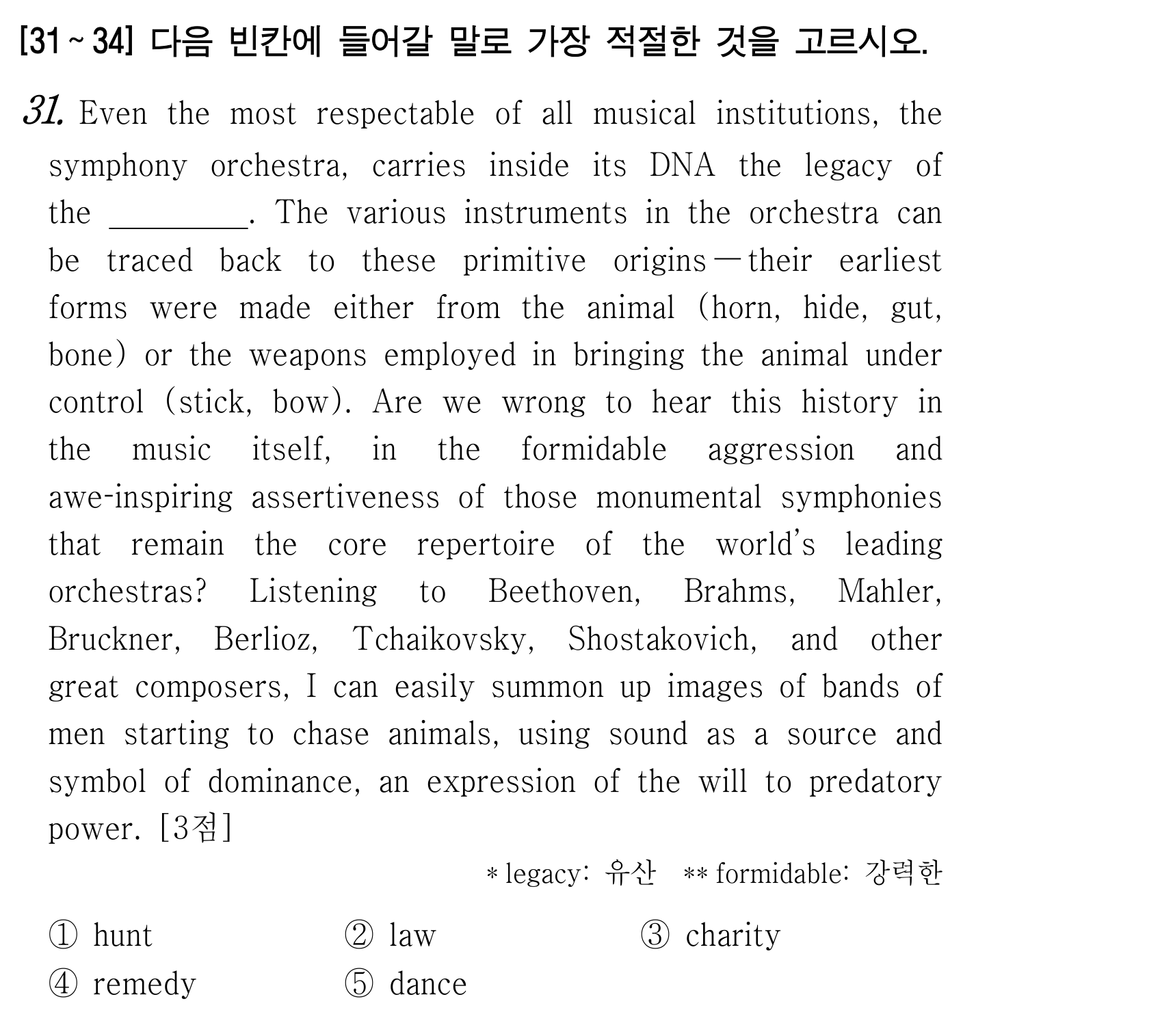
Even the most respectable of all musical institutions, the symphony orchestra, carries inside its DNA the legacy of the hunt. The various instruments in the orchestra can be traced back to these primitive origins—their earliest forms were made either from the animal (horn, hide, gut, bone) or the weapons employed in bringing the animal under control (stick, bow). Are we wrong to hear this history in the music itself, in the formidable aggression and awe-inspiring assertiveness of those monumental symphonies that remain the core repertoire of the world's leading orchestras? Listening to Beethoven, Brahms, Mahler, Bruckner, Berlioz, Tchaikovsky, Shostakovich, and other great composers, I can easily summon up images of bands of men starting to chase animals, using sound as a source and symbol of dominance, an expression of the will to predatory power.
32번빈칸추론3Our brains have evolved to remember unexpected events because basic survival depends on t…
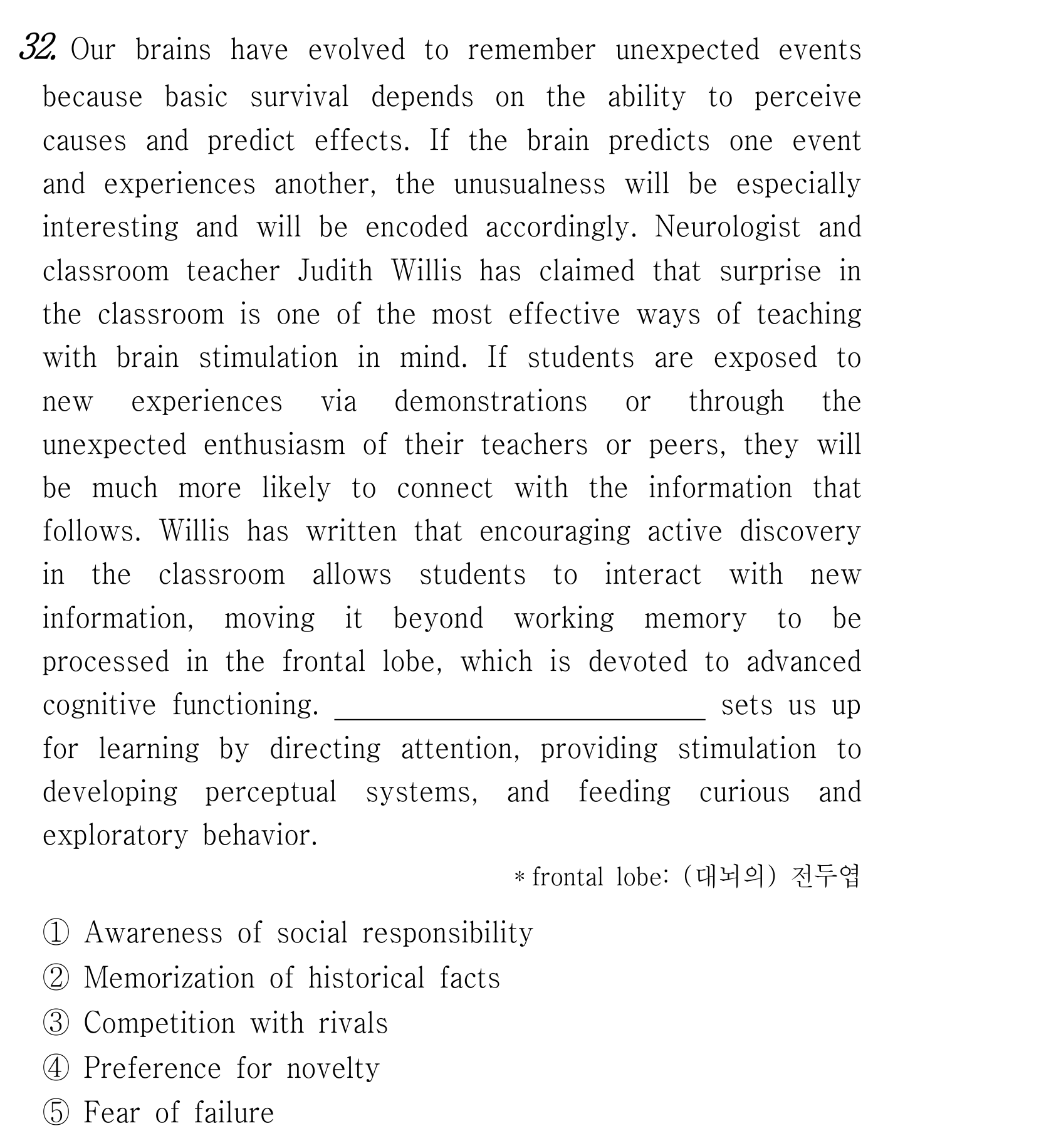
Our brains have evolved to remember unexpected events because basic survival depends on the ability to perceive causes and predict effects. If the brain predicts one event and experiences another, the unusualness will be especially interesting and will be encoded accordingly. Neurologist and classroom teacher Judith Willis has claimed that surprise in the classroom is one of the most effective ways of teaching with brain stimulation in mind. If students are exposed to new experiences via demonstrations or through the unexpected enthusiasm of their teachers or peers, they will be much more likely to connect with the information that follows. Willis has written that encouraging active discovery in the classroom allows students to interact with new information, moving it beyond working memory to be processed in the frontal lobe, which is devoted to advanced cognitive functioning. Preference for novelty sets us up for learning by directing attention, providing stimulation to developing perceptual systems, and feeding curious and exploratory behavior.
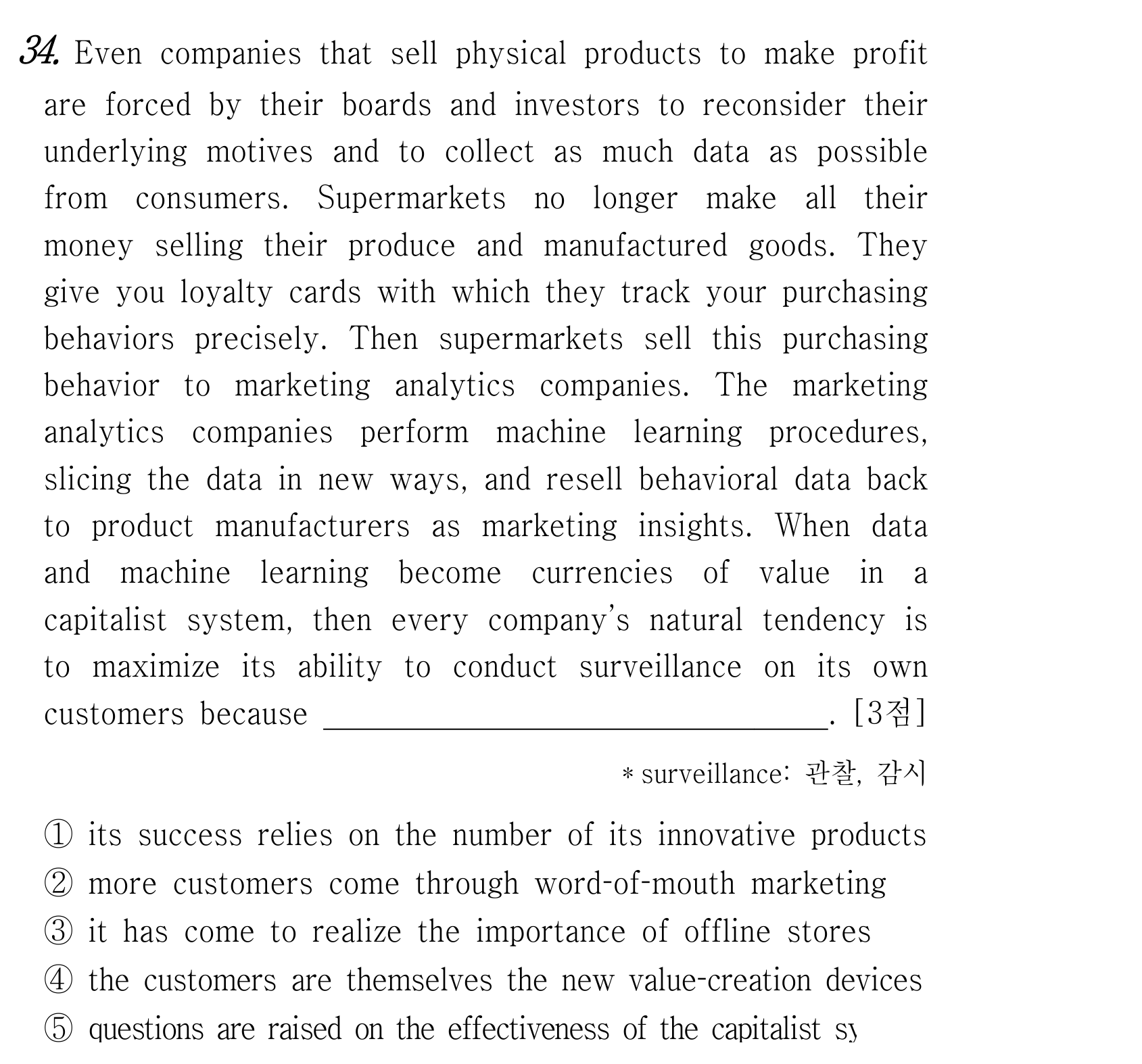
34번빈칸추론5Even companies that sell physical products to make profit are forced by their boards and…
Even companies that sell physical products to make profit are forced by their boards and investors to reconsider their underlying motives and to collect as much data as possible from consumers. Supermarkets no longer make all their money selling their produce and manufactured goods. They give you loyalty cards with which they track your purchasing behaviors precisely. Then supermarkets sell this purchasing behavior to marketing analytics companies. The marketing analytics companies perform machine learning procedures, slicing the data in new ways, and resell behavioral data back to product manufacturers as marketing insights. When data and machine learning become currencies of value in a capitalist system, then every company's natural tendency is to maximize its ability to conduct surveillance on its own customers because the customers are themselves the new value-creation devices.
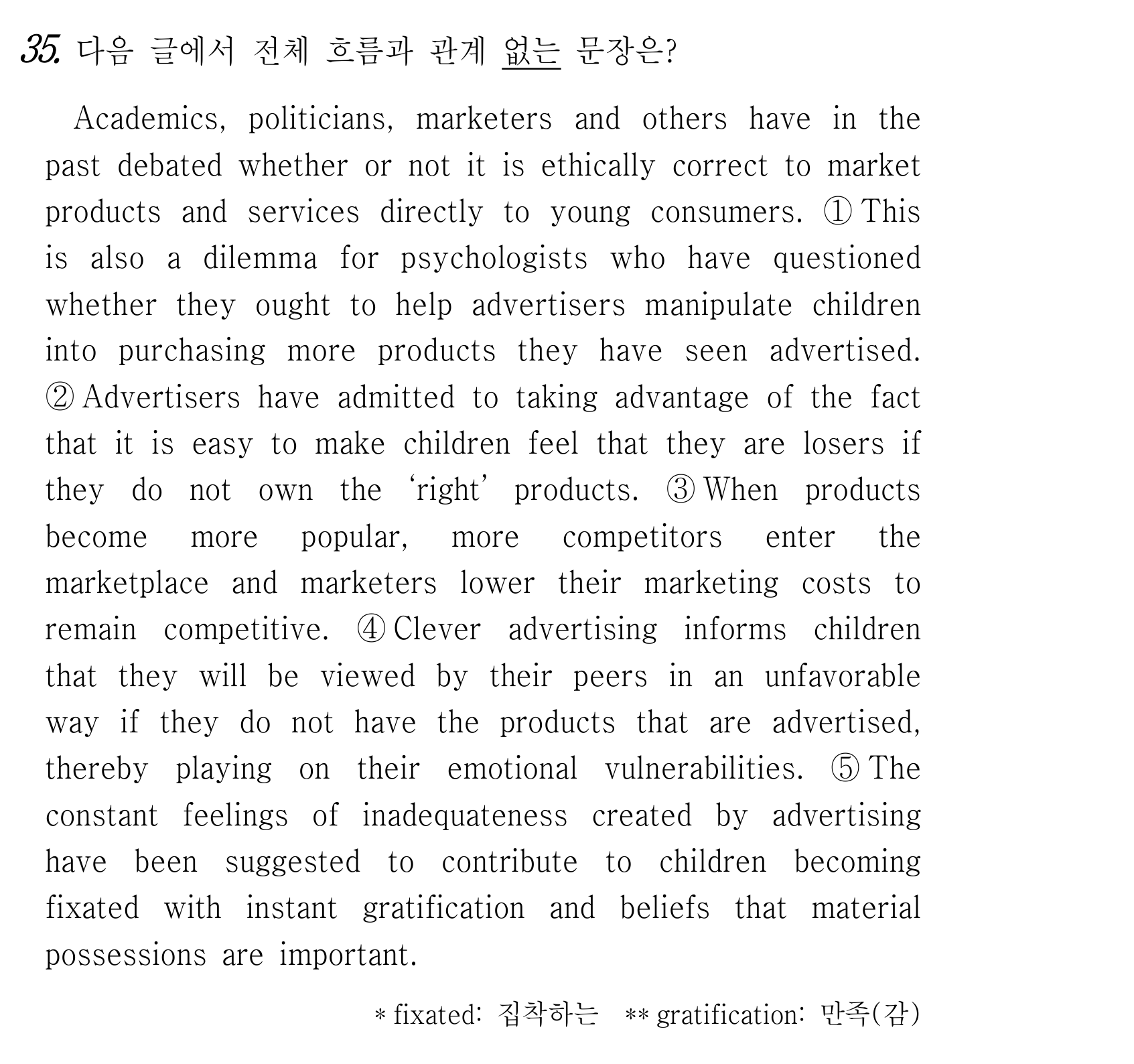
35번무관한문장Academics, politicians, marketers and others have in the past debated whether or not it i…
Academics, politicians, marketers and others have in the past debated whether or not it is ethically correct to market products and services directly to young consumers. This is also a dilemma for psychologists who have questioned whether they ought to help advertisers manipulate children into purchasing more products they have seen advertised. Advertisers have admitted to taking advantage of the fact that it is easy to make children feel that they are losers if they do not own the ‘right’ products. Clever advertising informs children that they will be viewed by their peers in an unfavorable way if they do not have the products that are advertised, thereby playing on their emotional vulnerabilities. The constant feelings of inadequacy created by advertising have been suggested to contribute to children becoming fixated with instant gratification and beliefs that material possessions are important.
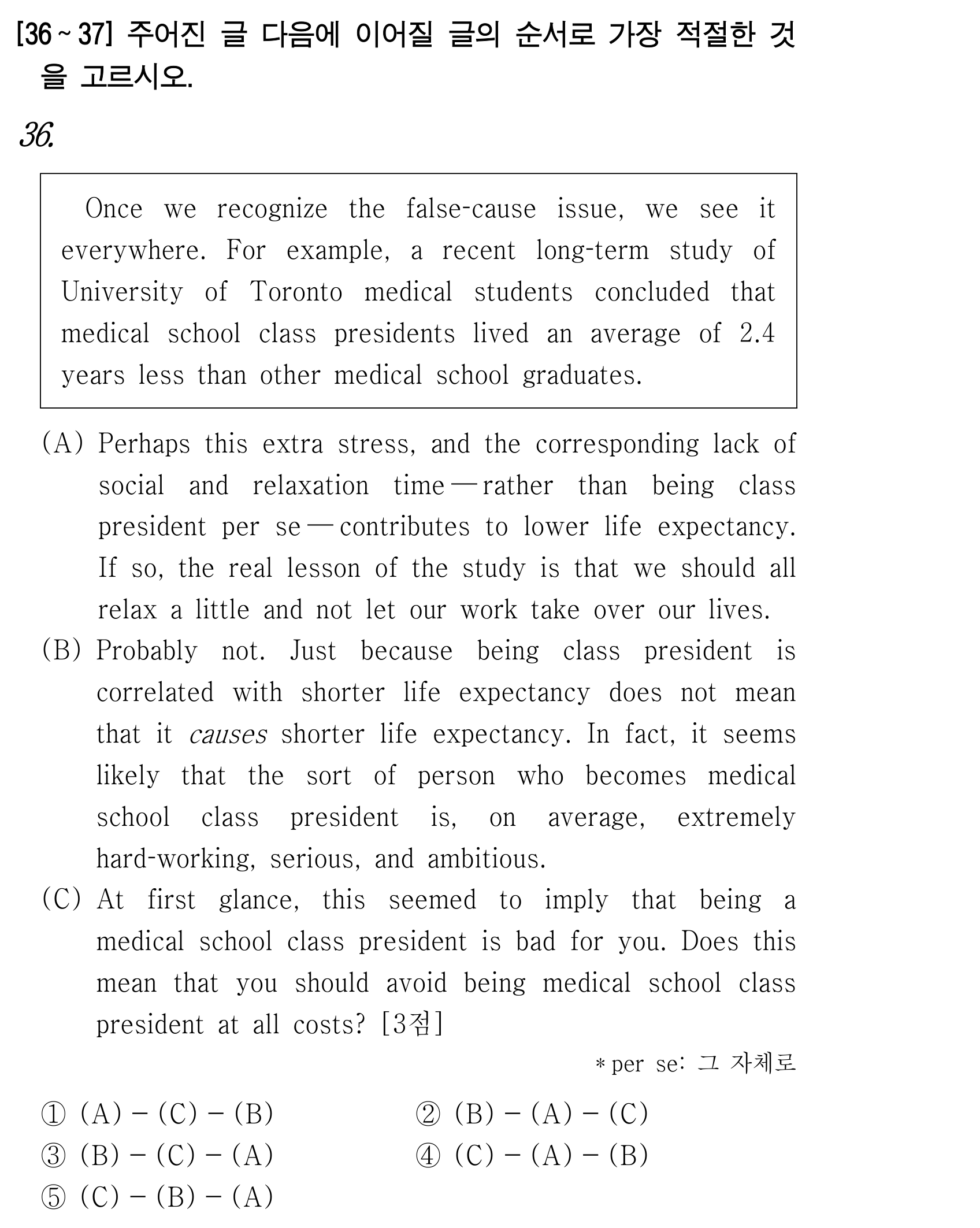
36번순서배열1Once we recognize the false-cause issue, we see it everywhere.
Once we recognize the false-cause issue, we see it everywhere. For example, a recent long-term study of University of Toronto medical students concluded that medical school class presidents lived an average of 2.4 years less than other medical school graduates. At first glance, this seemed to imply that being a medical school class president is bad for you. Does this mean that you should avoid being medical school class president at all costs? Probably not. Just because being class president is correlated with shorter life expectancy does not mean that it causes shorter life expectancy. In fact, it seems likely that the sort of person who becomes medical school class president is, on average, extremely hard-working, serious, and ambitious. Perhaps this extra stress, and the corresponding lack of social and relaxation time—rather than being class president per se—contributes to lower life expectancy. If so, the real lesson of the study is that we should all relax a little and not let our work take over our lives.
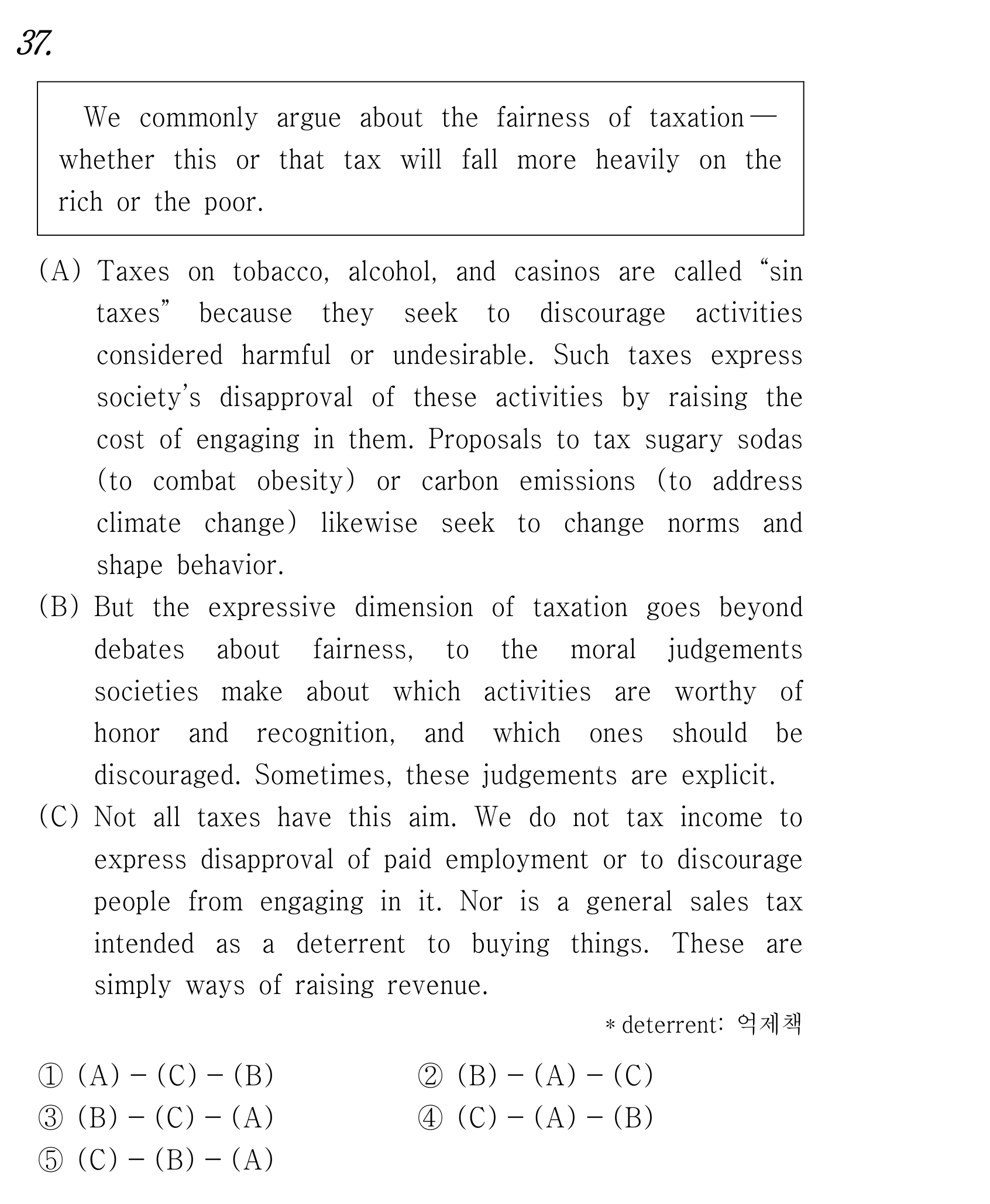
37번순서배열2We commonly argue about the fairness of taxation—whether this or that tax will fall more…
We commonly argue about the fairness of taxation—whether this or that tax will fall more heavily on the rich or the poor. But the expressive dimension of taxation goes beyond debates about fairness, to the moral judgements societies make about which activities are worthy of honor and recognition, and which ones should be discouraged. Sometimes, these judgements are explicit. Taxes on tobacco, alcohol, and casinos are called “sin taxes” because they seek to discourage activities considered harmful or undesirable. Such taxes express society’s disapproval of these activities by raising the cost of engaging in them. Proposals to tax sugary sodas (to combat obesity) or carbon emissions (to address climate change) likewise seek to change norms and shape behavior. Not all taxes have this aim. We do not tax income to express disapproval of paid employment or to discourage people from engaging in it. Nor is a general sales tax intended as a deterrent to buying things. These are simply ways of raising revenue.
39번문장삽입2Everyone automatically categorizes and generalizes all the time.
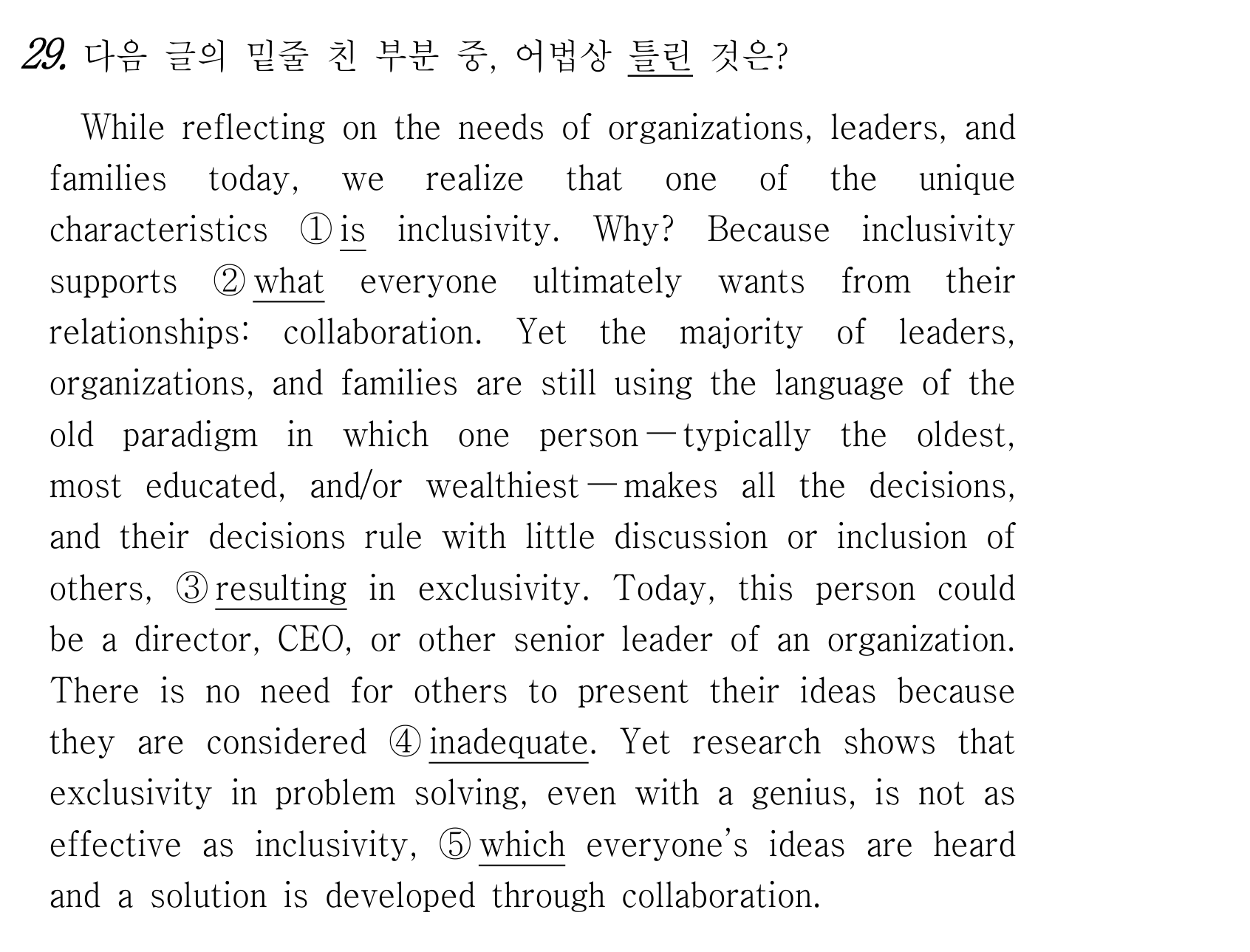
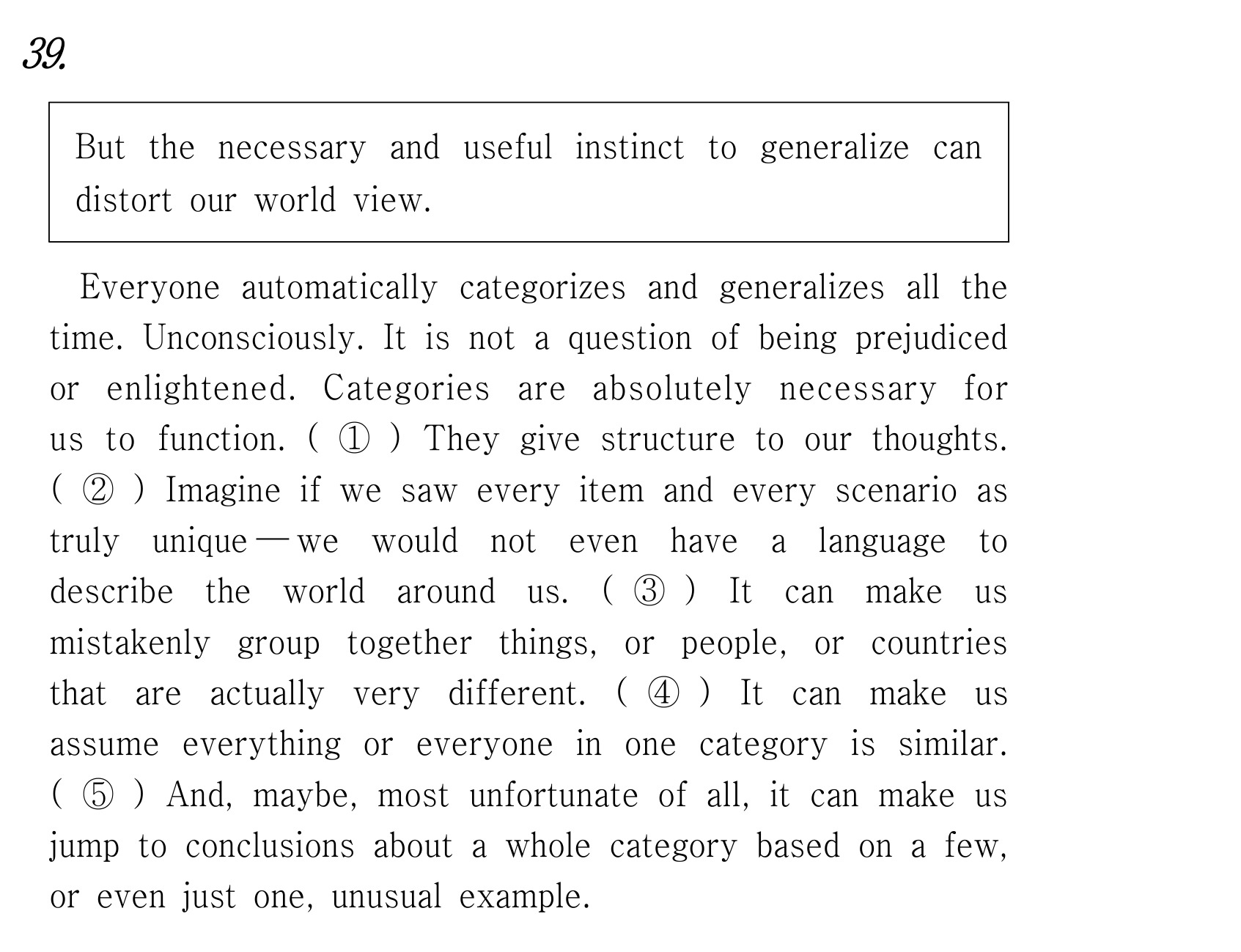
Everyone automatically categorizes and generalizes all the time. Unconsciously. It is not a question of being prejudiced or enlightened. Categories are absolutely necessary for us to function. They give structure to our thoughts. Imagine if we saw every item and every scenario as truly unique—we would not even have a language to describe the world around us. But the necessary and useful instinct to generalize can distort our world view. It can make us mistakenly group together things, or people, or countries that are actually very different. It can make us assume everything or everyone in one category is similar. And, maybe, most unfortunate of all, it can make us jump to conclusions about a whole category based on a few, or even just one, unusual example.
40번요약문완성At the University of Iowa, students were briefly shown numbers that they had to memorize.
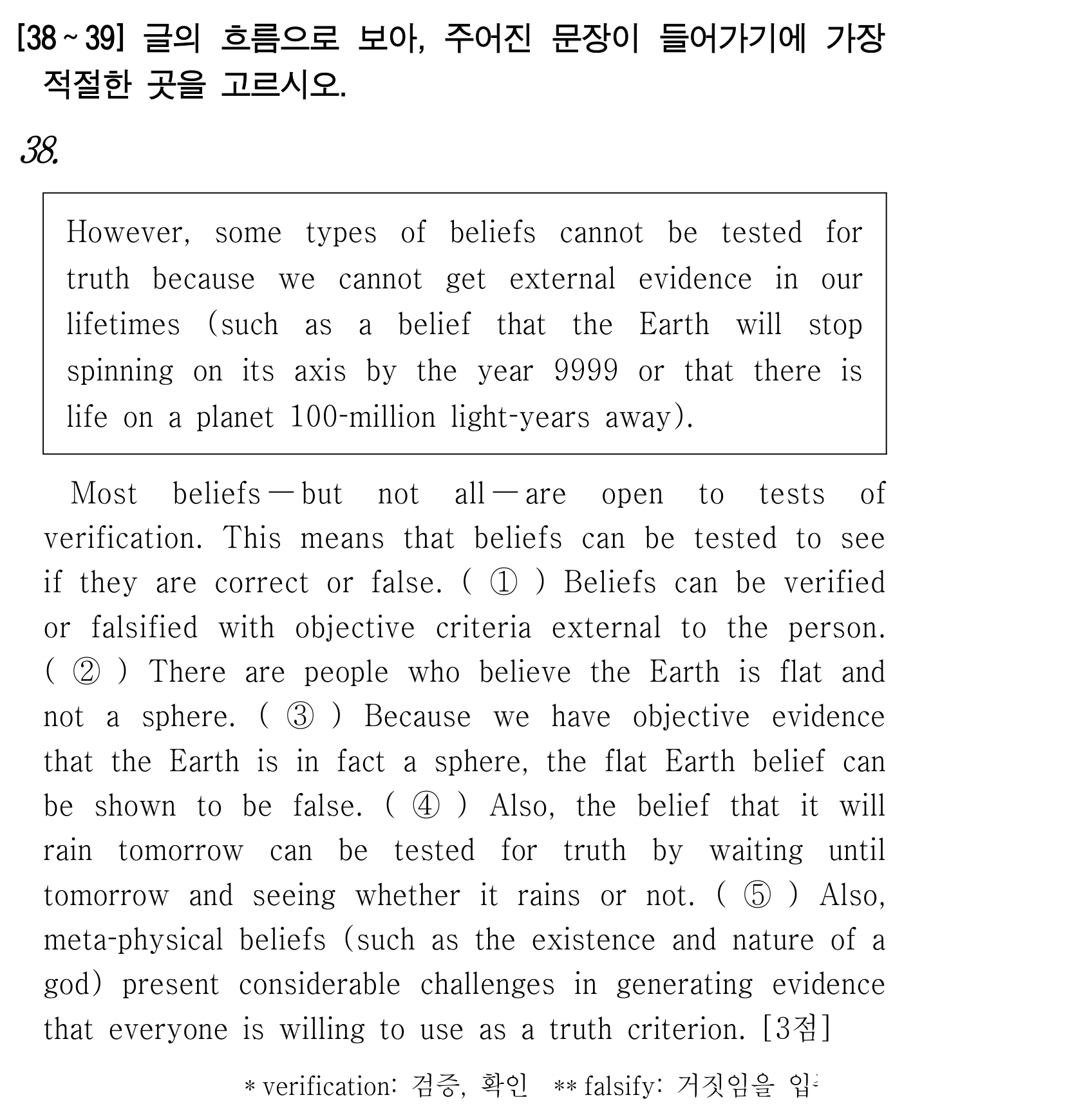
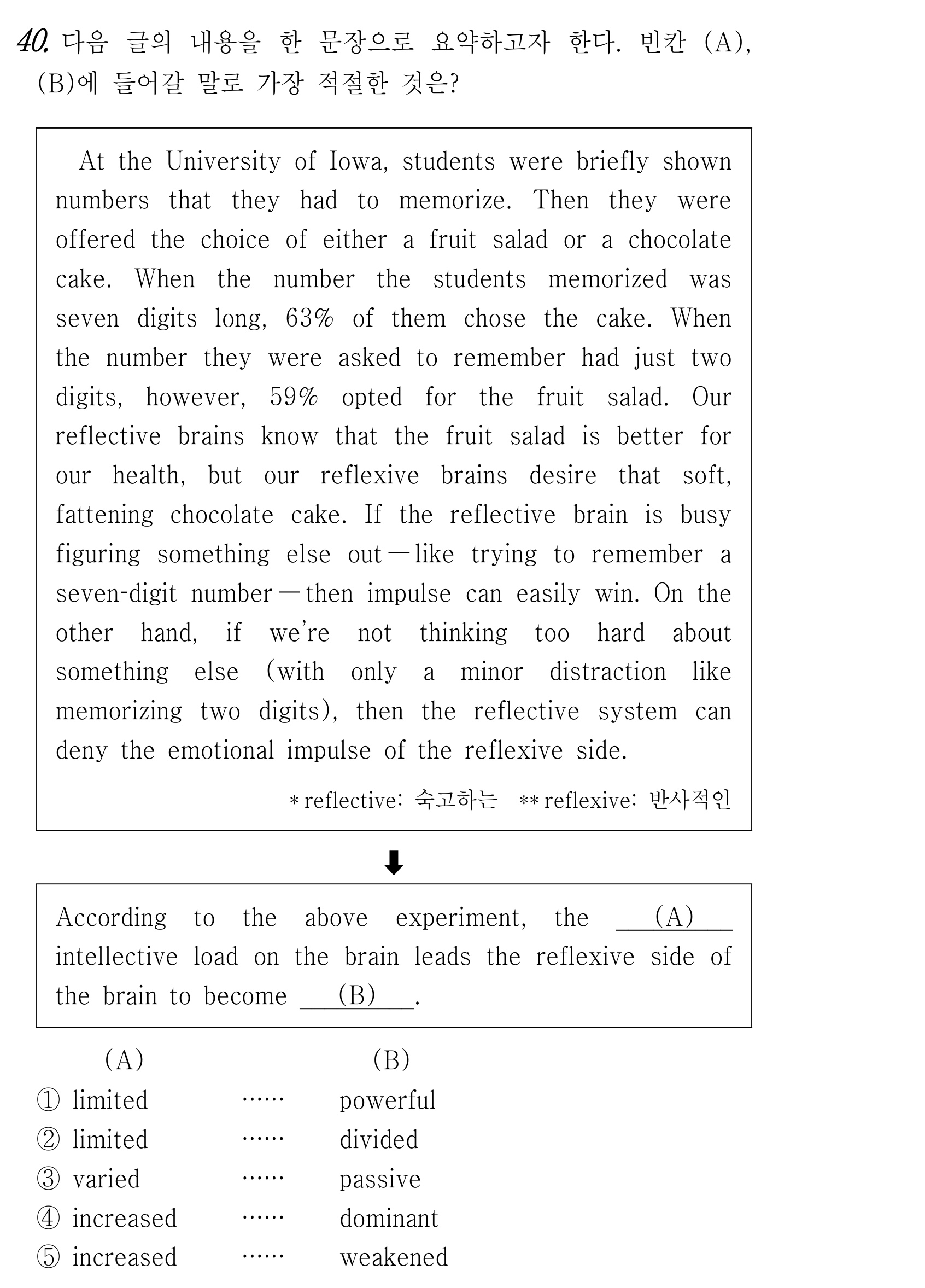
At the University of Iowa, students were briefly shown numbers that they had to memorize. Then they were offered the choice of either a fruit salad or a chocolate cake. When the number the students memorized was seven digits long, 63% of them chose the cake. When the number they were asked to remember had just two digits, however, 59% opted for the fruit salad. Our reflective brains know that the fruit salad is better for our health, but our reflexive brains desire that soft, fattening chocolate cake. If the reflective brain is busy figuring something else out—like trying to remember a seven-digit number—then impulse can easily win. On the other hand, if we're not thinking too hard about something else (with only a minor distraction like memorizing two digits), then the reflective system can deny the emotional impulse of the reflexive side.
41번장문_제목Test scores are not a measure of self-worth; however, we often associate our sense of wor…
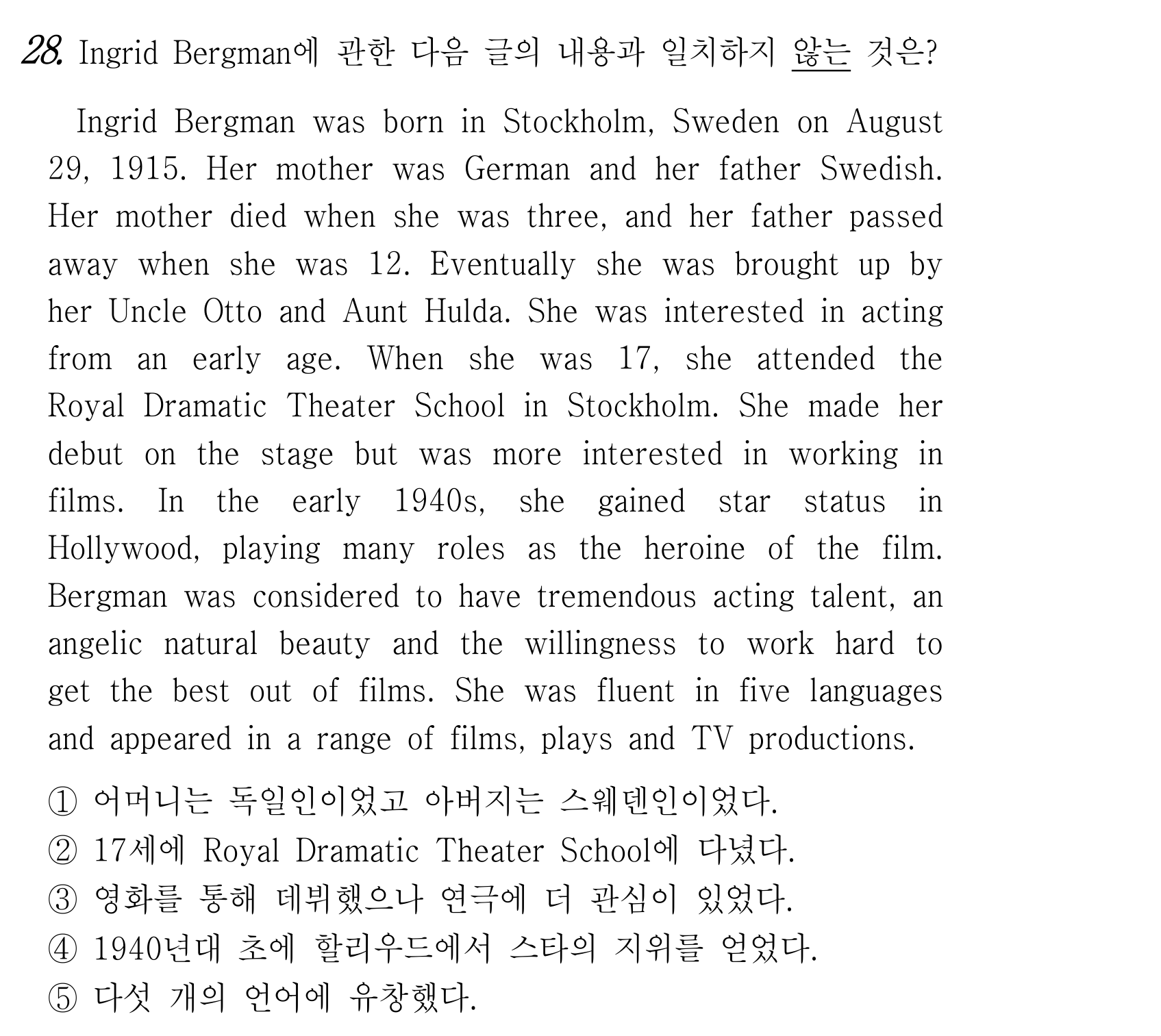
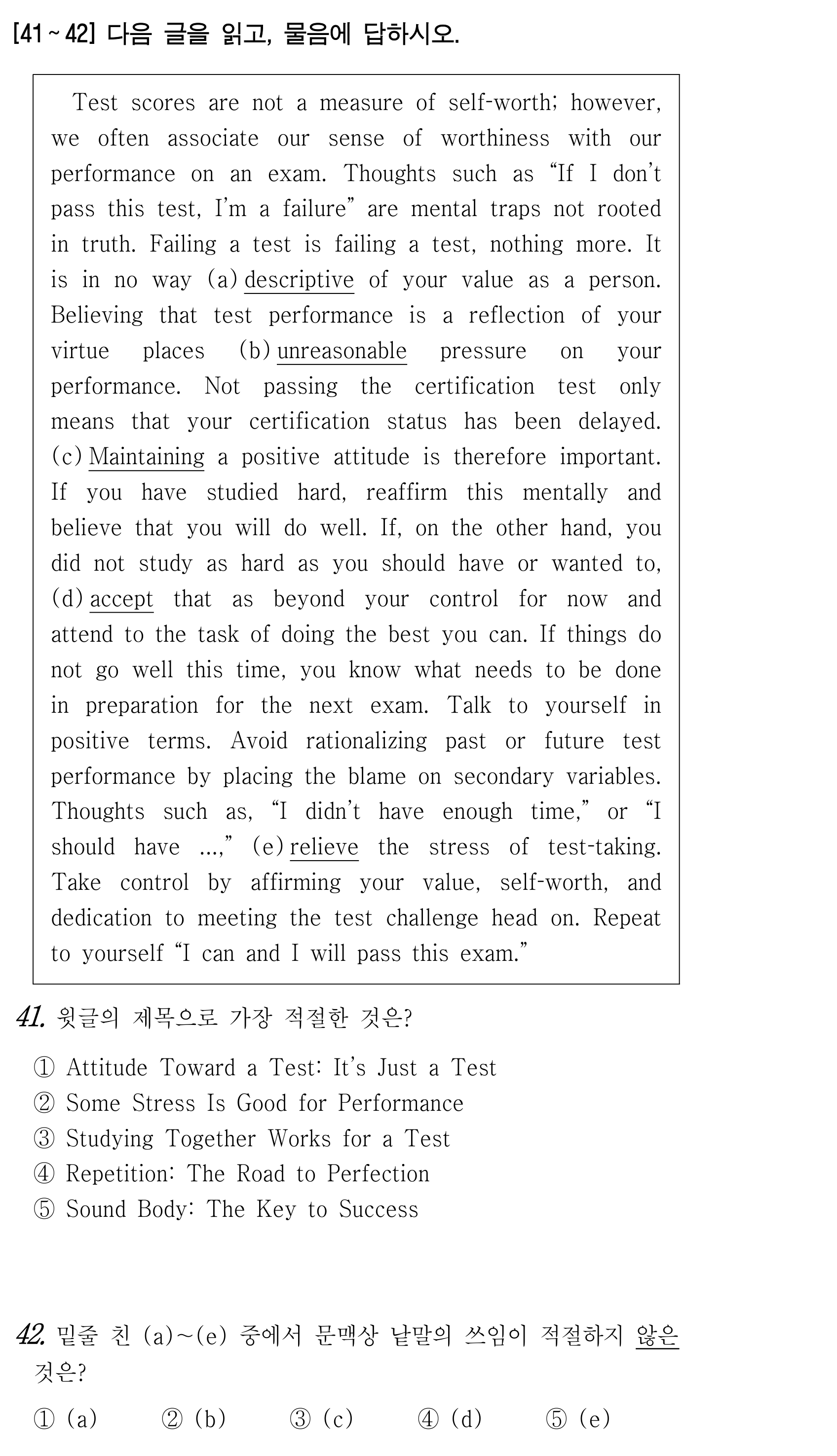
Test scores are not a measure of self-worth; however, we often associate our sense of worthiness with our performance on an exam. Thoughts such as “If I don’t pass this test, I’m a failure” are mental traps not rooted in truth. Failing a test is failing a test, nothing more. It is in no way (a) descriptive of your value as a person. Believing that test performance is a reflection of your virtue places (b) unreasonable pressure on your performance. Not passing the certification test only means that your certification status has been delayed. (c) Maintaining a positive attitude is therefore important. If you have studied hard, reaffirm this mentally and believe that you will do well. If, on the other hand, you did not study as hard as you should have or wanted to, (d) accept that as beyond your control for now and attend to the task of doing the best you can. If things do not go well this time, you know what needs to be done in preparation for the next exam. Talk to yourself in positive terms. Avoid rationalizing past or future test performance by placing the blame on secondary variables. Thoughts such as, “I didn’t have enough time,” or “I should have ...,” (e) relieve the stress of test-taking. Take control by affirming your value, self-worth, and dedication to meeting the test challenge head on. Repeat to yourself “I can and I will pass this exam.”
2021년 3월 고2 전국연합 영어 모의고사 변형문제 맛보기
이 시험 지문으로 만든 변형문제가 아직 없습니다. 지문을 고르면 어법·빈칸·주제·어휘 등 유형별 변형문제를 바로 만들 수 있습니다.
이 시험으로 첫 변형문제 만들기 →남은 시간
48:00
아직 28문제를 풀지 않았어요 (0/28)