2021년 3월 고1 전국연합 영어 모의고사
28문제 · 제한시간 48분
이 시험 한눈에 — 2021년 3월 고1 전국연합 영어 모의고사
18~45번 28문항을 유형별로 보면 목적 1 · 심경/분위기 1 · 주장 1 · 함축의미추론 1 · 요지/주장 1 · 주제 1 · 제목 1 · 도표 1 · 내용일치 1 · 실용문 1 · 어법 2 · 어휘 1 · 빈칸추론2 1 · 빈칸추론3 1 · 빈칸추론4 1 · 빈칸추론5 1 · 무관한문장 1 · 순서배열1 1 · 순서배열2 1 · 문장삽입1 1 · 문장삽입2 1 · 요약문완성 1 · 장문 5. 아래 지문으로 변형문제·단어장·정답표를 바로 만들 수 있습니다.
18번목적Dear members of Eastwood Library, Thanks to the Friends of Literature group, we've succes…
Dear members of Eastwood Library,
Thanks to the Friends of Literature group, we've successfully raised enough money to remodel the library building. John Baker, our local builder, has volunteered to help us with the remodelling but he needs assistance. By grabbing a hammer or a paint brush and donating your time, you can help with the construction. Join Mr. Baker in his volunteering team and become a part of making Eastwood Library a better place! Please call 541-567-1234 for more information.
Sincerely, Mark Anderson
19번심경/분위기On the way home, Shirley noticed a truck parked in front of the house across the street.
On the way home, Shirley noticed a truck parked in front of the house across the street. New neighbors! Shirley was dying to know about them. “Do you know anything about the new neighbors?” she asked Pa at dinner. He said, “Yes, and there’s one thing that may be interesting to you.” Shirley had a billion more questions. Pa said joyfully, “They have a girl just your age. Maybe she wants to be your playmate.” Shirley nearly dropped her fork on the floor. How many times had she prayed for a friend? Finally, her prayers were answered! She and the new girl could go to school together, play together, and become best friends.
20번주장At a publishing house and at a newspaper you learn the following: It's not a mistake if i…
At a publishing house and at a newspaper you learn the following: It's not a mistake if it doesn't end up in print. It's the same for email. Nothing bad can happen if you haven't hit the Send key. What you've written can have misspellings, errors of fact, rude comments, obvious lies, but it doesn't matter. If you haven't sent it, you still have time to fix it. You can correct any mistake and nobody will ever know the difference. This is easier said than done, of course. Send is your computer's most attractive command. But before you hit the Send key, make sure that you read your document carefully one last time.
21번함축의미추론Get past the ‘I wish I hadn’t done that!’ reaction.
Get past the ‘I wish I hadn’t done that!’ reaction. If the disappointment you’re feeling is linked to an exam you didn’t pass because you didn’t study for it, or a job you didn’t get because you said silly things at the interview, or a person you didn’t impress because you took entirely the wrong approach, accept that it’s happened now. The only value of ‘I wish I hadn’t done that!’ is that you’ll know better what to do next time. The learning pay-off is useful and significant. This ‘if only I ...’ agenda is virtual. Once you have worked that out, it’s time to translate it from the past tense to the future tense: ‘Next time I’m in this situation, I’m going to try to ...’.
22번요지/주장If you care deeply about something, you may place greater value on your ability to succee…
If you care deeply about something, you may place greater value on your ability to succeed in that area of concern. The internal pressure you place on yourself to achieve or do well socially is normal and useful, but when you doubt your ability to succeed in areas that are important to you, your self-worth suffers. Situations are uniquely stressful for each of us based on whether or not they activate our doubt. It’s not the pressure to perform that creates your stress. Rather, it’s the self-doubt that bothers you. Doubt causes you to see positive, neutral, and even genuinely negative experiences more negatively and as a reflection of your own shortcomings. When you see situations and your strengths more objectively, you are less likely to have doubt as the source of your distress.
23번주제When two people are involved in an honest and open conversation, there is a back and fort…
When two people are involved in an honest and open conversation, there is a back and forth flow of information. It is a smooth exchange. Since each one is drawing on their past personal experiences, the pace of the exchange is as fast as memory. When one person lies, their responses will come more slowly because the brain needs more time to process the details of a new invention than to recall stored facts. As they say, “Timing is everything.” You will notice the time lag when you are having a conversation with someone who is making things up as they go. Don’t forget that the other person may be reading your body language as well, and if you seem to be disbelieving their story, they will have to pause to process that information, too.
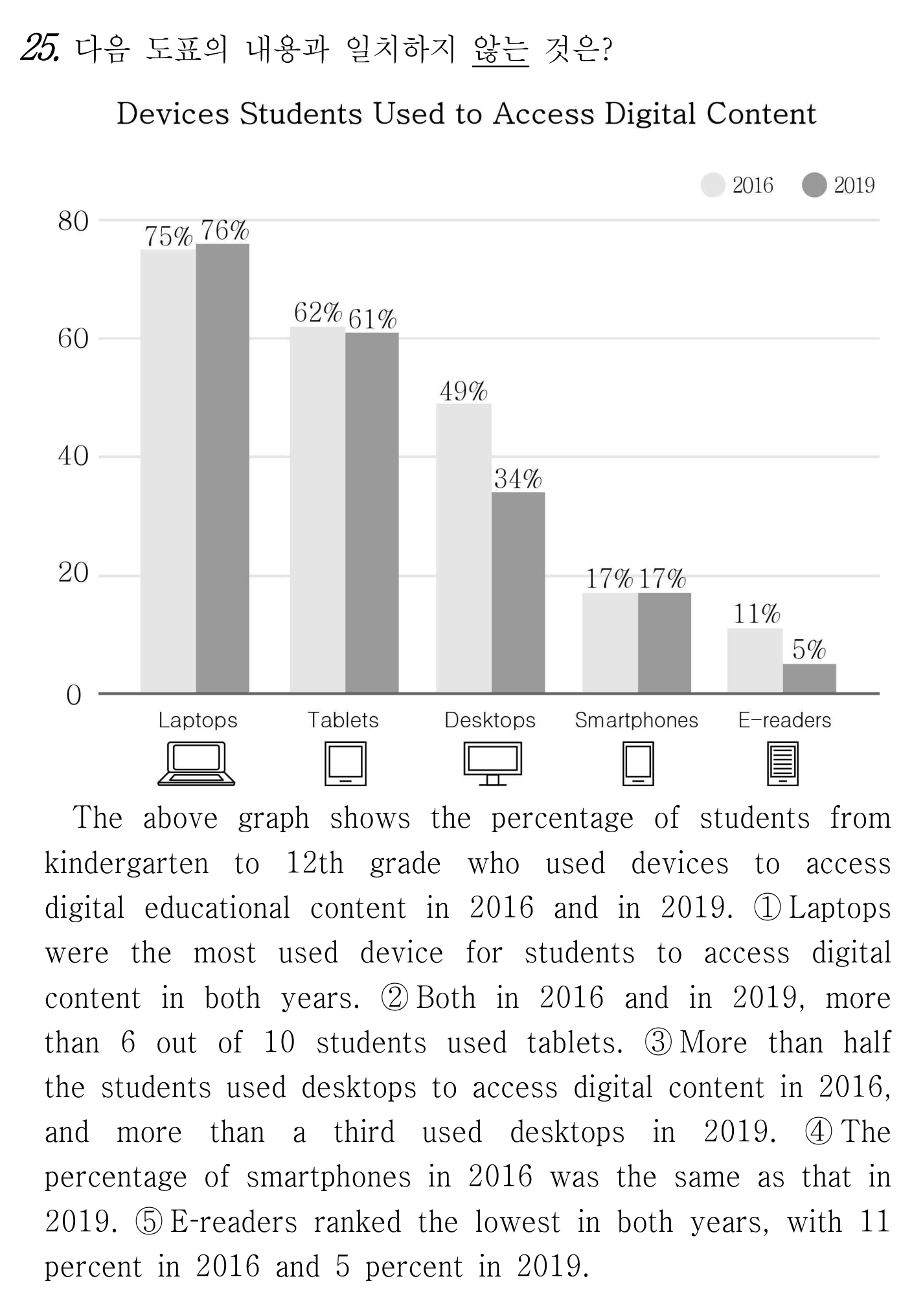
25번도표The above graph shows the percentage of students from kindergarten to 12th grade who used…
The above graph shows the percentage of students from kindergarten to 12th grade who used devices to access digital educational content in 2016 and in 2019. ① Laptops were the most used device for students to access digital content in both years. ② Both in 2016 and in 2019, more than 6 out of 10 students used tablets. ③ More than half the students used desktops to access digital content in 2016, and more than a third used desktops in 2019. ④ The percentage of smartphones in 2016 was the same as that in 2019. ⑤ E-readers ranked the lowest in both years, with 11 percent in 2016 and 5 percent in 2019.
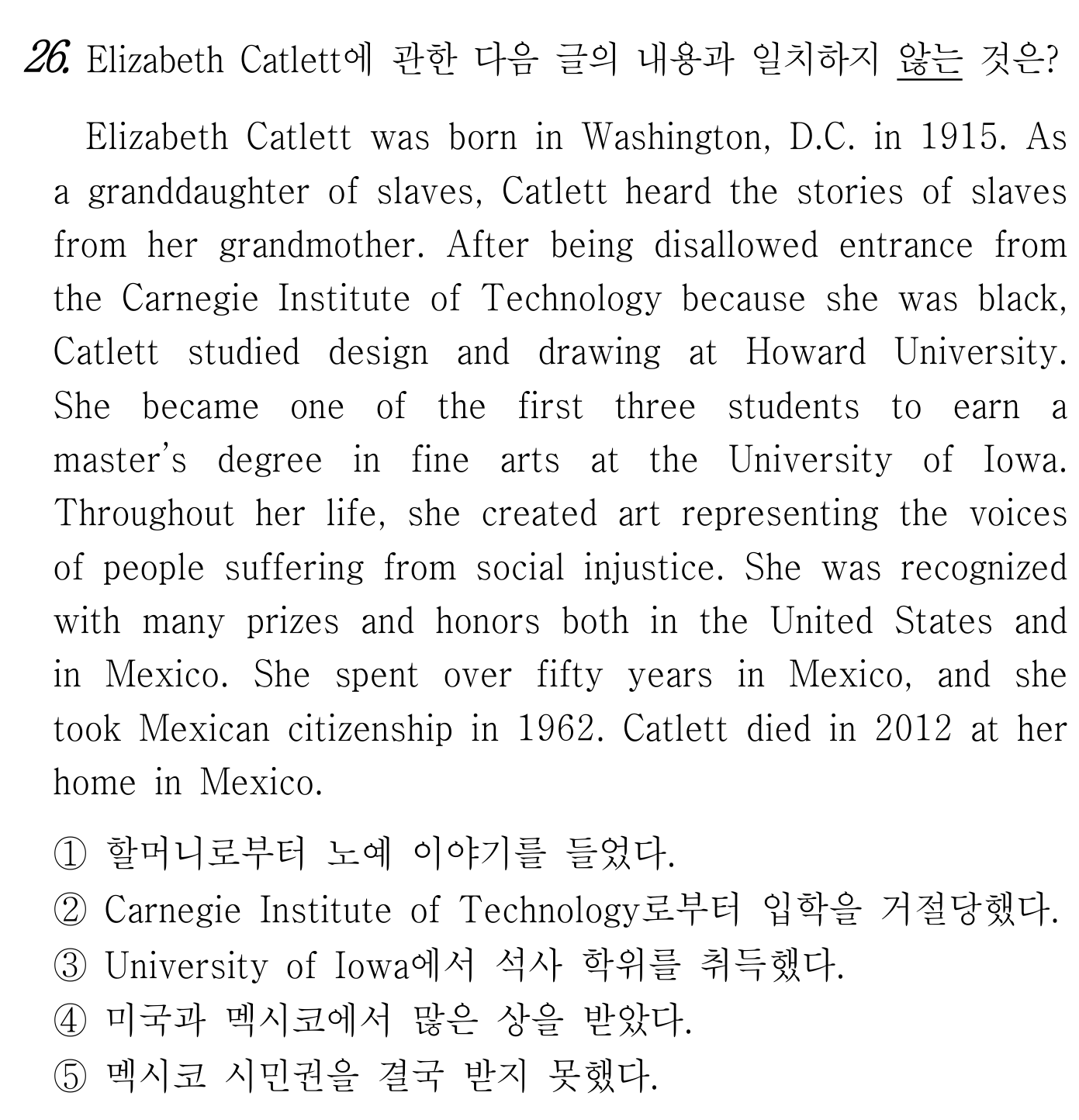
26번내용일치Elizabeth Catlett was born in Washington, D.C.
Elizabeth Catlett was born in Washington, D.C. in 1915. As a granddaughter of slaves, Catlett heard the stories of slaves from her grandmother. After being disallowed entrance from the Carnegie Institute of Technology because she was black, Catlett studied design and drawing at Howard University. She became one of the first three students to earn a master’s degree in fine arts at the University of Iowa. Throughout her life, she created art representing the voices of people suffering from social injustice. She was recognized with many prizes and honors both in the United States and in Mexico. She spent over fifty years in Mexico, and she took Mexican citizenship in 1962. Catlett died in 2012 at her home in Mexico.
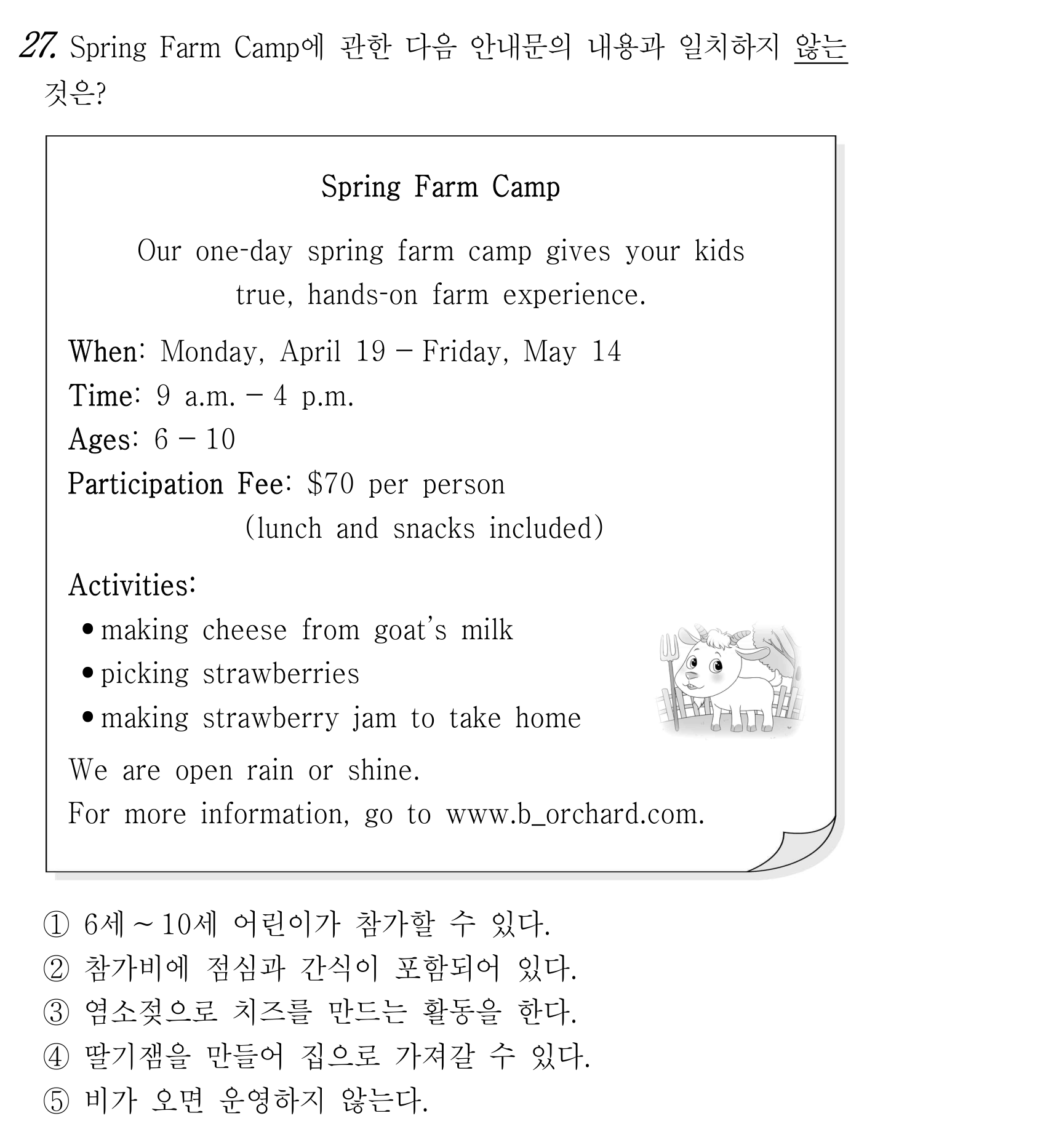
27번실용문Spring Farm Camp Our one-day spring farm camp gives your kids true, hands-on farm experie…
Spring Farm Camp
Our one-day spring farm camp gives your kids true, hands-on farm experience. When: Monday, April 19 - Friday, May 14 Time: 9 a.m. - 4 p.m. Ages: 6 - 10 Participation Fee: $70 per person (lunch and snacks included) Activities: • making cheese from goat's milk • picking strawberries • making strawberry jam to take home We are open rain or shine. For more information, go to www.b_orchard.com.
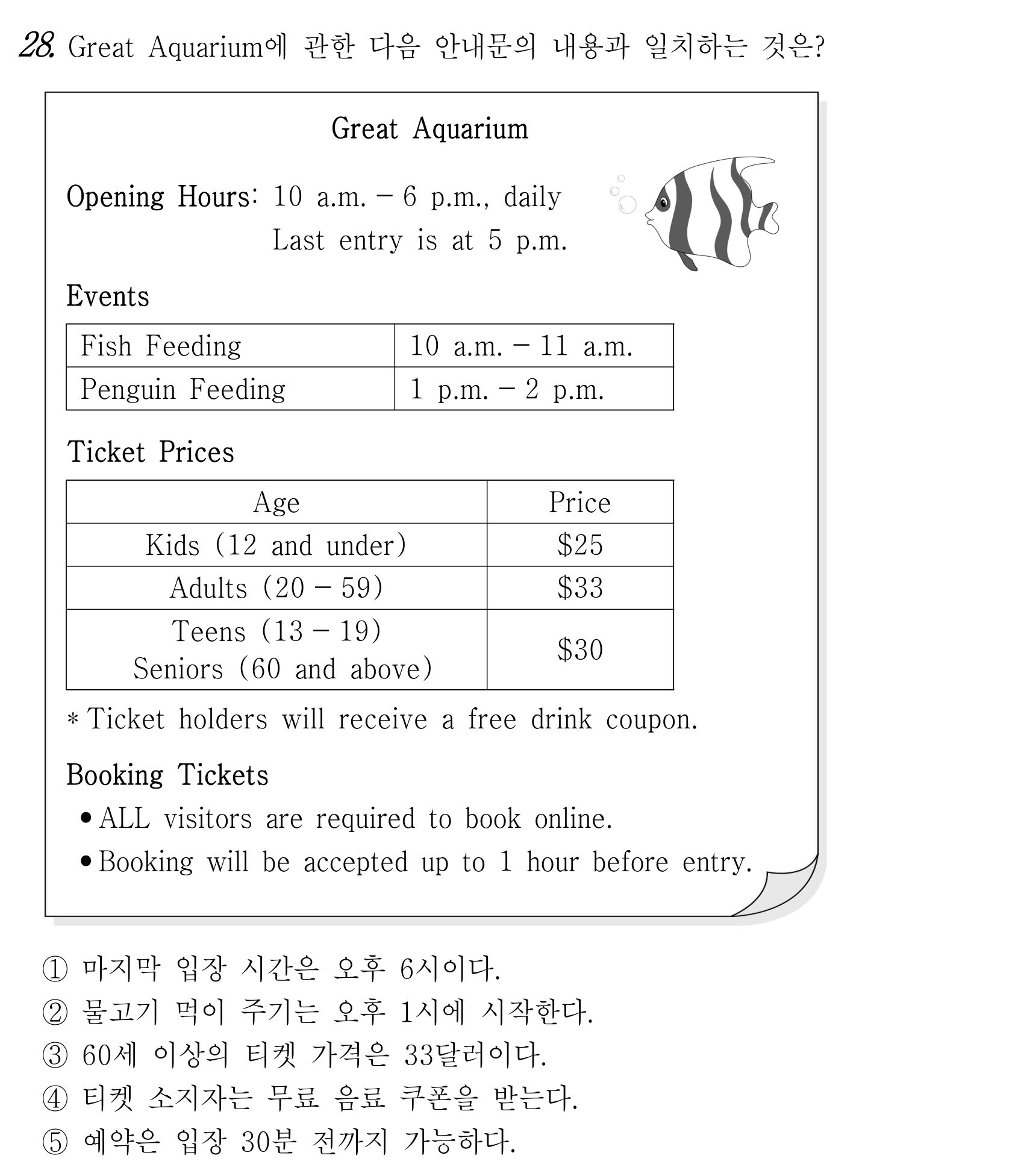
28번어법Great Aquarium Opening Hours: 10 a.m.
Great Aquarium
Opening Hours: 10 a.m. - 6 p.m., daily Last entry is at 5 p.m.
Events Fish Feeding | 10 a.m. - 11 a.m. Penguin Feeding | 1 p.m. - 2 p.m.
Ticket Prices Age | Price Kids (12 and under) | $25 Adults (20 - 59) | $33 Teens (13 - 19) | $30 Seniors (60 and above) | $30
* Ticket holders will receive a free drink coupon.
Booking Tickets • ALL visitors are required to book online. • Booking will be accepted up to 1 hour before entry.
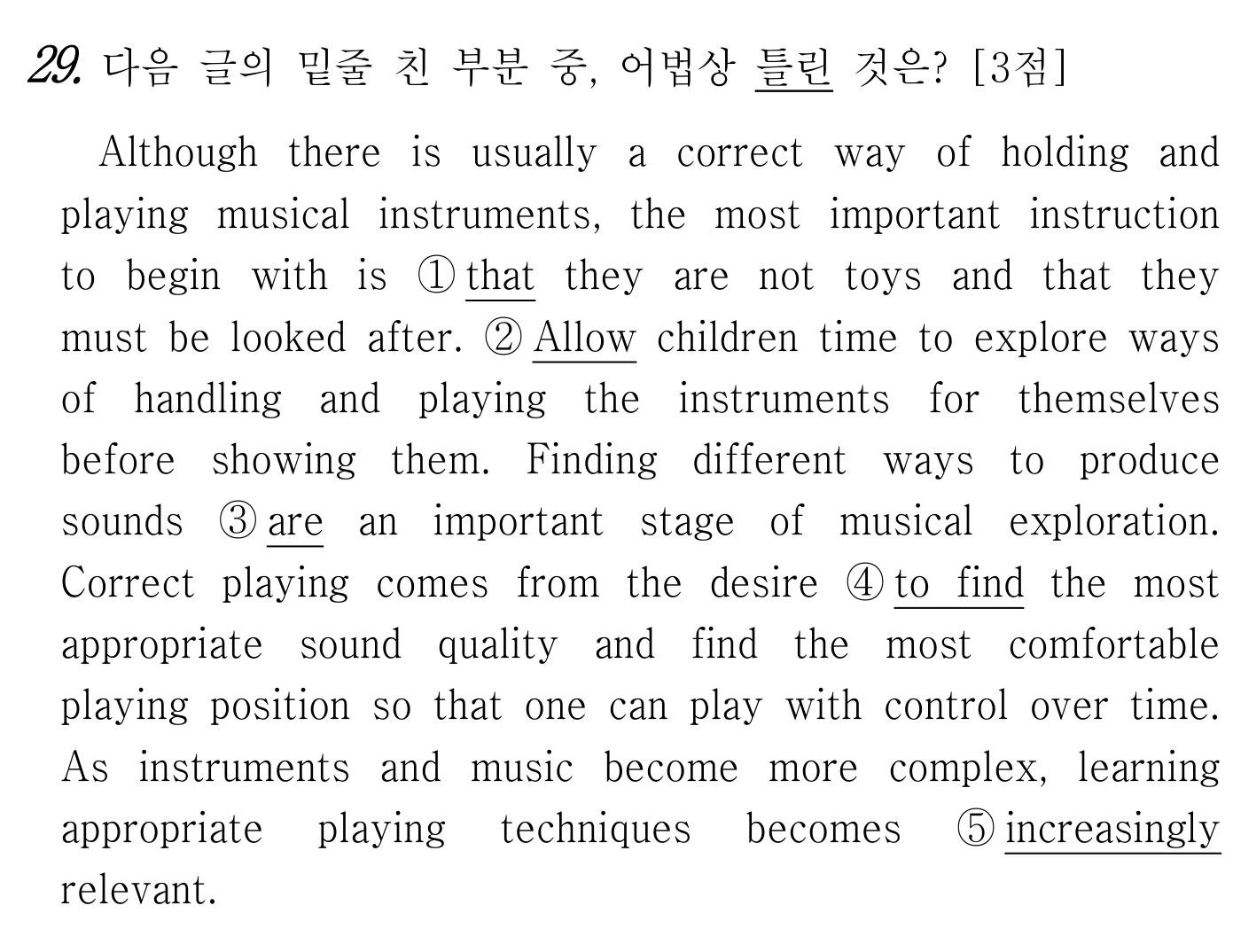
29번어법Although there is usually a correct way of holding and playing musical instruments, the m…
Although there is usually a correct way of holding and playing musical instruments, the most important instruction to begin with is that they are not toys and that they must be looked after. Allow children time to explore ways of handling and playing the instruments for themselves before showing them. Finding different ways to produce sounds is an important stage of musical exploration. Correct playing comes from the desire to find the most appropriate sound quality and find the most comfortable playing position so that one can play with control over time. As instruments and music become more complex, learning appropriate playing techniques becomes increasingly relevant.
30번어휘When the price of something fundamental drops greatly, the whole world can change.
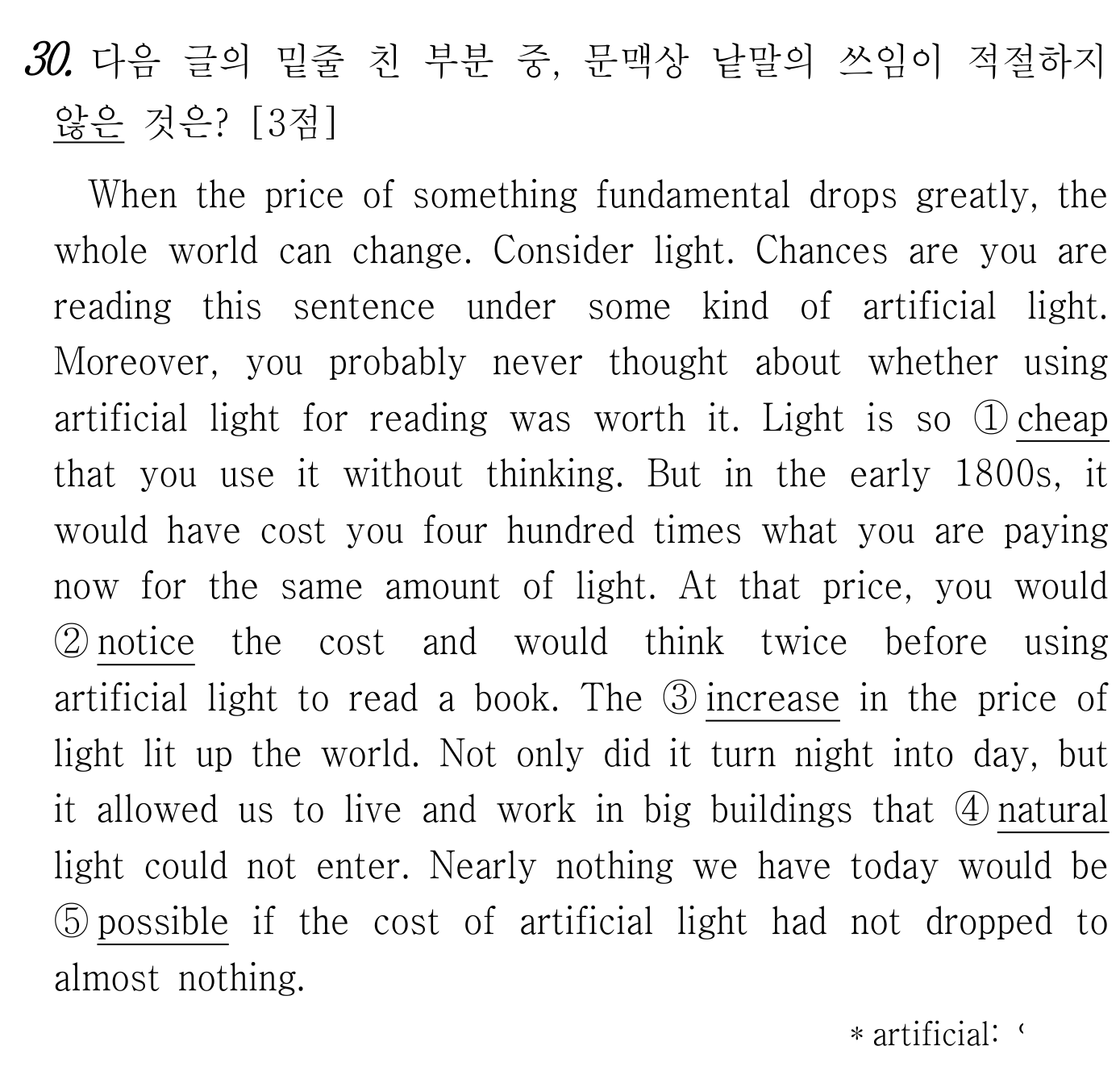
When the price of something fundamental drops greatly, the whole world can change. Consider light. Chances are you are reading this sentence under some kind of artificial light. Moreover, you probably never thought about whether using artificial light for reading was worth it. Light is so cheap that you use it without thinking. But in the early 1800s, it would have cost you four hundred times what you are paying now for the same amount of light. At that price, you would notice the cost and would think twice before using artificial light to read a book. The decrease in the price of light lit up the world. Not only did it turn night into day, but it allowed us to live and work in big buildings that natural light could not enter. Nearly nothing we have today would be possible if the cost of artificial light had not dropped to almost nothing.
31번빈칸추론2One of the most important aspects of providing good care is making sure that an animal’s…
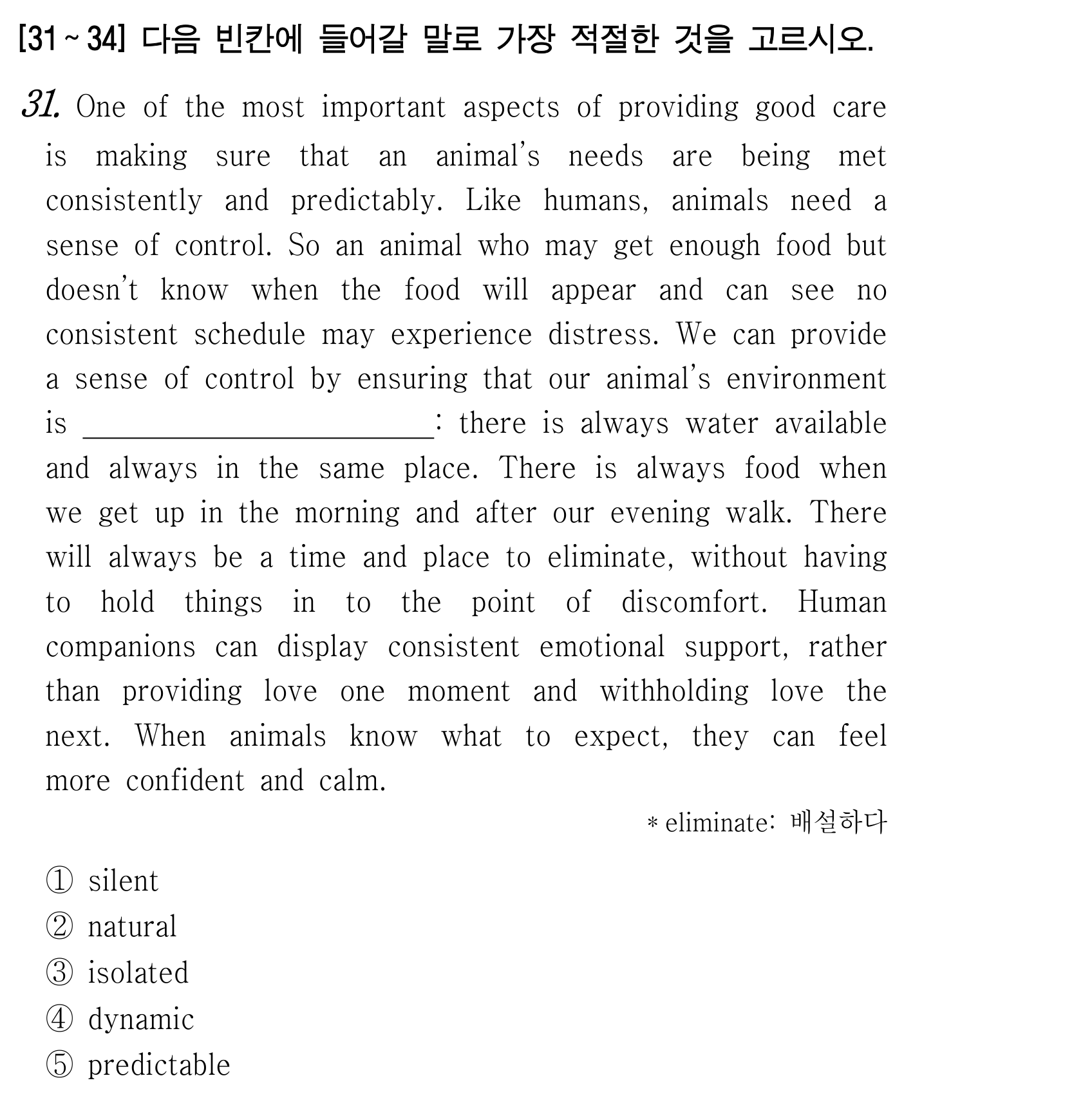
One of the most important aspects of providing good care is making sure that an animal’s needs are being met consistently and predictably. Like humans, animals need a sense of control. So an animal who may get enough food but doesn’t know when the food will appear and can see no consistent schedule may experience distress. We can provide a sense of control by ensuring that our animal’s environment is predictable : there is always water available and always in the same place. There is always food when we get up in the morning and after our evening walk. There will always be a time and place to eliminate, without having to hold things in to the point of discomfort. Human companions can display consistent emotional support, rather than providing love one moment and withholding love the next. When animals know what to expect, they can feel more confident and calm.
32번빈칸추론3When a child is upset, the easiest and quickest way to calm them down is to give them foo…
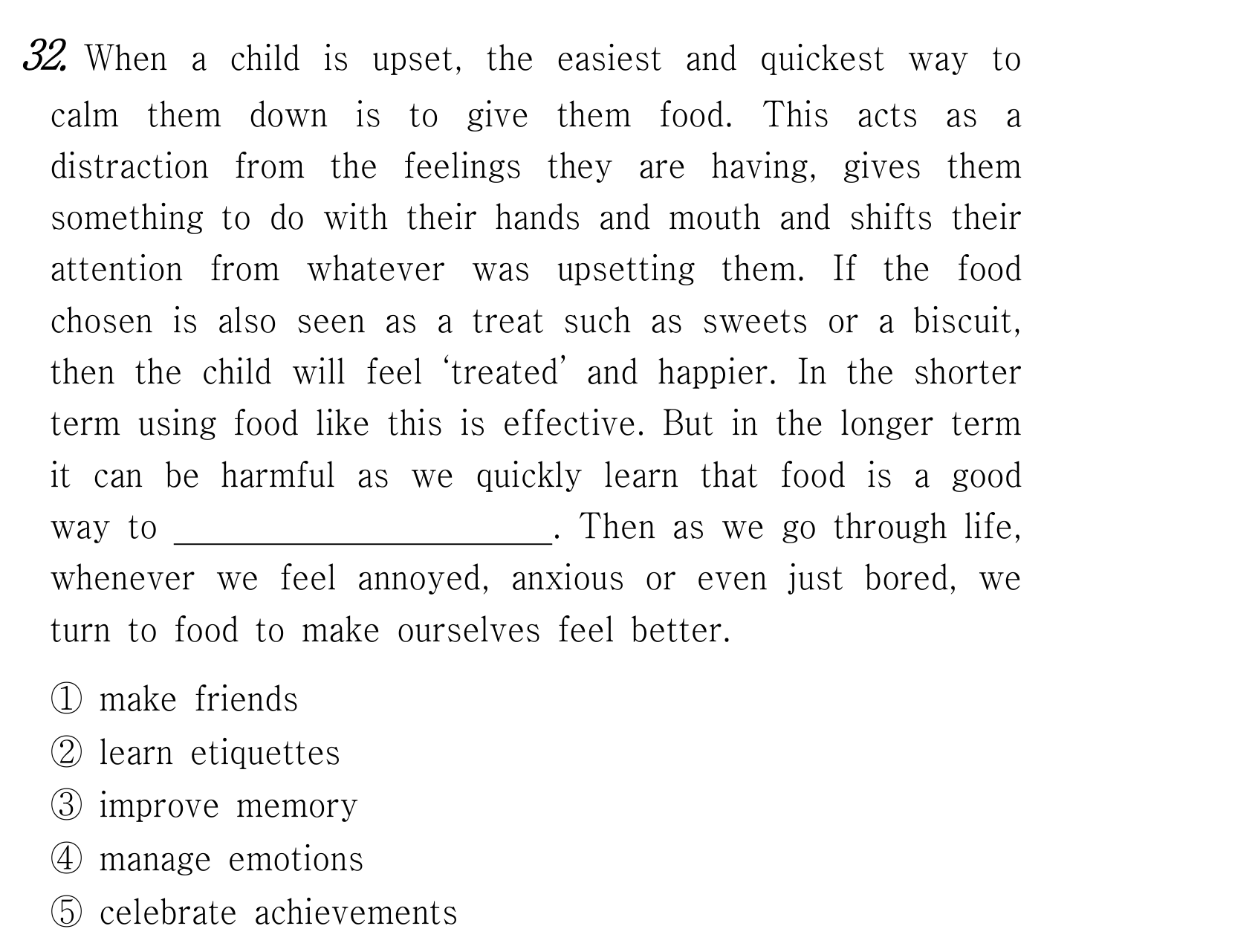
When a child is upset, the easiest and quickest way to calm them down is to give them food. This acts as a distraction from the feelings they are having, gives them something to do with their hands and mouth and shifts their attention from whatever was upsetting them. If the food chosen is also seen as a treat such as sweets or a biscuit, then the child will feel ‘treated’ and happier. In the shorter term using food like this is effective. But in the longer term it can be harmful as we quickly learn that food is a good way to manage emotions. Then as we go through life, whenever we feel annoyed, anxious or even just bored, we turn to food to make ourselves feel better.
33번빈칸추론4Scientists believe that the frogs' ancestors were water-dwelling, fishlike animals.
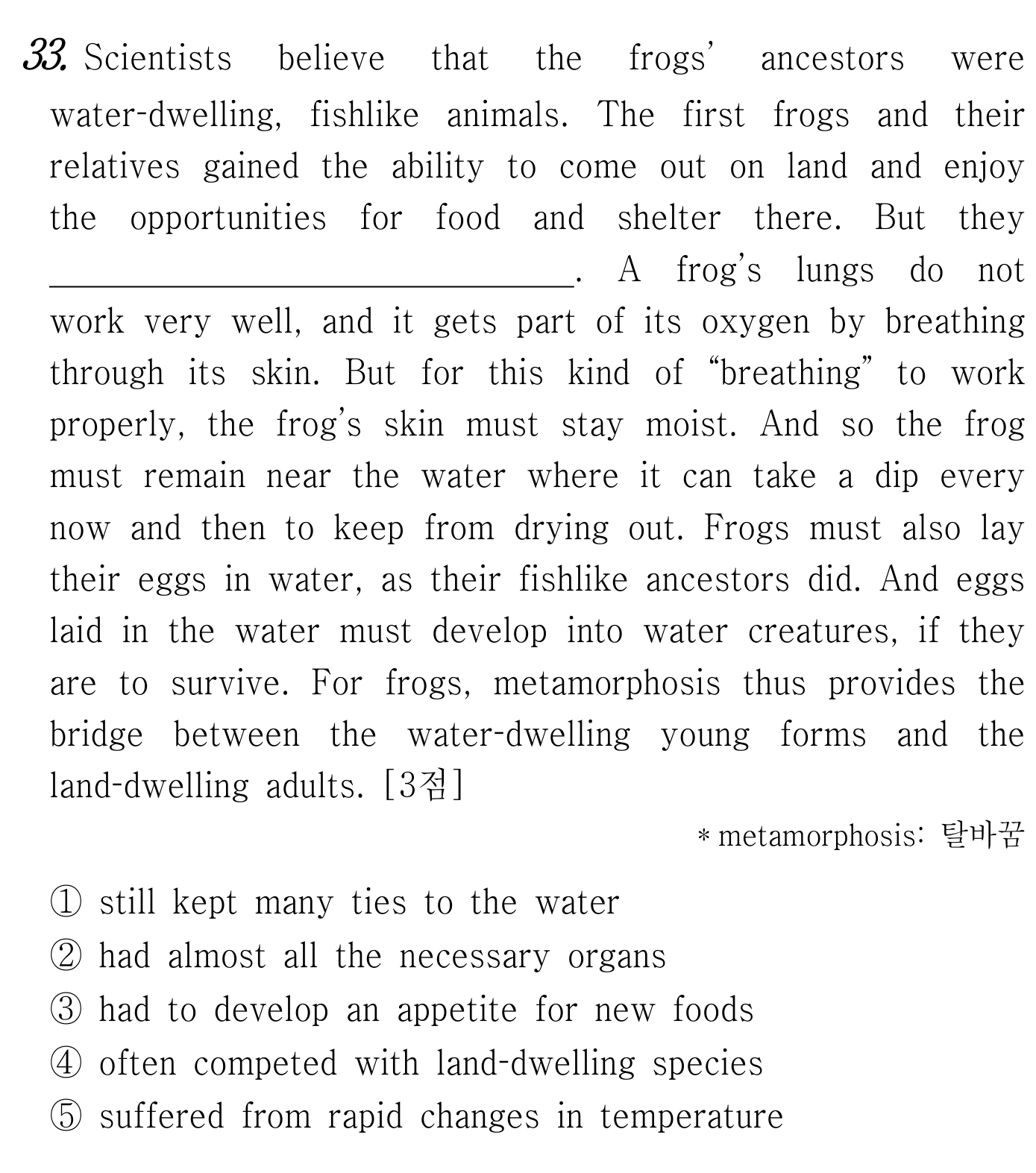
Scientists believe that the frogs' ancestors were water-dwelling, fishlike animals. The first frogs and their relatives gained the ability to come out on land and enjoy the opportunities for food and shelter there. But they still kept many ties to the water. A frog's lungs do not work very well, and it gets part of its oxygen by breathing through its skin. But for this kind of “breathing” to work properly, the frog's skin must stay moist. And so the frog must remain near the water where it can take a dip every now and then to keep from drying out. Frogs must also lay their eggs in water, as their fishlike ancestors did. And eggs laid in the water must develop into water creatures, if they are to survive. For frogs, metamorphosis thus provides the bridge between the water-dwelling young forms and the land-dwelling adults.
34번빈칸추론5It is important to distinguish between being legally allowed to do something, and actuall…
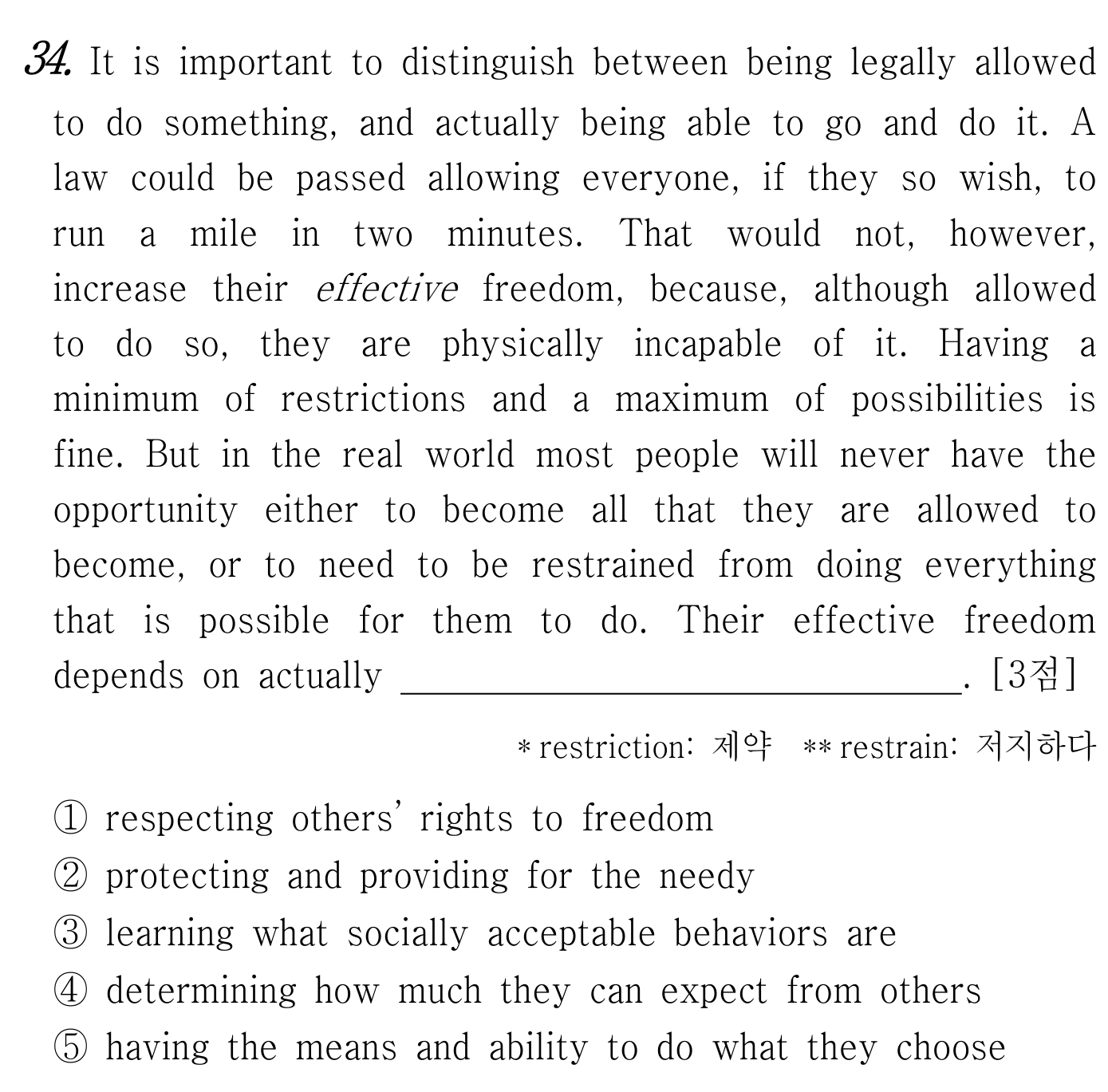
It is important to distinguish between being legally allowed to do something, and actually being able to go and do it. A law could be passed allowing everyone, if they so wish, to run a mile in two minutes. That would not, however, increase their effective freedom, because, although allowed to do so, they are physically incapable of it. Having a minimum of restrictions and a maximum of possibilities is fine. But in the real world most people will never have the opportunity either to become all that they are allowed to become, or to need to be restrained from doing everything that is possible for them to do. Their effective freedom depends on actually having the means and ability to do what they choose.
36번순서배열1Almost all major sporting activities are played with a ball.
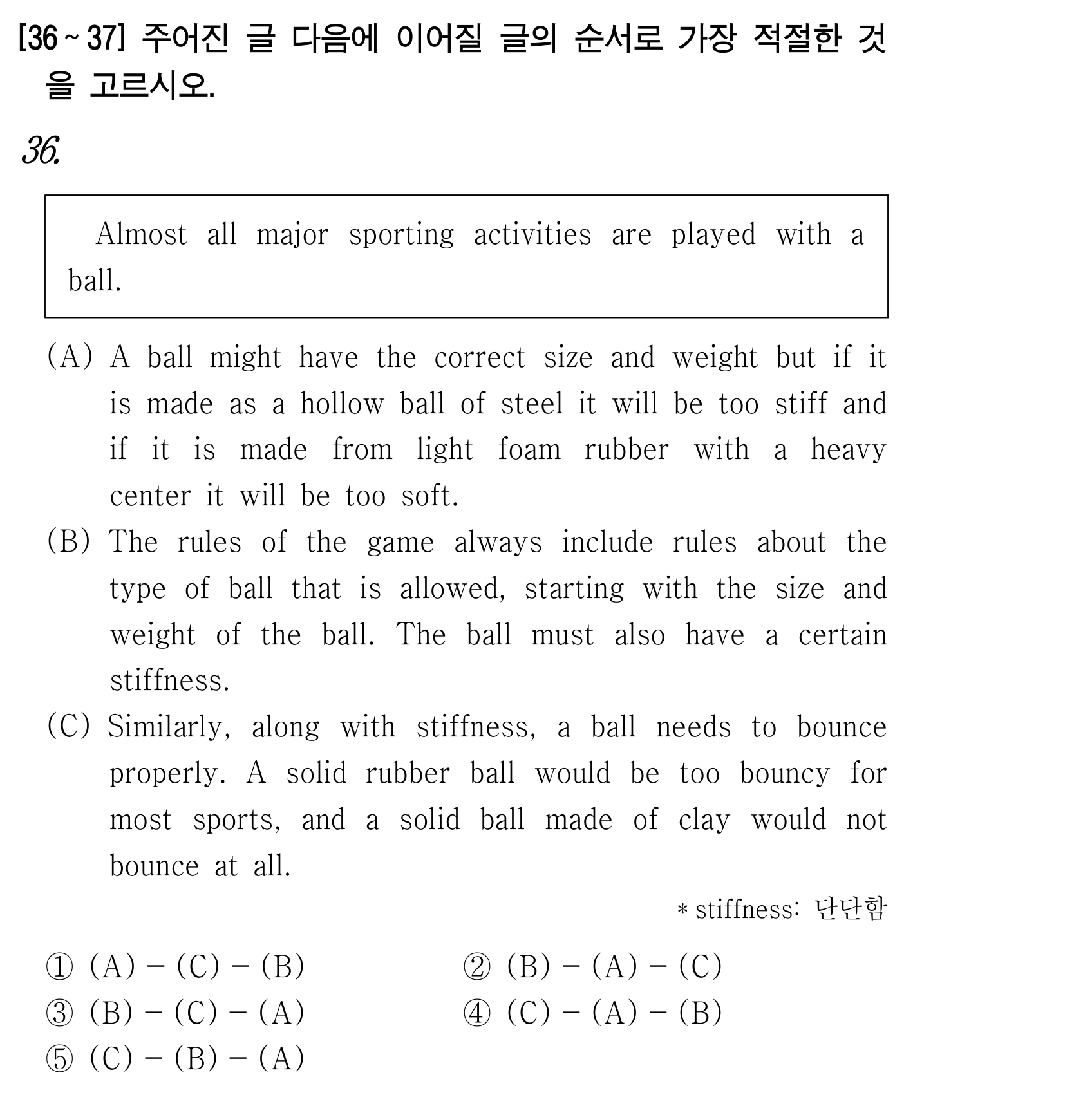
Almost all major sporting activities are played with a ball. The rules of the game always include rules about the type of ball that is allowed, starting with the size and weight of the ball. The ball must also have a certain stiffness. A ball might have the correct size and weight but if it is made as a hollow ball of steel it will be too stiff and if it is made from light foam rubber with a heavy center it will be too soft. Similarly, along with stiffness, a ball needs to bounce properly. A solid rubber ball would be too bouncy for most sports, and a solid ball made of clay would not bounce at all.
37번순서배열2If you had to write a math equation, you probably wouldn't write, "Twenty-eight plus four…
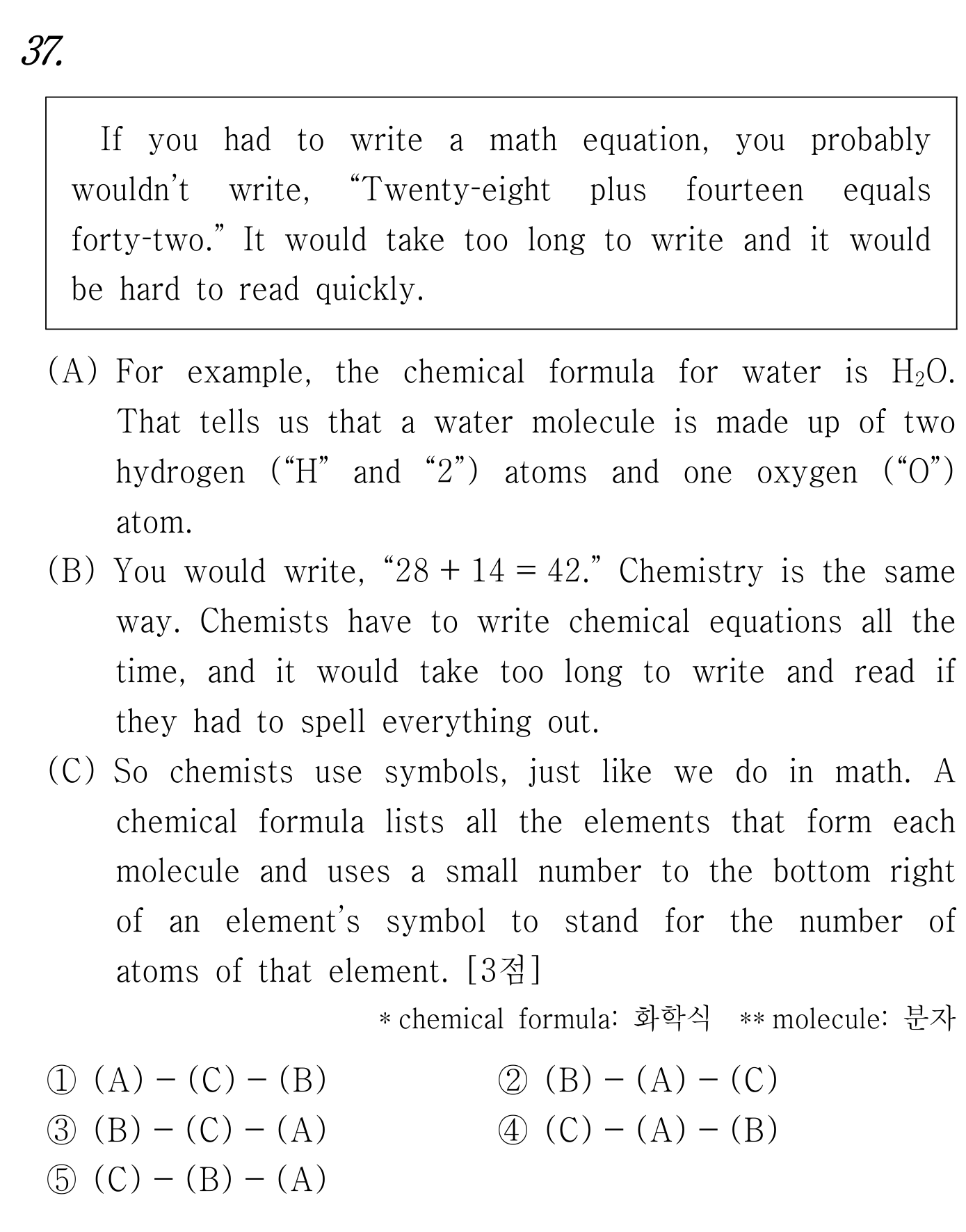
If you had to write a math equation, you probably wouldn't write, "Twenty-eight plus fourteen equals forty-two." It would take too long to write and it would be hard to read quickly. You would write, "28 + 14 = 42." Chemistry is the same way. Chemists have to write chemical equations all the time, and it would take too long to write and read if they had to spell everything out. So chemists use symbols, just like we do in math. A chemical formula lists all the elements that form each molecule and uses a small number to the bottom right of an element's symbol to stand for the number of atoms of that element. For example, the chemical formula for water is H2O. That tells us that a water molecule is made up of two hydrogen ("H" and "2") atoms and one oxygen ("O") atom.
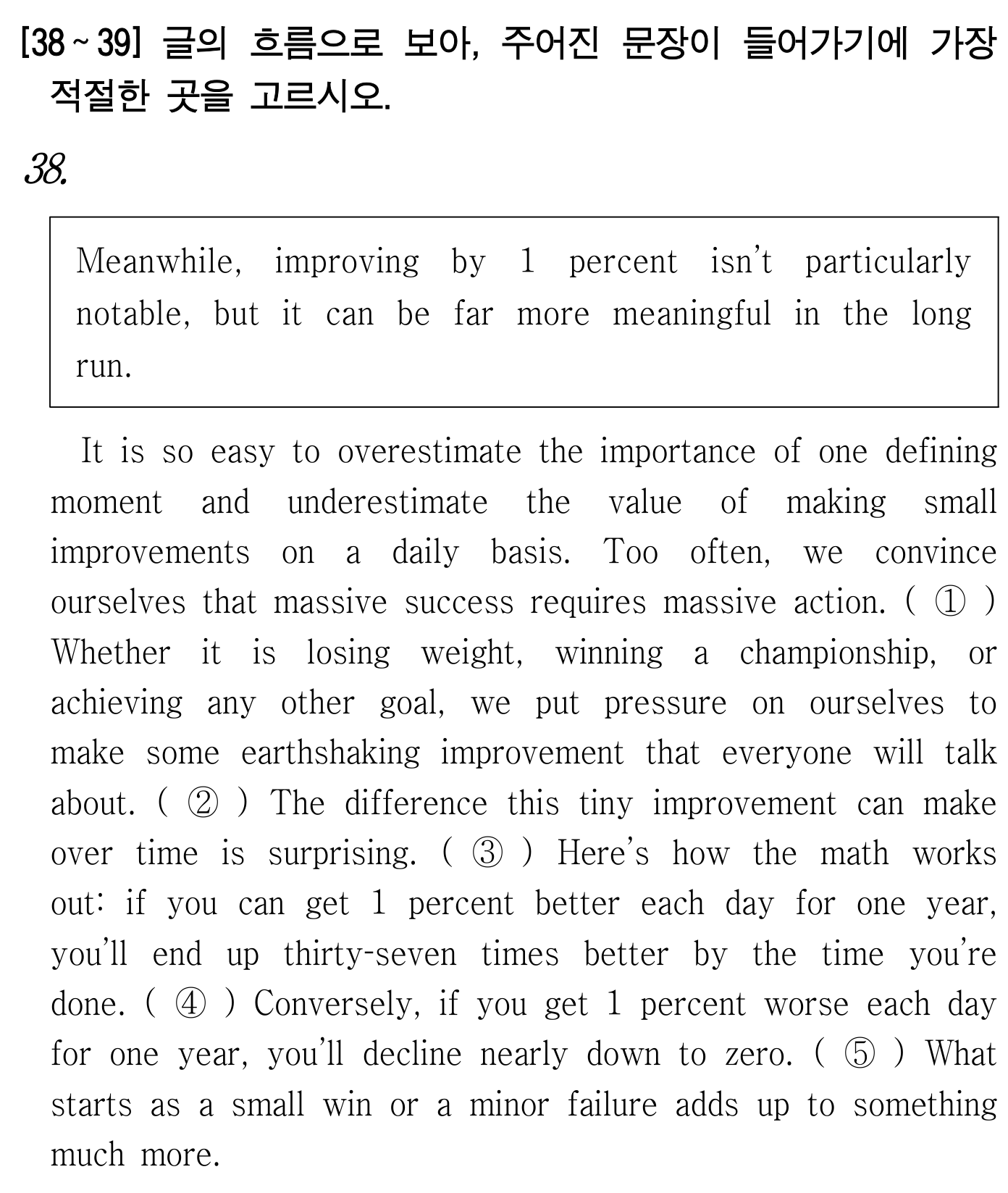
38번문장삽입1It is so easy to overestimate the importance of one defining moment and underestimate the…
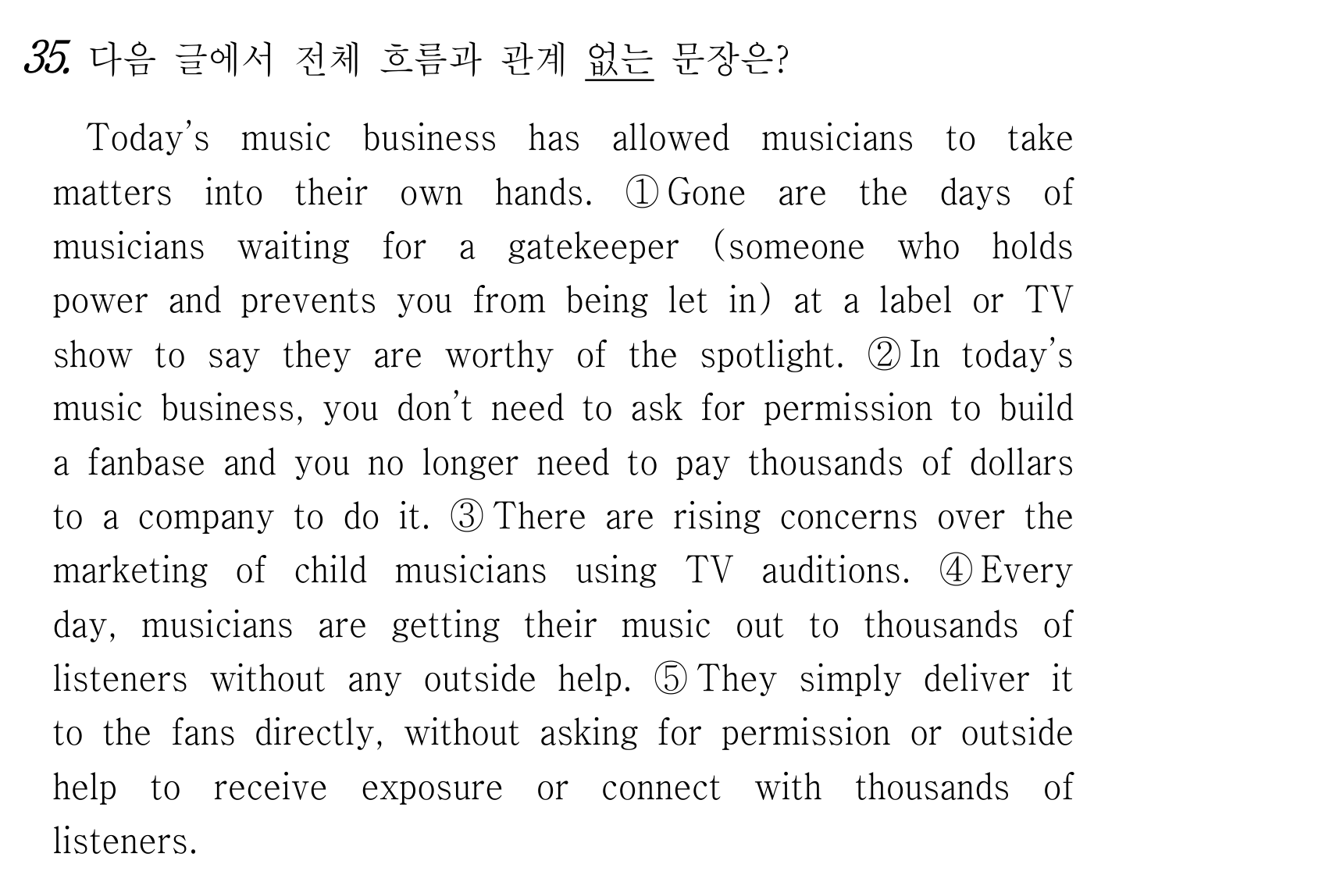
It is so easy to overestimate the importance of one defining moment and underestimate the value of making small improvements on a daily basis. Too often, we convince ourselves that massive success requires massive action. Whether it is losing weight, winning a championship, or achieving any other goal, we put pressure on ourselves to make some earthshaking improvement that everyone will talk about. Meanwhile, improving by 1 percent isn't particularly notable, but it can be far more meaningful in the long run. The difference this tiny improvement can make over time is surprising. Here's how the math works out: if you can get 1 percent better each day for one year, you'll end up thirty-seven times better by the time you're done. Conversely, if you get 1 percent worse each day for one year, you'll decline nearly down to zero. What starts as a small win or a minor failure adds up to something much more.
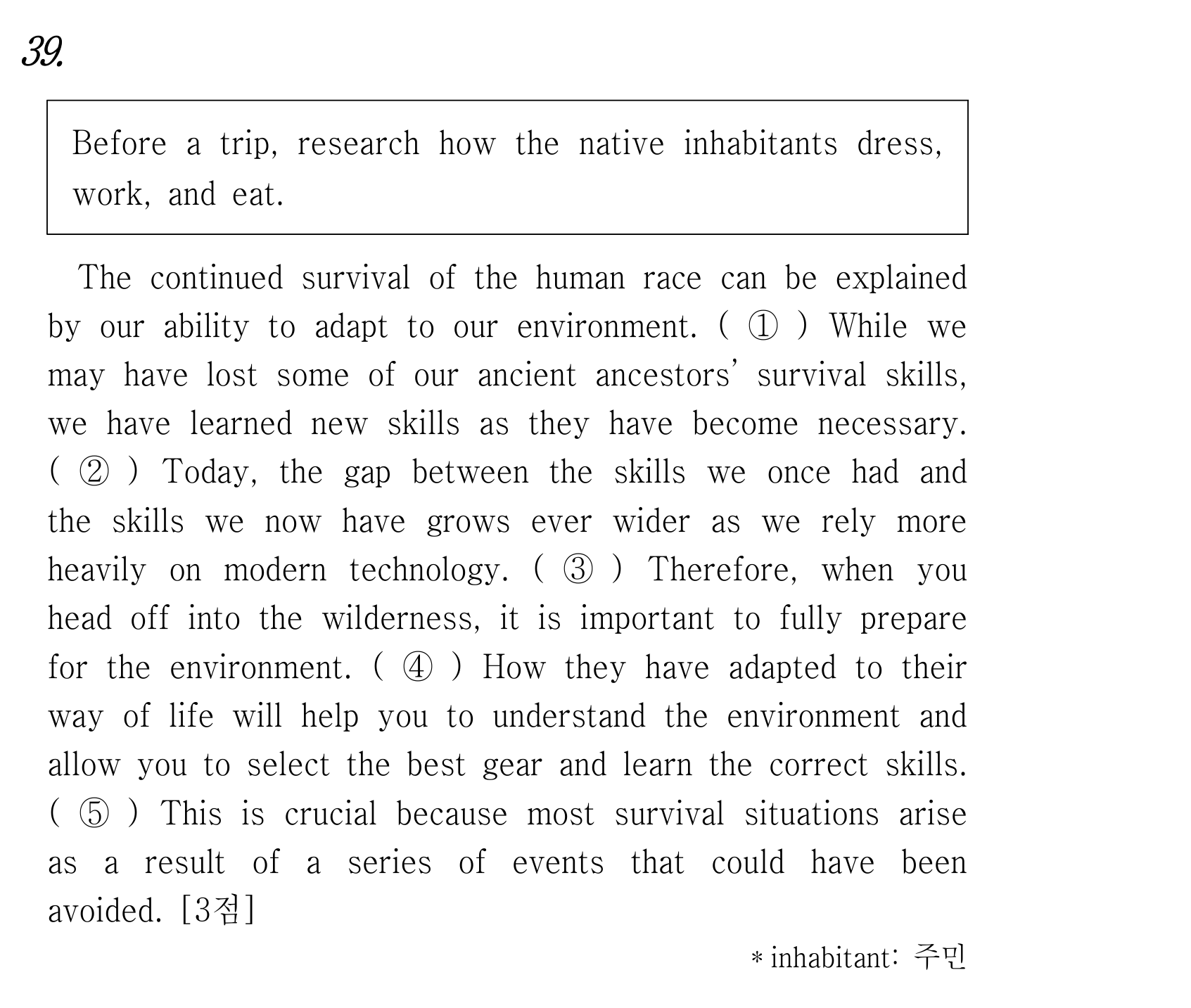
39번문장삽입2The continued survival of the human race can be explained by our ability to adapt to our…
The continued survival of the human race can be explained by our ability to adapt to our environment. While we may have lost some of our ancient ancestors' survival skills, we have learned new skills as they have become necessary. Today, the gap between the skills we once had and the skills we now have grows ever wider as we rely more heavily on modern technology. Therefore, when you head off into the wilderness, it is important to fully prepare for the environment. Before a trip, research how the native inhabitants dress, work, and eat. How they have adapted to their way of life will help you to understand the environment and allow you to select the best gear and learn the correct skills. This is crucial because most survival situations arise as a result of a series of events that could have been avoided.
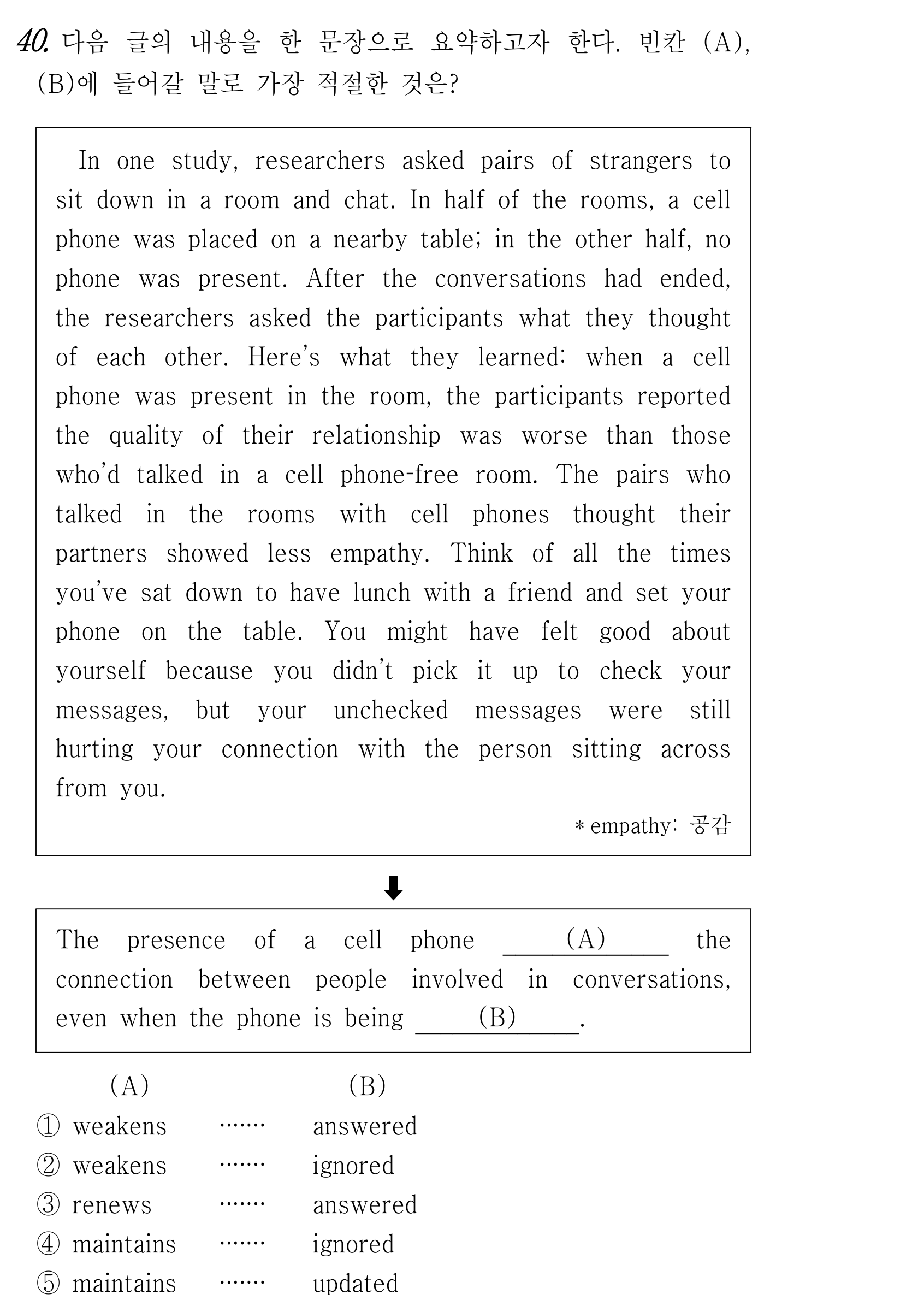
40번요약문완성In one study, researchers asked pairs of strangers to sit down in a room and chat.
In one study, researchers asked pairs of strangers to sit down in a room and chat. In half of the rooms, a cell phone was placed on a nearby table; in the other half, no phone was present. After the conversations had ended, the researchers asked the participants what they thought of each other. Here's what they learned: when a cell phone was present in the room, the participants reported the quality of their relationship was worse than those who'd talked in a cell phone-free room. The pairs who talked in the rooms with cell phones thought their partners showed less empathy. Think of all the times you've sat down to have lunch with a friend and set your phone on the table. You might have felt good about yourself because you didn't pick it up to check your messages, but your unchecked messages were still hurting your connection with the person sitting across from you.
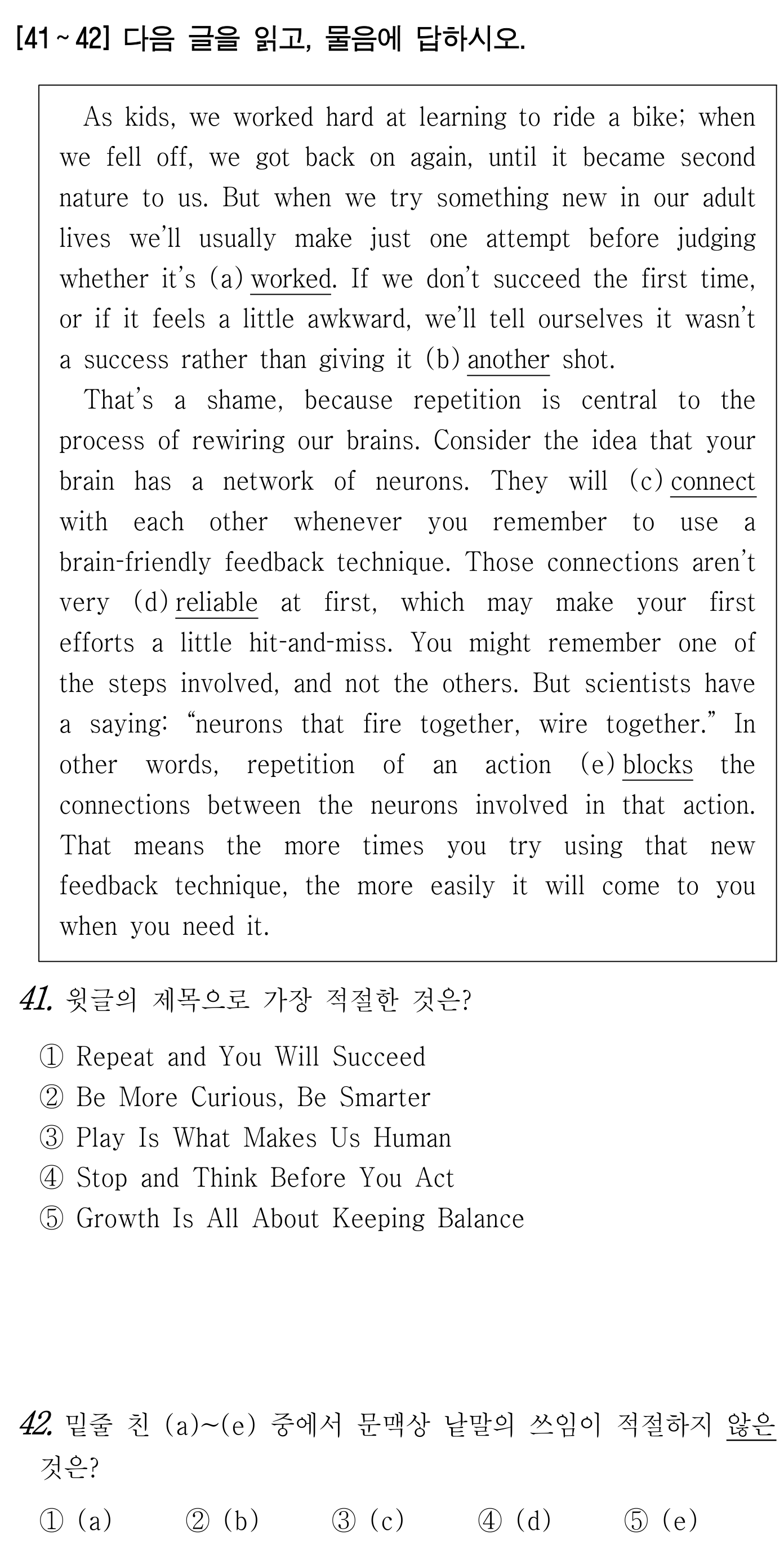
41번장문_제목As kids, we worked hard at learning to ride a bike; when we fell off, we got back on agai…
As kids, we worked hard at learning to ride a bike; when we fell off, we got back on again, until it became second nature to us. But when we try something new in our adult lives we’ll usually make just one attempt before judging whether it’s (a) worked. If we don’t succeed the first time, or if it feels a little awkward, we’ll tell ourselves it wasn’t a success rather than giving it (b) another shot. That’s a shame, because repetition is central to the process of rewiring our brains. Consider the idea that your brain has a network of neurons. They will (c) connect with each other whenever you remember to use a brain-friendly feedback technique. Those connections aren’t very (d) reliable at first, which may make your first efforts a little hit-and-miss. You might remember one of the steps involved, and not the others. But scientists have a saying: “neurons that fire together, wire together.” In other words, repetition of an action (e) blocks the connections between the neurons involved in that action. That means the more times you try using that new feedback technique, the more easily it will come to you when you need it.
2021년 3월 고1 전국연합 영어 모의고사 변형문제 맛보기
이 시험 지문으로 만든 변형문제가 아직 없습니다. 지문을 고르면 어법·빈칸·주제·어휘 등 유형별 변형문제를 바로 만들 수 있습니다.
이 시험으로 첫 변형문제 만들기 →남은 시간
48:00
아직 28문제를 풀지 않았어요 (0/28)