2020년 10월 고3 전국연합 영어 모의고사
28문제 · 제한시간 48분
이 시험 한눈에 — 2020년 10월 고3 전국연합 영어 모의고사
18~45번 28문항을 유형별로 보면 목적 1 · 심경/분위기 1 · 주장 1 · 함축의미추론 1 · 요지/주장 1 · 주제 1 · 제목 1 · 도표 1 · 내용일치 1 · 실용문 1 · 어법 2 · 어휘 1 · 빈칸추론2 1 · 빈칸추론3 1 · 빈칸추론4 1 · 빈칸추론5 1 · 무관한문장 1 · 순서배열1 1 · 순서배열2 1 · 문장삽입1 1 · 문장삽입2 1 · 요약문완성 1 · 장문 5. 아래 지문으로 변형문제·단어장·정답표를 바로 만들 수 있습니다.
18번목적Dear Mr.
Dear Mr. Collins, I am writing on behalf of Green Youth Center. We will be conducting a program titled “Arts For All.” This program aims to spend time with young children and provide an art education program for them. In line with this, we would like to ask for your support for the program. We are expecting 50-80 children ages 5-8 years as participants. We would greatly appreciate donations such as art supplies, picture books, or any other materials that would be beneficial to children’s art education. We sincerely thank you for your kind consideration in advance. Best regards, Rose Sanders, Program Coordinator
19번심경/분위기Daddy hums as he packs our car with suitcases and a cooler full of snacks.
Daddy hums as he packs our car with suitcases and a cooler full of snacks. We leave when the sky is still dark with sleep. Sister closes her eyes, but mine stay wide open. “Alan,” Momma says after a while, “you better catch some sleep while you can.” I try to rest, but can’t stop smiling. Soon I’ll get to see my great-grandma Granny and hang out with my cousins. But when I look at my hands, empty as the road in front of us, my grin fades. The anniversary celebration. I bet everyone will bring something to share except me. I have nothing prepared for Granny. I’m suddenly overwhelmed with worries.
20번주장One of the funniest things about becoming a boss is that it causes an awful lot of people…
One of the funniest things about becoming a boss is that it causes an awful lot of people to forget everything they know about how to relate to other people. If you have a complaint about somebody in your personal life, it would never occur to you to wait for a formally scheduled meeting to tell them. Yet, management has been bureaucratized to the point that we throw away effective strategies of everyday communication. Don't let the formal processes like annual performance reviews take over. They are meant to reinforce, not substitute, what we do every day. You'd never let the fact that you go to the dentist for a cleaning a couple times a year prevent you from brushing your teeth every day.
21번함축의미추론21.
21. 밑줄 친 boil a pot of water on medium heat가 다음 글에서 의미하는 바로 가장 적절한 것은? Under-slept employees are not going to drive your business forward with productive innovation. Like a group of people riding stationary exercise bikes, everyone looks like they are pedaling, but the scenery never changes. The irony that employees miss is that when you are not getting enough sleep, you work less productively and thus need to work longer to accomplish a goal. This means you often must work longer and later into the evening, arrive home later, go to bed later, and need to wake up earlier, creating a negative feedback loop. Why try to boil a pot of water on medium heat when you could do so in half the time on high? People often tell me that they do not have enough time to sleep because they have so much work to do. Without wanting to be combative in any way whatsoever, I respond by informing them that perhaps the reason they still have so much to do at the end of the day is precisely because they do not get enough sleep at night.
22번요지/주장The tendency for the market to reward caring for others may just be an incentive to act,…
The tendency for the market to reward caring for others may just be an incentive to act, or pretend, as if one cares for others. Say, for instance, a shopkeeper who realizes he is losing exchange opportunities because of his dishonest behavior may begin to act as if he were a kind and honest man in order to garner more business. He is persuaded to behave in an appropriate way, yet his actions may be insincere. While it is socially beneficial that he at least pretends to behave in this way, he may not actually become more virtuous. However, in order to maintain this status in his community and succeed in his business long term, he must continue to behave in this manner. Over time, it is likely that his once intentional actions will become instinctive and more genuine, and eventually result in actual moral development. Stated another way, a truly dishonest and conniving person is unlikely to convincingly pretend to be reputable for an extended period of time without being impacted by some sort of moral development.
23번주제The principle of humane treatment exerts an important constraint on the administration of…
The principle of humane treatment exerts an important constraint on the administration of criminal justice, a state-run process which has the potential to do very great harm to anybody who becomes caught up in its snares. Suspects and the accused are the ones most obviously in jeopardy. Procedural rules contribute to suspects' humane treatment by providing them with legal advice and assistance to prepare and present their cases in court. Rules of evidence perform a similar function by affording accused persons fair opportunity to answer the charges against them, whilst at the same time respecting their right to remain silent if they choose to keep their counsel and put the prosecution to proof. These and other rules of criminal evidence and procedure treat the accused as thinking, feeling, human subjects of official concern and respect, who are entitled to be given the opportunity to play an active part in procedures with a direct and possibly catastrophic impact on their welfare.
24번제목The view of AI breakthroughs that the public gets from the media-stunning victories over…
The view of AI breakthroughs that the public gets from the media-stunning victories over humans, robots becoming citizens of Saudi Arabia, and so on-bears very little relation to what really happens in the world's research labs. Inside the lab, research involves a lot of thinking and talking and writing mathematical formulas on whiteboards. Ideas are constantly being generated, abandoned, and rediscovered. A good idea-a real breakthrough-will often go unnoticed at the time and may only later be understood as having provided the basis for a substantial advance in AI, perhaps when someone reinvents it at a more convenient time. Ideas are tried out, initially on simple problems to show that the basic intuitions are correct and then on harder problems to see how well they scale up. Often, an idea will fail by itself to provide a substantial improvement in capabilities, and it has to wait for another idea to come along so that the combination of the two can demonstrate value.
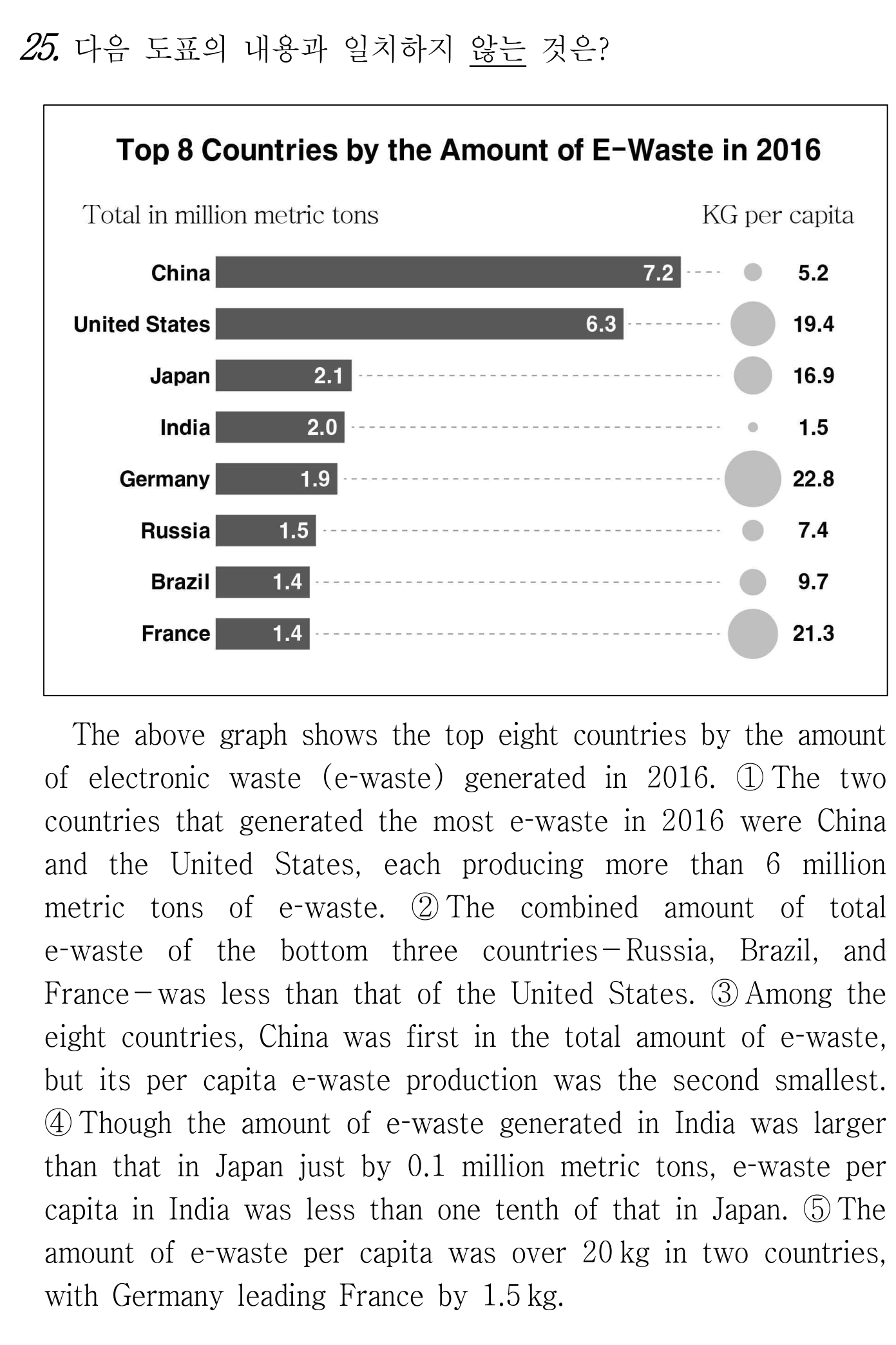
25번도표The above graph shows the top eight countries by the amount of electronic waste (e-waste)…
The above graph shows the top eight countries by the amount of electronic waste (e-waste) generated in 2016. ① The two countries that generated the most e-waste in 2016 were China and the United States, each producing more than 6 million metric tons of e-waste. ② The combined amount of total e-waste of the bottom three countries—Russia, Brazil, and France—was less than that of the United States. ③ Among the eight countries, China was first in the total amount of e-waste, but its per capita e-waste production was the second smallest. ④ Though the amount of e-waste generated in India was larger than that in Japan just by 0.1 million metric tons, e-waste per capita in India was less than one tenth of that in Japan. ⑤ The amount of e-waste per capita was over 20 kg in two countries, with Germany leading France by 1.5 kg.
26번내용일치Roman Jakobson was one of the greatest linguists of the 20th century.
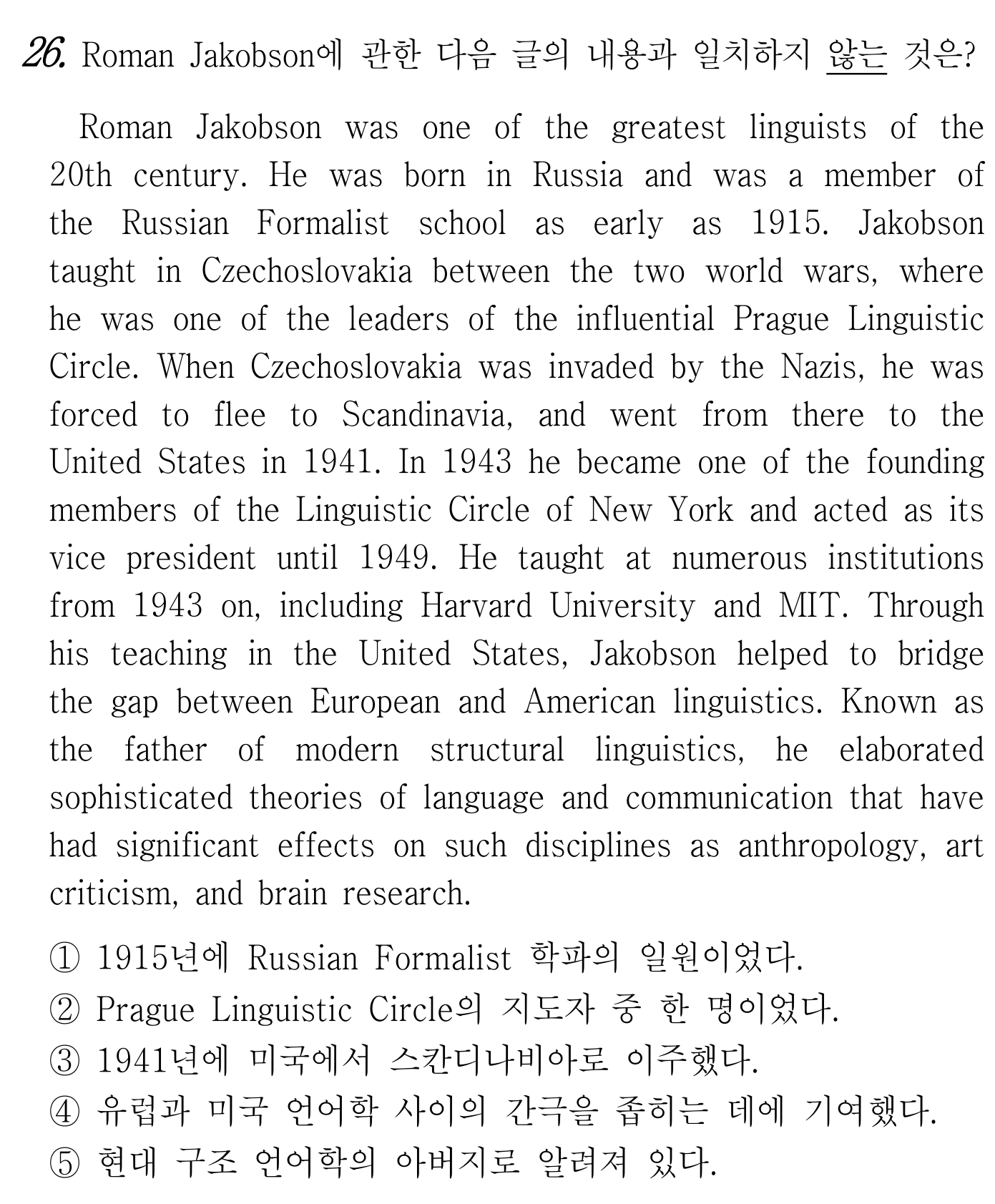
Roman Jakobson was one of the greatest linguists of the 20th century. He was born in Russia and was a member of the Russian Formalist school as early as 1915. Jakobson taught in Czechoslovakia between the two world wars, where he was one of the leaders of the influential Prague Linguistic Circle. When Czechoslovakia was invaded by the Nazis, he was forced to flee to Scandinavia, and went from there to the United States in 1941. In 1943 he became one of the founding members of the Linguistic Circle of New York and acted as its vice president until 1949. He taught at numerous institutions from 1943 on, including Harvard University and MIT. Through his teaching in the United States, Jakobson helped to bridge the gap between European and American linguistics. Known as the father of modern structural linguistics, he elaborated sophisticated theories of language and communication that have had significant effects on such disciplines as anthropology, art criticism, and brain research.
27번실용문Pottery Painting Event Instructors from O-Paint Pottery Studio will be traveling to our s…
Pottery Painting Event Instructors from O-Paint Pottery Studio will be traveling to our school for a fun family event of pottery painting! All students and family members are welcome to paint. Please bring the whole family!
Event Information ■ Time: 6 p.m. - 8 p.m. Friday, October 30, 2020 ■ Choice of pottery: mug, plate, vase (Choose one.) ■ Fee: $10 per person ($2 will be donated to Waine Library.)
* After painting, pottery will be fired and returned within one week. * All materials/paints are 100% non-toxic.
28번어법Double Swan Hot Springs Soak your way to health and have your cares float away!
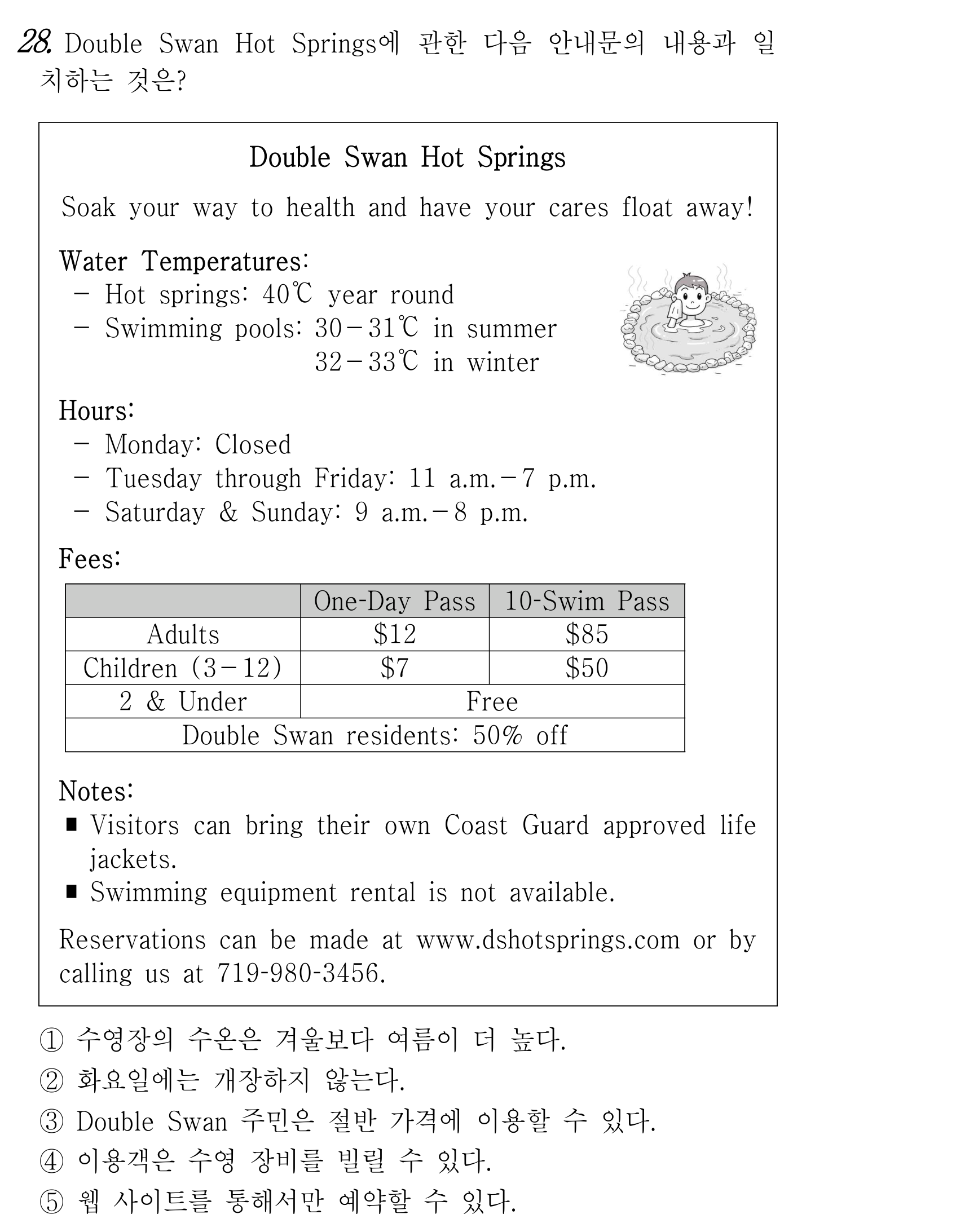
Double Swan Hot Springs
Soak your way to health and have your cares float away!
Water Temperatures: - Hot springs: 40℃ year round - Swimming pools: 30-31℃ in summer 32-33℃ in winter
Hours: - Monday: Closed - Tuesday through Friday: 11 a.m.-7 p.m. - Saturday & Sunday: 9 a.m.-8 p.m.
Fees:
| | One-Day Pass | 10-Swim Pass | | :--- | :--- | :--- | | Adults | $12 | $85 | | Children (3-12) | $7 | $50 | | 2 & Under | Free | | Double Swan residents: 50% off |
Notes: ■ Visitors can bring their own Coast Guard approved life jackets. ■ Swimming equipment rental is not available.
Reservations can be made at www.dshotsprings.com or by calling us at 719-980-3456.
29번어법Mathematical practices and discourses should be situated within cultural contexts, studen…
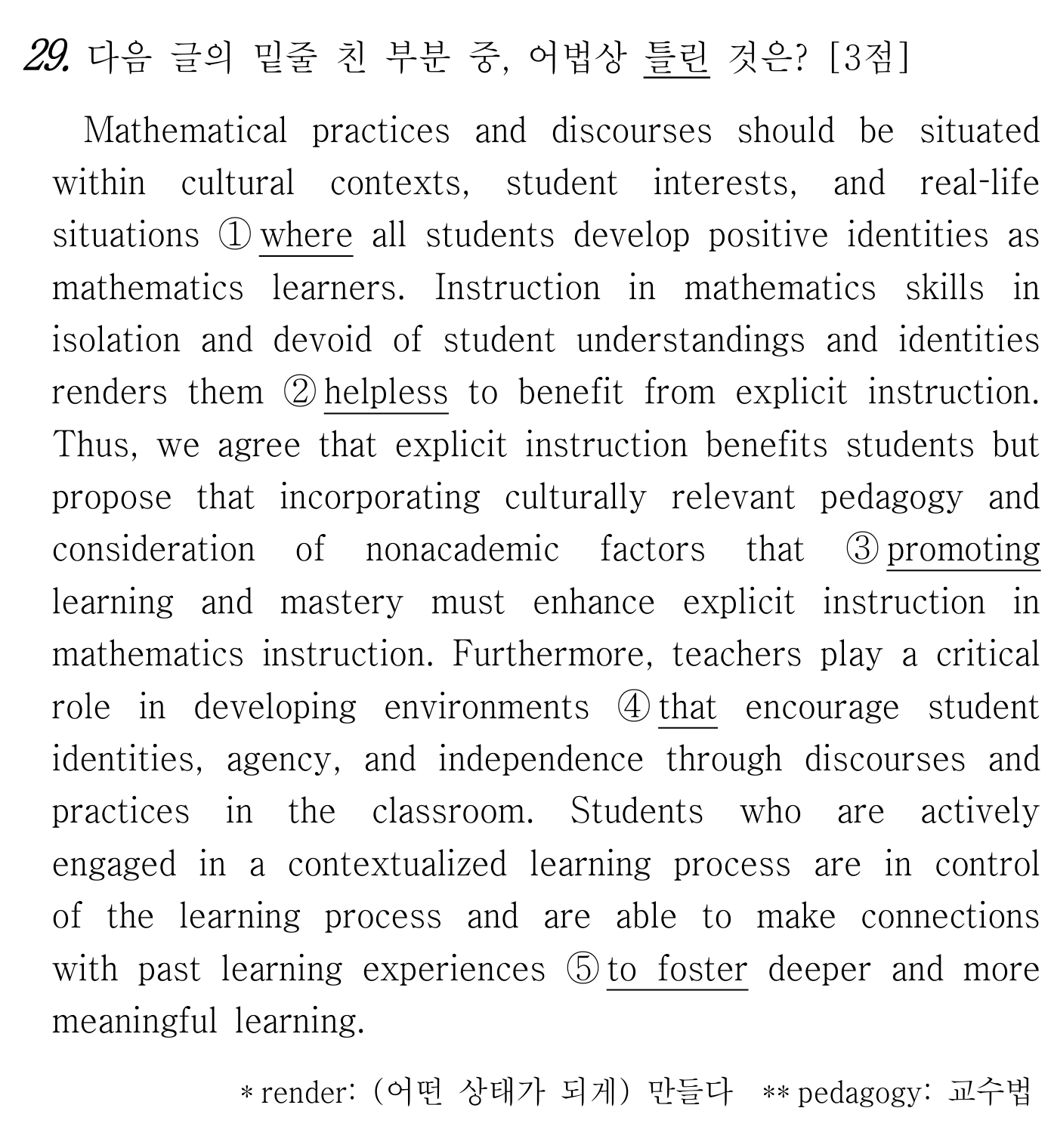
Mathematical practices and discourses should be situated within cultural contexts, student interests, and real-life situations where all students develop positive identities as mathematics learners. Instruction in mathematics skills in isolation and devoid of student understandings and identities renders them helpless to benefit from explicit instruction. Thus, we agree that explicit instruction benefits students but propose that incorporating culturally relevant pedagogy and consideration of nonacademic factors that promote learning and mastery must enhance explicit instruction in mathematics instruction. Furthermore, teachers play a critical role in developing environments that encourage student identities, agency, and independence through discourses and practices in the classroom. Students who are actively engaged in a contextualized learning process are in control of the learning process and are able to make connections with past learning experiences to foster deeper and more meaningful learning.
30번어휘In collectivist groups, there is considerable emphasis on relationships, the maintenance…
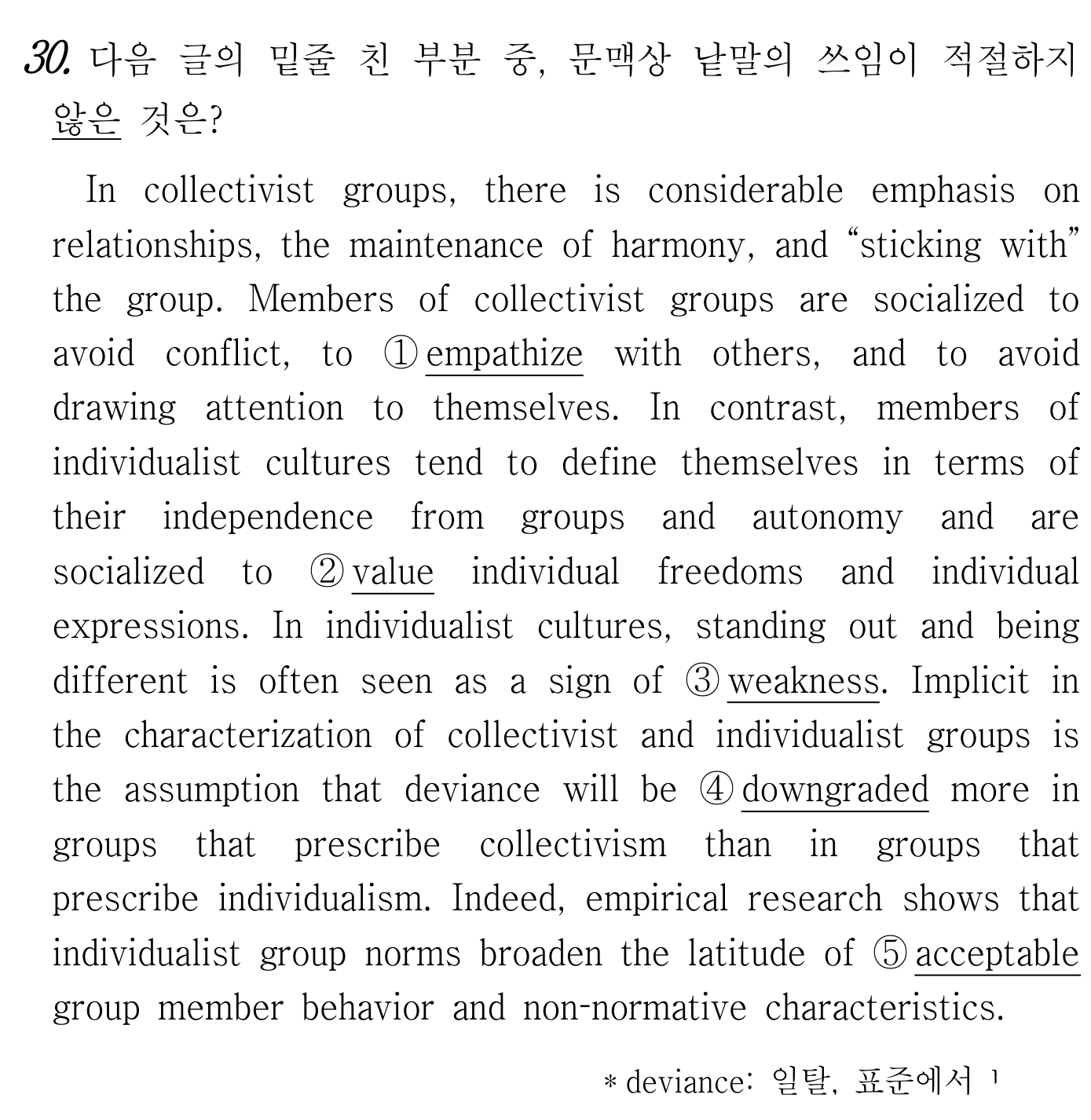
In collectivist groups, there is considerable emphasis on relationships, the maintenance of harmony, and “sticking with” the group. Members of collectivist groups are socialized to avoid conflict, to empathize with others, and to avoid drawing attention to themselves. In contrast, members of individualist cultures tend to define themselves in terms of their independence from groups and autonomy and are socialized to value individual freedoms and individual expressions. In individualist cultures, standing out and being different is often seen as a sign of strength. Implicit in the characterization of collectivist and individualist groups is the assumption that deviance will be downgraded more in groups that prescribe collectivism than in groups that prescribe individualism. Indeed, empirical research shows that individualist group norms broaden the latitude of acceptable group member behavior and non-normative characteristics.
31번빈칸추론2Some people may find it hard to believe they are making a difference all the time.
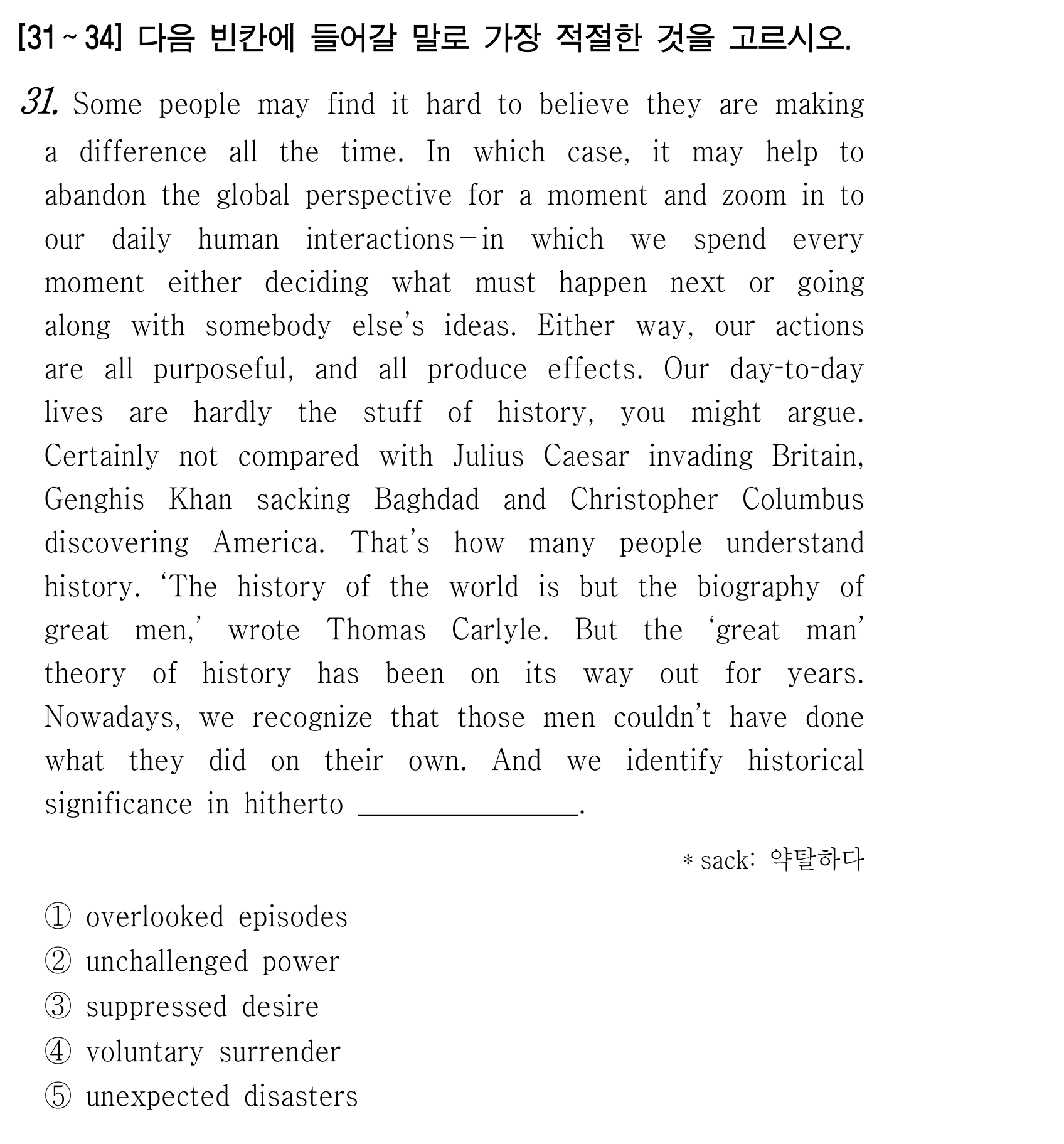
Some people may find it hard to believe they are making a difference all the time. In which case, it may help to abandon the global perspective for a moment and zoom in to our daily human interactions-in which we spend every moment either deciding what must happen next or going along with somebody else's ideas. Either way, our actions are all purposeful, and all produce effects. Our day-to-day lives are hardly the stuff of history, you might argue. Certainly not compared with Julius Caesar invading Britain, Genghis Khan sacking Baghdad and Christopher Columbus discovering America. That's how many people understand history. 'The history of the world is but the biography of great men,' wrote Thomas Carlyle. But the 'great man' theory of history has been on its way out for years. Nowadays, we recognize that those men couldn't have done what they did on their own. And we identify historical significance in hitherto overlooked episodes.
32번빈칸추론3The diffusion of media products enables us in a certain sense to experience events, obser…
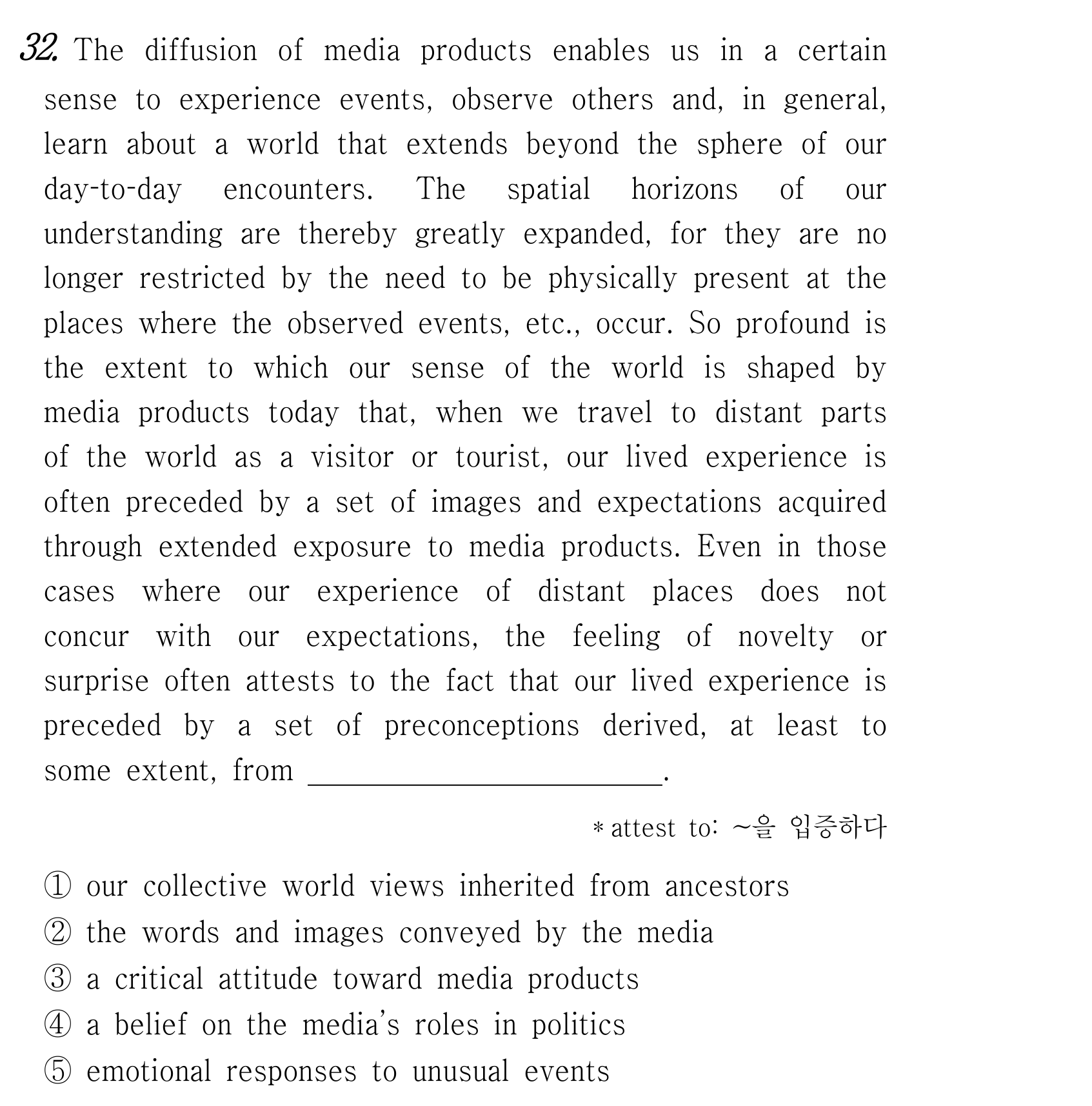
The diffusion of media products enables us in a certain sense to experience events, observe others and, in general, learn about a world that extends beyond the sphere of our day-to-day encounters. The spatial horizons of our understanding are thereby greatly expanded, for they are no longer restricted by the need to be physically present at the places where the observed events, etc., occur. So profound is the extent to which our sense of the world is shaped by media products today that, when we travel to distant parts of the world as a visitor or tourist, our lived experience is often preceded by a set of images and expectations acquired through extended exposure to media products. Even in those cases where our experience of distant places does not concur with our expectations, the feeling of novelty or surprise often attests to the fact that our lived experience is preceded by a set of preconceptions derived, at least to some extent, from the words and images conveyed by the media.
33번빈칸추론4At the level of hours and minutes, the most relevant constants are human heart rates, whi…
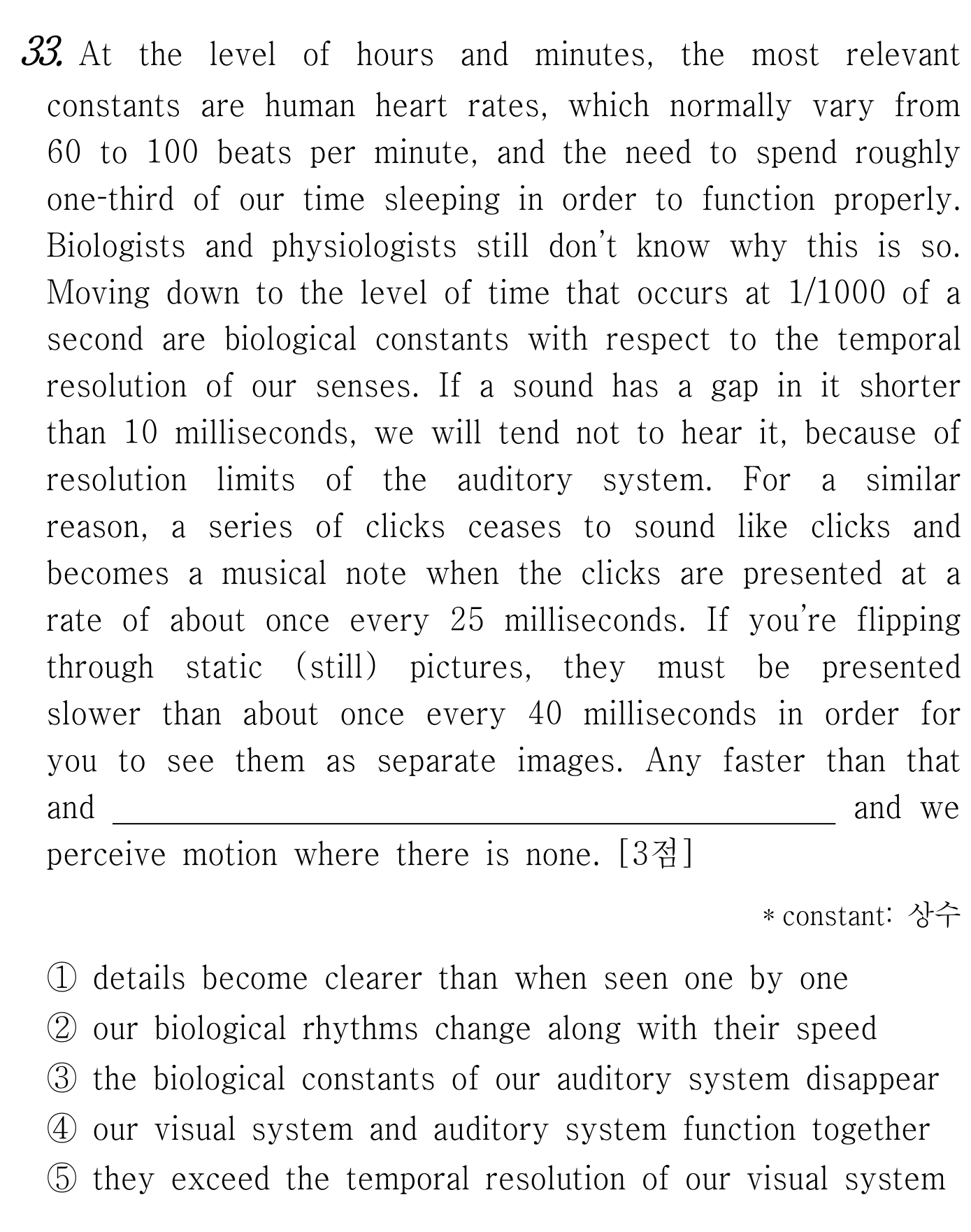
At the level of hours and minutes, the most relevant constants are human heart rates, which normally vary from 60 to 100 beats per minute, and the need to spend roughly one-third of our time sleeping in order to function properly. Biologists and physiologists still don't know why this is so. Moving down to the level of time that occurs at 1/1000 of a second are biological constants with respect to the temporal resolution of our senses. If a sound has a gap in it shorter than 10 milliseconds, we will tend not to hear it, because of resolution limits of the auditory system. For a similar reason, a series of clicks ceases to sound like clicks and becomes a musical note when the clicks are presented at a rate of about once every 25 milliseconds. If you're flipping through static (still) pictures, they must be presented slower than about once every 40 milliseconds in order for you to see them as separate images. Any faster than that and they exceed the temporal resolution of our visual system and we perceive motion where there is none.
34번빈칸추론5It is well established that the aerobic range of flight speeds for any bird is restricted.
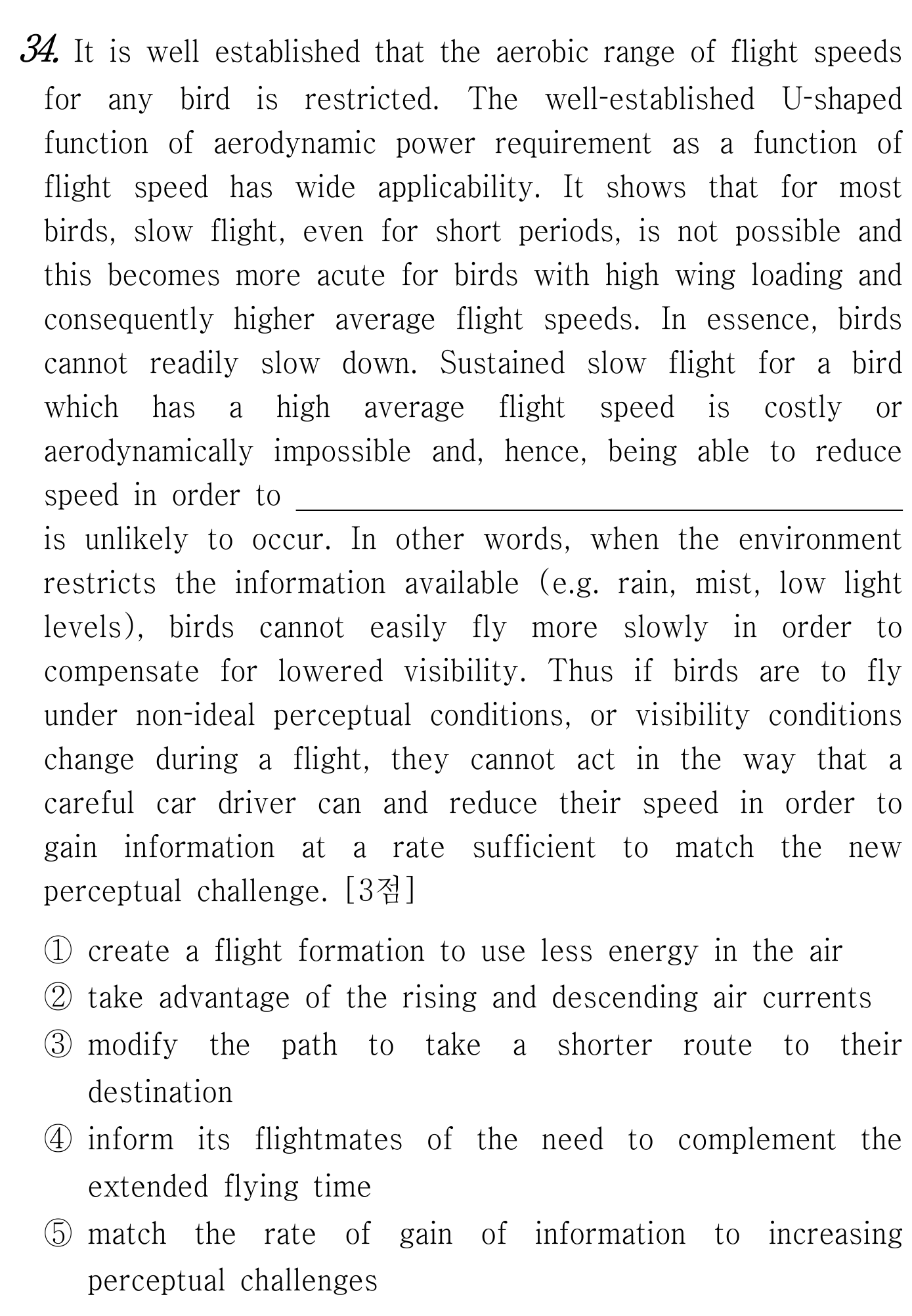
It is well established that the aerobic range of flight speeds for any bird is restricted. The well-established U-shaped function of aerodynamic power requirement as a function of flight speed has wide applicability. It shows that for most birds, slow flight, even for short periods, is not possible and this becomes more acute for birds with high wing loading and consequently higher average flight speeds. In essence, birds cannot readily slow down. Sustained slow flight for a bird which has a high average flight speed is costly or aerodynamically impossible and, hence, being able to reduce speed in order to match the rate of gain of information to increasing perceptual challenges is unlikely to occur. In other words, when the environment restricts the information available (e.g. rain, mist, low light levels), birds cannot easily fly more slowly in order to compensate for lowered visibility. Thus if birds are to fly under non-ideal perceptual conditions, or visibility conditions change during a flight, they cannot act in the way that a careful car driver can and reduce their speed in order to gain information at a rate sufficient to match the new perceptual challenge.
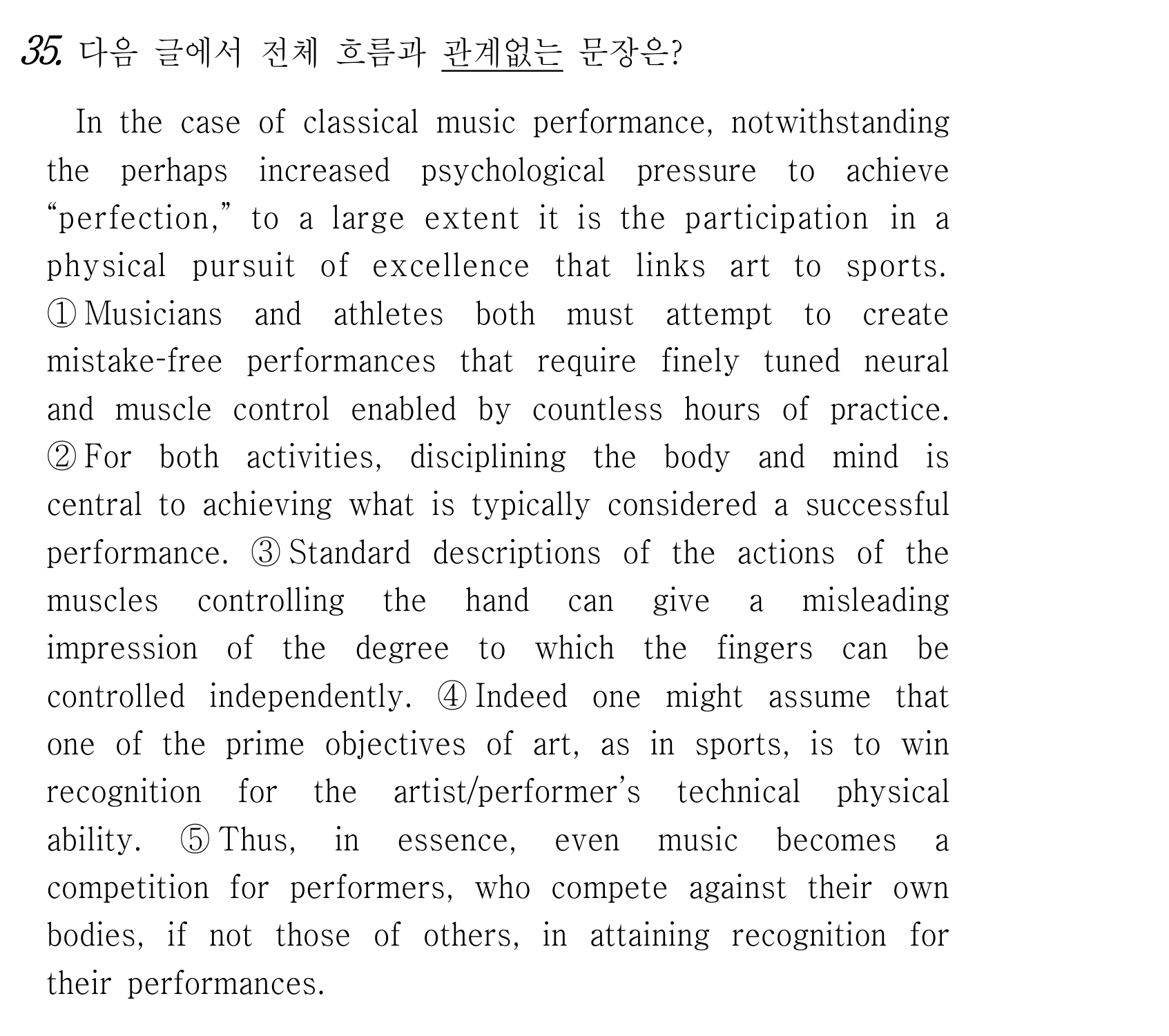
35번무관한문장In the case of classical music performance, notwithstanding the perhaps increased psychol…
In the case of classical music performance, notwithstanding the perhaps increased psychological pressure to achieve “perfection,” to a large extent it is the participation in a physical pursuit of excellence that links art to sports. Musicians and athletes both must attempt to create mistake-free performances that require finely tuned neural and muscle control enabled by countless hours of practice. For both activities, disciplining the body and mind is central to achieving what is typically considered a successful performance. Indeed one might assume that one of the prime objectives of art, as in sports, is to win recognition for the artist/performer’s technical physical ability. Thus, in essence, even music becomes a competition for performers, who compete against their own bodies, if not those of others, in attaining recognition for their performances.
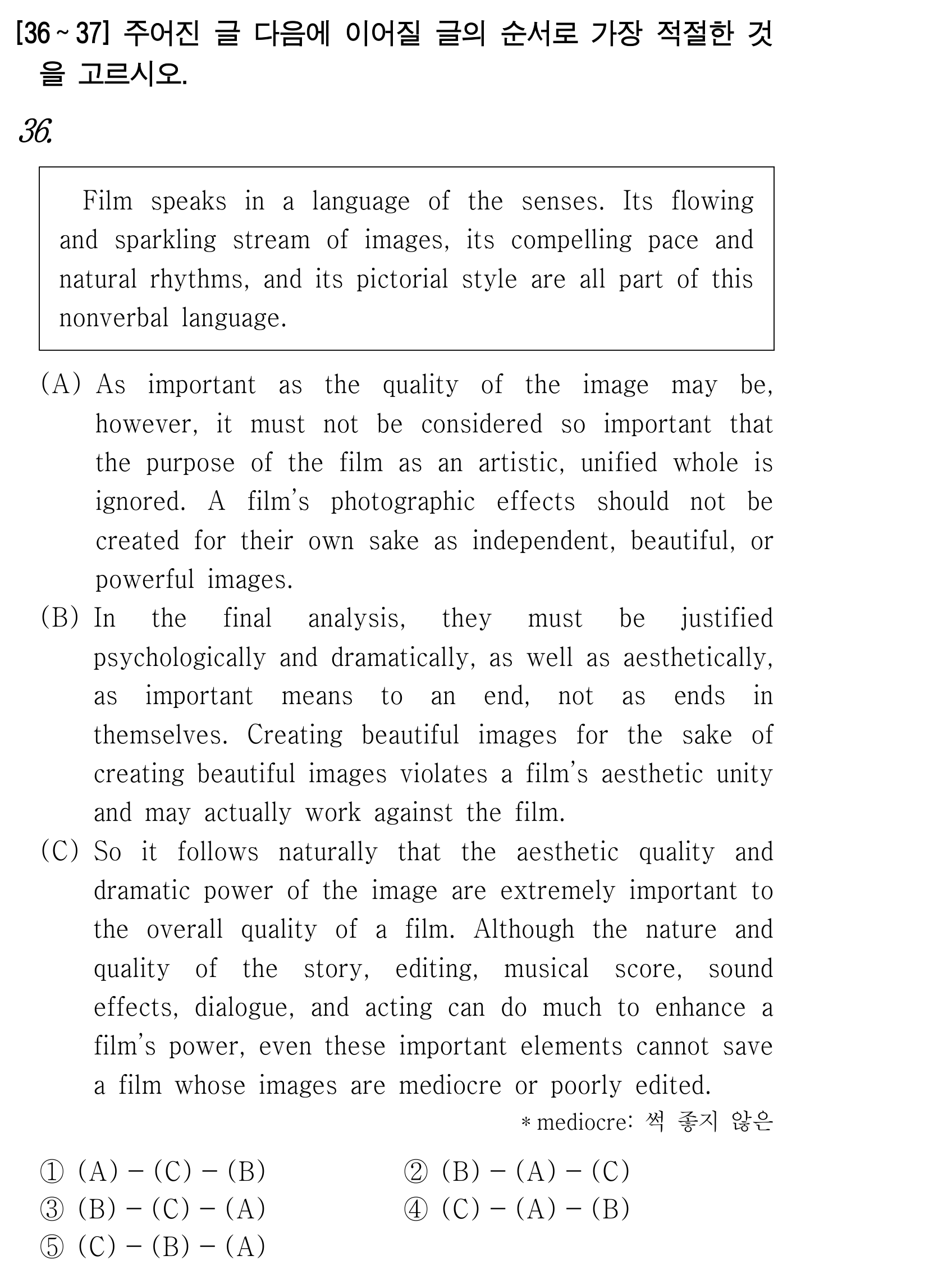
36번순서배열1Film speaks in a language of the senses.
Film speaks in a language of the senses. Its flowing and sparkling stream of images, its compelling pace and natural rhythms, and its pictorial style are all part of this nonverbal language. So it follows naturally that the aesthetic quality and dramatic power of the image are extremely important to the overall quality of a film. Although the nature and quality of the story, editing, musical score, sound effects, dialogue, and acting can do much to enhance a film's power, even these important elements cannot save a film whose images are mediocre or poorly edited. As important as the quality of the image may be, however, it must not be considered so important that the purpose of the film as an artistic, unified whole is ignored. A film's photographic effects should not be created for their own sake as independent, beautiful, or powerful images. In the final analysis, they must be justified psychologically and dramatically, as well as aesthetically, as important means to an end, not as ends in themselves. Creating beautiful images for the sake of creating beautiful images violates a film's aesthetic unity and may actually work against the film.
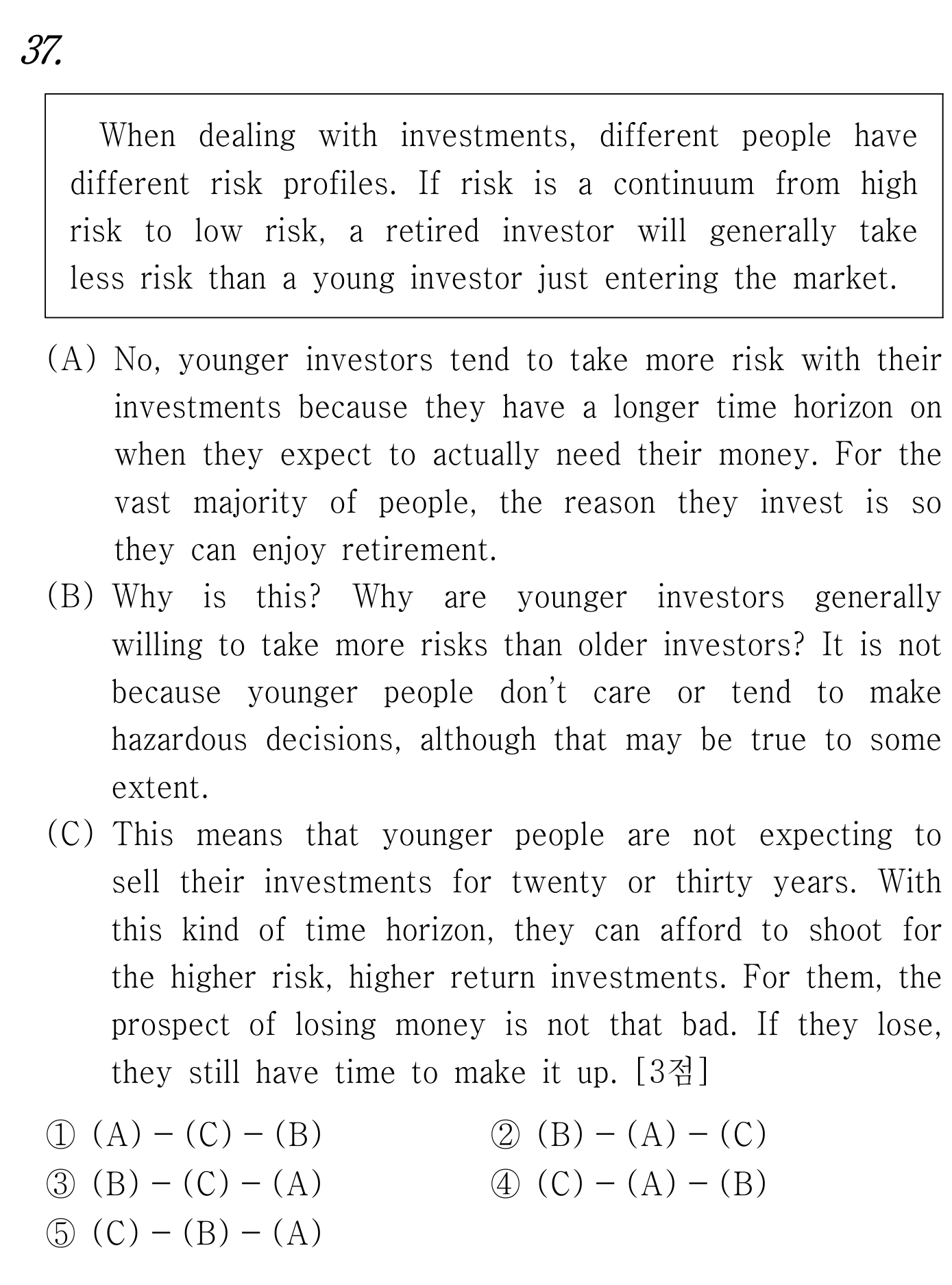
37번순서배열2When dealing with investments, different people have different risk profiles.
When dealing with investments, different people have different risk profiles. If risk is a continuum from high risk to low risk, a retired investor will generally take less risk than a young investor just entering the market. Why is this? Why are younger investors generally willing to take more risks than older investors? It is not because younger people don't care or tend to make hazardous decisions, although that may be true to some extent. No, younger investors tend to take more risk with their investments because they have a longer time horizon on when they expect to actually need their money. For the vast majority of people, the reason they invest is so they can enjoy retirement. This means that younger people are not expecting to sell their investments for twenty or thirty years. With this kind of time horizon, they can afford to shoot for the higher risk, higher return investments. For them, the prospect of losing money is not that bad. If they lose, they still have time to make it up.
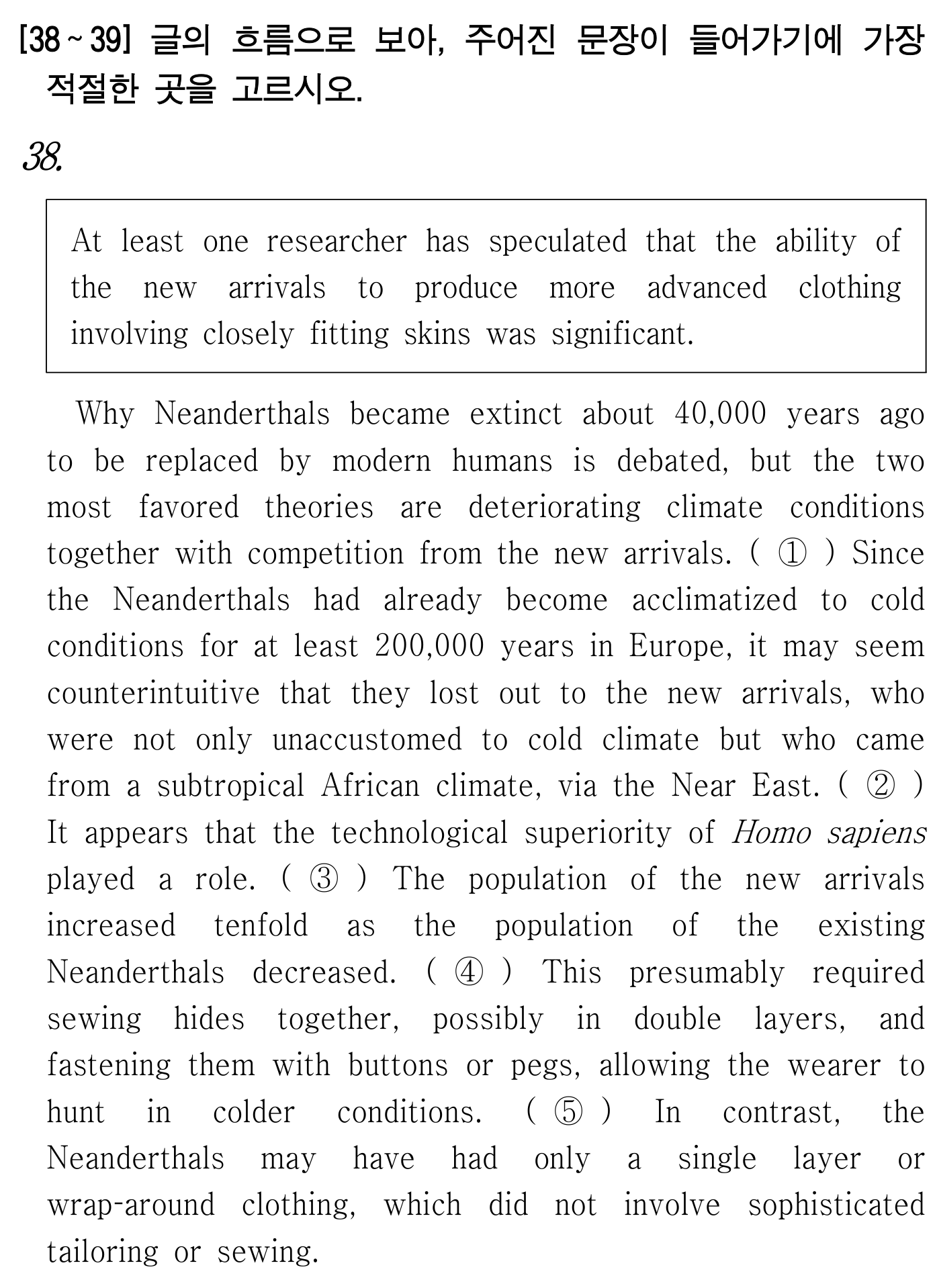
38번문장삽입1Why Neanderthals became extinct about 40,000 years ago to be replaced by modern humans is…
Why Neanderthals became extinct about 40,000 years ago to be replaced by modern humans is debated, but the two most favored theories are deteriorating climate conditions together with competition from the new arrivals. Since the Neanderthals had already become acclimatized to cold conditions for at least 200,000 years in Europe, it may seem counterintuitive that they lost out to the new arrivals, who were not only unaccustomed to cold climate but who came from a subtropical African climate, via the Near East. It appears that the technological superiority of Homo sapiens played a role. The population of the new arrivals increased tenfold as the population of the existing Neanderthals decreased. At least one researcher has speculated that the ability of the new arrivals to produce more advanced clothing involving closely fitting skins was significant. This presumably required sewing hides together, possibly in double layers, and fastening them with buttons or pegs, allowing the wearer to hunt in colder conditions. In contrast, the Neanderthals may have had only a single layer or wrap-around clothing, which did not involve sophisticated tailoring or sewing.
39번문장삽입2Any negotiation is bounded in terms of time allocated to it, and time constraints are esp…
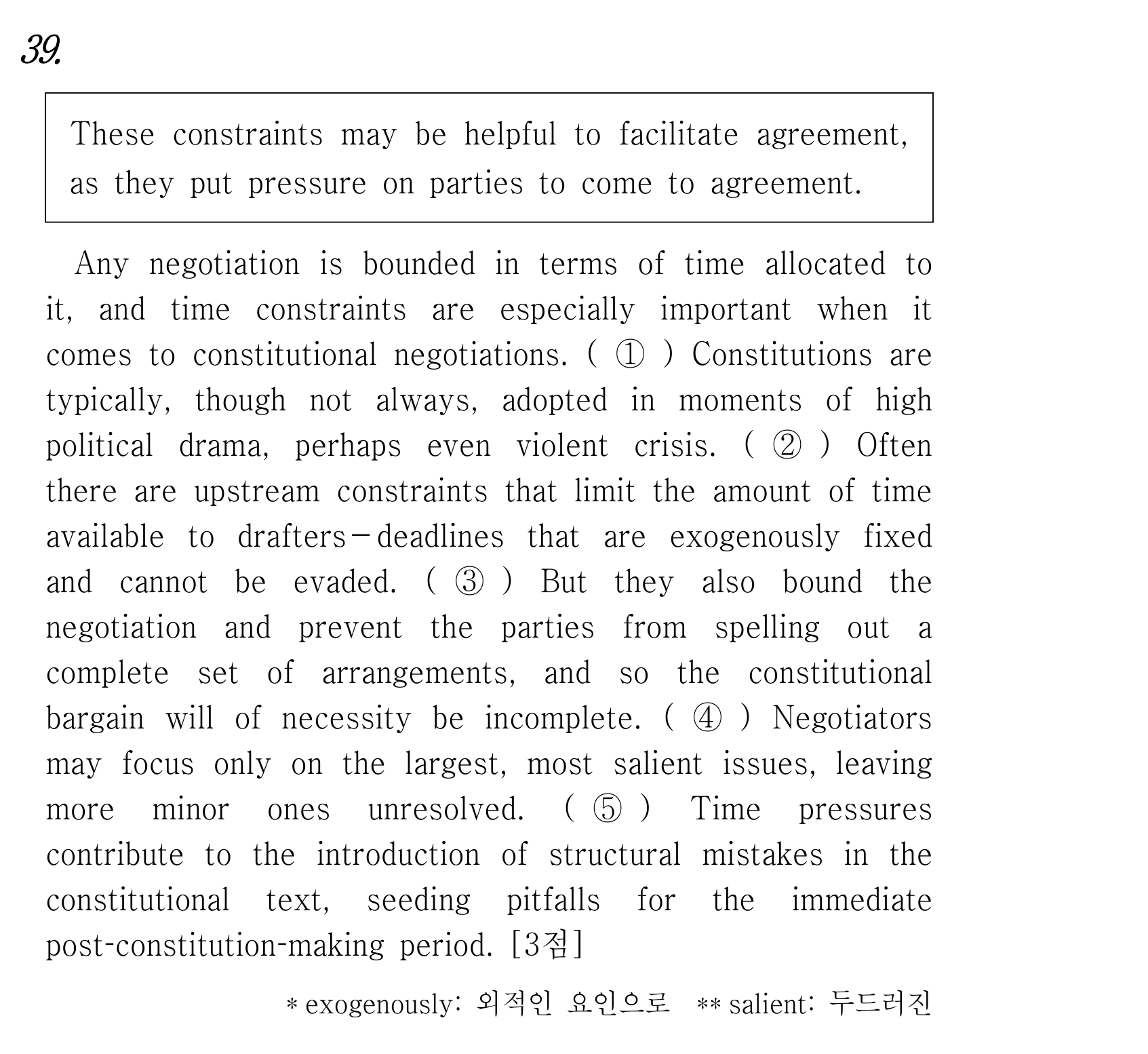
Any negotiation is bounded in terms of time allocated to it, and time constraints are especially important when it comes to constitutional negotiations. Constitutions are typically, though not always, adopted in moments of high political drama, perhaps even violent crisis. Often there are upstream constraints that limit the amount of time available to drafters-deadlines that are exogenously fixed and cannot be evaded. These constraints may be helpful to facilitate agreement, as they put pressure on parties to come to agreement. But they also bound the negotiation and prevent the parties from spelling out a complete set of arrangements, and so the constitutional bargain will of necessity be incomplete. Negotiators may focus only on the largest, most salient issues, leaving more minor ones unresolved. Time pressures contribute to the introduction of structural mistakes in the constitutional text, seeding pitfalls for the immediate post-constitution-making period.
40번요약문완성People typically consider the virtual, or imaginative, nature of cyberspace to be its uni…
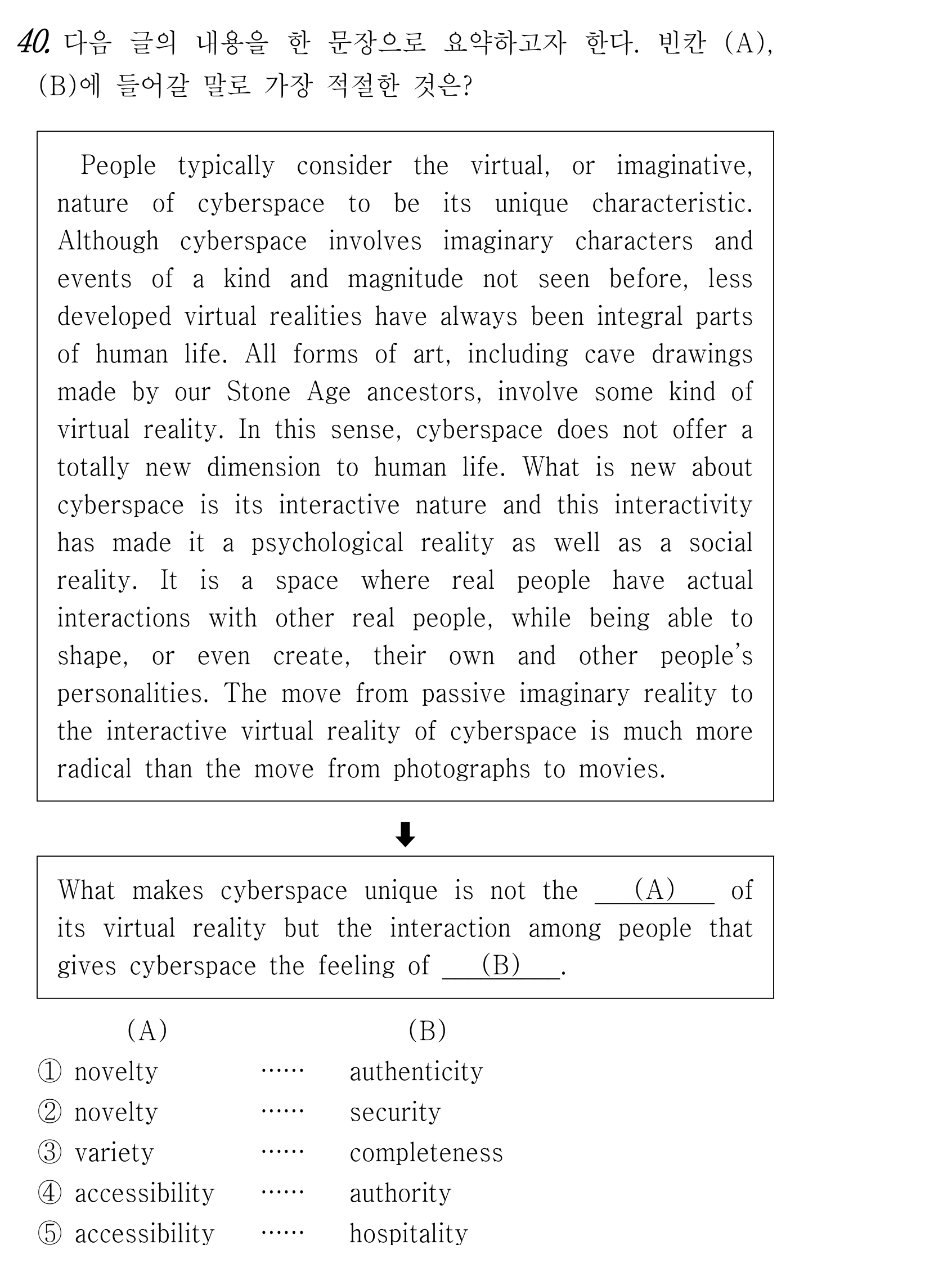
People typically consider the virtual, or imaginative, nature of cyberspace to be its unique characteristic. Although cyberspace involves imaginary characters and events of a kind and magnitude not seen before, less developed virtual realities have always been integral parts of human life. All forms of art, including cave drawings made by our Stone Age ancestors, involve some kind of virtual reality. In this sense, cyberspace does not offer a totally new dimension to human life. What is new about cyberspace is its interactive nature and this interactivity has made it a psychological reality as well as a social reality. It is a space where real people have actual interactions with other real people, while being able to shape, or even create, their own and other people's personalities. The move from passive imaginary reality to the interactive virtual reality of cyberspace is much more radical than the move from photographs to movies.
What makes cyberspace unique is not the (A) of its virtual reality but the interaction among people that gives cyberspace the feeling of (B) .
41번장문_제목Because personality is the innermost layer of your “personhood,” it’s easy (and very comm…
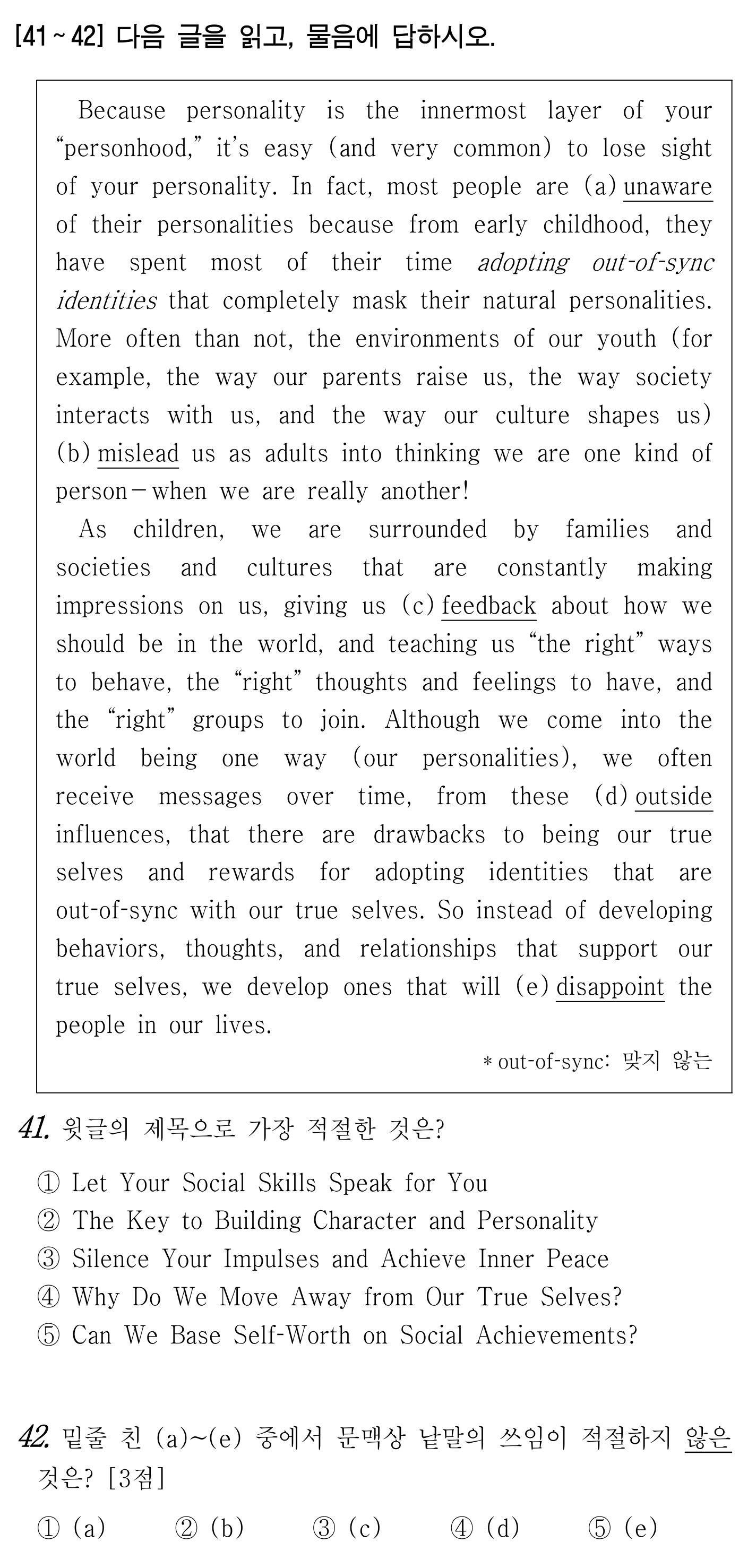
Because personality is the innermost layer of your “personhood,” it’s easy (and very common) to lose sight of your personality. In fact, most people are (a) unaware of their personalities because from early childhood, they have spent most of their time adopting out-of-sync identities that completely mask their natural personalities. More often than not, the environments of our youth (for example, the way our parents raise us, the way society interacts with us, and the way our culture shapes us) (b) mislead us as adults into thinking we are one kind of person—when we are really another! As children, we are surrounded by families and societies and cultures that are constantly making impressions on us, giving us (c) feedback about how we should be in the world, and teaching us “the right” ways to behave, the “right” thoughts and feelings to have, and the “right” groups to join. Although we come into the world being one way (our personalities), we often receive messages over time, from these (d) outside influences, that there are drawbacks to being our true selves and rewards for adopting identities that are out-of-sync with our true selves. So instead of developing behaviors, thoughts, and relationships that support our true selves, we develop ones that will (e) disappoint the people in our lives.
43번장문_순서[43 ~ 45] 다음 글을 읽고, 물음에 답하시오.
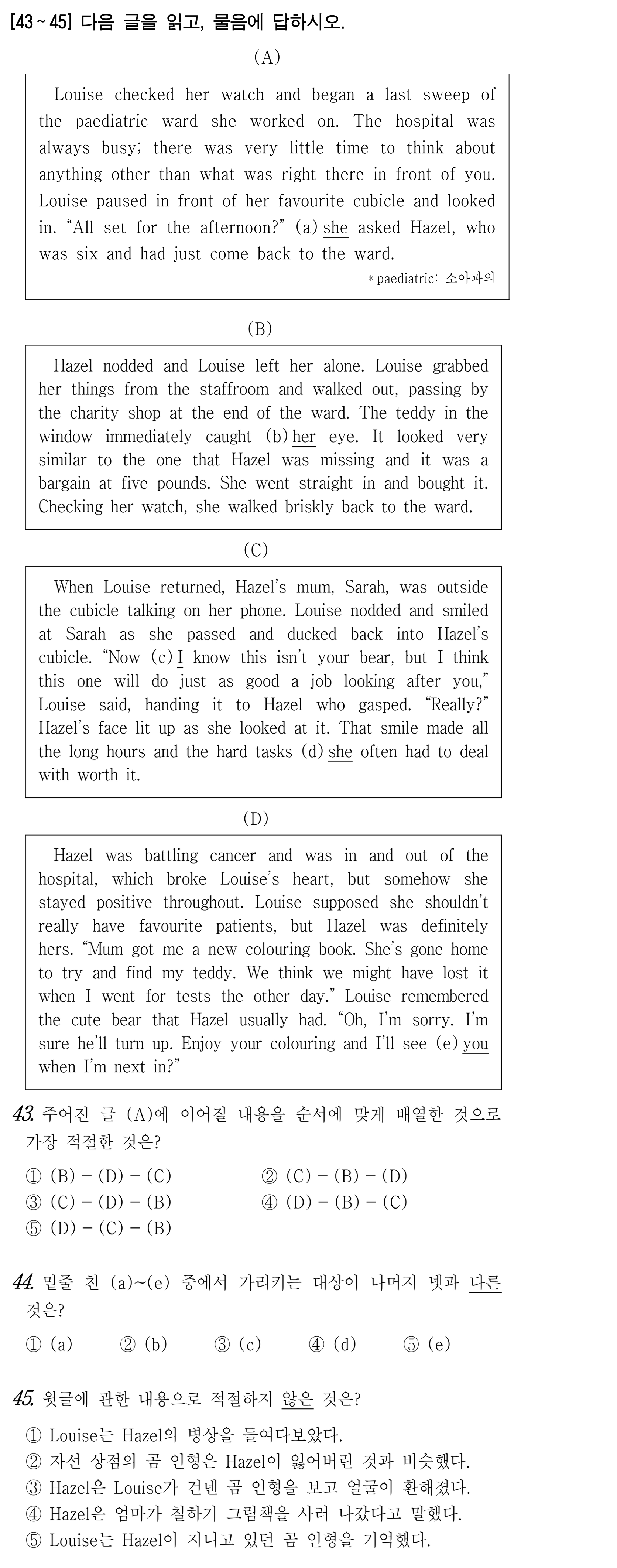
[43 ~ 45] 다음 글을 읽고, 물음에 답하시오. (A) Louise checked her watch and began a last sweep of the paediatric ward she worked on. The hospital was always busy; there was very little time to think about anything other than what was right there in front of you. Louise paused in front of her favourite cubicle and looked in. “All set for the afternoon?” (a) she asked Hazel, who was six and had just come back to the ward. * paediatric: 소아과의 (B) Hazel nodded and Louise left her alone. Louise grabbed her things from the staffroom and walked out, passing by the charity shop at the end of the ward. The teddy in the window immediately caught (b) her eye. It looked very similar to the one that Hazel was missing and it was a bargain at five pounds. She went straight in and bought it. Checking her watch, she walked briskly back to the ward. (C) When Louise returned, Hazel’s mum, Sarah, was outside the cubicle talking on her phone. Louise nodded and smiled at Sarah as she passed and ducked back into Hazel’s cubicle. “Now (c) I know this isn’t your bear, but I think this one will do just as good a job looking after you,” Louise said, handing it to Hazel who gasped. “Really?” Hazel’s face lit up as she looked at it. That smile made all the long hours and the hard tasks (d) she often had to deal with worth it. (D) Hazel was battling cancer and was in and out of the hospital, which broke Louise’s heart, but somehow she stayed positive throughout. Louise supposed she shouldn’t really have favourite patients, but Hazel was definitely hers. “Mum got me a new colouring book. She’s gone home to try and find my teddy. We think we might have lost it when I went for tests the other day.” Louise remembered the cute bear that Hazel usually had. “Oh, I’m sorry. I’m sure he’ll turn up. Enjoy your colouring and I’ll see (e) you when I’m next in?”
2020년 10월 고3 전국연합 영어 모의고사 변형문제 맛보기
이 시험 지문으로 만든 변형문제가 아직 없습니다. 지문을 고르면 어법·빈칸·주제·어휘 등 유형별 변형문제를 바로 만들 수 있습니다.
이 시험으로 첫 변형문제 만들기 →남은 시간
48:00

아직 28문제를 풀지 않았어요 (0/28)