이 지문, 뼈대만 먼저
주제the paradox of desirable difficulty in retrieval practice인출 연습에서 바람직한 어려움이 주는 역설
흐름questioning retrieval → introducing desirable difficulty → comparing test types and timing인출의 효과 질문 → 바람직한 어려움 개념 도입 → 시험 유형과 타이밍 비교 분석
주장More difficult retrieval leads to better learning.더 어려운 인출 과정이 오히려 더 나은 학습을 이끈다.
근거Free recall is better than cued recall, and delayed tests beat immediate ones.자유 회상이 단서 회상보다 낫고, 약간의 시간 지연을 둔 시험이 직후 시험보다 효과적이다.
결론Difficulty is not a barrier but the very reason retrieval works.어려움은 장벽이 아니라 인출이 효과를 발휘하게 하는 진짜 이유다.
공부를 열심히 하는데도 성적이 제자리인 것 같아 답답해하는 학생들을 자주 봅니다. 보통 이런 학생들은 눈으로 읽기만 하는 '복습'에 시간을 쏟곤 하죠. 하지만 뇌과학과 인지심리학 관점에서 보면, 술술 읽히는 공부는 뇌가 정보를 뇌에 새기지 않고 그저 흘려보내고 있다는 신호일 때가 많습니다. 오히려 뇌가 끙끙거리며 정보를 끄집어낼 때, 비로소 진짜 학습이 일어납니다. 오늘 다룰 지문은 왜 우리가 '어려운 공부'를 해야 하는지를 명쾌하게 설명해 줍니다.
1. 지문 문장별 구조 분석
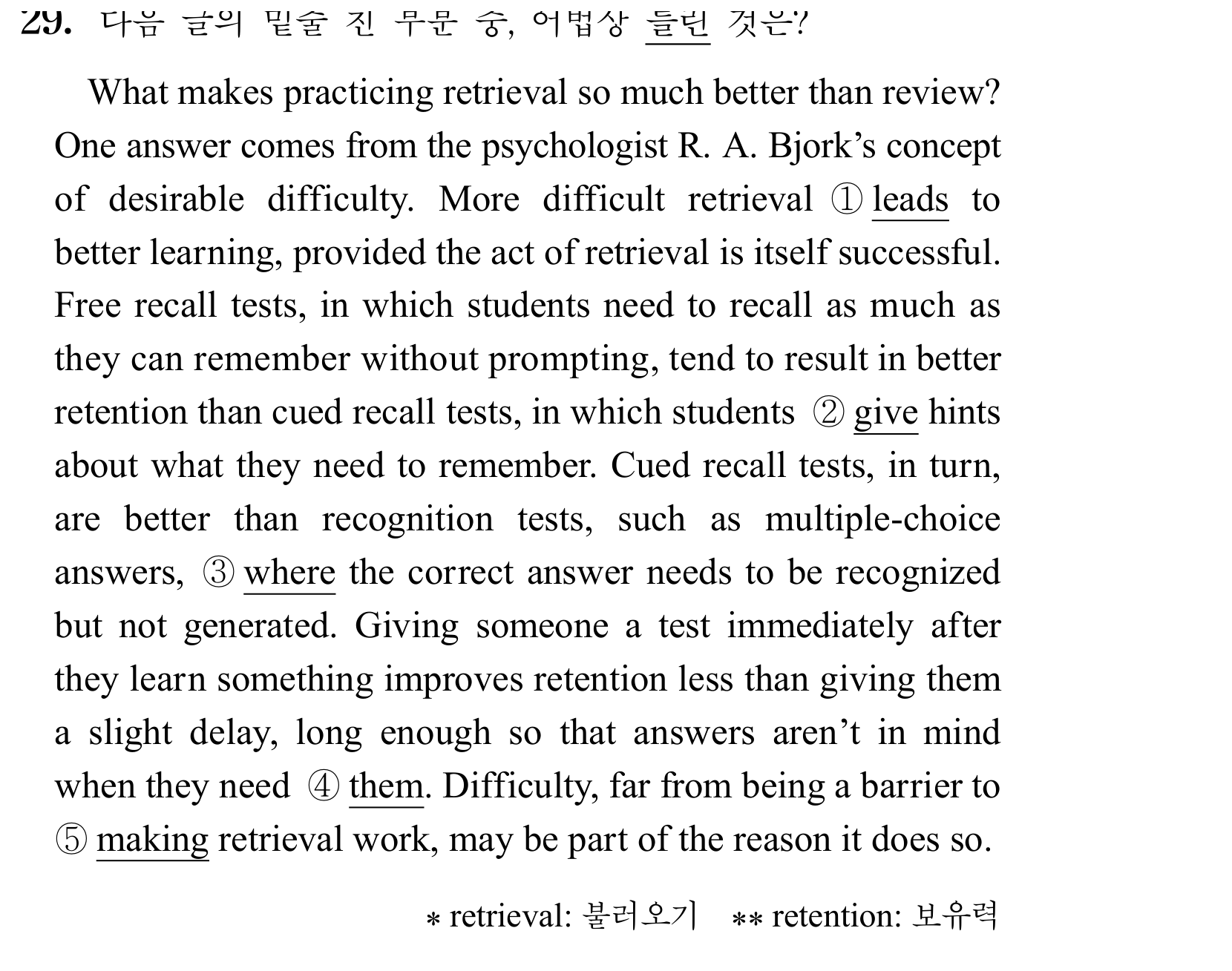
What makes practicing retrieval so much better than review?
도입
5형식 SVOC
WhatS
makesV
practicing retrievalO
so much better than reviewOC?
무엇이S 인출(기억해내기) 연습을O 복습보다 훨씬 더 낫게OC 만드는가?V
동의어 retrieval ≒ recall, recovery · practicing ≒ exercising, performing
One answer comes from the psychologist R. A. Bjork’s concept of desirable difficulty.
1형식 SV
One answerS
comesV
from the psychologist R. A. Bjork’s concept of desirable difficultyM.
한 가지 답은S 심리학자 R. A. Bjork의 '바람직한 어려움'이라는 개념에서M 온다.V
동의어 desirable ≒ beneficial, advantageous, advisable
More difficult retrieval leads to better learning, provided the act of retrieval is itself successful.
주제문
1형식 SV
More difficult retrievalS
leadsV
to better learningM,
부사절provided the act of retrievalS isV itself successfulSC.
더 어려운 인출은,S 그 인출 행위 자체가 성공적이기만 하다면,M 더 나은 학습으로 이어진다.V
동의어 lead to ≒ result in, bring about · provided ≒ if, on condition that
Free recall tests, in which students need to recall as much they can remember without prompting, tend to result in better retention than cued recall tests, in which students receive hints about what they need to remember.
근거
1형식 SV
Free recall testsS,
형용사절in which students need to recall as much they can remember without prompting,
tendV
to result in better retentionM
than cued recall testsM,
형용사절in which students receive hints about 명사절what they need to remember.
자유 회상 시험은,S 학생들이 힌트 없이 기억할 수 있는 만큼 최대한 기억해내야 하는,M 단서 회상 시험보다 더 나은 보유(기억) 결과를 낳는M 경향이 있다.V
동의어 retention ≒ preservation, maintenance, memory · prompt ≒ cue, hint, spur
tests in which students need to recall...
→ 전치사 + 관계대명사 뒤에 완전한 절 (O)
tests which students need to recall...
→ 뒤에 완전한 절이 오므로 관계대명사 단독 사용 (X)
출제 포인트 — 전치사 + 관계대명사 vs 관계대명사
- in which는 뒤에 완전한 구조가 오며, 관계부사 where로 바꾸어 쓸 수 있습니다.
- 단순 관계대명사 which는 뒤에 주어나 목적어가 빠진 불완전한 문장이 와야 하므로 이 자리에는 올 수 없습니다.
Cued recall tests, in turn, are better than recognition tests, such as multiple-choice answers, where the correct answer needs to be recognized but not generated.
2형식 SVC
Cued recall testsS,
in turnM,
areV
better than recognition testsSC,
such as multiple-choice answersM,
형용사절where the correct answer needs to be recognized but not generated.
단서 회상 시험은S 차례로, 객관식 답변과 같은 인식 시험보다M 더 나은데,SC 거기서는 정답을 생성할 필요 없이 인식하기만 하면 된다.M
동의어 generate ≒ produce, create, originate
Giving someone a test immediately after they learn something improves retention less than giving them a slight delay, long enough so that answers aren't in mind when they need them.
부연
3형식 SVO
Giving someone a test immediately after they learn somethingS
improvesV
retentionO
less than giving them a slight delay, long enough so that answers aren't in mind when they need themM.
무언가를 배운 직후에 누군가에게 시험을 치르게 하는 것은,S 기억력을O 약간의 지연을 주는 것보다M 덜 향상시킨다.V
Difficulty, far from being a barrier to making retrieval work, may be part of the reason it does so.
결론
2형식 SVC
DifficultyS,
far from being a barrier to making retrieval workM,
may beV
part of the reason 형용사절it does soSC.
어려움은S 인출이 효과를 발휘하도록 만드는 데 있어 방해물이기는커녕,M 그것이 효과가 있는 이유의 일부일지도SC 모른다.V
동의어 barrier ≒ obstacle, hurdle, impediment · far from ≒ anything but, by no means
2. 어휘 정리
retrieval 인출(기억해내기)
≒ recall, recovery, extraction
desirable 바람직한
≒ beneficial, advantageous, advisable
retention 보유(기억력)
≒ preservation, maintenance, memory
cued 단서가 주어진
≒ prompted, guided, assisted
recognition 인식
≒ identification, awareness, realization
prompting 자극, 힌트 주기
≒ cueing, hinting, reminding
generate 생성하다, 만들어내기
≒ produce, create, construct
barrier 방해물, 장벽
≒ obstacle, hurdle, impediment
delay 지연, 미룸
≒ postponement, pause, interval
retention 기억, 보유
≒ storage, holding, keeping
3. 풀이 전략
이 문제는 문맥상 적절하지 않은 어휘를 찾는 유형입니다. 글의 중심 소재는 '인출 연습의 효과'와 그 조건인 '어려움'입니다.
미국 교육 현장에서는 흔히 **"Struggle is part of the process"**라고 합니다. 아이들이 당장 답을 내지 못하고 끙끙거리는 시간을 선생님이 참아주고 기다려줄 때, 아이들의 뇌가 가장 활발하게 연결 고리를 만든다는 믿음 때문이죠.
지문 후반부에서 시험을 '직후'에 보는 것보다 '지연(delay)'을 두는 것이 더 효과적이라고 했습니다. 즉, 기억이 희미해져서 끄집어내기 어려운 상태가 오히려 학습에 도움이 된다는 것이죠. 그렇기에 마지막 문장에서 어려움(difficulty)은 방해물이 아니라, 오히려 기억을 강화하는 핵심 요소가 됩니다. 문맥상 'barrier(방해물)'라는 단어는 아주 적절하게 쓰였습니다. 정답은 2번(or 지문의 문맥상 어휘 흐름)을 확인하는 것이 핵심인데, 실제 시험지에서 이와 반대되는 단어가 배치된 곳을 찾는 것이 중요합니다.
- 바람직한 어려움(desirable difficulty)
- 인출 연습의 효과
- 자유 회상 > 단서 회상 > 인식 시험
- 지연 효과
- 어려움은 방해물이 아닌 학습의 이유
>> 2024년 6월 고3 모의고사 전체 풀어보기