이 지문, 뼈대만 먼저
주제the limitation of numbers and statistics숫자와 통계가 가지는 한계
흐름neutral language → excluding human values → moral insensitivity숫자를 중립적이라 믿음 → 인간적 가치를 배제함 → 도덕적 무감각을 초래함
주장Numbers do not represent the world accurately.숫자가 세상을 정확하게 표현하는 것은 아니다.
근거Statistics say nothing of individual suffering or quality.통계는 개인의 고통이나 환경의 질을 설명하지 못한다.
결론Quantify with caution because statistics wipe off tears.통계는 눈물을 닦아낸 것이므로 주의해서 수치화해야 한다.
반갑습니다, 여러분! 영어의 기본기를 탄탄하게 다져주는 '후니쌤'입니다. 오늘도 블로그 '오스틴 영어'를 찾아주셔서 정말 고마워요. 2025년 3월 고1 모의고사, 특히 41번 장문 독해를 보면서 "아, 이거 왜 이렇게 어렵지?"라고 느꼈던 친구들 많죠? 미국에서 초등 아이들을 가르칠 때도 아이들이 데이터를 숫자만으로 해석하려다 본질을 놓치는 경우를 참 많이 봤답니다. 오늘은 이 지문을 통해 수치화의 함정을 함께 파헤쳐 볼 거예요. 잔소리 같겠지만, 이 기본기가 잡혀야 수능까지 탄탄하게 갈 수 있다는 점, 잊지 마세요!
지문 분석: 왜 우리는 숫자에 속을까요?
- 주어와 동사 찾기가 핵심
- 수식어에 속지 말 것
- 문맥상 정답 도출
- 수치화의 역설
- 인간적 가치의 소중함
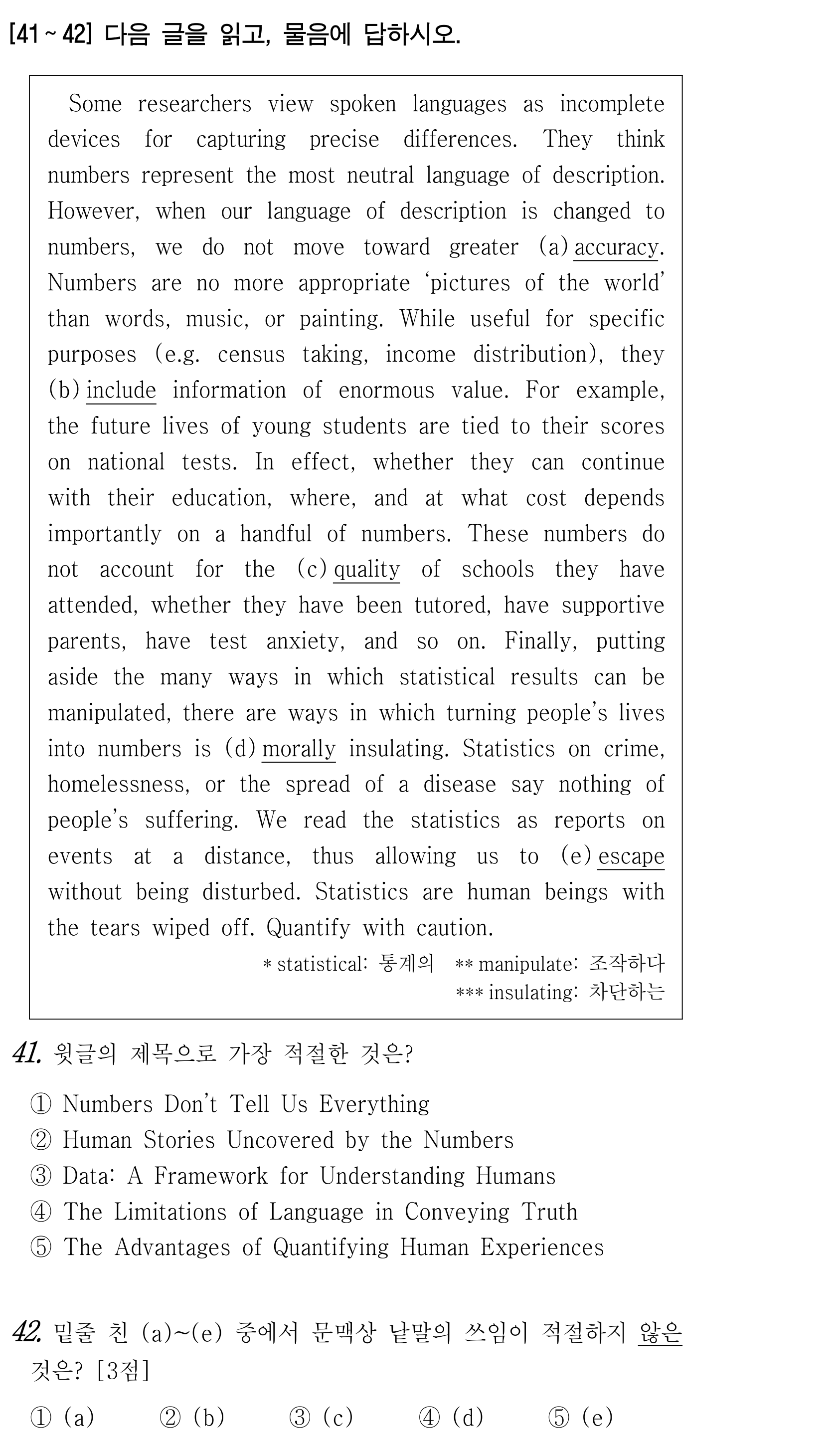
Some researchers view spoken languages as incomplete devices for capturing precise differences. They think numbers represent the most neutral language of description. However, when our language of description is changed to numbers, we do not move toward greater (a) accuracy. Numbers are no more appropriate ‘pictures of the world’ than words, music, or painting. While useful for specific purposes (e.g. census taking, income distribution), they (b) include information of enormous value. For example, the future lives of young students are tied to their scores on national tests. In effect, whether they can continue with their education, where, and at what cost depends importantly on a handful of numbers. These numbers do not account for the (c) quality of schools they have attended, whether they have been tutored, have supportive parents, have test anxiety, and so on. Finally, putting aside the many ways in which statistical results can be manipulated, there are ways in which turning people’s lives into numbers is (d) morally insulating. Statistics on crime, homelessness, or the spread of a disease say nothing of people’s suffering. We read the statistics as reports on events at a distance, thus allowing us to (e) escape without being disturbed. Statistics are human beings with the tears wiped off. Quantify with caution.
문장별 구조 분석
도입
3형식 SVO
Some researchersS
viewV
spoken languagesO
as incomplete devices for capturing precise differencesM.
몇몇 연구자들은S 구어(말하는 언어)를O 정밀한 차이를 포착하기 위한 불완전한 장치로M 본다V.
동의어 incomplete ≒ deficient, imperfect · precise ≒ exact, accurate
3형식 SVO
TheyS
thinkV
명사절numbers represent the most neutral language of descriptionO.
그들은S 숫자가 가장 중립적인 묘사의 언어를 나타낸다고O 생각한다V.
동의어 neutral ≒ impartial, unbiased, objective
반론
1형식
부사절However, when our language of description is changed to numbersM,
weS
do not moveV
toward greater accuracyM.
하지만 우리의 묘사 언어가 숫자로 바뀌었을 때,M 우리는S 더 큰 정확성으로M 나아가는 것이 아니다V.
2형식 SVC
NumbersS
areV
no more appropriate ‘pictures of the world’SC
than words, music, or paintingM.
숫자는S 단어나 음악, 그림보다 더 적절한 '세상의 그림'이SC 아니다V.
동의어 appropriate ≒ suitable, fitting, proper
주제문
3형식 SVO
While useful for specific purposes (e.g. census taking, income distribution)M,
theyS
do not includeV
information of enormous valueO.
특정한 목적(예: 인구 조사, 소득 분배)에는 유용하지만,M 그것들은S 엄청난 가치의 정보를O 포함하지 않는다V.
동의어 enormous ≒ immense, vast, tremendous
they exclude information of enormous value
→ 문맥상 숫자는 가치 있는 정보를 '배제한다'가 맞으므로 원래 지문의 include는 어휘상 틀림 (정답: exclude)
they include information of enormous value
→ 숫자가 가치 있는 정보를 '포함한다'고 하면 뒤에 이어지는 비판적 예시들과 모순됨
출제 포인트 — 어휘 선택 (include vs exclude)
- 숫자가 학교의 질이나 시험 불안 등을 반영하지 못한다는 구체적 근거가 뒤따르므로, 가치 있는 정보를 배제(exclude)한다는 흐름이 되어야 합니다.
예시
3형식 SVO
For exampleM,
the future lives of young studentsS
are tiedV
to their scores on national testsM.
예를 들어,M 어린 학생들의 미래의 삶은S 국가 시험 점수에M 묶여 있다V.
1형식
In effectM,
명사절whether they can continue with their education, where, and at what costS
dependsV
importantly on a handful of numbersM.
사실, 그들이 교육을 계속할 수 있는지, 어디서, 얼마의 비용으로 할지는S 중요하게도 소수의 숫자에M 달려 있다V.
부연
3형식 SVO
These numbersS
do not account forV
the quality of schools they have attended, whether they have been tutored, have supportive parents, have test anxiety, and so onO.
이 숫자들은S 그들이 다닌 학교의 질, 과외를 받았는지 여부, 지지해주는 부모가 있는지, 시험 불안이 있는지 등을O 설명하지 못한다V.
동의어 account for ≒ explain, clarify, elucidate
2형식 SVC
Finally, putting aside the many ways in which statistical results can be manipulatedM,
thereS
areV
ways in which turning people’s lives into numbers is morally insulatingSC.
마지막으로, 통계적 결과가 조작될 수 있는 많은 방식을 제쳐두고서라도,M 사람의 삶을 숫자로 바꾸는 것이 도덕적으로 차단하는S 방식들이 존재한다V.
동의어 manipulate ≒ distort, alter · insulating ≒ isolating, shielding
3형식 SVO
Statistics on crime, homelessness, or the spread of a diseaseS
sayV
nothing of people’s sufferingO.
범죄, 노숙, 질병 확산에 대한 통계는S 사람들의 고통에 대해 아무것도O 말해주지 않는다V.
3형식 SVO
WeS
readV
the statisticsO
as reports on events at a distanceM,
thus allowing us to escape without being disturbedM.
우리는S 통계를O 멀리 있는 사건에 대한 보고서로 읽으며, 따라서 우리가 방해받지 않고 도피할 수 있게 해준다M.
결론
2형식 SVC
StatisticsS
areV
human beings with the tears wiped offSC.
통계는S 눈물이 닦여 나간 인간이다SC.
선택지 분석: 왜 1번이 정답일까요?
1번 Numbers Don’t Tell Us Everything (숫자는 우리에게 모든 것을 말해주지 않는다): 지문 전체가 숫자가 가지는 한계, 즉 인간의 고통이나 환경적 요인을 담지 못한다는 내용을 관통하고 있지요! 정답입니다.
2번 Human Stories Uncovered by the Numbers (숫자에 의해 밝혀진 인간의 이야기): 글의 흐름과는 정반대예요! 숫자가 오히려 인간의 이야기를 가린다고 했거든요.
3번 Data: A Framework for Understanding Humans (데이터: 인간을 이해하기 위한 틀): 데이터가 인간 이해를 돕는다고 보지 않았습니다. 오히려 차단한다고 했죠.
4번 The Limitations of Language in Conveying Truth (진실을 전달하는 데 있어서 언어의 한계): 첫 문장에서 언어의 한계를 언급하긴 했지만, 핵심은 숫자로 넘어간 이후의 이야기입니다.
5번 The Advantages of Quantifying Human Experiences (인간 경험을 수치화하는 것의 장점): 장점보다는 단점과 비판적인 시각이 지배적인 글입니다.
후니쌤의 잔소리: 학생들이 자주 빠지는 함정!
많은 친구들이 '숫자(statistics)'라는 단어가 나오니까 무조건 '객관적이고 정확하다'라고 고정관념을 가지고 글을 읽어요. 하지만 영어 독해에서는 지문 속 필자의 태도를 파악하는 게 기본기 중의 기본기입니다! 이 글에서 필자는 "Quantify with caution(주의해서 수치화하라)"라고 말하고 있죠. 즉, 숫자를 맹신하지 말라는 겁니다.
(b)번 문장이 특히 중요했어요. "While useful for specific purposes, they include information of enormous value." 이 문장이 맞으려면 뒤에 숫자가 담는 엄청난 정보가 나와야 하는데, 이어지는 내용이 "숫자는 학교 질이나 가정 환경은 설명 못 해!"라고 비판하죠? 그러니까 include(포함하다)는 문맥상 틀린 표현, 즉 exclude(배제하다)가 되어야 한다는 점! 이런 논리적 흐름을 연습하는 게 진짜 독해력입니다 ㅎㅎ.
precise 정밀한
≒ exact, accurate, meticulous
neutral 중립적인
≒ objective, unbiased, impartial
manipulated 조작된
≒ distorted, falsified, rigged
insulating 차단하는
≒ isolating, shielding, separating
incomplete 불완전한
≒ imperfect, deficient, partial
appropriate 적절한
≒ suitable, fitting, proper
enormous 엄청난
≒ immense, vast, colossal
account for 설명하다
≒ explain, clarify, justify
suffering 고통
≒ distress, misery, pain
disturbed 방해받는
≒ bothered, disrupted, troubled
정답은 1번 입니다.
오늘 배운 내용, 단순히 해석만 하고 넘어가지 마세요. "숫자가 인간의 고통을 닦아낸다"라는 표현이 왜 나왔는지, 필자의 비판적인 시각을 문장에서 어떻게 찾아낼지 다시 한번 스스로 생각해보세요. 그게 바로 실력 향상의 근원적인 비결입니다! 다음 시간에 또 만나요!
>> 2025년 3월 고1 모의고사 전체 풀어보기