이 지문, 뼈대만 먼저
주제the role of philosophy and its collaboration with science철학의 역할과 과학과의 협력 필요성
흐름broad questions → non-empirical approach → collaboration with neuroscience넓은 질문을 던지는 철학 → 논리적 비경험적 접근 → 신경과학과의 협력 필요
주장Philosophy must collaborate with neuroscience for comprehensive understanding.의식을 온전히 이해하려면 철학과 신경과학이 협력해야 한다.
근거Philosophy provides theoretical insights, but lacks empirical evidence.철학은 이론적 통찰을 주지만, 경험적인 증거가 부족하기 때문이다.
결론Theoretical insights must be supplemented by empirical findings.철학적 통찰은 경험적 실험 결과로 보완되어야 한다.
안녕하세요! 네이버 블로그 '오스틴 영어'를 운영하는 후니쌤입니다. ㅎㅎ
오늘은 많은 학생이 3점짜리 문제에서 가장 많이 멘붕을 겪는다는 순서 배열, 그중에서도 고3 수험생 여러분을 울고 웃게 만드는 37번 유형을 함께 파헤쳐 볼 거예요. 미국에서 아이들을 가르칠 때도 느꼈지만, 영어 지문은 결국 **"논리적인 뼈대"**를 찾는 싸움이거든요. 자, 그럼 잔소리는 짧게 하고 바로 본론으로 들어갑니다!
1. 순서 배열은 '연결 고리'를 찾는 훈련입니다
많은 학생이 지문을 처음부터 끝까지 해석하느라 바쁜데, 사실 순서 배열은 '해석력'이 아니라 '연결성'을 찾는 문제예요. 미국 교육대학원에서 배울 때도 강조했던 부분인데, 문장 간의 지시어(This, These, Such), 연결어(However, Therefore), 그리고 **관사(a vs the)**를 보면 답이 어디로 향하는지 보이기 시작합니다!
- 지시어에 집중할 것
- 연결어는 흐름의 전환점
- 관사의 쓰임을 파악할 것
- 문장 간의 논리적 단절 찾기
- 흐름이 자연스러운지 확인
- 과도한 해석보다는 구조 파악
2. 지문 구조 분석 (꼼꼼하게 읽어보세요!)
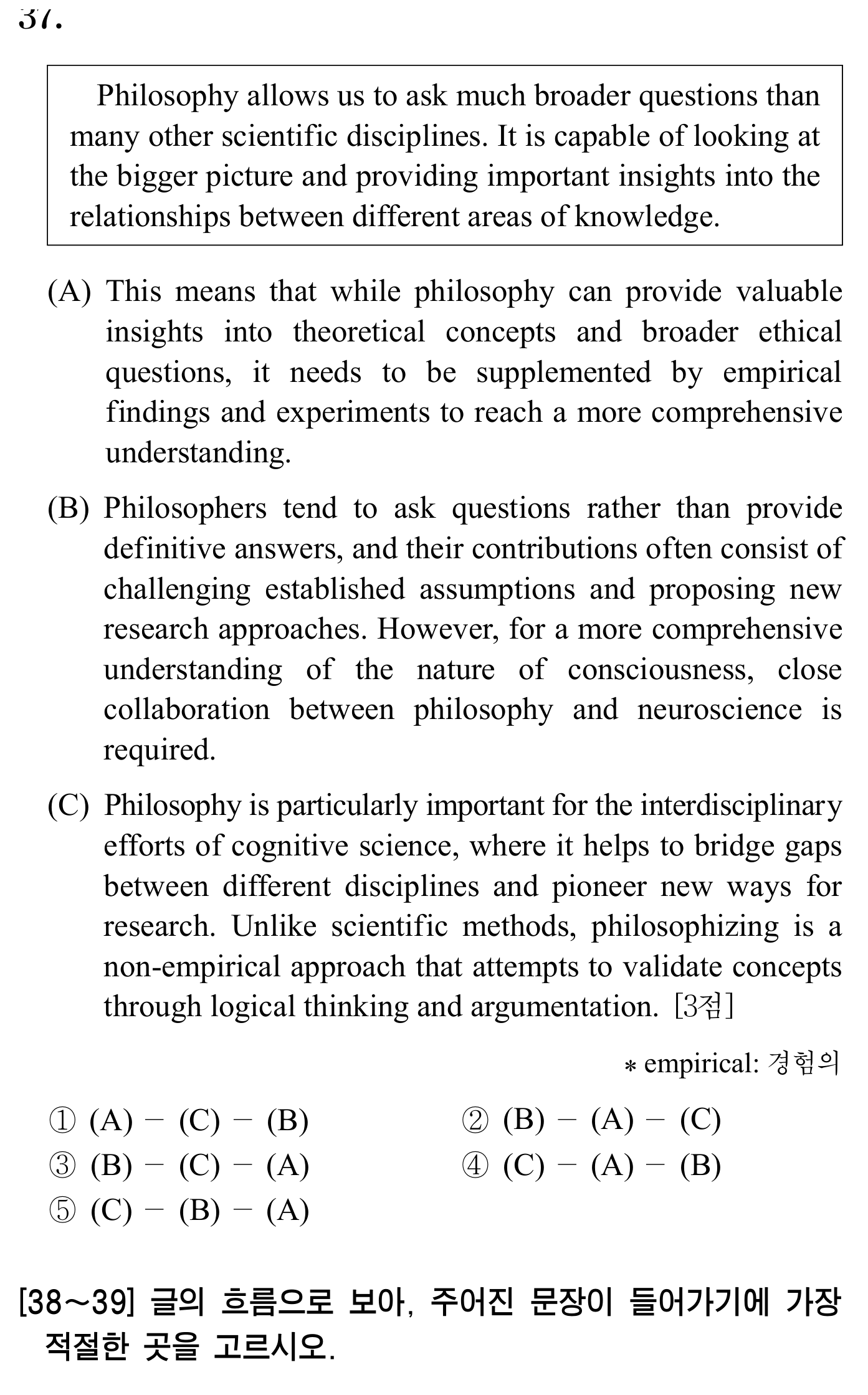
Philosophy allows us to ask much broader questions than many other scientific disciplines. It is capable of looking at the bigger picture and providing important insights into the relationships between different areas of knowledge. Philosophy is particularly important for the interdisciplinary efforts of cognitive science, where it helps to bridge gaps between different disciplines and pioneer new ways for research. Unlike scientific methods, philosophizing is a non-empirical approach that attempts to validate concepts through logical thinking and argumentation. Philosophers tend to ask questions rather than provide definitive answers, and their contributions often consist of challenging established assumptions and proposing new research approaches. However, for a more comprehensive understanding of the nature of consciousness, close collaboration between philosophy and neuroscience is required. This means that while philosophy can provide valuable insights into theoretical concepts and broader ethical questions, it needs to be supplemented by empirical findings and experiments to reach a more comprehensive understanding.
이제 문장별로 뜯어볼게요. 이게 바로 **"기본기"**입니다.
도입
5형식 SVOC
PhilosophyS
allowsV
usO
to ask much broader questionsOC
than many other scientific disciplinesM.
철학은S
우리가O
훨씬 더 폭넓은 질문을 하도록OC
허용합니다V
다른 많은 과학 분야보다M.
동의어 broader ≒ wider, more extensive · disciplines ≒ fields, branches of knowledge
2형식 SVC
ItS
isV
capable of looking at the bigger picture and providing important insights into the relationships between different areas of knowledgeSC.
그것(철학)은S
더 큰 그림을 보고 지식의 서로 다른 영역 간의 관계에 대한 중요한 통찰력을 제공할 수SC
있습니다V.
동의어 capable of ≒ able to, equal to · insights ≒ understandings, perceptions
2형식 SVC
PhilosophyS
isV
particularly important for the interdisciplinary efforts of cognitive scienceSC,
형용사절where it helps to bridge gaps between different disciplines and pioneer new ways for research.
철학은S
인지 과학의 학제 간 노력에 특히 중요한데SC,
그 분야에서 철학은 서로 다른 학문 간의 격차를 메우고 연구를 위한 새로운 방법을 개척하는 것을 돕습니다M.
동의어 interdisciplinary ≒ cross-disciplinary, integrative · bridge ≒ close, fill · pioneer ≒ develop, initiate
부연
2형식 SVC
Unlike scientific methodsM,
philosophizingS
isV
a non-empirical approachSC
형용사절that attempts to validate concepts through logical thinking and argumentation.
과학적 방법과 달리M,
철학하기는S
논리적 사고와 논증을 통해 개념을 입증하려는 비경험적 접근 방식SC
입니다V.
동의어 non-empirical ≒ theoretical, speculative · validate ≒ verify, confirm, prove
3형식 SVO
PhilosophersS
tend to askV
questionsO
rather than provide definitive answersM,
and their contributionsS
often consist ofV
challenging established assumptions and proposing new research approachesO.
철학자들은S
질문을 던지는 경향이 있으며V
확정적인 답을 제공하기보다는M,
그들의 기여는S
종종 확립된 가정에 도전하고 새로운 연구 접근법을 제안하는 것으로O
이루어집니다V.
동의어 definitive ≒ conclusive, final · consist of ≒ be composed of, comprise
반론
3형식 SVO (수동태)
HoweverM,
for a more comprehensive understanding of the nature of consciousnessM,
close collaboration between philosophy and neuroscienceS
is requiredV.
하지만 의식의 본질에 대한 더 포괄적인 이해를 위해서는M
철학과 신경과학 사이의 긴밀한 협력이S
요구됩니다V.
동의어 comprehensive ≒ inclusive, thorough · collaboration ≒ cooperation, partnership
close collaboration ... is required
→ 협력이 요구되는 대상이므로 수동태가 올바름
close collaboration ... requires
→ 능동태로 쓰면 목적어가 빠져 문법적으로 틀림
출제 포인트 — 수동태와 능동태 구분
- 주어가 행위의 주체인지 대상인지 파악: collaboration은 요구되는 대상이므로 수동태가 정답.
- 수동태 뒤에는 일반적으로 목적어 명사가 오지 않음을 활용하여 빠르게 판단 가능.
결론
3형식 SVO
ThisS
meansV
명사절that while philosophy can provide valuable insights into theoretical concepts and broader ethical questions, it needs to be supplemented by empirical findings and experiments to reach a more comprehensive understanding.
이것은S
의미합니다V
철학이 이론적 개념과 더 넓은 윤리적 질문에 대한 가치 있는 통찰력을 제공할 수 있지만, 더 포괄적인 이해에 도달하기 위해서는 경험적 발견과 실험에 의해 보완될 필요가 있다는 것을O.
동의어 supplemented ≒ complemented, augmented · empirical ≒ experimental, factual
3. 단계별 풀이 전략: 잔소리 타임!
- 지시어 파악: 마지막 문장의 **"This means"**를 보세요. 앞에 나온 '협력의 필요성'을 가리키고 있죠? 그러니까 이 문장이 마지막에 오는 게 논리적으로 딱 맞아요!
- 연결어 활용: **"However"**를 찾으세요. 철학의 일반적인 특징을 설명하다가 '하지만 신경과학과의 협력이 필요하다'라고 대조를 이루며 전환되는 지점, 여기가 바로 B와 C를 나누는 핵심 포인트입니다.
- 소거법: 1번부터 4번까지는 흐름이 꼬여있어요. 5번이 정답인 이유는 모든 문장의 논리가 '철학의 역할'에서 '한계'로, 그리고 '협력을 통한 보완'으로 체계적으로 흘러가기 때문이죠.
4. 자주 하는 실수 (이건 정말 주의해야 해요!)
- 해석에만 매몰되기: 문장 하나하나 해석하다 보면 숲을 못 봐요. 문장 사이의 '논리적 연결 고리'를 찾아야 합니다.
- 연결어 무시: 'However', 'Therefore' 같은 힌트를 그냥 지나치면 3점짜리 문제에서 무너집니다. ㅠㅠ
- 대충 읽기: 특히 관사(a/the)나 대명사(it/this)는 그냥 휙 지나가기 쉬운데, 거기서 답이 갈리는 경우가 정말 많아요!
5. 핵심 어휘 정리
discipline 학문 분야
≒ field, branch, subject
insight 통찰력
≒ understanding, perception, intuition
interdisciplinary 학제 간의
≒ cross-disciplinary, integrative
bridge 메우다, 다리를 놓다
≒ close, fill, connect
pioneer 개척하다
≒ develop, initiate, spearhead
empirical 경험적인
≒ experimental, factual, observational
validate 입증하다
≒ verify, confirm, prove
definitive 확정적인
≒ conclusive, final, decisive
comprehensive 포괄적인
≒ inclusive, thorough, exhaustive
collaboration 협력
≒ cooperation, partnership, teamwork
supplement 보완하다
≒ complement, augment, add to
consciousness 의식
≒ awareness, mindfulness, sentience
자, 오늘 배운 내용 어떠셨나요? 체계적으로 접근하면 어려운 순서 배열 문제도 충분히 정복할 수 있습니다! 매일 조금씩이라도 지문을 구조적으로 분석하는 연습을 해보세요. 그럼 우리 다음 시간에 또 만나요! ㅎㅎ
정답은 5번 입니다.
>> 2025년 11월 고3 모의고사 전체 풀어보기