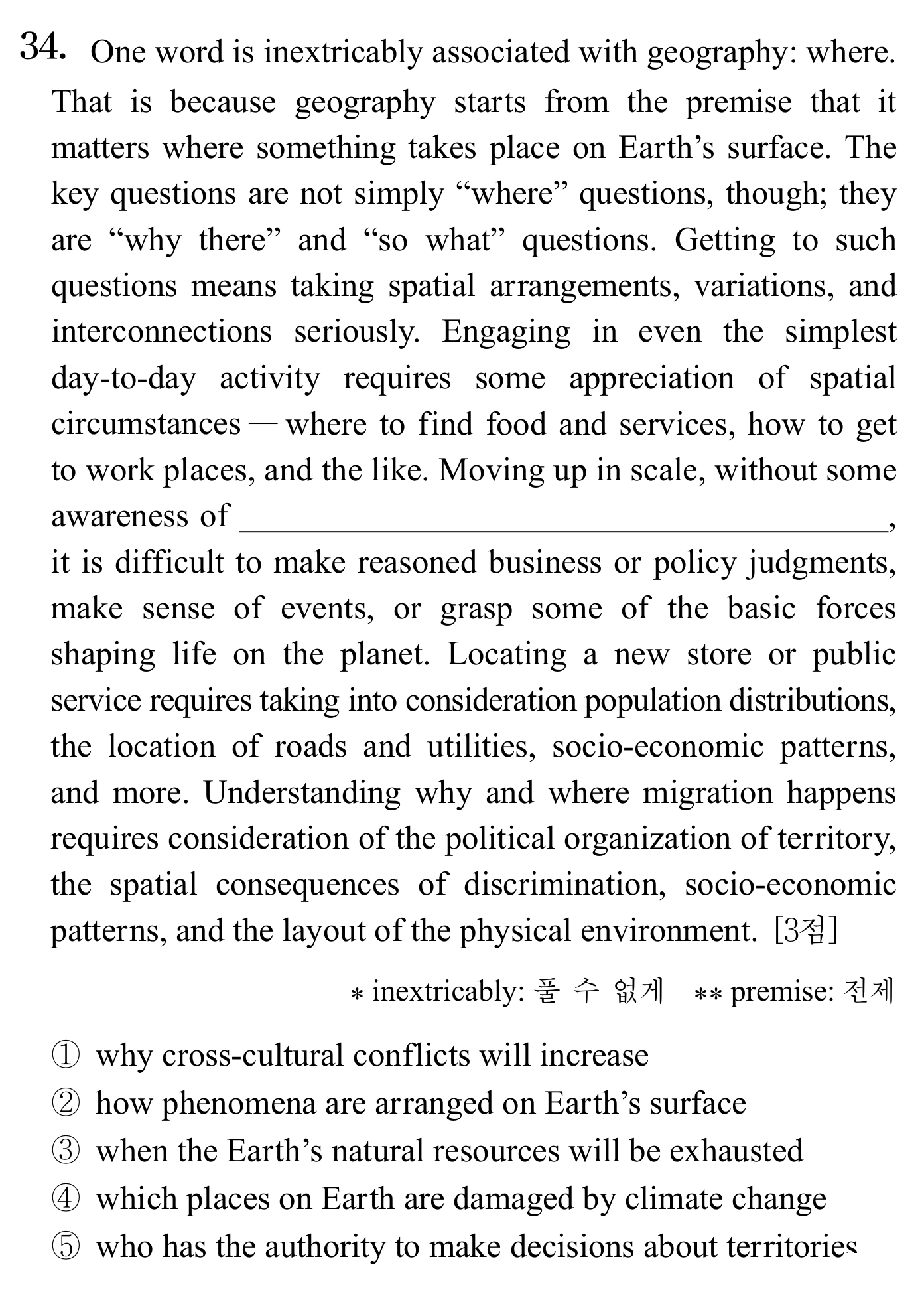
One word is inextricably associated with geography: where — 2025년 6월 고3 34번 해석/풀이
후니쌤2026년 5월 22일조회 147
2025-06-08
핵심 문제유형: 빈칸추론 — 지리학적 사고의 핵심은 공간적 맥락 이해
이 지문, 뼈대만 먼저
주제the significance of spatial context in geography지리학에서 공간적 맥락이 갖는 중요성
흐름definition of geography → key questions → practical applications지리학의 정의 → 핵심 질문(왜 그곳인가) → 실생활과 정책에서의 실제 적용
주장Geography is not just about "where" but "why there."지리학은 단순히 '어디'가 아니라 '왜 그곳인가'를 묻는 것이다.
근거Decisions require understanding spatial arrangements and variations.의사결정에는 공간적 배치와 차이에 대한 이해가 필수적이다.
결론We must recognize how phenomena are arranged on Earth.우리는 현상들이 지구상에 어떻게 배열되어 있는지 인식해야 한다.
지리학이라는 단어를 들으면 단순히 세계 지도를 펼쳐놓고 나라 이름이나 수도를 외우는 장면을 떠올리는 경우가 많아요. 그런데 수능 영어 지문에서 지리학을 다룰 때는 그 이상의 관점을 요구하곤 하죠. 특히 이번 34번 문제는 '단순히 어디인가'를 묻는 것을 넘어, '왜 하필 그곳인가'라는 질문이 어떻게 세상을 바라보는 틀이 되는지를 묻고 있습니다. 많은 학생이 빈칸 앞뒤의 긴 문장 구조를 보며 당황하는데, 사실 문장의 뼈대만 잘 발라내도 정답은 생각보다 명확하게 보입니다.
문장별 구조 분석
도입
3형식 SVO
One wordS
isV
inextricably associated with geographySC: whereM.
한 단어가S 지리학과 불가분하게 연관되어 있는데SC, 바로 '어디'이다M.
동의어 inextricably ≒ inseparably, indissolubly · associated with ≒ linked to, connected with
2형식 SVC
ThatS
isV
명사절because geography starts from the premise that it matters where something takes place on Earth’s surfaceSC.
그것은S 지리학이 무언가가 지구 표면 어디에서 일어나는지가 중요하다는 전제에서 시작하기 때문이다SC.
동의어 premise ≒ assumption, presupposition, postulate · matter ≒ count, be important
주제문
2형식 SVC
The key questionsS
areV
not simply “where” questionsSC, thoughM; theyS areV “why there” and “so what” questionsSC.
하지만M 핵심 질문은S 단순히 '어디'라는 질문이 아니라SC; 그것들은S '왜 그곳인가' 그리고 '그래서 무엇인가'라는 질문이다SC.
부연
3형식 SVO
Getting to such questionsS
meansV
taking spatial arrangements, variations, and interconnections seriouslyO.
그러한 질문들에 도달하는 것은S 공간적 배치, 변화, 그리고 상호 연결성을 진지하게 받아들이는 것을O 의미한다V.
동의어 arrangement ≒ layout, configuration, setup · variation ≒ diversity, difference, disparity
3형식 SVO
Engaging in even the simplest day-to-day activityS
requiresV
some appreciation of spatial circumstancesO — where to find food and services, how to get to work places, and the likeM.
가장 단순한 일상 활동에 참여하는 것조차도S 공간적 상황에 대한 어느 정도의 이해를O 필요로 한다V — 음식과 서비스를 어디서 찾을지, 일터에 어떻게 갈지 같은 것들이다M.
동의어 engage in ≒ participate in, take part in · appreciation ≒ understanding, comprehension, awareness
근거
2형식 SVC
Moving up in scaleM, without some awareness of '...'M, itS isV difficultSC to make reasoned business or policy judgments, make sense of events, or grasp some of the basic forces shaping life on the planetM.
규모를 더 넓혀보면, '...'에 대한 인식 없이는M 합리적인 사업이나 정책적 판단을 내리거나, 사건을 이해하거나, 지구상의 삶을 형성하는 기본적인 힘들을 파악하는 것이S 어렵다SC.
가주어 it — 진주어 to부정사 구문
It + be동사 + 형용사(보어) + to V(진주어)
주어가 너무 길어지면 뒤로 보내고, 그 자리에 가짜 주어 it을 씁니다. 문장의 주어와 동사를 찾을 때 it을 보고 바로 뒤의 to부정사를 찾아내는 것이 독해의 속도를 높이는 핵심이죠.
It is difficult to grasp...
→ 가주어 it + 진주어 to부정사
→ 가주어 it + 진주어 to부정사
It is difficult grasping...
→ 진주어로 동명사도 가능하지만, 관용적으로 it 가주어 구문 뒤에는 to부정사가 더 선호됨
→ 진주어로 동명사도 가능하지만, 관용적으로 it 가주어 구문 뒤에는 to부정사가 더 선호됨
출제 포인트 — 가주어-진주어 구조 파악
- it은 형식적인 주어(가주어)이므로 해석하지 않음
- 진짜 주어 역할을 하는 to make ... , make ... , or grasp ... 병렬 구조를 정확히 파악해야 함
3형식 SVO
Locating a new store or public serviceS
requiresV
taking into consideration population distributions, the location of roads and utilities, socio-economic patterns, and moreO.
새로운 가게나 공공 서비스를 배치하는 것은S 인구 분포, 도로와 시설물의 위치, 사회경제적 패턴 등을 고려하는 것을O 필요로 한다V.
동의어 locate ≒ position, place, situating · take into consideration ≒ take into account, consider
결론
3형식 SVO
Understanding why and where migration happensS
requiresV
consideration of the political organization of territory, the spatial consequences of discrimination, socio-economic patterns, and the layout of the physical environmentO.
이주가 왜 그리고 어디에서 일어나는지를 이해하는 것은S 영토의 정치적 조직, 차별의 공간적 결과, 사회경제적 패턴, 그리고 물리적 환경의 배치를 고려할 것을O 요구한다V.
동의어 migration ≒ relocation, movement, emigration · consequence ≒ outcome, result, effect
동명사구 주어와 단수 동사 수일치
V-ing (동명사구 주어) + 단수 동사 (S가 붙은 형태)
동명사구(Understanding why and where...)가 주어 자리에 올 때는 셀 수 없는 하나의 행동 개념으로 보아 단수 취급합니다. 따라서 동사 자리에 복수형 require가 아닌 단수형 requires를 써야 합니다.
어휘 정리
inextricably 불가분하게
≒ inseparably, indissolubly, tangly
premise 전제
≒ assumption, presupposition, postulate
spatial 공간의
≒ geographical, dimensional, territorial
utilities 공공시설
≒ public services, infrastructure, amenities
migration 이주
≒ relocation, movement, resettlement
arrangement 배치, 배열
≒ layout, configuration, alignment
variation 변화, 차이
≒ diversity, fluctuation, modification
appreciation 이해, 인식
≒ understanding, awareness, perception
consequence 결과
≒ outcome, result, aftermath
discrimination 차별
≒ bias, prejudice, inequity
미국에서 생활하다 보면 '지리학적 사고'가 단순히 학문적 용어가 아니라 일상 그 자체라는 것을 느끼게 됩니다. 예를 들어, 특정 지역의 학군(school district)이나 상권이 왜 그렇게 형성되었는지를 이해하려면 인종적 역사나 도로망 같은 공간적 데이터를 자연스럽게 분석하게 되거든요.
정답은 2번: how phenomena are arranged on Earth's surface 입니다. 이 지문에서 빈칸은 '공간적 맥락에 대한 인식'을 의미하며, 그것은 곧 현상들이 지구 표면에 어떻게 배치되어 있는지를 파악하는 것과 직결됩니다. 긴 문장에 겁먹지 말고, 주어와 동사만 꾹꾹 눌러 읽는 연습을 해보세요.
- 가주어 it 진주어 to부정사
- 동명사 주어와 수일치
- 문장 구조 분석의 단순화