In fact, scientists attributing consciousness to any animal — 2026년 6월 고3 21번 풀이
후니쌤2026년 8월 14일조회 39
2026-06-고3
핵심 문제유형: 함축 의미 추론 — 과학적 관점의 변화와 그 영향
많은 학생이 이런 유형의 문제를 풀 때 지문에 등장하는 단어 하나하나를 번역하느라 정작 글쓴이가 숨겨놓은 '진짜 의도'를 놓치곤 합니다. 특히 오늘 다룰 지문처럼 과학사적 사실을 나열하는 글은 정보가 많아 보이지만, 사실 문단 뒤쪽으로 갈수록 글쓴이의 주장이 명확해지는 구조를 띠죠. 핵심은 '과학자들이 동물의 의식을 언제부터 진지하게 논의했는가'입니다.
이 지문, 뼈대만 먼저
주제scientific recognition of animal consciousness동물 의식에 대한 과학적 인정
흐름recent recognition → Griffin's claim on cognition → abandoning human exclusivity최근에야 시작된 인정 → 인지 능력이 있다는 주장 → 인간만의 고유성이라는 집착 버리기
주장Animal thought and reason must be studied seriously.동물의 사고와 이성을 진지하게 연구해야 한다.
근거No human-unique brain part for consciousness has been found.의식을 담당하는 인간만의 독특한 뇌 부위는 발견되지 않았다.
결론It is time to abandon the myth of human exclusivity.인간만 의식을 가졌다는 낡은 믿음을 버릴 때가 되었다.
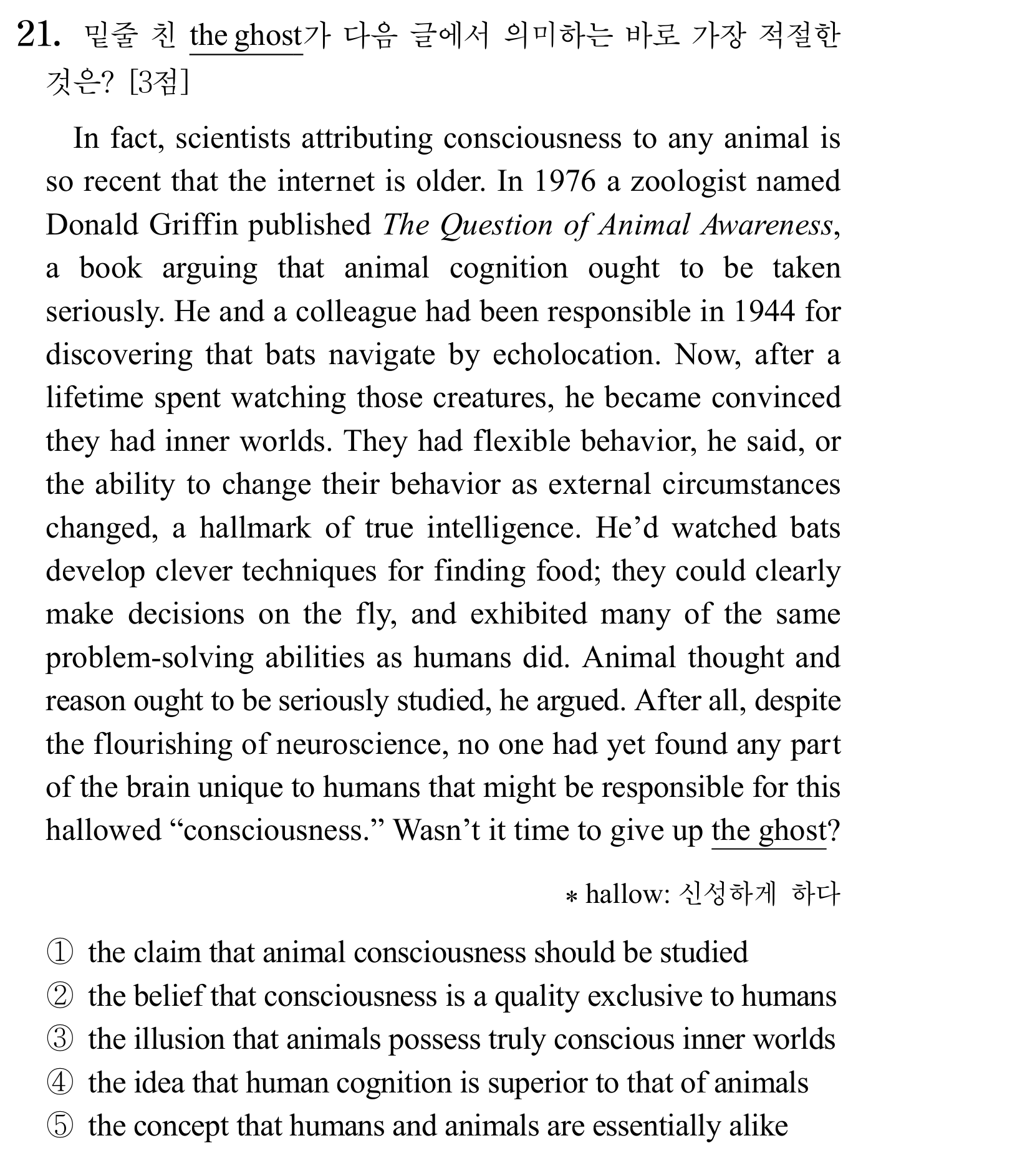
In fact, scientists attributing consciousness to any animal is so recent that the internet is older.
도입
2형식 SVC
In factM,
scientists attributing consciousness to any animalS
isV
so recent 부사절that the internet is olderSC.
사실,M 과학자들이 어떤 동물에게든 의식이 있다고 인정하는 것은S 인터넷보다 더 나중에 시작된 아주 최근의 일입니다.SC
동의어 attribute ≒ ascribe, credit · recent ≒ late, modern
so ~ that 구문
so + 형용사/부사 + that + 주어 + 동사
너무 ~해서 ~하다라는 뜻으로, 앞에 나온 상태의 정도를 뒤의 결과로 설명합니다.
In 1976 a zoologist named Donald Griffin published The Question of Animal Awareness, a book arguing that animal cognition ought to be taken seriously.
3형식 SVO
In 1976M,
a zoologist named Donald GriffinS
publishedV
The Question of Animal AwarenessO,
a book arguing 명사절that animal cognition ought to be taken seriouslyM.
1976년,M 도널드 그리핀이라는 동물학자가S '동물 인식의 문제'를O 출판했습니다,V 동물의 인지를 진지하게 다뤄야 한다고 주장하는 책인.M
동의어 publish ≒ release, issue · cognition ≒ perception, awareness
He and a colleague had been responsible in 1944 for discovering that bats navigate by echolocation.
2형식 SVC
He and a colleagueS
had been responsibleV
in 1944M
for discovering 명사절that bats navigate by echolocationSC.
그와 한 동료는S 1944년에M 박쥐가 반향정위로 길을 찾는다는 것을 발견한 것에SC 책임이 있었습니다(장본인이었습니다).V
Now, after a lifetime spent watching those creatures, he became convinced they had inner worlds.
2형식 SVC
NowM,
after a lifetime spent watching those creaturesM,
heS
becameV
convinced 명사절(that) they had inner worldsSC.
이제, 그 생명체들을 관찰하며 평생을 보낸 후,M 그는S 그들이 내면의 세계를 가지고 있다는 것을SC 확신하게 되었습니다.V
동의어 convinced ≒ certain, assured, persuaded
They had flexible behavior, he said, or the ability to change their behavior as external circumstances changed, a hallmark of true intelligence.
3형식 SVO
TheyS
hadV
flexible behaviorO,
he saidM,
or the ability to change their behavior 부사절as external circumstances changedO,
a hallmark of true intelligenceM.
그들은S 유연한 행동, 다시 말해 외부 상황이 변함에 따라 자신의 행동을 바꿀 수 있는 능력을O 가지고 있다고V 그는 말했습니다, (그것은) 진정한 지능의 특징인.M
동의어 flexible ≒ adaptable, pliable · hallmark ≒ trademark, indicator
He’d watched bats develop clever techniques for finding food; they could clearly make decisions on the fly, and exhibited many of the same problem-solving abilities as humans did.
예시
5형식 SVOC
HeS
’d watchedV
batsO
develop clever techniques for finding foodOC.
그는S 박쥐가O 먹이를 찾는 기발한 기술을 개발하는 것을OC 지켜보았습니다.V
지각동사 watch의 5형식
S + watch(지각동사) + O + OC(동사원형/현재분사)
지각동사는 목적어와 목적격보어의 관계가 능동일 때 목적격보어 자리에 동사원형이나 현재분사(-ing)를 취합니다.
watched bats develop / developing
→ 지각동사의 목적격보어로 동사원형 또는 현재분사 사용 가능
→ 지각동사의 목적격보어로 동사원형 또는 현재분사 사용 가능
watched bats to develop
→ 지각동사의 목적격보어로 to부정사는 쓸 수 없음
→ 지각동사의 목적격보어로 to부정사는 쓸 수 없음
Animal thought and reason ought to be seriously studied, he argued.
주제문
1형식 SV
Animal thought and reasonS
ought to be seriously studiedV,
he arguedM.
동물의 사고와 이성은S 진지하게 연구되어야 한다고V 그는 주장했습니다.M
동의어 reason ≒ intellect, mind · argue ≒ assert, contend
출제 포인트 — 조동사 뒤의 수동태
- ought to 뒤에 수동의 의미를 나타내기 위해 be studied(be + p.p.) 형태가 쓰였습니다.
- 동물의 사고와 이성은 연구를 '하는' 주체가 아니라 '되는' 대상이므로 수동태가 올바릅니다.
After all, despite the flourishing of neuroscience, no one had yet found any part of the brain unique to humans that might be responsible for this hallowed “consciousness.”
근거
3형식 SVO
After allM,
despite the flourishing of neuroscienceM,
no oneS
had yet foundV
any part of the brain unique to humans 형용사절that might be responsible for this hallowed “consciousness.”O
결국 신경과학의 융성에도 불구하고,M 아무도S 이 신성한 "의식"을 담당할 인간에게만 고유한 뇌의 부위를O 아직 발견하지 못했습니다.V
동의어 flourishing ≒ prosperity, boom · hallowed ≒ sacred, revered
Wasn’t it time to give up the ghost?
결론
2형식 SVC
WasV
n’tM
itS
time to give up the ghostSC?
이제S 그 낡은 생각을 버릴 때가SC 되지 않았을까요?V
핵심 어휘
attribute ~의 특징으로 간주하다
≒ credit, ascribe, assign
echolocation 반향정위
hallmark 특징, 증표
≒ trademark, indicator, sign
on the fly 즉석에서, 빠르게
≒ spontaneously, extemporaneously
give up the ghost 낡은 생각을 버리다, 포기하다
≒ abandon, relinquish, discard
cognition 인지
≒ perception, awareness, apprehension
convinced 확신하는
≒ certain, assured, confident
flexible 유연한
≒ adaptable, elastic, versatile
flourishing 융성, 번창
≒ thriving, prospering, blooming
hallowed 신성한
≒ sacred, holy, revered
풀이 전략
이 문제는 'give up the ghost'가 의미하는 바를 묻고 있습니다. 미국 문화권에서 이 표현은 흔히 '죽다'를 의미하지만, 이 문맥에서는 '인간만이 고유한 의식을 가졌다는 낡은 믿음을 포기하는 것'을 뜻합니다. 즉, 동물의 지능을 낮게 평가하던 기존의 과학적 태도를 버리자는 것이죠.
정답은 2번: abandoning the conventional belief that only humans have unique consciousness 입니다.
결국 과학계가 인간의 우월성을 증명하려던 낡은 프레임에서 벗어나, 동물의 지능을 있는 그대로 인정하기 시작했다는 흐름이 핵심이었습니다. 질문하신 'give up the ghost'는 지문 속 의식 논쟁의 종지부를 의미하는 표현이었네요.
- 함축 의미 추론
- 인간 중심적 사고의 탈피
- 동물의 지능 인정
- 과학적 관점의 변화
- 논리적 반전
2026년 6월 고3 · 21번 · 함의 추론
이 지문, 어떻게 쓰시겠어요?